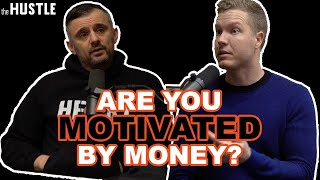
In this excerpt from the My First Million podcast, Gary Vaynerchuk asks Sam Parr to quantify how his current motivations are divided among money, legacy, and the process of building. Sam reflects that he no longer feels primarily money‑driven; having achieved a level of "fuck‑you money" (around $10,000), he can turn down lucrative but uninteresting offers. He shares early hustles—selling baseball cards at age 13 and hot‑dog tips—where even a few thousand dollars felt like a fortune, coining the term "hood rich." Sam describes growing up in St. Louis and later Nashville, living across from the projects, and how those years of scarcity made him happiest. Both hosts discuss how wealth influences emotional states: Gary observes more sadness, envy, and loss among the very rich, while Sam agrees that having plenty can breed depression, whereas scarcity fuels a strong drive. The conversation also touches on Sam’s family background (youngest of three) and the broader idea that starting with little can be an advantage for happiness and motivation.
Chapters
Where are you at this point in your life between money, legacy, the process? If I said, if I said 30-year-old you right now between, genuinely, in your stomach, in your heart, in your gut, about how much you're driven by and how much you like, the net win is around dollars, is around process, being able to do your process and around legacy. How are you currently broken down between 100% of those?
Well, I don't have children yet, so maybe things will change, but I have enough that I don't have to worry for maybe forever. I find my— I thought I was really money motivated, but when you get all these, like, opportunities, when you get to a little bit of a level, like, we'll pay you $10,000 to come here and do this or whatever. And I just— and I, and I found myself not wanting to do that because I don't— I'm like, oh, that sounds so boring to me. I don't want to do that. So I guess that answers the question of where I am a little bit. I would— I mean, like, one time we had a client do something that we thought was an asshole thing and we fired them and we lost a quarter of a million dollars and I slept like a baby. So I don't think I'm as money-motivated as I thought.
Do you think that's because you checked some sort of box for yourself along the way versus—
No, I would say I think I had fuck you money when I had 10 grand.
Yeah, I get that.
I understand.
Yeah, I do know that.
And then once I was like, wait a minute.
I still don't think I've ever been more rich than when I was doing baseball card shows at 13. Because $3,000, $4,000 when you're 13 and you came from nothing, I thought I had like a trillion.
I remember one day I sold hot dogs and I had a grip of cash. It was like a grand. A grip. Yeah.
It was just a grip.
I call it a grip. Let me get that grip. It was 'cause I had like a jar here for tips and I had like a grand in $5 bills. And I was like, this is— I made money. This is it. I was, I was like, we called it hood rich. And where did you grow up again? In St. Louis, Missouri. But then I lived in Nashville, Tennessee. But I grew up with a lot of like poor people. And, you know, that's why I talk like this. But I felt—
did you like it? Did you think about—
I was happy. So in Nashville, I lived across the street from the projects and we would hang out all the time.
And how old were you then?
19 to 21, 18 to 21, and I would just hang out there with my buddy Rydell, and we would just chill and just sit on— that was the most— it was— that was my happiest when I had nothing, which is weird, right?
No, I think it's— I think it's not weird at all.
But, uh, what'd you guys talk about?
Just shoot, like, guy talk? Girls? Sports? Just random shit? Or would you talk about dreams?
Business? Yeah, I mean, he— this dude had served 25 years years in prison, and he would talk about that. But just stupid stuff. But it was just, it's really fun. I think that when you come from not a lot, which, you know, I had a good family and everything, but when you start from, when you're trying to start on your own from scratch, you're actually—
And do you have siblings?
Yeah. Yeah. I have siblings, older brother and older sister.
You were the youngest?
Mm-hmm. Yeah. I think when you start from not a lot, it's actually a huge advantage, and you could be a lot happier that way. I think if you're born into a wealthy family, the likelihood of depression might actually be higher.
I think so.
You know what I mean?
Based on our societal norms right now.
Yeah.
So much of my passion about what I talk about and the content I put out is to create empathy for— it's very hard, you know, I get it, I grew up in it. It's very hard for somebody that doesn't have much to have empathy for somebody who's driving a BMW and has a Rolex, but You know, based on all my readings, all my DMs, I get, at this point in my life, I have hundreds of thousands of interactions per month, year, whatever it is. It's just a lot of interactions. I see far more sadness in people that had too much than in people who had too little. I see envy in people that don't have as much. I see drive in people that don't have as much. I see resentment in people that don't have as much. I see deep, lostness in people that had too much. You know? Like, there's just, when people didn't have as much, there is an inherent, I'm gonna pull myself out of this. Whether it's illegal, legal, there's a drive. It's really hard to be hungry when you started fed. It just is.
No, and I agree.
And I have wealthy kids and I think about it constantly.