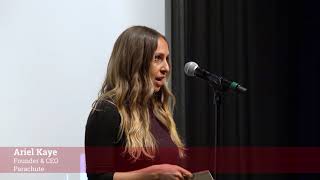
In this solo presentation Ariel Kaye recounts her journey from a strategic role at a large New York ad agency (2012) to founding the direct‑to‑consumer bedding brand Parachute in 2013. She describes feeling unfulfilled by agency politics and the dilution of creative ideas, which sparked a desire for more impact. Observing friends in startups who were passionate and willing to work all night inspired her to seek a role where she could build something tangible. A pivotal conversation with a friend encouraged her to start her own company. Drawing on a lifelong interest in home and interior design, she experienced a "lightning‑strike" moment while shopping for sheets in a big‑box retailer, recognizing a lack of differentiation and a market gap in bedding. Noting the rise of DTC brands and a consumer trend toward self‑investment, she decided to create a brand that asked customers how they sleep. In 2013 she left advertising, moved to Los Angeles, built a pitch deck, and secured early validation from a former boss. She concludes with advice: don’t wait for permission, give yourself a push, and dream big.
Chapters
Hi. Hi everyone. Thanks for being here. So my story starts in 2012. Obama was president. Yeah, big up for that. I was living in New York City. I was working at a big ad agency on Park Avenue. I was working with big brands, big budgets. I was on the strategic side of creative, which meant I was using both sides of my brain all the time. And so things on paper seemed pretty good. But I was stuck and feeling unfulfilled and realized that I needed a change. I took some time to reflect and realized that over the past few years working at this big agency, I had decided that I was no longer drawn to climbing the corporate ladder. There were too much politics, too much red tape. I couldn't get anything done that I really felt passionate about. I also realized that over the past few years, I was consciously disengaging from the work that I was doing because by the time By the time— or once we started, we would have these big ideas, everyone would get really excited about them, and by the time they saw the light of day and ended up somewhere in the world, they were so different than what we actually created. They basically all ended up— all the good stuff had ended up on the cutting room floor. And that was just really frustrating. And being able to recognize that, you know, made me realize that it was time to do something different. Meanwhile, I had all these friends that were working at startups, both in LA and New York, and what I saw from them was something entirely different. They were passionate about what they were doing. They were, like, deciding to bail on dinner plans with me without even thinking twice because they wanted to work all night. And for some reason, that seemed very appealing to me also. So what I decided was, for me to feel this professional satisfaction, what I needed was to be making an impact. I needed to be building something, to be creating something that I could then see out in the world. And I took it a step further and realized that I actually wanted to create something physical, something that I could hold and touch and use and that people could use around me. But I wasn't sure what that was. I knew that I was looking for this greater purpose and a job that I could also, you know, bail on dinner and work all night and be excited to do so. So I decided, this is the summer, I decided to give myself till the end of the year to figure out what I was going to do next. And so, you know, I did what most people do is start putting out the feelers. I started talking to all of my friends that worked in startups to understand what they were doing and what they thought I could be doing based on my experience. And one night out to drinks with a good friend of mine, I had been probably complaining for the majority of the time we had been spending— we were spending together, just upset about what I was doing and feeling like I didn't know what to do next. And how would what I was doing in advertising translate to something else? And he looked at me and just interrupted me and said, I don't think you should be looking for what's next in a new company. You should start your own company. I see this founder in you. And I've never said this before, but I really believe in you. And that took me by surprise. I was not thinking, oh, it's time to go start my own company next. I didn't go to business school. All these things that you hear about, I didn't identify with that. But after that conversation, that idea and that thought really stuck to me, and I started to kind of dig deep and think about what was it that I was really passionate about? Where could I find this sense of fulfillment and desire to build and learn and keep growing. I've always been obsessed with home and interior design. I used to help friends and family decorate their homes just for fun, which meant that I was doing a lot of shopping with them, not my money, which also made it more fun. I also had an interior design blog long before blogs were cool, like in 2006, and while I went through grad school. And so, you know, that It was something that I was really into. And so I found myself one day shopping for bedding and had one of those lightning strikes moment when you least expect it. And it was in this big box retailer. And I think probably many of you have had this experience before, shopping for sheets or for towels or something in these enormous rooms where there's floor-to-ceiling stacked products. Everything is completely undifferentiated. No one can help you. And I was like, this is it. I was like, "This is the worst. This experience is the worst. There's no differentiation. Everything is in packaging that I can't touch. I think it could be better." And I identified this void in the market. So I spent a lot of time thinking more about the home category and really understanding where I could fit in and what I would want to do and how ultimately I could affect change. And that led me to the bedroom because, You spend a third of your life in bed, and sleep impacts everything— your happiness, your productivity. And what I realized in one of these aha moments for me was, how is it possible that at this day and age there had never been a bedding brand that had asked me how I slept at night? You'd think at some point someone would be like, hey, you're sleeping. Let's make this better. And so again, this is 2012. We're getting closer to the end of the year at this point. But this is when a lot of direct-to-consumer businesses were really starting to gain momentum. And I also saw that that was really appealing to me and to my peers and that there was this new way to shop that felt much more authentic. And through my experience in advertising and working with consumers and really understanding what motivates them, I saw this trend that people really were taking time and spending their money to invest in themselves. And so it became clear to me what I was going to do and how I was going to make impact. And so now it's 2013. It's been about a year since this whole process started. I left my job, I moved to LA to start Parachute, and I was back in New York and decided to meet my old boss. And I showed him my pitch deck and I was all giddy with excitement and also kind of scared with the unknown, but had product and we were having coffee. And at some point he again interrupted me and he said, "You should have left advertising a long time ago. It's clear that this is what you were meant to do." And he was right. And so, you know, I realized at this moment that I had had this founder inside of me all along, but I was really looking for someone to give me permission and to give me this push to go do something on my own. It wasn't something that had ever registered. And so I'll leave you with this. This is my parting words of wisdom. Don't wait, and give yourself that push. You don't need to wait for anyone. And dream big.