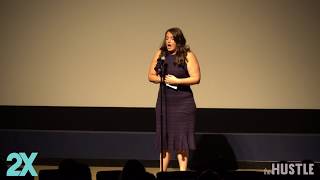
In this live presentation, Ashley McCollum, General Manager of Tasty at BuzzFeed, shares her personal journey from a sign‑holding intern at the Today Show to leading one of the most recognizable food video brands. She begins with audience polls that illustrate Tasty’s massive reach (about 90% brand awareness, 50% of those having cooked a recipe). McCollum recounts how she secured her first media job by boldly displaying a handwritten sign at a Sean Kingston concert, emphasizing the role of confidence over experience. She then outlines Tasty’s rapid ascent, the flood of copycat competitors, and the strategic need to move beyond a crowded top‑of‑funnel video marketplace. Observing that viewers were immediately purchasing ingredients and cooking the dishes, she identified an untapped bottom‑of‑funnel sales opportunity. Over the past year she championed a full‑funnel advertising solution, confronting senior skeptics who doubted the ability to prove sales impact. Within nine months, Tasty launched a 90‑SKU cookware and bakeware line in every Walmart store, backed by research demonstrating sales lift for three major clients, and she announced an upcoming reveal at a leading CPG advertising conference. The talk concludes with a leadership lesson: when you’re the youngest or least experienced person in the room, confidence and willingness to challenge established conventions can drive breakthrough results.
Chapters
OK. Hi. Great. That's great. Hi. I'm Ashley McCollum. Nice to meet you all. I'm general manager of Tasty, which is the food studio at BuzzFeed. Great. Great reaction so far. So why don't we just get into it. So how many of you— it's kind of hard to see, but how many of you know Tasty? Give me a raise of— show of hands. Awesome. Great. So how many of you have actually made a Tasty recipe at home? Show of hands. Okay, so that's about what I would expect. So usually our research says that about 90% of the people in the room have heard of Tasty, and about 50% of those people have actually made a recipe at home. So LA market doing okay. Great. So a lot of the women on the stage will talk tonight about challenges they have had as a result of being a woman. In the workplace. I have had my fair share of those challenges, but tonight I'm going to talk to you about something different, which is being the youngest person in every room. So I'm 30, and I've often felt insecure about my age, and so hopefully tonight we can— you can end, leave with a little bit of a different perspective on having experience or not having experience. So I'm going to kick it off with a story of how I got my first job in media. This is going That's kind of the story that will never leave me, fortunately or unfortunately. So I grew up in South Carolina with no experience in media, no connections. But when I decided I wanted to be in media, I knew I had to be creative. So I flew myself to New York City to visit a friend who was studying there. And I thought to myself, if I'm going to be physically near these media companies, I should be able to get a job, right? It just was very intuitive to me. This was like before social media. I just, I couldn't go to New York City and not leave with a job. So I'm gonna show you a photo, but I'm gonna caveat it to say that I asked the event organizers if I could show a photo and they said, "Nope, there are no visuals, no slides," but I asked for an exception. And if you're following along, this is a trend for me. So I'll show you this photo, maybe. Is that you? That's not you. Who is it? One day we'll show you a photo. Oh, there it is. OK. So that was 10 years ago. I showed up to the Today Show— yeah. So that was 10 years ago. I showed up to a Sean Kingston concert. Anyone remembers him? Very popular 10 years ago. And that's a sign you can read that says, "This southern belle wants to be NBC's next summer intern." And so I held it up during commercial breaks, 'cause I didn't care about being on TV. I wanted the producers to see it. And it worked. So the executive producer of the show at the time, Jim Bell, came down and met me. And he asked for my resume and cover letter, and I got the job, which is kind of crazy. And please don't do that. It's like super stalker to do that now. You should just like— tweet at someone, like don't show up, that's super weird now. But I was too inexperienced to know that it was creepy, and I was too inexperienced to know what was possible, what was impossible. And so not having experience and just having confidence was the thing that really helped me in that situation. So let's flash forward to today, to present day. So I've been at BuzzFeed for 6 years, which is like dog years for BuzzFeed. It's like, you know, I've been there forever. And so I moved to LA a couple years ago and started running Tasty, which is this massive success for BuzzFeed. And I've had a lot of fun doing it. We have some Tasty producers in the room. I don't know where they're sitting. Where are they? Right over here. OK, you guys know the hands in the Tasty videos? Like, they're right there. Put your hands up, Diana and Julia. OK. Just two of the hands. Are you moisturized? You guys are good? OK. Thanks for coming, by the way. So Tasty's had an incredible rise. And the fact that all of you know it in this room is pretty amazing. But it became very quickly a crowded marketplace. So you know how you scroll through your Facebook feed and everything kind of looks like a Tasty video? You don't even know what you're watching anymore. You end up in this vortex of food videos or something that's top-down and fast. That's because a lot of people copied us really fast. And so usually copycats take a long time, but this time, for whatever reason, within a year we had tons of copycats. Entire companies sprung up really just to copy our strategy and copy our format. So I knew that we had to provide more value, particularly to our advertising partners. There's no way we could just have a massive commoditized crowded marketplace and continue to remain, remain on top. So trying to figure out where was Tasty gonna provide more value. So I started looking at our editorial operation and trying to understand the audience more. And what I saw was that within hours after posting a video, our audience was uploading photos of them actually making it. So I asked you earlier how many of you actually made a recipe. People were watching a Tasty video, getting in their car, driving to the grocery store, buying the ingredients, and coming home and making it for their friends and family. Now maybe that seems intuitive, but with digital publishers, we've always kind of been bucketed as top of funnel. So I don't— how many of you work in advertising? OK, some of you. So right. So we've always been bucketed as top of funnel, mid-funnel. But the idea of Tasty, or a big mass media company, being able to drive sales was totally counterintuitive. But our editorial work was indicating that we could. So last summer, I held an offsite for all the people who work on Tasty advertising business. And we had talked about all the normal stuff, renewals and accounts and all that stuff. And then I had a 30-minute session where I said, tasty the full funnel advertising partner, question mark. And so I got up in front of the room and I said, hey guys, like I have this hunch that I think that we can actually play in this space, but I want all of us to be aligned on this thing that we're building. Are we building a full funnel advertising solution? And I got head nods from most of the people in the room. And then there were these two old dudes, two senior men in the back of the room who immediately shot me down and they said, "No way, you will never compete in this space. We cannot prove bottom of funnel sales. Their entire companies, Google has spent the better part of the last two decades proving last click attribution. What is BuzzFeed gonna do? Like how are we gonna prove this?" I took this on as a personal challenge and so I went I had an unwavering vision for Tasty that we could do this, even though it didn't make sense that I would not listen to two senior men who spent their entire lives in advertising. And I was fairly new to advertising. And so the fact that I didn't listen to them doesn't make a ton of sense. But I was very focused. I had this clear vision for what we could do. That was 9 months ago. In 2 weeks, we're rolling out research that proves that we can drive sales. With 3 of our biggest clients today, we launched a 90-SKU cookware/bakeware line in every Walmart store in America as a result of us being able to drive sales. And in— thank you, keep it coming. And in 2 weeks, I will be announcing at the biggest CPG advertising conference in the country Tasty's full-funnel advertising solution in 2 weeks. So— thank you. So the point of that is to say that you should challenge this convention that experience— more experience means you're more qualified or you're smarter or you're better. Because if I had listened to the people with all the experience, we would have never pushed the boundaries. So when you are the most junior person in the room and you have an idea that's not clear or it's not clear that it'll work, You should just remember that the most senior people in the room are probably the ones who made the rules, so they're not going to be the ones who break them. And so if they made the conventions, they won't ignore them. You have to do that, and so you often have to push, and you have to push back and ignore experience and just focus on your confidence. Thank you.