Black Lives Matter: Our Thoughts On The Riots, Protests, & Looting | My First Million Podcast
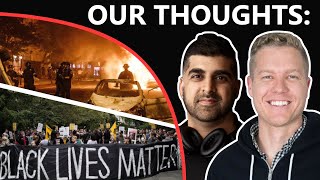
Sam Parr and his co-host discuss the protests and riots following George Floyd's death, exploring how race and identity shape different interpretations. Sam shares his sister's childhood racism experiences and reflects on having a Black spouse and mixed-race children, while both hosts use a social-contract framework to understand the unrest.
Chapters
You know, one great quote I saw was, "Are you seeing unrest and protesting and looting where you live?" I'm seeing it because I'm just glued to Twitter.
Me too.
You know, I'm just scrolling and I can't believe my eyes. And it is, it is so sad. There's so many different things going on at the same time. And the shitty part about that to me is that Everybody pulls a different meaning away from it. So like, if your bias going in is, you know, if you're racist in one way, you're gonna look at this and say, "Oh man, they're looting and rioting, and this is awful. What did those small business owners do? Why are they getting their stores smashed?" And then if you're somebody else and you're looking at this, you're like, "Dude, people are sick of it. They've hit their breaking point because this has been going on for so long, this police brutality." and I totally understand what's going on. And then other people are looking at it and they're sort of like, hey, what's like, why are these other malicious groups kind of hijacking the movement and just inciting violence? And, you know, Antifa, or some people believe, you know, Russia, China, whoever it is, who's dropping these pallets of bricks off trying to bait people into violence. And, you know, some people just trying to make the world burn. And so there's all these things mixed together, and I think Whoever you are, you're gonna select the evidence that supports your feeling, and you're just gonna get stronger. You're just gonna see more evidence towards your view, and it's gonna make people more divided.
My friend shared something, and it was like 4 circles, and it was like, I'm pissed off about the racism in our country, and Black Lives Matter, Black Lives Matter has a point. I'm pissed off that businesses are getting ruined. This is not the right way to do it. I'm pissed off at the police because I think most of them are good, but a few bad cops ruin shit for everyone. And then I forget the fourth one. And then it was like at the center, all the circles had a little bit of everything, and like, you can be here. I was like, that's how I feel. I'm angry and sad.
And so what was the fourth one? What's the fourth circle?
I don't know what the fourth one was. Let's see. Uh, it was really great though. Uh, did you happen to see this go around?
I didn't see that, but no, that explains like exactly how I feel, you know, and how many people feel. And, you know, I think it's really crazy. There's a whole bunch of things that you hear, you learn from these experiences where you're like, oh, you know, that is a sort of a nugget of wisdom or a bit of empathy that I didn't have before. And so, you know, when you see people that are, you know, one great quote I saw was, when you have 1,000 good cops and 10 bad cops, but the good cops don't police the bad cops, then you have 1,010 bad cops. And, you know, I believe that. And then that sort of applies to my life too. Like, in what— anytime I sort of stand by and do nothing while injustice is happening, that makes me sort of complicit in my own way, right? And, you know, I think about little minor examples of that in my own life.
And then, you know, it was George Floyd's— George Floyd's death was murder, and the police should be held responsible. I think most cops are good, but police departments are corrupt, and there are some bad cops. Looting businesses and destroying property is immoral, and it hurts the cause. I empathize and I agree with Black Lives Matter protesters and believe in them and their right to be heard. And then right in the middle was like, I am here and this is sad.
Right. Yeah, it's really crazy. And I know people don't listen to this podcast to hear like, you know, talks about socioeconomic issues and racism and whatnot. But, you know, this I think affects everybody. This is very different than anything that's happened in my lifetime where you have riots breaking out across the nation all simultaneously, and things really do feel like they've hit a breaking point for many reasons. I think also the fact that people were pent up at home for the last 3 months, I don't think that helps necessarily, because that's a sort of a bunch of, a bunch of, you know, just water boiling over, you know, at a certain point as well.
I agree. I, so I agree. I don't even love discussing this stuff because I don't think about it a lot, and I also tend, I try to like talk about the positive. But let me bring something up that I don't think I have bring up, brought up, and I want to hear your opinion. So I don't, this doesn't matter and it doesn't change. I don't think it should like validate or not validate anything I say. So like my wife's Black, my family's Black, I'll have Black children. And this was the first time, or half Black or partially Black children. This was the first time that I was at my house with Sarah, my wife, and like she broke down. She was like, I don't know how, she's like, I don't know where I fit in on this because she's like a successful Black woman. She's like, I haven't had a lot of racist stuff happen to me. Or if any. And she's like, but I— yeah, it was just a total mindfuck because I'm like, fuck, what am I supposed to— how am I supposed to— I didn't know what to feel. I was like, I don't know what to do. And it was incredibly exhausting. Do you— you're Indian. Do you consider yourself white or not white or what?
Definitely don't consider myself white, and nor does anyone who sees me thinks I'm white.
Well, I don't know, like how—
No, but I get what you mean in the sense of like, In some ways, like, do you feel that you're privileged or prejudiced against? I think that's a different way of looking at it. And like, you know, my sister— so we— I was born in Tulsa, Oklahoma, which is like, you know, not the most open-minded and racially friendly place. And so my sister, when she was in kindergarten, uh, you know, students would draw a picture of a pig and then write her name on it and cover the pig in brown mud, and then they would give it to the teacher and the teacher laughed. And my sister always remembers this, like, she was I don't know, 6 years old, and she vividly remembers the teacher sort of looking at this and laughing and saying, "No, no, no, put it away," but like being, you know, involved in it. And I never experienced that.
I don't understand that. What's the pig have to do? Is that because—
just like brown, dirty, in the mud, you know, that sort of thing. And, um, and, you know, I remember, you know, when she went to my mom, it was like, "Why can't we be white?" type of thing, where it's like, you know, asking questions as a kid, just trying to understand why am I different. What does that mean? Why do other people think we're worse than them? That sort of thing. I personally never experienced that because I luckily moved out of Oklahoma when I was really young and went to different places where it was less so, or just got lucky in sort of my experiences around who I was around. But I guess I would say, like, you know, when 9/11 happened, you know, it's not fun to be a brown guy in America, right?
Are you any religion? Are you Muslim?
No, I'm not religious, but I would be Hindu. Yeah, I would be Hindu, but, um, you know, just that's typically what most Indian people are. Um, but yeah, you know, I'm not religious, but you know, I do grow a beard pretty quick. And so like, yeah, you know, like when you go to the airport, I don't think you think about how do I look today, whereas I think about that because I'm like, look, I'm not trying to get hassled for no reason here, so let me shave before I get on this flight. Or like, you know, I had friends who like are Muslim who had like key— their house keys taken away from them in TSA because it was like, this is, uh, you know, potentially a dangerous thing. And they're like, this is my apartment keys, what are you talking about?
How does that make you feel? So the fact that you have to shave, are you angry or are you— where do you— what's that make you feel like?
Uh, I'm not angry about it. You know, I, I sort of have this opinion that, um, uh, my, my personal philosophy, if you're gonna boil it down to any one thing, is the only thing you have control over is your attitude towards the present moment. And so, so that's empowering and disempowering, right? It's disempowering because it's like, shit, I can't control anything that's going on. I can't control how other people feel, how they're gonna act. I can't control the results I'm gonna get in my life. But it's empowering. It's like, the one thing I control is my attitude towards the moment. So that sort of is a superpower, because then no matter what the situation is, no matter what the moment is, I can decide what my attitude about it is gonna be. So for example, when something shitty happens to me, someone says something shitty, or, you know, I, you know, get that extra sort of, hey, come into this room while I go through TSA clearance, you know, the meaning I put on that is of my choosing. And if I put the meaning of it that, you know, I'm less than, I'm being wronged, that doesn't help me. It makes me feel like shit. And so I just decide not to feel that way. But I know that, like, on the grand scheme of things, I get off pretty light. It's very different than never feeling safe you know, going for a jog in your neighborhood or something like that. I think, you know, there's levels to it, and I haven't experienced those levels where it would be very, very challenging to put a positive meaning on what's going on.
Yeah, it's, uh, it's just a confusing time because you feel so many different emotions, and some of them are, uh, opposite. And I had to, like, talk to the whole company today, which— we're small, let's say 20 or 30 people. And I was like, I don't know what to say other than if you guys like ever feel out of place somewhere, like our company, we're gonna make you feel safe. Like we'll hire all types of people. We like, and I wasn't sure if that felt like weak or like, oh, like barely anything to be done. But I was like, I don't know what, I was like, I don't know how to fucking handle this other than You're safe here.
But, uh, yeah, you know, I think that's the right approach because it's not about having the answer or the wisdom or the most heartfelt thing and the best speech. But like, I think it is important if you're the leader to show up as a decent human being in that moment and just say, look, I understand, I'm also feeling this crazy mix of emotions. I just want to do my best with this. Anything, you know, we're gonna, we're gonna try to do our best with this. I think it goes a long way to just be a decent person and try to be present and visible there versus kind of shying away from it, which is what a lot of people do.
Yeah, it's crazy. And I have a feeling once I have children, my opinion is going to change a lot. Like, or not my opinion, but my— I think I'll learn a lot. Yeah, like having Black kids or part-Black kids, I think, well, I'll— so maybe I'll see something that I didn't previously see.
And one more thing, which, uh, you know, we can cut all this out if people tell us later, hey, you shouldn't have talked about this on the pod, but did you watch the Trevor Noah, um, thing that he posted on YouTube or whatever?
I did not. I'm typically not a fan of his. I think that a lot of the times the shit he says is the wrong take, so I tend to avoid him, but I would watch it if you suggest it.
I avoid him because he— I don't think he's that funny, but, uh, I did watch this thing And he brings up like what's going on. He's like, yeah, a lot of people are looking at what's going on and saying, well, this isn't right either, right? Of course, police should not murder citizens. That's wrong. But also rioting and looting and destroying things is also not right. And what his point was, which I think made me better understand what was going on, his point was like, you got to think about this. What is society? Society is essentially a contract. It is an agreement amongst a group of people of here's what's right and wrong of how we're going to act. Here's the behaviors that are tolerated. Here's the behaviors that are not tolerated. He goes, so what you're seeing is that one side of a contract, you know, if we're— if we go into a contract together and you're just breaching your side of the contract regularly and without recourse, and I just see, wow, this guy just keeps breaching his side of the contract, then I also have no, no desire or incentive to uphold my side of the contract. He goes, you'll see somebody that's homeless and, you know, they don't go and just murder necessarily because they're in a bad position. They say, look, these are the rules of the game. I'm losing in the current game, or I have not been able to sort of get to an advantage position in this game, but like, I still respect that we're in a game together and there are rules of this game. He goes, what you're seeing now is that a group of people, you know, Black people in America, feel like the contract has just been breached over and over and over again. Where there, you know, unnecessary and unjust violence against us. And so now we're going to breach the contract too, and we're going to sort of make it very known what it feels like when the contract is being breached for apparently no reason, and it doesn't seem like a positive thing. And so that made me look at, you know, when somebody is either protesting, whether it's peacefully or not peacefully, when somebody's rioting and they're creating a sort of unsafe environment for all, it sort of I don't know, it sort of explained to me why somebody would behave that way. It's because if you feel like the other party's just terminally breached the contract and there's no recourse, then it's like, I'm going to terminally breach the contract and we'll see, we'll see how it feels. And now both sides feel what it's like when the societal contract gets totally breached.
And let's see if that gets your attention. I feel it. I feel it definitely feels like, like almost like the end of the world, a little bit. It's like there's— it's like a small— it's like in the same way having a new puppy is just like a small taste of having a baby. It's like, that's how I feel right now. Like, I'm like, if like the world— if like everything that I believed in is gonna come to an end, it's gonna like a little, a little like this, right?
Um, you know, for every sad story, there's also an inspiring story where people are, you know, waking up the next day and going and cleaning up the city and people standing together. And, you know, I think there's a lot of really positive things going on too. And I think that's the, you know, that's the silver lining, or that's the other side of the coin here, where is progress being made.










