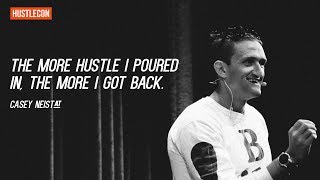
In this 2017 HustleCon keynote, filmmaker and YouTube creator Casey Neistat delivers a candid, narrative‑driven chronicle of his life framed around the concept of "the hustle." He begins by describing his teenage years—dropping out of high school, working as a dishwasher and line cook, and learning that hard work yields direct rewards. Moving to New York with $800, he survived as a bike messenger before landing a low‑pay job with artist Tom Sachs, where he started making videos with his brother Van. A chance birthday video for an art collector led to a meeting with former President Bill Clinton, which catapulted them into the art world and resulted in shows at Art Basel and the São Paulo Biennial. After returning to NYC, Neistat struggled financially despite the prestige, illustrating the duality of success and hardship. He recounts the breakthrough HBO deal (a $2 million sale of a show) and the subsequent period of complacency that left him miserable, prompting a return to pure, self‑driven creation on YouTube, where he amassed 150 million views and built a personal brand independent of traditional media. A fellowship at MIT’s Media Lab sparked his pivot into technology, leading to the founding of Beam, a live‑streaming platform. Beam raised millions, faced cash‑flow crises, and ultimately was sold to CNN, giving Neistat unprecedented resources but also new pressure. Throughout, Neistat reflects on the philosophy of hustle: relentless focus, the inevitability of either achieving a goal or dying trying, and the importance of continuously setting bigger ambitions. He emphasizes that family—especially his children—provides the personal reason to hustle, and he shares his extreme time‑management routine (working from 10 am to 6 pm, then 8 pm‑midnight, plus early‑morning hours) and minimal sleep. In the Q&A, he answers questions about balancing family, organizing projects, his proudest content (family‑focused videos like "A Love Story"), and his biggest failure (celebrating success without new goals). The talk ends with a call to embrace the grind, noting that few are willing to truly hustle, and those who drop out clear the path for the relentless.
Chapters
Hi everybody. How's it going? I flew in from France yesterday, so I just want you guys to know that the time zone's in my favor, so I'm totally fucking charged up right now. I was super excited to come here because I do as much public speaking as I can possibly do, and it's always focused on different aspects of my career, or media, or social media, or technology, or filmmaking, or what have you, but the reason The reason why I was so excited about HustleCon is 'cause it's just about the hustle, and the hustle is my favorite thing to talk about, and I never really get to indulge in it. So I wanna sort of take you guys through a story of my life, my career, how it landed to where I am right now, with a really narrow focus on the hustle part. Which is something I haven't really, really pulled apart yet. So, with that, indulge me. Alright. Hustle, where does it begin? Well, I think if I go all the way back, I never really understood the hustle until I found something that was worth hustling for. And what I mean by that is, in high school, literally this was like, this was my goal when I was in high school, and I would say this, like out loud, I'd like tell this to my guidance counselors. When I was in high school, my goal was to maintain a straight D+, C- average, which was the bare minimum to graduate. And when my guidance counselor would ask me that freshman year, and I explained that as frankly as I just explained it to you, And she'd be like, "That's terrible." And I'd be like, "Mm, not really into it, but I'm here, so just give me the diploma so I can get past this." 'Cause I didn't care. And I never did, I never got that C-, D+ diploma. I ended up dropping out when I was 15 years old, I dropped out of high school. And I say that not to glorify dropping out of school. My kid Owen is a sophomore in college this year, and he's a sophomore because he wants to be, and he's a sophomore because he has to be. But for me, it was a very different situation. Like, I had run away from home, my girlfriend was pregnant, we were like living in a trailer park. Had I had the option to finish school, I would have finished school. But I didn't. But then I started working. And work then was very different from work now. And work then was tough. And I spent between 45 and 60 hours a week, which is how much time I spent working, I spent 45 to 60 hours a week doing something I hated. And I think that window of time, which was about 3.5, 4 years of my life, was the most, instrumental part of my life. It's a time in my life that I call like a phase of arrested development. And what that means is no matter how much I grow, no matter what success I find or happiness I find or struggles I have, for the rest of my life, I will never get past being that kid. And that kid was like a 16 to 19 to 20-year-old, like a that informed me, like, late teen years. And I worked in a restaurant scrubbing dishes for a living. I had a whole bunch of bosses and a bunch of cooks in the restaurant that gave me a hard time. And then at home I had a baby, and I lived in a trailer park and barely had enough money to make it by. And no matter what happens to me— I just got back from the South of France, but even so— when I think, like, "Who am I?" Whenever I have these moments of existential crisis, that is what I identify with, and that's what I identify with more than anything. That's what affected me the most. And it was like, when I was a dishwasher, when I scrubbed pots for a living, I was the best fucking dishwasher that restaurant ever had. Because that, unlike high school, that was the first time I understood. The more hustle I poured into that job, the more I got back. And I remember, like, I had a system. I was the best dishwasher. I had a system. Nobody could beat my system. Dishes were always clean. I'd sit there on a Saturday night like this. The whole sink clear, being like, "What? That's all the dishes you got for me?" Because I knew the harder I worked, like, the more I'd get back. And sure enough, like, before I left that kitchen to move to New York City to become a filmmaker, before I left that kitchen, I was a line cook. I had like 2 promotions. Pretty big deal. Pretty big. I was making salads. But that was where I understood really the value of hustle and what hustle meant. And it was like the most fair transaction ever. You put a lot in and you get more out. And that very rudimentary, very fundamental understanding was something that I first tasted in the kitchen, and it's something I've never, ever, ever let go of. And to get a little personal, a little bit weird right now, because I feel like I know you guys, you've been pretty generous with your laughing at my weak jokes so far, One of my biggest frustrations in life when Candice and I are with the marriage counselor is I try to equate my work ethic to my marriage or relationship ethic, and I'm like, I just don't understand. I work so hard for this marriage, why isn't it yielding dividends? And both my wife and our marriage therapist looks at us and like, what the fuck is wrong with this guy? Oh my God. So I moved to New York City, and I moved to New York City, I had $800 to my name, no high school diploma, the only work experience I had was in the back of a kitchen, and not even a great kitchen, and the hustle in New York City really sucks. It's super easy and fun to romanticize, especially now, but the reality of those days was absolutely miserable. It was like, you know, my apartment then, I had a futon in my bedroom, and the bedroom was so small I couldn't lay the futon flat. I had to sleep on a futon that was upright, which wasn't a big deal, but I also had a 2-year-old at the time, and a shared bathroom in the hallway of my building, which is like particularly— it always kept you humble in the most literal way possible when you have to like take a leak in the middle of the night, so you like You put on your shoes, and you walk down the hall like it's a college dorm room or a summer camp, but instead of sharing it with your campmates or your dormmates, you're sharing it with people who just got out of prison and undocumented immigrants. It was a gnarly, gnarly situation. And in the meantime, I had a job that barely, barely, barely paid me as a bike messenger. This is 2001, so you paid for your cell phone by minutes. I don't know if anybody remembers those horrible days. You couldn't take a call until 8 o'clock when your minutes were unlimited. But I'd get all my bike messenger assignments on my phone, and I remember at the end of the first month as a bike messenger, my bill was exactly $40 more than my income for the entire— so it cost me like $10 a week to be a bike messenger. It was a pretty shitty job. And then, like, how I got my first real job working for an artist in New York City was an artist who made sculptures. His name was Tom Sachs. He made sculptures out of all kinds of things. One of his favorite materials were those police line "Do Not Cross" barriers, the wooden ones. And a friend of a friend told me he's like this cool famous artist, and he has a bounty of $10 per barricade. I was like, "Shit, those things are all over the city. Free money." So the next day I wheeled into his office like 25 of them. And he offered me, he was like, "You want a job?" And I was like, "Yeah, that's exactly what I want is a job." And I started working for him, and that was a pretty, that was tough as well. It was a super, super challenging job where I was kind of a nobody. I got paid $10 an hour to work in a warehouse and cut cardboard squares out of slightly larger cardboard squares. Not a super challenging job, but a lot of work. But the hustle really began there, because I was able to look around in New York City, this foreign place, and all I saw were people who were really doing everything they could to chase down what it was they wanted. The magic of New York City is that no one, at least no one I'm exposed to, lives in Lower Manhattan because they have to. It's only people who live there because they want to. And they pour that want into their hustle, because otherwise you just get chased out of that. It's just so hard there. There's no relaxation. There's no comfortable life you can have in New York City doing something you don't really love. You're either chasing after it or you're leaving it. And it was after I started working for him that I was able to feel that for the first time. And the hustle went in a million different directions. And I remember I would work for him from 10 to 6 PM, and then after 6 PM, I would sneak around his office filming stuff with my camera with my big brother, and then we'd go edit little videos about our job. And then one day he kind of accidentally saw those videos, and he was like, "You made these?" And we were like, "Yeah." And he was like— I thought I was about to be fired. He was like, "This is all I want you doing from now on is making these videos." I was like, "Oh, okay. Cool. Sounds great. I'm really good at making videos." And that ultimately led to one of his art collectors, a very fancy, very— very distinguished-looking guy, the kind of person you make eye contact at and look away because you don't want him to see you because you're scared. And this guy saw the videos and he was like, "Hey, will you make a birthday video for my husband?" And I was like, "Birthday videos are my specialty, and funny you should ask." Because I'm looking at this guy and I'm like, "Shh, I don't know what birthday videos mean to him, but whatever he wants, I'm sure I can do it well." And this was really the first time that Van and I, my brother and I, got paid to do something with a camera. I mean, working for the artists, we were getting $10 an hour to make little silly videos. We didn't really understand what they could have been or what they were, but this was like a real transaction. He was like, "How much money?" And I was like, "Let me get back to you on that." And then we were like, "What the fuck do we charge this guy?" In any event, when we were like, "Yeah, let's make the birthday video," he was like, "Here's a list of people that we want." to have in the video wishing Freddie, my husband, a happy birthday. And the first was like, former President Bill Clinton. And I was like, pffft, okay, this is going to be a birthday video. Just a quick digression. There were like 20 people of very serious stature in that. I mean, like, heads of companies, his husband Fred Hochberg was a huge politician, was in the Clinton administration, was in the Obama administration. Huge, big deal of a guy. I didn't know that then, I know that now. Freddie's a friend of mine. But when we went to interview the President, Bill Clinton, I had a really funny joke that I was excited about having the President deliver. And we went in there and it's like, I mean, I look like a bum now, you should have seen what I looked like back then when I was an actual bum. And I just remember Secret Service being like, talking to the handler being like, We can't let these fucking guys in here. Who are these people? And we finally get let in, and we like sit down in the conference room, and the woman comes in and she's like, okay, the president will be right out. This is gonna be 30 seconds, and this is what he's gonna say, and that's it. And I was like, I had this joke, and she's like, ah! So we like, we waited and waited, and like 5 minutes, 10 minutes went by, and then they left us alone in that room. And I'm looking at the teleprompter setup, and I'm like, yeah, this is so This is such a lame shot. I start messing with the teleprompter, and I realize it's just kind of like a Microsoft Word text document kind of thing. So I just like Control+Alt, and the whole thing shut down. And literally as that happened, in walks Secret Service, like full on, like doors slam open, stand back like this, and then in walks the President, and I'm like, Whoa. And he sits down, he's like, you know, he's Bill Clinton, he's like the king of cool, and he sits down and he looks into the teleprompter and he's like, "All right, I'm ready." And then the woman's like, "Okay, Mr. President, right into the camera and the teleprompter. Just a second, Mr. President." And I was like— and I go over to the president and I was like, "Mr. President," and as I'm approaching him, like, Like, literally like this. The Secret Service is like, "Ah." And I was like, "Mr. President, I have this funny joke." And he's like, "All right, boys, I love that." And I hit record. He delivers the joke, and then we stop recording, pack up the cameras, and the woman's like, "I almost got it, Mr. President." We got it, we were out. So the video was like, when we played the birthday video, it was very well received. And then that was kind of the beginning of bigger things. Because we showed that to a room full of people that were, like, you know, important, other people started asking, like, who are these guys that make that video? How the hell did they get Bill Clinton to say that? And we were given kind of other opportunities. And that very art collector was like, I'd love to do something with you guys. And we're like, great, we have this art series we'd love to do. And he gave us— hundreds of dollars to bankroll that art project, which was a series of short videos that Ben and I wanted to make, and literally we used Mr. Wizard's World's book of experiments to do at home as our script, and we shot them in the bedroom of my apartment, just up against the wall, and we called it Science Experiments, and we did that because we couldn't afford sets, we couldn't afford a lot of footage, we couldn't afford anything, But we had these little interesting stories that we shaped around science experiments. And then when that same art collector saw that video, he was like, this is going to stop traffic. This is incredible. And we started pushing it around. We had an art collector in Miami who showed it at Miami Art Basel. While there, the chief curator, whose name I literally remember, Giacopo Visconti. He saw that. He was the chief curator of the São Paulo Biennial, the biggest art show in Brazil, the national art show of Brazil. He invited us to show those movies, science experiments, at the National Art Show of Brazil. I was like 23 at the time, and I was like, it was a huge honor. And all of a sudden, my brother Van and I were sort of catapulted out as like fine artists all of a sudden. Funny story, on our way to the São Paulo Biennial, we were stuck in traffic because there was this gigantic traffic jam to get to that art show. I know it's a bit of a reach, but when the guy told us that our movies would stop traffic, in some version of that, well, we were stuck in traffic trying to go see our movie, so it kind of counts. And all of a sudden, we got back to New York, and it's like, this is where the hustle comes in. It was like, whoa, I'm this huge deal. I'm the youngest invited artist ever to go to this national art show in Brazil on this gigantic— like, I wore a suit. I was special, and I get back to New York City, and it's like, "Oh, my rent is $1,100 a month. I still can't quite figure out how to make that. I still have a day job, so I can't do—" And the realities of the hustle, that unromantic part that is so easy to gloss over when telling fun stories of being this young artist and getting to do these wonderful things, that was omnipresent. It never faded. It never went away. I still struggled. Every week to come up with $110, which is how much a round-trip train ticket cost to Connecticut, where my kid Owen was going to school, and I would stay in the attic of my dad's coffee shop there, an attic that was so unfinished I stapled tablecloths to the beams in there to sort of make it feel like a room for the kid and me, and we slept in the same bed. Those are the two sides of the very same coin. Literally one week I'm in São Paulo, being celebrated on this big deal and giving interviews and doing all this, and then the very next week I'm asleep in the attic of a coffee shop with a baby. And that's like, to me, that is the struggle, that is the hustle, that is the looking at that and saying, "Well, what are the priorities here? What do I want here?" And to talk more generally about about the idea of hustling. It's like, you know, I'm super old now. I'm 36. Some people laugh and everybody else is like, "Damn. Damn." But there's a few isms or a few truths that I've learned, and it's like the beauty of hustle, the beauty of work, is it will truly like never let you down. And they always say the guaranteed recipe for success is to dedicate your entire life to something. And one of two things will happen. It's absolute. This is objective. This is not an opinion. You either achieve that something or you will have died trying. And either one of those, they're kind of the same thing. I mean, obviously, one's slightly better than the other. But it's a guaranteed path to ensuring a kind of focus on what you want. And, you know, one of my favorite movies is a documentary about a rock band called Anvil. And I've talked about this in the vlog before, and actually the band got in touch with me after making that, which is pretty awesome. But this story— and I'm digressing now— but this story is a much better example of what the hustle and the commitment means than my own story. But in the movie, they're like this rock band that almost made it, big hair band, almost made it in the '80s. But they never actually made it. And then they show them now, and these guys are living in Canada. The lead singer delivers trays of food to grammar schools, like a really 4 AM to 7 AM kind of job, barely makes enough money to eat. He's this 55-year-old kind of haggard-looking guy who still every weekend puts on his leather chaps, like rockers in the '80s, and goes and plays in a bar. To like 6 people, 5 people, the kind of thing where it's like, you cringe watching this because you feel so bad for this guy. And they interview him, and he's like, "I won't give up my dream." He's like, "I'm a rock star, and I'm gonna figure this out." And you watch it, and you're like, there is no way on planet Earth that this guy's ever going to make it. No one will ever wanna watch a haggard, old, dead broke guy in his 50s who's all wrinkled, who's singing music that hasn't been hip for 30 years. No one will ever, there's no path to success for this guy. His family shuns him, everybody shuts him down, but he refuses to give up on this dream that's his dream. And then what happens? This movie comes out, fucking great movie, like wins all the awards and everything, and because this movie is so huge, the demand to see his band play goes through the roof. And all of a sudden he's now selling out shows all around the world because of a movie about how he wouldn't let go of his dream. Like how you could never, how something like that could happen, but it is a testament to what never giving up means. So back to 2006, which is about where I'm at, you know, I was given an opportunity by an entrepreneur named Tom Scott. He's an entrepreneur who started a juice company and sold that. He started a TV network, and now he's running this whole other thing. He's a serial entrepreneur. He's one of the very few people in this world that I would refer to. In genuine sincerity, is a mentor of mine. And I met him when I was young, and he loved what my brother Van and I did, and we did some fun things for his little TV network, and he gave us a big opportunity, and he said, "Let's do something big." And that something big ended up manifesting as the HBO show my brother Van and I did. And that was— the experience of making that was amazing, but the experience of selling that to HBO was an even more amazing experience. I was 28 at the time. We sold it to HBO for over $2 million. It was this huge achievement. There was like a thing in Variety about HBO buying our show. I made it. I had made it. I was a big fucking deal. Like my home newspaper wrote about it. My teachers in high school had to read about it. I had made it. Don't applaud that because this is the story of what happens when you let go of that hustle. And they bought the show in 2008, and for the first time ever, I kind of took a big step back. I was like, "OK, well, I've got money now, I've got success, I've got everything I need now." And it was the first time ever that I sort of leaned back. And I leaned back because I didn't have to. I didn't have to pay rent on my trailer anymore. Like, I was good. And I just chilled out. And I have to say, like, those couple of years were the most depressing time in my entire life. 2008, 2010, I didn't make anything. I didn't do anything. The HBO show was caught up in all kinds of bureaucracy. It took 2 years for that to be put on the air. And when that show was on the air, there was this moment, this vivid, visceral moment for me in 2010. And it was the same week that I was in Los Angeles, and the movie that I had produced, the feature film that I had produced, won an Independent Spirit Award. And I was, like, onstage on TV receiving this award, and my parents saw it, and at the same time I had an HBO show that was premiering every Friday night on HBO. It was the pinnacle of what I had thought was success. And I was miserable. I was miserable because instead of hustling, instead of fighting, instead of chasing down what it was that I was into, I was sort of basking in the sunlight. I was like taking a warm shower, and the water running over me was like, "Look what I did. I did it. I'm good." And I was miserable. I was miserable. I lost touch of what it was that I was so passionate about. I lost touch of what the hustle was about for me. And that was when I kind of stopped everything. That was when I went back to the drawing board. And that was when I decided to start really focusing on YouTube. YouTube to me at the time was the most pure form of hustle. I was a guy who liked to share ideas and perspectives using moving images, using video. And YouTube ensured it wasn't about the politics. Of HBO and that article in Variety, it was certainly not about standing on a stage and winning an award among big-time celebrities. It wasn't about telling my parents and my teachers in high school, "Look what I did." It was just about me busting my ass for the craft where nobody was watching. Nobody was paying attention. Nobody was making me do that. Only I chose to click upload. And that, to me, was the— That was sort of the phase 2, the 2.0 of my career, was when I really invested myself in YouTube. And that led me to all kinds of places. 3 years later and, you know, 150 million views on YouTube later, I had carved out a career for myself that wasn't the career I built with my brother, it wasn't the career from YouTube— it wasn't the career from HBO, rather, it wasn't a career in feature films. It was something that was mine, and it was based purely on that hustle, which meant the world to me. And around that time, 2013, is when I was invited to go to MIT. It was a fellowship that was a joint program between the Rockefeller Foundation that paid for it, the Massachusetts Institute of Technology Media Lab, which put it on, which sponsored it, and then the Sundance Institute, which sort of chose candidates for it. And they chose me. And I remember at the time, one, thinking what going to MIT would mean for me, as a high school dropout. I needed that just so my dad would have something else to talk about. But it also meant shutting down my company, it also meant dropping everything and moving to Cambridge, leaving a wife who was new and pregnant, and it was a gigantic risk. But this was sort of, in success, I think the first major crossroads for me. And it forced me to reset, it forced me to go back to that, like, "What is it that I want? What am I willing to do to chase down?" what it is that excites me in life. And I did it, and I dropped everything. I shut down my company and took big risks and went back to school. And I spent a semester at MIT working out of the Media Lab. When I left there, I left there with this big, fat, new understanding, which is what happens in the world of technology. I'd only ever understood media. And it was because of that that I was like, "Fuck it, I'm starting a tech company. I can do this." I've never written a line of code in my life, but I think I've got some good ideas and I can find people who can write code. And that was Beam. And, you know, Beam for me was the greatest departure because it was the only thing that had not even a semblance of a relationship to what I'd been doing and building my entire career around. It was purely about technology. It wasn't about media and leaning into personalities and the other facets that I would say describe my career in media. And I think the more interesting part about Beam, the part that I've talked about a lot less, is what happened a year and a half into Beam. You know, we raised several million dollars, we had a big team, we had a bunch of success at the beginning because of the way that I was able to leverage my footprint in the social space and bring a lot of people to this exciting idea. The idea that the product itself didn't quite deliver on. But a year and a half in, we were just about out of money. Weren't growing at a rate where it made it easy for us to raise money, and it was sort of like, what now? What do you do now? And I made a decision then, which my lead investor did support, although most people on YouTube didn't really understand, which was like, we had just enough money to pay our bills and pay payroll at Beam, and Matt and I were having to make a decision. What do we do now? And I came up with this great idea, and I was like, why don't we take the entire team on vacation? And Matt was like, "That kinda makes sense." And I was like, "It totally makes sense." So we did, we went on this big vacation. We all literally went to the Dominican Republic and like sat in the sun for a week. And that sounds crazy and stupid, but what came from that was this understanding like the most valuable thing we have is this team. 'Cause we work together so well, we love each other, we make incredible products. I was like, "Okay, we got this team, what else do we have?" We got this great show that I call a vlog about what we're doing here. Like there's a lot here. There's a lot here that's beyond this one product that didn't make it. There's so much here. And it was that enthusiasm that was yielded from that trip that sort of made me go back out there and rethink what it was that we had, what the value prospect was on this company. And that ultimately manifested into the sale to CNN. And that's sort of where I leave this talk and where I leave us now, which is that for the first time in a really long time, I'm standing at the bottom of a mountain that's probably bigger than any other mountain I've ever looked up at. Trying to figure out what the fuck to do. I mean it. CNN just bought my company. All of a sudden we have tremendous resources. We have an unbelievable team. We have all the resources from Turner and above. And we have all these eyeballs looking at us saying, "What are you gonna do now?" And when I look at it and try to figure out how to build yet— how to build a really successful company and how to build it under such scrutiny, I don't entirely know I don't entirely know how to do it, but I know what the number one most important ingredient is in making it happen, and that ingredient is the hustle. So that feels like it's like a really full circle kind of way to end this talk right here, so I'm just gonna stop there. But that's where I am now, and I think we're doing questions, but I wanted to thank you guys for coming and hanging out.
Hey, Casey.
Yeah, I had like, I was gonna show you guys videos, but they're on YouTube, and I'm so excited to talk to an audience about the hustle, I kind of, that's cool though, right?
They can always use their phones, you know.
You can always use your phones.
Okay, so we had a handful of great questions from the Facebook group. I'm gonna go ahead and pick one or two because we only have a few minutes. But Casey, one question that came up a bunch is, how do you manage to do everything you're doing with a family? 'cause you've had a child from very early on. Now you have a wife and two young kids.
Sure. You know, people used to ask, especially when I was really struggling and had a baby at home, like, "How do you do it with a kid?" And my response has always been, "I can do this because I have a kid." You know, I, as much of a crazy egomaniac narcissist as I am, it's like, you need a reason in life to do to do things. And for me, I don't know what else could drive me if it wasn't for having somebody else to do all of this for. And that's kind of the role that my family plays. Pragmatically, how do I do it?
Yeah, so another question that got upvoted a bunch was, how do you organize all your projects? Which is quite similar though to how you manage your time with your family.
I mean, the time management thing is real. It's hard. I mean, what it literally manifests as, it's like, I leave for work every day at 10, which is after Francine is off on her day to school, and I'm home every day before 6 o'clock, and she goes to bed at 8, and then I'm working from 8 until midnight, and I work from 4 AM until 7 AM when she wakes up. So it's really just, it's a prioritization, and then also, you know, I don't party, I don't really drink, I don't socialize. I say this in jest, but I mean it, like I don't hang out with friends. I don't really know if I have any friends.
So you're saying you do all this with 3 hours of sleep?
Well, my recipe for sleep is like, I need 3 to 5 to function, but I can only do that for like 4 or 5 days in a row, and then I need like last night, like a solid just 8 hours of sleep and I'm good. But yeah, sleep is a— sleep's a fucking huge— sleep and the wind are my two biggest arch-nemesis in this world.
All right, we have just a minute or two left. One question that I think is is super interesting is what piece of content that have you created that you're most proud of?
I mean, the stuff that I'm most proud of is anything involving the family, because it becomes a little portrait of my life that I'll always be able to look back at. When I think of the first year of making the vlog before it got so big, it got really scary and I had to stop putting my baby in it because I was scared of all kinds of realities, but when I look back at those early days of the vlog and I see like, what was my burgeoning family then, like, that's incredibly valuable to me.
Any particular videos that they can search?
I mean, yeah, I would say look at the one called "A Love Story." It's about how Candice and I got married. Like, I watch that, and no matter how much we're fighting, I'm like, "Oh, I do like her." And last question: What's been the biggest failure so far for you? Sure, the biggest failure was, um, was celebrating success was the biggest failure. I think the biggest takeaway from that is like with each new success, with each new, with every success should come a bigger, more ambitious goal, and I think it took a real couple years of what I would define as, describe as failure to be able to appreciate that. Anything left you wanna say? I mean, sure, can you reset the clock? I'll go another 30 minutes.
No, we've got about 10 seconds.
I just want to thank you. And, you know, we were talking backstage before I came out, and I was just saying how infrequent it is to get to speak to an audience that is as sort of well-informed, as engaged, and is as focused as I've understood this audience to be. And I just say that, like, the thing about the hustle is that so few people are actually willing to do it. So few people are willing to put in what it takes, that every time you see somebody drop off take the safe route or do something that is a huge compromise because it's less risky, that's just one less person that you'll have to climb over on your way to the top, and never forget that. Thank you.










