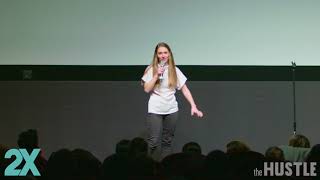
In this keynote, Chelsea Cooper, Senior Vice President of Member Strategy and Operations at Oscar Health, shares the personal philosophy of "back yourself"—a British expression meaning to take initiative and trust in one's own abilities. She recounts her childhood experience of being bullied in Worcester, Massachusetts, and how the lack of self‑advocacy shaped her early years. Later, a male manager recognized her potential and gave her responsibilities she doubted she could handle, illustrating the power of external belief. Cooper describes how she turned that experience into a habit of advocating for other women, highlighting a specific instance where she elevated a shy teammate by assigning her high‑visibility work and pushing her to present to senior leadership. She then narrates a pivotal career moment: while attending London Business School, she agreed to launch Uber in the United Kingdom, juggling the launch with a full academic load. This high‑stakes risk reinforced her "back yourself" mantra. Concluding, she urges women to lean into discomfort, to "shove" themselves and others into challenging opportunities, arguing that both individuals and companies benefit when women are pushed to grow.
Chapters
So my name is Chelsea Cooper, and I am an SVP at Oscar Health, the insurance company. I'm sure you've seen the ads during OE around New York, and I oversee our member strategy and operations there. So I've married a Scot, and one of my favorite expressions that they use in the UK is "back yourself," and it refers to essentially a play that you run when you're playing rugby, and you can't quite get the, you can't quite pass, make a pass, and instead what you do is you take it and you run it down the field yourself and try to score. And if you think about, if you think about that, there's a lot of meaning packed into that. It's about self-confidence, it's about advocating for yourself, it's about really leaning in and being fearless in everything you do. So we've heard some incredible, incredible stories tonight from these women. And while I don't know many of them well, I've got to imagine that they will have had to really live, eat, and breathe that phrase, those two words, "Back yourself," in order to get to where they are today. So when I was 8 years old, Growing up in a place called Worcester, Massachusetts, also known as the Woo for folks who are from there. Adam Sandler used to do a little spoof on Worcester. But growing up there, I changed schools, and within a couple of weeks of my new school, I found myself being, I found myself as the new target for the school bully. Every day when I walked into class, I could really count on Andrina to call me names, pick on me, all the things that bullies do. And when you're that young, those interactions that you have, I mean, it's your whole world. I have two kids now, two babies now, and I see how those interactions that they have at school really impact everything they do. So those moments when I was little, like, really mattered. And so every day, I'd go home, you know, crying and really quite upset, and hope that the next day I would have the courage to stand up. And this went on and on for a long time, for about 4 years. And one of the things that still haunts me to this day is that at that time, I didn't tell my parents. I didn't really— I wasn't comfortable telling my teachers. But more importantly, I didn't have the courage to really stand up for myself. Well, fast forward a few decades, and I started working for a new company, a new job, and we were doing well. I had a new team. We were kind of killing it. And I remember my boss coming to me, male boss, and kind of sitting me down and saying, "You're doing well. You're doing really well, and I want you to take on all these other additional responsibilities." And I remember having kind of that inner sort of stomachache and thinking, "Oh man, I don't know that I can do this." And it was so clear in that moment that he really believed in me, and I think somebody else kind of shared a similar story. But he believed in me more than I believed in myself. And so, was really advocating for me even when I didn't have that yet. So, one of the things that I found myself doing more and more, though, over kind of middle of my career was finding those opportunities to start advocating for others. And I don't know why it is that I found it easier to advocate for others, but then advocate for myself. And I think it's something that as women we do a lot of. And so I— there were all, you know, there were a number of moments I can think about where I would see talented women. And, you know, one comes to mind in particular where I was working in a new role with a new team, and I had someone who was maybe a little less confident, a little shyer on the team. And in fact, she was powering all of the, like, analytics and dashboards. That one of the men on my team was actually getting credit for. And when I kind of dug in and uncovered it and realized pretty quickly how talented she was, I just kept on putting more and sort of more on her plate. She probably didn't thank me for it at the time, but putting more and more on her plate. And it was because I just totally believed in her. And it was kind of that same thing that I had seen from my male boss years before, believing in me. And so I would shove her to speak in front of our whole company. I would shove her to go have lunch with our CEO. And I would shove her to talk to our leadership. And it really, I think, helped her. And ultimately, she just crushed it as I knew she would. And I thought the company was really better off for it. So I found myself advocating for others, but really there was a sort of pivotal moment when I just threw sort of all caution to the wind and just decided to just kind of go for it. I moved back to London for business school. I had married a Brit and was going to London Business School. And maybe about 6 months in, an old friend from San Francisco got in touch with me, and his US-based ride-hailing app was taking off, Uber. And so Travis asked if I would help— first year of business school— if I would help launch Uber in the UK. And I said— remember going out to dinners with him over the course of, I don't know, 4 or 5 months, trying to introduce him to many other friends that could do this for him. And said, "Look, I just moved here. I've got my life. I've just gotten married. I'm starting business school. Sort of no thanks." And finally, at one point, sort of towards the end of my first year, I ended up kind of going out and finally was convinced that I should do this. And I just said, "You know what? I've got business school." but I've also got this great opportunity. I don't know how I'm gonna do it, but I'm just gonna do it, and I'm gonna do both. And so over that summer between my first and second year, I launched Uber in the UK, and then during my second year of business school was running it while also juggling a sort of full course load. And it was that moment where I was incredibly nervous. I didn't know if I could do it. All of those things that I just said, screw it, I'm gonna just go for it. And it was one of the best sort of learning experiences I've had and fundamentally changed the way that I think about things. And so I guess from sort of my— if I could leave folks here with one thing, it's when you find that stomachache, those inner feelings that are telling you don't do that thing or there's no way I can handle it, especially the women out there, those are the times that you have to lean in and you have to just jump in both feet and really go for it. And also, if you notice folks around you who, again, especially women, don't have that own, their self-belief, that's when you have to, I don't even think it's pull them up, I really think it's about shoving them, shoving them. Telling them they gotta do it. They kinda don't have an option. I mean, the women on my team know that, they know when I'm just kind of forcing them to do things. But ultimately, they come back and they're better off for it. I think I'm better off for it. And actually, I think our companies that we work for are much better off for it. So thank you all.