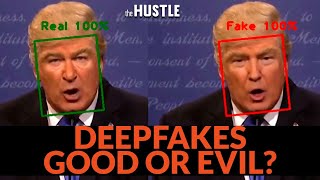
In this episode Sam Parr talks with a guest about deepfake technology—how AI can synthesize realistic video and audio from minimal source material, such as making Obama say any sentence or animating the Mona Lisa from a single photo. They discuss the rapid improvement of the tech and its dual‑edged impact: on the negative side, deepfakes enable political misinformation, revenge porn, bullying, and slander, illustrated by the rise and eventual ban of the r/deepfakes subreddit. On the positive side, the same tools could democratize content creation, allowing anyone to generate movies, animations, or virtual actors without artistic skill. The conversation then shifts to regulation and mitigation. The guests argue that traditional ad disclosures won’t suffice; instead, they propose a hardware‑level cryptographic seal that tags each video or photo at capture, similar to tamper‑evident packaging, so viewers can verify authenticity via a “legitimacy icon.” They note that only camera manufacturers (Apple, Samsung, security‑camera makers) can implement such a system, and that startups alone cannot solve the problem. The episode ends with a vision of a future where every piece of media carries a visible trust indicator, much like organic or gluten‑free labels.
Chapters
But this is also like part of this deepfakes, like this deepfakes problem. And so if you don't know what a deepfake is, a deepfake is basically people can now use technology to make a video look real. You can make anything look— so for example, what they do is they'll take Obama, Obama's talking, Yeah, but I can just say any sentence. I could just be like, uh, hey, hey, my name's Barack and, um, I'm the worst president of all time. And it'll make it look like his lips are moving to my sentence because they basically feed in a bunch of footage of Obama talking normally. And it basically— the algorithm learns, okay, here's how Obama's face moves when he says certain things. And then when I— I can input any audio and it'll make it look like he's doing it. And now Right now the technology is where it looks a little off, but it's not that far off. Like, if I showed it to my—
not all of it, right?
But it's just getting better month over month. So they just showed a, um, like a paper just came out with a new one, and it's literally just taking a still photo. So they took the Mona Lisa, and then they do the same thing. I can go say a sentence and it will make the Mona Lisa say it. Like, the, the voice can— is that good? And so like It's pretty crazy that they can just do that off a still photo. You don't even need like hours and hours of raw footage of the person in order to do this now.
So I downloaded an app that does that with the Mona Lisa.
Which app is that? Do you remember?
Uh, yeah, it's amazing. I'll tell you what it's called. It's really neat, and I think that everyone should download this stuff. I paid $5 for it. It's called, um, um, no, I don't remember the name of it.
Okay, no worries.
Um, but what do you What do you think of this whole deepfakes thing?
Because it's a big problem. Like, your sister's a lawyer. And I think she was like a DA before, right?
Or something like that? Yeah, well, she works in the DA.
Public defender.
And then she's a public defender in the Bronx.
And people, now it's like, if you can't trust what you see, right? If audio, like, we already had photos that could be Photoshopped. Audio now that can be, like, Livebird, I think is the name of it. Where basically you just talk, you can train this system to where you can just type anything and it'll say it in your voice or it'll say it in Donald Trump's voice. So if you can't believe what you see, what you hear, or what's in video, then how does that mess up the world? Fake news is gonna become a bigger problem.
Yeah, it's gonna become a problem, but why are we defaulting to that? Why are we worrying about, I mean, yeah, it's gonna be a problem. But also let's think about all the amazing things like, like act, like there's going to be fake actors.
Like my dance vid, like your dance video. Yeah.
Like it's going to focus on that. It's going to make movies amazing. Like, like Brad Pitt won't exist. There'll be, it will be, it'll be AJ Pitt and it will be some fake person. And I think that's awesome.
So here's a future world. You literally are just looking at your computer and instead, like, Today, if you want to make a movie or an animation, you have to like be an animator or a movie editor or an artist to be able to draw. You're just going to be able to say things and it's going to be able to create what you're saying. So you're going to be able to say, okay, what if Donald Trump was talking to, you know, whatever, Barack Obama, and then Donald jumped in the air and he said this, and then literally it's just going to be able to animate. That's how far this is going to go. And that's going to unlock the ability to create stuff to people who don't have the technical skills to do it today.
Yeah, I mean, I'm— but I'm not too worried about how they're gonna, um, regulate it because like if you have a political ad now, it— like anyone could run an ad on Facebook or on TV and it says Donald Trump, I'm Donald Trump and I hate Mexicans. Anyone could do that now. But I mean, like literally the tech, like, you could buy ads, but there are ways to say like, well, no, that's not allowed, and it has to say like, I'm Donald Trump and I support this. You know what I mean? Like, there are ways to like prevent— like, if you run a TV, a political TV ad right now, it has to say who pays for it.
Sure.
It has to say, is this—
but it doesn't have to be— it doesn't have to be a political thing, right? This could— this can go for anyone. Someone in high school can just bully somebody else. Like, right now, the thing that— yeah, I think Deepfakes got famous because people were putting other people's faces on porn actors. And you could make it look like— I could take a photo of your mom and I could put it on, put it into a porno and it would look like your mom's in the porno. And people were doing this with celebrities, people were doing this with their classmates. And, you know, the Reddit, the subreddit for this got huge, is r/deepfakes, r/deepfakes. And so this is how it got popular because it was like this incredible bullying tool. Like, forget about political ads. It's just like slander left and right.
Did it get taken down, that subreddit?
No, I think it's still up. I'm gonna— I don't know, I haven't been in a long time. But when it first blew up, you know, it got really popular because people were, you know, if— oh yeah, it is banned from Reddit now because it was like, it was becoming a problem.
Oh yeah.
But that didn't stop the actual problem, that just stopped the subreddit where people were sharing it. So I think there's gonna be a massive, massive problem for evidence. I think it's gonna become a massive problem for just like slander and, you know, spin. Like, I could take a video of you and make it say that you hate Mexican people and it's not Donald Trump. Yeah, you're right. And people would believe it because they would see your face and they would say, I saw him say that, you know?
Yeah, I don't know.
And so I'll tell you what some people are trying to do to combat this. There's a whole bunch of programmers who, programmers in general have a high bar for the truth. They really want, things to be true, logical, solvable, reliable. And so when you take away evidence, evidence which used to be a source of truth, it's like, well, you're saying this, but I have video of you doing that thing, so that's evidence. But now it's like, well, this video could be anything, this video could be fake. So they're trying to solve this in the way that they think it can be solved. So the theory is anything you make to sort of validate stuff, um, the con artist will always be one step ahead. And there's too big of a payoff to be able to fake this stuff well. It's like a counterfeiter. And so you're always a cat and mouse game, which is not a winning solution. So the solution that they believe is that the phone makers themselves, the device makers themselves, will need to put a cryptographic seal on the video when it's taken. And it's like a tamper-proof seal, like we have with medicine or whatever, where it's like, If this seal is broken, that means this video has been edited in some way. And so at some point, people will only trust videos or photos that have this, this cryptographic seal on them that says this has not been edited because it's, it's on the device itself from when it got captured. It gets instantly implemented on. And so who's working on that? Well, the problem is a startup can't do this, right? Because it's actually Apple that needs to implement it. It's actually Samsung that needs to implement this. And so luckily Apple's a pretty privacy-conscious company and they know that like, if their tools are being used for evil, they usually actually do stuff about it. So hopefully Apple is working on this, but I have a friend who was doing a startup trying to do this and he was running into this problem, which is like, look, the people who need to do this are all the camera makers. Like, you know, the security camera itself needs to do this. And that's the only like decent solution. Now, some technical people will say, oh, there's nothing that's actually tamper-proof. You can still, you can still, you know, get around it.
Sure, sure, sure.
But it's better.
And they are right, but there are still things where it mostly works.
Right, exactly. So I think that's the world, that's the way the world is going to work later, where you're going to need to see this little, you know, icon that says— it's like, you know, it's the gluten-free icon, it's the organic icon. It's going to be— this is legitimate, and there's going to be a legitimacy icon on any photo or video.
That's the icon business. That's a good business. You know, JD Power.