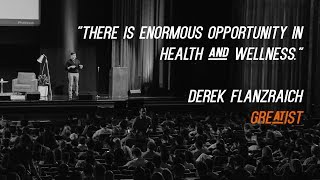
Derek Flanzraich built Greatest.com into a wellness media brand with 10-15 million monthly visitors and $8 million in funding by combining science-backed articles with a friendly voice aimed at millennials. He grew the audience through influencer outreach and early Pinterest adoption, then monetized through ads, branded content, and subscriptions.
Chapters
I grew up struggling with my weight. Like many of the people that are speaking today, I started a company based on my personal frustrations as the biggest kid in the class, feeling like time and time again the products I purchased, the magazines I opened up, the programs I tried, the TV shows I turned on were not on my side. It made me feel worse about myself instead of better. And it felt so at odds with the way the world, especially millennials, were starting to talk about health and wellness. So at odds with the way I wanted to hear health and wellness being talked about, which was not about health and fitness being the point, but about it just being a part of living a better, happier, longer life. So this notion that there's a major profound shift where 73% of millennials would rather be healthy than wealthy, so profoundly different from the generations in the past, in the past. Like, the notion was like, why aren't there brands and businesses that speak to this? So in the last 6 years, what we've done is try to build that brand, and we've done that primarily through content. So today we write content. We're a health and wellness media website, greatest.com, check it out. We have built a leading, far, clear and far away market leader in terms of healthy-minded millennials. We reach 10 to 15 million people every single month. Using science-backed, expert-approved content that's fun and friendly, just like your friend, but a little further along. Along the way, we've raised $8 million, led by Floodgate, dream investor. We have— we're profitable now, which is pretty exciting. You know, not making buttloads of money yet, but we're on our way. And what we're really doing, which is, you know, we're especially excited about, is taking this notion of like a friend who's a little further along, which I think is the voice that we're aching for, that's been missing in the space, taking that voice and actually productizing it. So imagine if we could pair you with a friend who's a little further along, you know, just 6 months ahead of you, who can show you sort of the path, guide you towards where you want to go, maybe even pair you with a group of people just like you, um, who want to accomplish the same goals on the same timeline. So anyway, we're playing with a lot of different stuff, but if you want to ask me about what it's like to run a business for 6 years, how to start something that some people every now and then will walk up to me and be like, "Oh, you run that blog, right?" And being like, "No, it's not a blog, it's a media company." If you want to talk about really anything, the NBA draft, my job here is to answer anything that you guys have pressing, and I was going to perform my Nicki Minaj song, but I'll do that later. Any questions? Yes, sir. I'm sure there's like mics or something. No one actually told me how this worked, but I will listen to you. Totally. Yeah, so in case you didn't hear, the way I understood the question at least was like advertising is a pretty mediocre business, unless you're Facebook. And how are media publishers going to monetize? And you mentioned Rodale. Rodale actually just last— I think this week actually said that they are considering a sale. Rodale, for those of you that might not know, Men's Health, Women's Health, Runner's World, they're sort of the largest private health and wellness publisher. Actually one of the largest private publishers, period. The way we think about this is that advertising is actually a pretty great market. Obviously, some of the largest companies in the world actually are built on advertising. But as a publisher, especially as a niche publisher that doesn't want to sell your soul and doesn't want to, yeah, like sell out and just write about Kim Kardashian all day, you do have to kind of pursue other options. But it's because you don't write about Kim Kardashian all day that you can sort of double down on the trust that you built. I have strong feelings about the market of health and wellness as well. I think if you're building a publisher in news and politics or media entertainment, I think it's really, really, really hard to figure out how to charge your customers. But my guess is every single person in this audience spends every month some amount of money on health and wellness, and if I could tell you, you could spend it on something that will actually help you get healthier, you'd probably move your spending. 80% of millennials today say they're spending on health and wellness. They say on average they're spending 20% of their annual income. So gut check that for a second. Does that seem right? If that's right, that's $420 billion being spent in the United States right now on health and wellness. What are they spending it on? Maybe ClassPass, which you'll hear from Pei-Yao later. So yeah, I think, I think it's really tied to the market that you're in. Uh, and I think that there is a massive opportunity to build. This is my opinion and my pitch ultimately when we continue to grow is like, my opinion is there's enormous open opportunity in health and wellness in terms of a subscription you pay for every month that actually drives you value. Peloton is a perfect example, but what's something that like normal people can afford? Um, and so I don't know if any of you guys are working on any ideas. Um, we're excited to hear about that. Hi, thanks. My name's Chicote, and I was curious, as an upstart media brand with a very targeted demographic in 2017, what are your thoughts about cannabis and its contribution to health and wellness amongst our generation who are more comfortable with it, at the same time that you guys are building a brand and have, you know, a myriad of advertisers and stakeholders that you have to satisfy? God, everyone is into weed right now, right? Man, like I have like so many pitches on like weed-infused green juice. It's like, I don't even understand. That's just weed juice? Yeah, so I think it's an enormous market. I mean, it's definitely an enormous like economic like opportunity, especially as it continues to expand and grow and be legalized, which, you know, is the only assumption as it like is starting to go state by state. I think in the media space, I would argue that weed has actually been like covered a lot. You know, High Times has existed for longer than like anyone can imagine. I think Snoop Dogg just bought it. I could be going crazy, something like that. I actually think that weed probably is one of the most oversaturated niche topics that gets covered a lot in media. But I think if you're building a product in We, that's a major opportunity. Thank you. Other questions? Yes, sir. Yeah. So we work with big deal brands almost entirely. And those we're very proactively going out to. Or they're coming into us. You know, the only real way to monetize online today is through sort of these direct branded content sponsorships, which are, you know, sometimes people will call them advertising, sometimes they won't. It's obviously advertising. Our pitch to them is, look, we can activate and engage millennials who care about their health better than anyone on the planet, and we speak their language better than your brand will ever speak. And so if you're trying to introduce something new, you're trying to launch something new, you're trying to change something that people didn't know before but like are finding out that you've changed the formula or trying to introduce something new, that we can do that and help kind of move the needle for your business, build that brand awareness in a different way. But yeah, the big brand partnerships, I've been doing this for 6 years and Greatest was not always 10 to 15 million unique visitors a month and when we were much smaller, it was much harder to get people people to take notice. In fact, unfortunately, I would say that the goalposts for when you can really start truly selling to these big brands continues to move. I remember when we hit 5 million unique visitors, I was like, "This is it, this is the moment," and then everyone was like, "Now you need 10." I was like, "Oh man," and then we got 10 and everyone's like, "Yeah, but you don't have 30." So it takes time to get there. Yes. Hi, this is Stephanie. I'm curious to know if there's anything coming up for you that you're excited about? In my personal life, of course, you mean? Your business. Yeah, the thing that I'm most excited about is actually the space in general. I think health and wellness, I've alluded to it, but I think like this is the year. Like there are businesses that are being built. Every January for us is our Super Bowl. You know, I don't know if you guys think of January and are like, "This is the day that I'm going to— this is the month that I'm going to get everything on track." Well, if it's not, everyone else is thinking that, and so January becomes the, the Super Bowl, and every January for the last 5 years has just gotten bigger and bigger in terms of how seriously people are starting to take their health and how much smarter they're getting about building it into their lives. So I'm actually just really excited about the continued increasing importance of health and wellness. And yeah, I mean, it was not a thing. If I was here 4 years ago, you know, I'm pretty sure half the speakers on this stage are like health and wellness related or lifestyle related in some way. And that was not true 4 years ago. So I'm excited about where it's all moving and where it's all heading. Yes, sir. Hey Derek, my name is— Wow, that's really trippy. My name is Amit. I'm really curious to pick your brain on habit formation. Could you talk about like about, you know, this notion that you just said January is your Super Bowl, that means that there are a lot of New Year's resolution people coming to your site to look for help, right? But how do you sustain that motivation and that energy? So I have some strong opinions on this. Greatest was really built, the whole actually name itself is not because I don't know, like, I don't know how to spell. It's actually the idea is that it's somebody who's trying to get better. Like an artist works on art, a greatest just works on being greater. They don't have to be the greatest. So this notion of like it's all about actually, you know, kind of working at it and trying and learning is what I think is the only thing that really sticks, is finding what's good for you, that you actually enjoy, and then you keep doing it over time. It's what I found time and time again. Almost anyone who's doing like a crash diet, you know, to accomplish a certain goal, if you're not going to end up sticking to some of that stuff, like you're in trouble in my mind. And actually science says— Not only is yo-yo dieting bad for you, but look, the country has never been more obese, the world has never been more obese, and a big part of that is because of— but yet we on average diet 3 to 4 times a year in America, which is a crazy number. So I think actually that the job is not to change the behavior though. I think people do, we just go through ups and downs in terms of our motivation. And I like, in the health world, people hate January, 'cause they're always like, you know, oh, all these New Year's resolution people are gonna like go into the gym, and then they're gonna give it up, or they don't really mean it, they'll give up after 12 days. But I actually think like, what an amazing opportunity. You have this moment where you're like, I wanna start fresh, I wanna start new. And there are different times of that throughout the year, and so the way I think of it is don't change the behavior, but actually like embrace that, and just make it easier easier and more effective if people want to commit to something. I'm really excited about, I don't know if some of you have heard of this diet called Whole30. I'm excited about this notion that diets as we think of them are shifting and that the new diet is actually a short thing that you do for a small period of time in which you take away 2 to 3 life-changing things. So with Whole30, which is really hard, I lasted 20 days on it, it's really tough, it's like a very like It's basically extreme paleo with some weird stuff thrown in, but I'm a big fan of it. And you do Whole30 and you'll learn, one, to cook more than you ever have before. You'll learn that there's added sugar in just about everything, and that sriracha is delicious because it's full of sugar, and Cholula is less sugar, so you're allowed to eat that for some bizarre reason. And you'll learn about sort of the way your body feels when you're just eating eating kind of good food. And so these are like things that you can take away and stick to. And the Whole30 folks actually talk a lot about how, Melissa Hardwig, the co-founder, she talks a lot about how it's not supposed to be for 365 days. So if a diet tells you you're gonna do this for the rest of your life, and you're never gonna have guac and chips, and you're never gonna have ice cream again, like that's not for me, and I imagine it's not for most people in this audience. Though if it is, like props to you, and I'd love to eat your guac and chips. But I think that that's a major shift that's happening. So anyway, I think the idea is not to actually like try to change behavior necessarily, but to lean into trying to improve like the effect of when that, you know, kind of rise in motivation exists. Yeah, totally. How are you? Greatest has a really huge audience. Can you elaborate more on the marketing and what you've found to to be successful, to grow, and also attract your unique visitors? Yeah, so we do things really differently. I actually spoke at ConCon, which is the event that The Hustle put on before this, I don't remember, I have a shit memory, and what we talked about was I have this extremely strong belief that what you need to be doing is producing a lot less content that's a lot more awesome, and that in a world where the distribution networks have changed dramatically, but are now not going anywhere, you only stick out by being really, really relevant to a small niche group, and by super-serving them. And so that's what we do in health and wellness, which is a space that's sort of typified by people not doing that. You know, people have made money in health and wellness the easy way, 'cause it's easy for like most of time. And so what we do is we produce science-backed, expert-approved content that's terrifically legitimate. We produce a very small amount of it compared to anybody that we ever, that we get compared to. And we tend to perform really well on places that you might think are less sexy. Places like Google Search, places like Pinterest. People come back, and when they come, they spend over 7 minutes on every article page on average, which is like— they really read the content, which is like a crazy thing in media apparently. So, you know, my opinion is that it's not what you think. It's not about sort of spray and pray. It's actually about finding your niche audience, engaging them terrifically, and growing that audience over time. It doesn't happen overnight. It's weird that there's no mic over there, right? Hope none of you have questions. Alright, go ahead. Bit of a similar question. I was wondering what was the number one strategy you used to first build your audience and how did that change when you got to the stage of scaling that audience? Yeah, number one, like what's the thing that worked, or number one as in what's the first thing I tried that flopped disastrously. I would say, what's the one you would prioritize now that you know looking back? So look, Greatest started 6 years ago and the world was very different. The way that we— the true like first big thing that we did was we reached out to 100 top influencers in the space. I was like, you know, I read voraciously, so voraciously that I used the word voraciously just now out loud, which is embarrassing. So I read like crazy, and I knew all the people that I admired in the space, and so I reached out to them, I was like, "Hey, I'm launching this site, I want your help. How do I reach normal people just trying to get better in a voice that will actually empower them to improve?" And those 100 people, when I actually later was like, "Okay, we launched the site," ended up sharing it. Today, that's an influencer strategy, and if that's your strategy, like, you better have a billion dollars, because it's shifted in such a different way. So that was the strategy that sort of worked then. The next thing that sort of changed the game for us was we hitched a ride on Pinterest's bandwagon. It was an early— we were all using it in the office. It was just starting to grow in late 2011. We decided to double down on this platform that has become one of the largest platforms on the internet, and we just honestly got it right. We committed to improving all of our content in a way that was more visual and more driven. We sort of looked at that and we were like, we're gonna own this for health and wellness and food and drink, which at the time were the third and fourth most popular categories or something like that. And so we just like really hitched a ride to this. And the challenge now is like, what is that platform? And so, you know, I would still give the same advice, which is how do you find a platform that's growing, that you believe in, that is really, really truly like something your audience is on, and start growing from there. It's harder to do than ever before because the gatekeepers are, there are less of them now, and it takes more resources to get ahead. So if you're thinking, "Oh, well the answer is video," video's more expensive, doing video right is really, and uniquely, is really tough, and so I'd encourage everyone who wants to build a media brand, who wants to build an audience, to focus on a very, very specific demographic, and then try to make it like 10 times more specific than that, and super, like super, super serve them in a way that actually they basically like, you become their must-read, or their must-follow, or their must-share. Otherwise, you're screwed. There's, you know, creating like general content for people, it just doesn't work anymore. And I don't know why it would, and I'm upset that it ever did. Go ahead. Hi there. Could you talk a little bit about any sort of frameworks, heuristics, or even your editorial strategy, content strategy, the things that you guys use as your north star to make decisions, whether it's what you're going to publish or not publish, or what you're investing in, or where you're spending your time. Talk as much as you're able to about how you make decisions within the company. Yeah. Choosing what to cover is really hard, actually. Especially if you have limited resources. It's a great question, and it's not easy, and we've gone, we've changed a lot over time in terms of how we approach it. I would say roughly the way it breaks down is about 30%, like a third of the, 33.333, a third of the decisions that we make come from numbers, right? It's like, what's working for us? What's working for other people? About a third comes from our internal editors and like their judgment. This is really kind of crucial, because it's like you have to trust the people that know what they're doing. And then about a third comes from like the outside world, which is, you know, like what's trending in Google, for example. So it's sort of this mixture of the three, and it's absolutely an art more than a science. Because we write 2 to 3 articles a day, which again might seem like a lot to you guys, but you know, the people we're sort of you're competing with, or the people who usually people compare and are like, "Oh, you're just like that other media company," they're writing 50 to 500 articles a day. So, you know, we think of it as like we have very few shots on goal, we gotta make— take hella good shots. I obviously have— I'm not a sports guy or else maybe I would make that metaphor better. So I don't know if that answers your question, but that's how we think about it, and it changes over time, and it's— It's like, you know, you're constantly trying to provide something that's different, and providing something that's different can just be your voice, it can just be your tone, and it can just be sort of the— how comprehensively, how you frame and package it, you know, how you're speaking online, how you're bringing content. We probably produce meaningfully more content every day that's built for each of the social channels that we're trying to build an audience on than we do for our site proper, which is crazy. Crazy, so you know, this, it all continues to evolve and shift. Go ahead. Your time. I have like a bunch of questions as you keep talking, but I'll stick with my initial, which was how did you know when to quit your day job and go into this full force, and how did you know who to hire, when to hire, you know, how did you realize you had the funds to do it, you know, just as you progressed? Yeah, how did I figure out everything? Yeah. Well, what I'll start with is that I think, like, I'm broken. I've been building stuff my whole very short life. I don't think that's the only way to build businesses. I think people build businesses for lots of different reasons and lots of different stages in their lives. But I, from like, in middle school and high school and college, I started organizations that are all still around, are all still growing, honestly are all bigger and better than when I was there, which is which is kind of cool and actually flattering, but also, like, what does that say about me? But, like, I've always started new stuff, and I'm surprised time and time again by people who are drawn to sort of entrepreneurship for reasons that I think are wrong. Like, I don't know how else, I don't know what else to do, and I'm a shitty employee, I always have been, and, like, I have always believed that I can do better something in this world, like truly that I can do it better than anybody else. That's totally not normal, and I hope very few people think that, because it's kind of messed up, but it's, I think, the only feeling you need to have when you're trying to start a business. It's like this bubble, this, I think of it as like, you've got a lot of like idea bubbles, and one like bubbles to the top, and you're like, "I need to do that, and nobody can do this better than me." And it's a crazy thought to say that when you have no remote experience. You know? And so my opinion on this is if you're considering quitting your day job to do something entrepreneurial, it has to be such a no-brainer to you. You have to be sitting there saying, you know, I think if you're truly asking yourself that question, it's probably not right for you, would be my strong opinion. And that you should have— it should be such a feeling like, of course I have to do this. And so that's my very strong opinion on that. I don't know if that's helpful. I feel like I just scared everyone. I have two questions and I'll ask both of them. First should be straightforward, I think. What's the most popular piece of content you've ever published? Oh man, that's a great question. Uh, it is 17 or 24 portable high-protein snacks. It's true. Right now the number one thing that's trending actually is 24 tricks. 24, huh? 24 tricks to stay cool during the summer when you don't have an AC. And everything is science-backed and expert-approved. What? But yeah, those have been the— it's mostly food. Food does terrifically well for us. And the second question is, as you grow to compete with these traditional media companies, how do you think about a comScore number, which is gonna be used by the P&Gs and the huge companies that might be coming to you with ad dollars? Yeah. We think about it too much, probably. You know, there's a funny constant struggle between, like, "Hey, we're different. We're not doing things like the other people. We're the upstart," as someone said, "and we're going to transform and disrupt and be different, but also we want your money, and how do you decide to give us your money? Oh, it's with all the metrics that everyone else is using." So it's a constant battle, actually, and there's no really simple solution. You'd like to think that you can actually push the market forward and actually define the market in a different way, which is what we do. Things like experiences, branded content, those are hard to quantify, and so if that's what people want from you, that's what you could sell in a very different way. But yes, of course we have a ComScore number. Every month we're like, "Ugh, wish it was larger." And it's a, um, you kind of have to play the game a little bit. And as much as I always want to be like, "You don't understand, like, we do things so differently, you can't even put us on a chart!" But people need charts to decide how to spend money, especially if they're at P&G and are worried about getting fired by their boss if they make a silly decision. So it's a balance. Just like everything in health. Everything is a balance. Go ahead. Thanks, Derek. So say you wanted to start a media company, you think you've identified a good niche, made it specific, have an idea on how to super serve them, what's a quick way to validate if those people are gonna care about your content without slaving at it for 5 months and spending money getting your content out there? I think you should slave at it for 5 months. I mean, you could write a blog post on your own, You know, in the early days of Greatest, I say a lot to people that if you can't start the business on your own, you shouldn't start it, or you should find a co-founder who can help you build it. Every now and then someone's like, "I'm gonna build an app," and you're like, "Oh cool, I love apps, I get apps." And they're like, "But, you know, all I know how to do is strategy consulting." And you're like, "Alright, well, strategy consulting is cool, but do you know how to build an app?" And if they don't, I worry about how they're going to put the resources together, make the right decisions, decisions, even find the right people to work with, and so I always encourage people, if you're gonna build a media company, like, write and edit. Like, you should be— or find someone who's like gonna start with you who can do it too. So first I would say like, create some stuff, put it out there. It's definitely never been easier to test people's reactions because of Facebook, because of, you know, social media. You can both put stuff out there, you can pay to get it promoted and see what the reactions are. But yeah, I actually believe a lot of times that people overrate sort of the, "I'm gonna just put a feeler out there and see how people respond or react." I think a lot of times the things that are truly— again, most of the people that are speaking on this stage built something that didn't exist before and that no one was like, "Man, what I really need is a protein bar that has slightly less calories and less sugar but high protein and is made of good Good ingredients. Like nobody was sitting there actively maybe thinking that, and so I think, you know, like that's the way to be. It's like the world needs this. I keep always thinking about the Henry Ford quote, which is like, "If you had asked people what they wanted, they would have wanted a faster horse." I'm relatively sure that's a myth and not a real quote, but it's a good one. Yeah, go ahead. Yeah, as a large publisher, what do you think of programmatic ads and, Assuming that you think it's broken, how would you fix it? Ah man, programmatic. If you're producing really high-quality content, I actually think programmatic is a great way to move upstream and make more money. Programmatic, for those of you that don't know, is basically like display advertising that you're monetizing through a waterfall, and the waterfall is like you get to choose which vendors are bidding on your inventory. It's a big thing, a lot of people are moving to there. In particular, a lot of big brands are moving a lot of their spending there, which is very frustrating if you're trying to convince them to spend money on branded content. They're like, "Nah, I'm good. I just want to spend money using robots to decide what to buy." I think it's really smart for the industry, honestly. I think for a publisher, you can't possibly get by on just programmatic. I think it's really hard unless you've got like, I don't know, 300 million unique visitors or something. Um, and, uh, I welcome anybody who's innovating to try and improve the quality of the ads and the relevance of the ads, because our content and our audience is real, and so that helps us. But it doesn't help everyone. It's a mess of a thing, though. Programmatic, yeah. So, uh, I know there's a lot of controversy in diets, especially things like fat intake, and I'm curious, when your experts disagree with each other. How do you resolve that and, you know, prevent being fake news? Alright, this is unfortunately the last question. So sorry. But it says "Time's up" in very scary red letters, so I have to trust that. I will answer this question though, because I think it's really crucial. Some of you might have heard recently that coconut oil is the devil for you, and it has saturated fat. It always did. And saturated fat is not bad for you. And the American Heart Association, which makes recommendations— like, when you read that site, I guarantee you, any of their recommendations, you'll be like, "Oh, this is a hard thing to trust." Fat is not bad for you. It's a long story. But you'd be surprised at how much we don't disagree with the science. Health and wellness sounds controversial a lot of the time, A lot of things in health sound like everyone disagrees, but honestly, it's mostly traditional media just trying to confuse the shit out of you, and there's a general scientific consensus about almost— about many, many things, if not almost all major things in health and wellness today. Now, that doesn't mean it's not going to evolve and change, but there's a general scientific consensus, and so you'd be surprised how rarely people actually disagree. Internally. Remember, we have every article that needs it approved by at least 2 experts. Sometimes we'll bring in 5 because there's so many different varying takes. I'm waiting for Sam to like run out and drag me off. I really appreciated being your lunch entertainment, and I think Nicki Minaj is next. Thanks.










