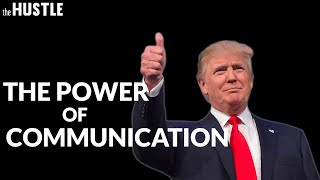
In this segment of the My First Million podcast, the host Sam Parr and a guest (Speaker A) discuss the mechanics of persuasive communication, using controversial historical figures as case studies. They argue that even when persuasion is employed for harmful ends, the underlying techniques can be dissected and repurposed for positive use. The conversation highlights Donald Trump’s knack for simple, vivid language and image‑based messaging, Scott Adams’ early recognition of Trump’s persuasive skill set, and Adolf Hitler’s contrasting visual propaganda strategy (black‑and‑white, large images, film). The guest emphasizes learning from these examples to build a personal toolkit for effective, ethical persuasion.
Chapters
Okay, so the other way of doing this— so one way, one thing is to say what you just said, which is use these powers for good. The other thing I've been able to do is the opposite, which is when I see somebody do something for evil but it works, I try to learn from it. And so, for example, I remember the first time I saw— I'll give you a recent example first.
No, I completely agree.
So Trump is somebody who I'm not a fan of. I think the guy is bad in all these different ways. But when I watch him, the guy is an incredibly effective communicator. And he's not polished. He doesn't use fancy $15 words. He doesn't have a lot of substance behind what he's saying. But the guy is like a master of communication. The guy knows how to get his point across in a way that resonates with people.
I completely agree.
Scott Adams, who's the creator of Dilbert, was talking about this when Trump was running. If you haven't seen it, go read Scott Adams's blog. He's the creator of Dilbert, and he was early on when Trump first announced his candidacy. Scott Adams called it. He goes, this guy's going to win. And people were like, what? He goes, I've been studying persuasion for 20 years. I've been studying hypnosis. I've been a communicator through cartoon. I know an effective communicator when I see one. This guy is a master. He goes, and so he would come up with whenever Trump would say things like low energy Jeb or whatever, when he would like call Jeb Bush low energy. He was like, these are linguistic kill shots. These are— and when he would talk about the wall, he'd be like, it's a great big wall, a huge wall. And he's like, he's painting a picture in people's minds, which is much better than talking about policy. And so you can learn from people that you think are using it for—
well, he, he, and he called out that he was going to win.
He called that he was gonna win months before anybody even took him seriously. When FiveThirtyEight was like, this guy's got a 0% chance, Scott Adams was like, this guy's gonna win. And of course, if he was wrong, nobody would ever even really pay attention to it, 'cause, you know, but when you're right on a contrarian prediction, you get all the credit. And the other example of this was Hitler. So Hitler, when Hitler was rising to power, I studied how did this guy get so popular? What did this guy do? 'Cause when you watch him speak, he's not a very compelling guy. But they did a lot of things. So one thing I remember that stood out to me, I was in 7th grade and I remember learning about this, and when Hitler was trying to rise to power, all the political campaign posters were all like full color, lots of text, people trying to explain their position on things. And Hitler went the other way. Everything he did was black and white, which would be normally, it would not stand out, but he was like, well, I will contrast everybody else who's using tons of color on their stuff, I'll go black and white. The second thing was he would use only like big images and like really powerful images and not a bunch of text. And then he would use movies as propaganda and fill the cinema with people to watch a movie, but it was very much a propaganda thing behind it. So even though he used it for evil, those techniques and principles are interesting to learn from for me as somebody who wants to have a strong toolkit that I can use for good.
I completely agree. I was reading, I've been going down so many Wikipedia holes now that I'm home so much. I was reading about, I read Hitler's Wikipedia because I was reading about World War II and it let me, like I was reading about the mafia and then World War II and then like, and it was like, his rise to power was because he like would speak at these, I don't know what the equivalent of is now, but just like halls where he, like bars, like veteran halls. And I'm like, wait a minute, he started as a speaker? That's it? Right. It was kind of crazy.