Elon Musk And Mark Zuckerberg Agree To Fight In A Cage Match (#468)
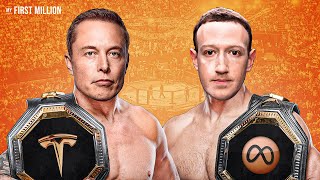
In this episode Sam Parr and Shaan Puri riff on the viral idea of Elon Musk fighting Mark Zuckerberg in a UFC‑style cage match, tracing its origin to a leaked Facebook internal presentation, the ensuing social media banter, and Dana White’s involvement, while offering predictions about the fight’s outcome. The conversation then shifts to a detailed examination of the newsletter‑building platform Beehive: its product features, early traction, pricing, and the founders’ background. Sam and Shaan discuss their investment decision‑making process, debating market size, venture‑scale potential versus a modest exit, and the importance of rapid iteration (the "fix‑it" framework). They also share frameworks for evaluating founders, such as Paul Graham’s "animal" heuristic, and outline best practices for transparent investor updates, emphasizing key metrics, churn, burn, and honest communication. The latter part of the episode introduces a new branding concept called "Total Man," sparked by a gifted domain and discussions about modern masculinity, branding, and the appeal of rugged, hard‑core self‑improvement movements. They brainstorm a "Man Month" challenge inspired by 75 Hard, involving daily cold showers, push‑ups, and tough conversations, positioning it as a free, viral movement rather than a paid program. Additional anecdotes include the veteran‑founded Black Rifle Coffee brand, personal stories about moving to San Francisco, and reflections on identity and cultural shifts.
Chapters
needs a hold-me-back guy. You're at a hold-me-back guy, you're in a fight, and you're like, hey, listen, I'm gonna go after these guys. I need you to hold me back. So I'm not, I'm not actually trying to fight this guy. I need it to look like I'm trying to fight this guy, and I need you to hold me back. And I, it's got to be, ah, if these guys weren't holding me, I would have kicked your ass. He needs to find a hold-me-back guy.
I think Elon's hold-me-back guy, his hold-me-back guy is going to be a hard sneeze. He's one hard sneeze away from getting like a back spasm. You know what I'm saying? Like All right, we are live. What's going on, dude?
Amazing hoodie. Sick hoodie.
You like that? Hampton?
Yeah, that is, uh, very nice.
I had a, uh, team offsite. We had all of our employees get, get together in Brooklyn and the CEO, my CEO Jordan, organized this lovely event and he gave us all hoodies that say Hampton and then our city that we live in.
You're, um, you're a stressful dude to organize an event for. I've never had to do it, but I've been a part of events where people are organizing for us and I'm like, they're like, oh yeah, by the way, it's everything, you know, the venue changed and we forgot, you know, there's only one chair on stage. I'm like, it's cool. All right, no problem. And then you're like, what the hell? And so I would be very stressed if I had to throw an offsite or an event where you were my like kind of core customer of it. Is that fair?
Let me, yeah, yeah, that's fair. But let me explain my reasoning behind that. And this is very business related. Number one, I believe the way you do one little thing is the way you do everything. So what that means though is once you have, but, but if you've proven to me that I can trust you, I'm all in and I don't question anything. And so until you've proven that to me, I question everything. And if there's not a good answer behind it, I doubt you. And once we get past that stage, I'm good. The second reason— there is no second reason. I actually forget what it is.
That was a good reason.
Oh, I know. The second— here's this, here's the second reason. And we could actually talk about this for a second if you want, but basically the second time around you've done something, everything is so much calmer because now my entire reputation, my entire net worth, it's not tied up into this one entity, which is what many things I've done in the past have been. So I'm much calmer. I'm way more— subdued this time.
Yeah, I think that's true for sure. And do you find yourself thinking bigger as a kind of like the next—
way bigger.
Now this is, you've got one win under your belt. What was the phrase that Justin Mayer said? Once you do whatever you gotta do to get your nut, and after that go for your noble mission. So, you know, you've got your nut now, you know, you're financially secure, you're safe. Do you, Not only are you calmer, but are you more, I don't know, ambitious or long-term oriented in some way?
Yes, 100%. I used to criticize, uh, founders if they would sell secondary. So you'd read about this a lot. You, you, you typically only read about it when it's done in a bad way, of which it's done in a bad way many times. You'll see this company, which is gonna go bankrupt, the founders took $50 million off the table and it didn't work out. The reasoning behind that I think is great still. Which is you give an entrepreneur $5 or $10 million and they're like, wow, I can live a really nice life now. I think bigger. That's definitely the case with me. I think significantly longer term. So I think like, what's this like in 20 or 30 years as opposed to next quarter? And I don't care if it fails, which is actually a good thing, meaning I'm able to try more within it. I, what have I said? Treat 'em mean, keep 'em keen. It's like that with trying to find a date and make money. So like, The less I care, the more it happens.
Yeah. The way I think about it is like, because you see examples on both sides, you see when somebody had no other option back against the wall, that's when they, when they, when they rose to the occasion. And you could also hear the other, other scenario, which is because I was secure, I was able to play a long-term game and I was less emotionally invested in the ups and downs of it. Therefore, I was able to make better decisions. And blah, blah, blah. And you could see both examples. So which one is it? And actually, I think the reality is that success is not based on either one of those. It's not based on how much money you had in your bank account when you had zero or when you had a bunch. People tell themselves stories about it either way. I think fundamentally, if a person is driven, intrinsically driven, it doesn't matter whether that fuel is because they're a technologist and they just love technology, they're trying to make something good for humanity, or they're insecure because in 7th grade Rachel dumped them. And it's like, well, either way, it doesn't matter. It doesn't matter what your driving force is as long as you have a driving force. And it's different for a whole bunch of people. There's examples of people on all kinds of, with all kinds of chips on their shoulder. I think you do need to be driven, and it's just a question of by what. And I think everybody's got a different by what.
Are you more calm now that you've had success?
I'm definitely more calm, but I was pretty calm before. So calm, I would say, is not really the word. I guess the way I would put it is I'm less desperate. And yeah, I think that has ups and downs. Again, like I said, like when I was desperate to prove myself, like you saw that I worked in that really fancy office. I also slept in that office. I think basically it was like one year, like 275 days out of the year. I slept there and like, it was nice to sleep there. It's a really nice, they had an apartment built into the office. So it wasn't like the, it's not like I was sleeping under my desk on the like concrete floor, but nonetheless, that just sort of means I just didn't have a life. I didn't want to have a life. I didn't want to care about friends and dating and other things. I cared about just making it. I just wanted to be successful really badly. And I was like, it's not even that I was super productive all those hours, but I was like, look, I'm going to throw all my hours at the problem. I will sleep here. I will wake up here. That just seems more efficient. I'm just going to do that. I did that for several years, but now I would say that desperation has been replaced with a different asset. Okay. I lost the desperation, which was serving me. What do I have now? Which is like, I can operate more out of a, like I can choose things that are like, I'm actually driven towards, like that have a purpose, even if there's no short-term—
a little more offensive as well.
Yeah. There's no short-term path to like right now, for example, I'm writing this newsletter every day. I write this thing every day. There's no ads. There's—
I subscribe. No small boy or small boy. Yeah, just smallboy.com.
And I'm writing this thing. There's no ads, there's no premium, there's no upsell, there's no business model. So why am I doing it? And I'm like, because I really like writing. And more than I like writing, I like finding interesting shit to write about, things that scratch my curiosity. So I'm able to do something. And then as I'm doing this thing that has no business plan, that has no whatever, I'm seeing all these extra opportunities open up because that I, that I couldn't have seen at the beginning. And so just by doing the thing I really kind of am drawn to, I'm most interested in, I'm doing my best work. And when I'm doing my best work, these unforeseen things start to open themselves up. And I'm like, oh, I would have— the 24-year-old me would have never been able to do this because 24-year-old me was desperate. I needed, I needed a payoff quick. Now I don't need a quick payoff. And so I'm able to do things differently. And I think that has a different advantage.
Can we talk about, um, is there a new chip on your shoulder now? Now that you and— there's been a very— well, you tell me, is the feud that you're experiencing right now, your internet feud, is that— has that even made it to the point where you bring it up at the dinner table?
No, no, no. But my wife is not aware of it, but she's like, hmm, how come he's looking at his phone for like an extra 30 seconds longer? And it's because I'm coming up with a badass slam in my head is what's actually happening. I'm wordsmithing a 7th grade insult right now. And, uh, I don't know what, what does my kid want? What do you want? Hold on. Daddy's busy. I'm coming up with a yo mama joke to Jason Calacanis right now.
Background of this is there's a podcast called the All In Pod. They're great. I think they're good, but they're different than us. And we, a lot of people will listen to both of ours. Yeah. So maybe there's a little, definitely some competition in there, but we can all win. And last podcast, Sean challenged them basically to a $100,000 poker bet, heads up poker. But there was some more, there was some more detail behind it, but I shared that on the internet and Jason Calcanis, I thought he was coming hard at me too, but he came hard at, he said, Sam, you're great. Sean, you'll still learn. And he gave you a head pat and he said, smart of you, Sean, to punch.
Well, I don't know if he— so the background is while we were— I forgot what we were talking about. I think we were making fun of him a little bit because he, in the Rogan debate, people were like, it's raised $2 million for this, the scientist to come debate this guy, like a kind of a famous internet challenge here. And he's like, I'm in for $10K, which is funny because the answer he was doing was $100K plus.
I've never made fun of Jason. If it comes down to it, I, you have my loyalty. I will, I'll die for you, but I've so far, if you want me to, I'll, I'll, I'm gladly hop in. I've stayed mostly neutral. This is a you thing.
Yeah.
Yeah.
Yeah. Yeah.
Yeah.
That's fine. I, by the way, I like Jason for the record. I have nothing against Jason Calacanis. Uh, I, I'm, uh, I've listened to This Week in Startups for a long time. I don't listen anymore, but I used to listen back in the day. I like the All In podcast. It's sort of like two thoughts that are both true. I like their content and I have nothing against them personally. I've met him a couple of times in passing, whatever. No, totally harmless. There's no ill will there. Also, I think some things he says are funny and cringy. Funny kind of laugh at you, not with you type of thing. And cringy. I think the joke I had made that he didn't like was that when I said All In is billionaires talking about billionaire shit, MFM is millionaires talking about millionaire shit, and somebody goes, actually, it's more like 3 billionaires and their friend Jason Calacanis. And he came in for his own defense and goes, actually, I'm a centimillionaire. I just thought that was cringe as fuck, which objectively and scientifically it is. And so I think he might have, might have taken offense to that and he didn't, he didn't fully like it. But I would say my poker challenge to them is only for fun. I just think it would be a fun thing to do. I think it'd be a fun thing to watch. I'm just looking for some action. I love playing poker. They say they're great at poker. Okay, let's do a little celebrity, but no, no celebrity challenge.
Nothing's been settled. You're not doing it yet.
Well, they didn't take the bait. I think, you know, he was sort of just like, well, you know, you're not famous enough for me to do this challenge. I have more to lose than I do have— than I have to gain out of doing this was sort of the vibe I got, which honestly, the problem with that is that that's not entirely true.
Are they— are they more popular? You could argue that for sure.
For sure.
But— but there's a ballpark and, you know, it's there.
I'm in the stadium.
Yeah. It's not like calling a— you know, what do I say? It's not like calling a 5'10" guy tiny, you know what I mean? Like, you got to be at least 5'6" to get that nickname. You're 5'10" here, you know what I mean? Not small enough.
Yeah, yeah. But the funny thing is, as I was talking about, yo, we should— like, on the podcast, I was joking. I was like, oh wait, is this fake internet beef? I would love to have some fake internet beef. That's, you know, this is how rappers for generations have been getting famous. You know, they just have fake beef. We should do this as podcasters with other podcasts. And so I think that was the sort of like the the fun behind it. We got one-upped big time. Just when I thought me and Jason Calacanis were getting some fake internet beef, Palmer Luckey comes off the top rope, the founder of Oculus and Anduril, comes off the top rope and just body slams Jason. People love that. And then while that's going on, Elon Musk challenges Mark Zuckerberg to a fight. And now I don't even give a shit about my own poker match. I need to see these guys fight. Uh, let's break this down. We have to do this story.
Yeah. So basically, I don't actually don't know how it started. Do you know how it started? But what I do, I'll fill in when Facebook actually, Facebook officials replied with a beautiful response.
Well, there's a few steps to it. So I think the first thing was, um, I guess the old, I think the origin of this was a presentation leaked out of Facebook that was talking about the Facebook's coming out with a Twitter competitor. I think it's called Project 92 or something like that. And it's a Twitter competitor. And their pitch was sort of like, yeah, it's a Twitter competitor. Instagram people will be able to immediately have their Instagram following on this. So if you want to, if you're already famous on Instagram, you could just start sharing short-form text like Twitter on our new thing. And, you know, it will be run by, like, run in a sane way. Like, it'll be managed in a sane way. I think it was the something, something with the word sane in it. And so essentially implying that Twitter is sort of insane and the way Elon's running it is reckless. So that got out, that internal presentation leaked, maybe intentionally, maybe not, I don't know. And so Elon started making fun of Zuckerberg. He's saying like, you know, Zuck my blink, you know, like, you know, he's just sort of like, you know, tweeting stuff like that. And then somebody was like, you know, watch out, Zuck's been training. And Elon replies and says, I'll fight Zuck in a cage match. So he says this and Zuck screenshots it and posts on his Instagram story with the caption, send me location, which for those who don't know is an iconic UFC slogan by Khabib, one of the great, I think one of the greatest UFC fighters of all time. Who was when he was fighting with Conor McGregor and McGregor was like, oh, he's scared. He doesn't want to fight me, blah, blah, blah. And Khabib just goes, brother, I'm not scared. You want to fight me? Okay. Just send me location. Just send me location. Like basically, where do I need to go? I'll fight you anywhere. And so Zuck hits Elon with the send me location. And this triggers a chain of events that I thought was a joke. So I thought, first of all, I've never seen Zuck talk trash. That was already kind of an amazing moment. He did a heel turn, which is awesome. The second thing is I was like, okay, well, there's no way this is serious. And then Elon sees that tweet and goes, or sees that story and goes, I'm serious. I'll do it if he's down. And then people are like, wait, what? I don't know if you saw this today, Sam. Do you see that Dana White's involved? So Dana White, who's the president of the UFC, comes out because again, I'm sort of you know, my greatest fantasy would come true if this, uh, if randomly two tech billionaire CEOs went and decided to do a UFC match. That's my two worlds colliding. All of a sudden, Dana White comes out and he says, I talked to Mark and Elon last night. Both guys are absolutely dead serious about this. Um, he goes, this would be the biggest fight of all time. Floyd and Conor was one of the biggest fights of all time. This, I think, triples it. There is no limit on how much this could make. He said it would be in Las Vegas, it would pay-per-view, and it would be about $100 pay-per-view. And you would have 51-year-old Elon Musk against, I don't know, like 39-year-old Mark Zuckerberg, who's 100 pounds lighter than him. And, uh, dude, what is happening? Is this, is this real?
And then The Verge reached out to Facebook and a Facebook official, which is— replied, and they just said Yeah. And they go, the story speaks for itself, which is another, like, basically there's a guy in the UFC that always says, it is what it is. And that's exactly what Facebook just said. They said, we are, it is what it is. It sounds, it sounds serious. And I thought that was a pretty baller move. I think this is hilarious. I think this is awesome. I love a freak show. Assign me.
All right. So I have, I have some rapid fire questions. Topic number one. Most importantly, do you believe this will happen? Yes or no?
And why? I believe Zuck will do it. And I think he would do it. I think there's not a chance that Elon would do it. I think Elon would get very hurt just training for it. And I don't think there's a, there's a, there's not a world where Elon does.
So you think it's a no? No, because Elon. I 100% agree with you. I hope it happens. I'm not saying it won't happen, but I would just, if I had to guess, I had to guess, I would say it doesn't happen because Elon realizes that he's going to lose a lot. He's going to lose. First of all, if he does this, he's going to get destroyed. He's going to get tapped out. And if he does it, I think he realizes that it's a pretty bad look for him to lose to Zuck. His cool factor is really high and he needs to find a wiggle out. He needs a hold me back guy. You're at a hold me back guy, you're in a fight and you're like, hey, listen, I'm going to go after these guys. I need you to hold me back. I'm not actually trying to fight this guy. I need it to look like I'm trying to fight this guy and I need you to hold me back. And it's got to be, if these guys weren't holding me, I would have kicked your ass. He needs to find a hold me back guy.
I think Elon's hold me back guy, his hold me back guy is going to be a hard sneeze. He's one hard sneeze away from getting like a back spasm. You know what I'm saying? The guy's not fit. He's a charley horse away from quitting.
Yes. Winner by noogie. Yeah. All right. So that's my second question, which is, how do you think— let's say our dreams do come true, this fight does happen. What do you think would actually happen? Like, predict the actual fight. What would happen? Fight starts. What happens?
I think that— look, so I box for fun and I spar. And what I've learned is it doesn't really matter that much. It matters a bit, but it doesn't matter how in shape you are. It doesn't really matter. How tough you are. If you don't practice that skill set and you go against another person that doesn't have that skill set, it just, it just, you're light years away from one another. Just being comfortable getting hit. I think Zuck would finish him within 2 minutes. He would probably get him on the ground and Elon would tap from getting his arm injured or something like that.
Yes. Now the counterargument would be, but Elon could train. Are you counting Elon out? This guy's proven he could do anything. He could train. What's the counter to that?
He won't, I don't think he'll train and I don't think any amount of training, look, you can't make an overweight 51-year-old fit in any amount of time.
Ozempic, the magic powers of Ozempic. He's already on Ozempic. He's already lost like 30 pounds on Ozempic.
It doesn't matter. Keep in mind, Zuck's still only 39, I think, or 38. No, I don't think that Elon can train. I don't, any, no amount of training will get him to the point where he's fit.
Here's some extra data. People were on Twitter were like, Elon, we love you, but man, I think Zuck would handle you. Here's what Elon said. 3 things that he said.
Oh, I saw this.
Number 1, he said, I don't work out except for sometimes when I pick my kids up and throw them in the air. So he doesn't work out at all. He doesn't exercise. Forget about fighting. The guy doesn't exercise. Secondly, he's like, I'm so much bigger than the guy. Just for reference, Elon's like 6'3". 200+ pounds. You know, Zuck is probably 5'9", I think. 5'8", 5'9", maybe 5'10" max. And, uh, it's probably giving up easily 50 pounds in a fight here. So weight classes do matter. And Elon says, I have this move called the walrus. Uh, yeah, I'm just like a walrus. I just lay on them. They can't do anything. They're just pinned. This is, this is his plan. None of that matters. It doesn't matter what that guy does. Jiu-jitsu people want to start on their back with you on top of them.
It doesn't matter. I, I'm not a practitioner of jiu-jitsu, but I've watched it enough that I feel, I feel confident, at least in this call, it was so one-sided. Exactly. It, it doesn't matter.
By the way, training, like, uh, you could— if you're a beginner in jiu-jitsu, you can go to a jiu-jitsu gym for 6 months and you'll still be getting your ass whooped by, like, you know, people who are just, like, you know, 1 year ahead of you because the learning curve is very steep to actually get good at this stuff. Like, you don't pick up boxing or jiu-jitsu very quickly. Boxing, I don't even think would be a factor. I think the fight's going to the ground. Both guys are too uncoordinated. Nobody's knocking anyone out. Both guys, I think, would look very unathletic and would end in Zuck tapping him out. By the way, do you see this picture I put in the doc? Look at this picture of Elon wrestling a sumo wrestler. Have you seen this?
Ugh. Yeah.
He said he's briefly done karate, briefly done judo, and done a little bit of jiu-jitsu is what Elon has said in the past.
If I had to bet on Elon versus Mark on most everything, I think I would choose Mark Zuckerberg.
Yeah.
Like whether business or fighting, I think both a good hang. I think Zuck would be a better hang. I think Zuck would trump him in just about everything. Don't you agree?
I mean, good hang. I think a lot of people would pick Elon. They think Elon's looser and for fun. And it's like, oh, he smoked weed with Joe Rogan. He must be awesome, right? Like, this is like how most people's brains work.
I think he would be an awkward hang. I think it'd be very uncomfortable. I think Zuck is just—
Zuck, dude, they're both podium in the awkward Olympics. I mean, let's be real here.
Yeah, but Zuck, he reads books on where to place his hands when he meets people. He's like, place on shoulder. You know what I'm saying? Like, and he actually like studies it, you know, I think that Zuckerberg is going to win in every aspect. Do you agree?
I agree. I really hope this happens. There's this Dana White thing gave me a slight hope, but there's a famous— people don't know this. Dana White is a like, he's a world-class liar. In fact, if you ever go into like the UFC communities on Reddit, whatever, like one of the most famous like taglines of the community is don't believe his lies because he'll tell you, he'll sell you anything. He's a promoter. he will, he will try to drum up interest doing whatever he's got to do and, uh, and, and try to pull things off like that. Uh, this might be, by the way, this might be the Hail Mary save Twitter, uh, thing. You know, like, uh, Mayweather McGregor did like $500 million. If he thinks this is going to do triple that, let's, let's just pretend Dana White's not lying for a second here. If this fight did like a billion dollars and Elon took home, you know, $200 million out of that net, Hey, that's just another few months of runway for Twitter, which is currently unprofitable. And depending on who you believe, could be bleeding advertisers.
I have to imagine that there's also a life insurance policy that these guys have. I wonder if it's like, you have to have security with you. You can't ride a motorcycle.
They're just going to do what billionaires do. They're going to just send in like a proxy. It's like, here's my bodyguard versus yours, right? In history, isn't this how Conquerors fight, they don't go fight themselves. They send in their best gladiator. Like the top engineer at Facebook and the top engineer at Tesla need to go in and fight for their honor.
I would still, I would still bet on anything Zuck does. Do you want to, um, can we talk about Beehive?
Yeah, let's do it.
Tell me a little bit about the background of Beehive.
All right. So what is Beehive? Beehive is a piece of software. If you want to create an email newsletter, Beehive, in my opinion, is the best way to do it. I'm, biased because I invested in it, but I also used it before I invested in it. We used it for the Milk Road. We built our whole business off this. I basically saw what you had done with The Hustle, what the Morning Brew guys had done, and you guys had all done almost like what I'll call like the homebrew version of Beehive, which was like when I asked you, I said, hey, what should I use for this? You're like, well, you know, you're going to— here's some things you care about. You care about deliverability. You care about how easy it is for your writers to write. You care about a referral program, blah, blah, blah. There's 5 tools. And what Beehive was, was— and it's complicated and it's complicated and it's expensive. And what Beehive did instead was the guy worked at Morning Brew and he built out their like referral and growth program. I think he left and he basically was like, how do I productize the internal tech that we kind of had at Morning Brew so that it makes it easier for anybody to create a newsletter brand?
So, and this is a constant discussion that we had at the hustle. And my constant answer was, no, let's just focus on this one thing. And that's true. I made the right decision because it's so challenging for a media company to be a software company and vice versa. It's hard when you're doing one thing to like, I had ad salespeople. I'm like, you guys can't sell software. It's just different. And he has proven that I actually predicted. I was like, no, because we're not, we need to focus. And also because I don't think there's a market for it. So far I think I have been proven wrong, but I haven't been proven wrong totally. We'll see if it actually works.
So he spins it out. He, or so he creates Beehive. It's basically you go on, you click a few buttons, you got a newsletter, you got your templates, you can create segments, you can do all the features of a newsletter. Great. It's good. We use it for the Milk Road. We build our whole business off this thing. We sell Milk Road after a year or so along the way. Um, I got pitched by him probably when you did. It was like, hey, I'm thinking about this Beehive thing. Uh, we're raising money, big fans of you guys, would love to have you involved. And I, I had the same opinion as you. I was like, I don't know, seems small. I was like, I think, I think there's some newsletter brands that will be big, but, um, I don't know if their underlying tech is gonna be that big. I don't know if there's, I don't know how big that platform would be as a, as a software. So I, we passed, uh, and I think the first valuation we looked at was maybe $10 million-ish.
$10 million-ish.
Um, yeah, you passed too at that time, right? For the same reason, market might be too small.
And at the time I was saying no to most stuff, but really I also thought, I don't think this can work. I don't think it's, I don't think it could work at a venture scale.
And there's a classic lesson here, which is like, um, you sometimes, there's such a thing as knowing too much. Um, often the people who know the most about an industry are either A, too much scar tissue. They just don't want to be involved with it anymore. They just want to go do other things. They just don't want to think about that because there's too much, like, I spent 7 years, I left a piece of my soul over there, and I don't really want to worry about that again. And the other is you get too defined by how things are, and you don't really see— you're almost too deep in. You don't see where it's going. This is why very few breakthrough innovations come from traditional industry experts. They come from often beginners. And why would a beginner be able to create a breakthrough and not an expert? Because they come in with a fresh perspective and a blank slate. They're not limited by the prevailing wisdom. So that's happened many times over. So we pass, we start using it though. I'm like, ah, I'll be a user. So there's that. I'm not going to invest, but I'll be a user. So we start using it.
And what did you think of the product?
And at first it was good, but I kept running into these limitations and I would be like, hey, Oh my God, they don't even let you filter by X or wait, you don't even have analytics for my growth side or the referral program only does this. You know, like I would find these, I'd bump into the limitations. This was very early on. We were like one of their first users, I think.
And his reply, I bet, was the best reply on earth because that's what it seems like.
It was the perfect reply as always, which is, uh, I hear you. We agree. Already working on it. But let me see if I can get you something a little sooner. Um, you know, we're planning to release this in 2 months, but let me see what I can do here. And what they would do is either he would manually do a workaround for us. It'd be like, look, uh, we don't have this analytics thing yet, but here's what I'm going to do. I put a button on your dashboard. It's ugly. It's gray. Nobody else can see it. It just, but it's an export. It'll email you a CSV. And then can you just run the, run the analytics yourself for now until we build it? So he would give me a, uh, he would take 3 hours and just make my life better. He would understand. He would also ask me a bunch of questions like, so what are you trying to really do here? And, uh, let me just confirm I understand this like a good product person would do. He's trying to really understand the needs. The second thing he would do is then they would actually ship the feature. So he'd say that's 2 weeks away. I remember telling Ben many times, Ben be like, oh yeah, they said they're coming out in 2 weeks. I was like, dude, are you a rookie?
Like, no way.
Startups say anything. They don't like, no, what engineer has ever hit a timeline? Like this never happens. Sure enough, 2 weeks later, hey, they would proactively reach out. Hey, the feature's out, test it out. I want you to, uh, I think it'll work for you guys now. And we would go do it. And he just did that 3 times. So over the course of about 3 or 4 months, I was like, change my mind. Call Tyler. We need to invest in this thing. I was like, but what about your concerns about the market? I was like, I don't know, still might be true, but here's what I do know. This guy's an animal. Is making a product that's really good. And, um, you know what, this might be an example where the market is bigger than you think, uh, which has been the case for many big winners. Like, you know, what's the market for, you know, private black town car on demand or crashing on someone's house as an Airbnb, right? Like these things can become a lot bigger than you sort of initially look at if you sort of squint.
I've heard so many people say the same thing about him and I've noticed, 'cause I follow him online, I've only talked to him once or twice. I've noticed online of him changing like quickly, moving quickly, changing the product quickly. And whenever I saw that, I, I thought, damn, he's gonna do it. He's, he's gonna, I don't know how big, but something's gonna get pulled off here. That's, that's, I, you, you could tell that right away.
And this is, uh, so two things on this. One, there's a framework that we had at my very first startup. We realized this, we were in the, we were doing a sushi restaurant and in the restaurant industry there's this weird phenomenon, which is provide what's expected. No points. Mess up their order, minus 10 points. But fix the mess up, plus 5 points. So it's like, I was like, hold up. If we had just given them the right dish, they don't care. They just, uh, move on as expected. If we mess up their order, they're angry. But if we fast fix and we not just fix their order, but we give them the freebie with it, or we, you know, we, we really make come back and make sure that they're all good, or we take it off their bill. All of a sudden they had a tremendous experience with us and they'll go tell their friends. And I was like, what's with that? And I was, I came up with this sort of like the fix-it theory of restaurants, which is actually mistakes, they're gonna happen anyways. And actually what you need to train instead of mistake minimization, it's how fast and how like thoroughly can you fix it? Because that actually creates like a, a higher net promoter score.
That's beautiful.
This guy's doing this with software basically.
Did you make this up?
Yeah, I'm sure there's, um, some, I'm sure there's some name for this. I don't know. This was like a, whatever, or, you know, discovered by the hard way. But like, I'm sure there's a fancy name for that. I just called it the fix-it theory, right? Like, if we fix it, it's all about how you fix it. And the fix-it's where you get the, like, diehards.
So that's very good.
I noticed that. And, um, so he was doing that. I'll give you one other little Beehive story, which is like, I don't know, a little dark. Maybe he doesn't want me to share this, but like, do you know, at some point, Ben, am I right? This, the CTO passed away, right? His CTO passed away. So we were the biggest jerk of all time. He says the 2-week thing, something didn't happen in the 2 weeks one time. And I was like, dude, come on, you said whatever, where's that feature? We really need it. Don't you understand how important my newsletter bubble? I'm being like, you know, I didn't say those words, but like, I'm playing it up in a way here. We were, we were just like, oh God, complaining. Like, it's not ready yet. He's like, I'm so sorry. We're just dealing with something right now. His co-founder or CTO had passed away. During the startup and they were, you know, that's a very hard thing for any entrepreneur to deal with. Yeah, he handled that like as well as a human being can handle it, meaning was totally, you know, like gracious and empathetic around what was going on, but also understood that like, you know, he's got it. He's got to keep moving forward in some way and he's going to have to figure this out. And it's not an easy thing to figure out. I mean, like, all kinds of great— you just don't know the passwords to half the things, right? Like, it's like all kinds of stuff that you don't even really think about because, knock on wood, this never happens. But, you know, just seeing how somebody overcomes adversity and deals with really tough situations is another thing where you sort of see, you know, characters revealed in moments of difficulty and adversity. You see how somebody handles something, you think, you know what, I think they're going to figure things out. Fast forward to—
I think he's really young too, right? He's like 20. He's, he's in his Probably 27.
Yeah, something like that. Yeah, he's pretty baby-faced. I don't know. He seems youngish. I'll tell you two other interesting things. So yesterday, the reason why we're talking about it is yesterday they announced— we should probably should have led with this— yesterday they announced they're raising— they raised a Series A, $12.5 million Series A from Lightspeed at like a $50 million valuation, I think is what an article said. Yeah, I think a little more than that. So they raised this money. And it's, uh, and they— he posted a graph of their ARR, so their annual recurring revenue, and it's a hockey stick curve. It's $3 million in ARR in like, I don't know how long, let me, let me check. I think it's sort of like, uh, um, yeah, $3 million ARR in like 12 to 18 months, maybe something like that. Um, just really, really, really impressive. And so he, um, Uh, the run rate's, I think, $4 million. He's like, and he said in the thing, we're trying to end the year at $12 million. And, uh, super impressive.
And the end this year. So go from $4 to $12.
That's what he's trying to jump. He says currently at a $4 million run rate. Um, they have $3 million of recurring revenue from their subscription product, plus another million of revenue from their, like, cause they'll help you. Let's say you want to sell ads or you want to monetize your newsletter. They'll help you monetize your newsletter too. So they have like other products now.
Wow.
And it says, yeah, I forgot, he posted the chart, but I think it's like roughly 18 months to 2, you know, maybe 24 months at the max that it did that.
Oh, you got a call out in the TechCrunch article. It said used by Milk Road.
Hell yeah. That's right. I'm in the ballpark, baby. So, you know, I think that this is a good, an interesting example. I'm curious to see how this plays out. I could see this still honestly going one of two ways. You know, I'm an investor, but I could totally see this being a great business that wasn't venture scale, meaning like he might sell this thing for $100 million. They might get to $25 million in revenue and sell for $200 million. I think that could be, that's probably the expected outcome, to be honest.
Would that be, would you be happy with that?
Yeah, I'd be happy for them. I mean, we would make some money. It wouldn't be like the type of return we would like, you know, that you would like in a startup portfolio, you're obviously looking for these like billion-dollar-plus outcomes. But hey, you know, like that's a win's a win. And I would be really happy for their team. So, you know, I think that would be life-changing money for him. It'd be a great outcome. I think that's like, that's like the, the, the, like if they do well, if they execute well, I think that's on the table. I think what's the question is how big does this kind of newsletter media thing get? Can this get to the scale where, okay, if they're trying to get to $10 million ARR this year, they're at $4, trying to get to $10. If they get to $100, right? If they 10x once from, if they 10x from there over the next, you know, 5 years, that's now a billion-dollar company. And the question is like, can it become that? What would they need to do to do that? I think that's going to be the challenge or the big question for them.
I don't think that's going to happen. If I had to bet, I think that there's a 9-figure exit that's going to happen here that will make them wealthy and be a huge success. I don't think a billion-dollar company is going to happen. I think it's too challenging. I think that, I'm an investor of ConvertKit. If you Google ConvertKit and then the word bare metrics, you can see all of the revenue and the churn on ConvertKit. ConvertKit's been doing it for 8 or 9 years, I think. And you, they're a little bit more focused on small businesses as opposed to Beehive, which is like freelancers turned one-man, two-man companies. And you can look at their churn of ConvertKit, and I would think it's better than Beehive. And it seems very challenging to get to $100 million in revenue in a venture times— in a venture timeframe.
Yeah, I think that's— I think that could be totally, totally, totally the case. So on ConvertKit, their MRR right now says Basically 3 million a month. So 36 million.
So it's 36 million a year. Yeah, 36. And look at the churn. I think it's 4% a month.
Yeah, 3.5% a month.
So does that mean that most people churn out after 1 year? Is that what that math means? No, I don't know.
I don't know.
I can't math.
I don't do public math. Definitely don't try to do monthly compounding into extrapolating that for 12 months. That's not easy for me. But I think 3, you know, 3, 3.5% churn per month is, uh, you know, obviously not great, but, uh, it's also not like bleeding in, in, in SaaS metrics.
No, not at all. And I think that I would rather be Nathan Barry and own 90% of that company. Of course, Nathan probably had money or had some income coming in, so he had like the, the ability to do this. And like you said, everyone's gotta get their nut and get it how you can.
Yeah.
So I think it's gonna be massive success. I just don't know if it's gonna be a billion-dollar company, but I think that the takeaway here for myself, for you, and for the listener is the speed of shipping new stuff and making iterations and more so talking to your customer constantly and hearing what they have to say and asking them why, not what do you want, but why? And I'll come up with a solution. I think that's the takeaway here. I think the fix-it menu thing is, or the fix-it framework is really, really, really good. Is that what you call it?
Yeah, I'll give you, I'll give you two other little frameworks around this. So one is from Paul Graham. Paul Graham wrote this essay once where he goes, A thing I've noticed, like, you know, in successful entrepreneurs, Paul Graham created YC, so he saw, you know, whatever, 1,000+ entrepreneurs try to come through there and picked, picked very well. He goes, one of the things I would say is most commonly linked with like success, he goes, can you describe this person as an animal? And what that means is not, oh, he's like a giraffe, he's got a long neck. No, it means, could you just be like, dude, that guy's an animal, right? Dude, she's an animal. Uh, it's basically just, just, just describes the sort of tenacity, intensity, and speed with which somebody moves and just figures things out and gets through obstacles and breaks through plateaus. And that one piece of like, kind of like investing advice has really stuck with me and like served me well because it's really easy to get analytical about the market, about the product, about the industry, about the competitors. And, uh, you should, that's, that's good. Look at it from all angles. But whenever I'm like, this person's an animal, I'd make a bet for better or worse. I'm just like, I'm just going to err on the side of betting on people when I think, when I can describe them as an animal, uh, because that type of person could figure things out. And I think on balance, it's just a higher predictor of like outsized success. Um, and also the opposite is true. I've had, I've made some mistakes in investing when I'm like, oh, love this market, love this product. And I'm sort of projecting If somebody was just a beast and took this on, they would just crush it. And I kind of overlooked the fact that the person going after it is sort of soft and timid and seems to lack aggression and doesn't seem to know their shit. They don't really know their numbers that well. When I ask about the customers, they don't really know.
Post on LinkedIn a lot.
Yeah, they keep wondering about stuff. And when I ask them what's going on 3 weeks later, they don't really have clarity on like what's changed, what's better, what they're focused on. Um, you know, when they hit, they get overwhelmed easily. And it's like, I've also talked myself into market, uh, you know, market investments. And I guess for me, early stage investing, I think that the— is the person an animal is just a very important test. That's one. Our software is the worst. Have you heard of HubSpot? See, most CRMs are a cobbled-together mess, but HubSpot is easy to adopt and actually looks gorgeous. I think I love our new CRM.
Our software is the best.
HubSpot. Grow better.
I got an update from a company I invested in and they were talking about their new, like, LinkedIn content series. And that was like the main thing. And I, and this is a software company and I was like, okay, but how about revenue, profit, and like how fast? Like, you know what I mean? I was like, I don't care. Also, I don't care about the new hires, frankly.
100%. I'm going to shit on my own portfolio this way. I would say, I said this the other day, I said to my investment partner Ramin, I go, Ramin, man, like, I feel like maybe 15, best case 20% of our portfolio writes good updates. I said, that makes me worried. Because I was like, really, there's two buckets. There's people who just don't write updates at all, or they're inconsistent. They pop up when things are good or they need something and then they disappear for 9 months when things are going tough. And Paul Graham also has written about that, which is when you stop talking is when things go bad. Like the people who survive are the ones who continue being in communication even when things are tough.
And when you omit information, when it's like, hey, so why didn't you just put how much you told me how much your burn was and your lot? Why didn't you put your cash balance in there?
Exactly.
Like, like, you know, I could do the math.
We invested in one company early on. That's a pretty famous company in Silicon Valley, and it was really hot for a period of time, and now it's like people have gone sour on it.
I know what you're talking about.
And they said they would write— first, when it was really hot, they would write these very surface-level updates like, oh, we hired this VP and this person and this person, and we brought on this new investor. It's like, cool, but what about the business? How's the business going? And you're almost like, it's almost like, don't ask about the business. It's like, what's going on? Why is that the feeling? And then sure enough, 18 months later, oh, bad news coming out. We had to do layoffs and there's bad press article and all this stuff. And we're just, you know, we need to raise money, but it's not looking good. It's like, what's your burn rate? Oh, we burn $3 million a month. I was like, dude, what? And why haven't you been saying this? Right? Like, it's an unbelievable. And then, and if you ask them like, okay, what's the problem right now? It's like, oh, the problem is, you know, the funding market right now and this, that's like, no, the problem was you were burning $3 million a month. For a long period of time without the corresponding reward for that burn. You weren't growing in proportion to that burn and you were reckless with money, right? That's the reality. That's the honest lesson out of it. You might be telling yourself some other story. Similarly, with our portfolio, up to about 20% are writing good updates. And a good update is— here's anatomy of a good update. I might actually just release a template for all on this, but it's basically Hey guys, as a reminder, we are Hampton. What we do is this, right? Like first, just like say what you do. Uh, not that like your investors forget, but it's in general, you're not top of mind for people and you should have a real clear punchy thing that you're drilling in this association. Whenever this, whenever you think of this word, think of us. Whenever somebody has this problem, think of us. And so like first start with that. Then say last month was, and your answer, you're a great month, uh, good or bad. Answer that question and then write the KPIs. And the KPIs gotta be revenue, active users or active usage, active customers in some way. Then the negative of that, so some churn or, you know, cost number, uh, associated with that, your net burn, maybe cash balance. You know, how much cash do we have on hand? And then you want to write the number for, we have to write the number for what it is in parentheses. You want to write how much is that up month over month and what is your goal, right? How are you doing against your own goals? Because our annual goal is to get to $10 million in revenue or get to $100 million in revenue. And to do that, we need to be doing X and we're actually either above that, below that, or on track. That's the honest way to start an update. Below that, you can write whatever the hell you want, to be honest. You got to write that part first. The next part you should write is why that happened. So revenue's down because blank. Revenue's up because we tried this affiliate thing and it's actually working pretty good. We're gonna double down on it. Revenue's down because blah, blah, blah. Uh, users is flat because, you know, we didn't do XYZ or we are doing XYZ and it's just maintaining. We gotta figure out how to get to the next level. So you have your, your sort of two-sentence commentary on the metrics. Then after that, you could put your ask, like, here's what I need from you. And below that you can put in whatever the hell updates you want. Honestly, I don't—
like the fluffy stuff.
Yeah. What you don't want to do is what a lot of people do. Hey, we have this article. Can you share? That's the, you know, the start of the update. Um, just a quick update on our end. Good month for us. Um, we made these 4 hires. I want to welcome, you know, Steve. It's like, why are we talking about Steve? You're VP of marketing. Um, you know, they just go on, you know, Steve used to work at Visa, but now he's over here and that's really great. Uh, blah, blah, blah. Oh, on the product side, we released these new updates. It's like, dude, this is not where you put patch notes. Um, like your investors care about something and, um, you don't want to go over here and wave your hands about all this other shit that's not actually like the core relevant information. And I think, uh, it's just wild to me that people don't get that. I, I refuse to, like, I'll die on that hill. That's how investor updates should be written. And it's crazy to me that people don't just do that consistently.
Yeah. When I see that, I just think you're lying about something. This is, goes back to what I said about the way you do one thing is the way you do everything. If you're not honest, if you're not honest about it, I think that you're lying about other stuff. And I just, and, and so I think it's really important to do these things really in the right way. I used to do this all the time at the hospital. I felt, I think you used to get mine, right?
You, you used to send me your updates and they were phenomenal. They were perfect. It was exactly in this format. And you were like, you know, you were just the university of common sense. It's not like you were like getting mentorship or advising or you had your fifth startup. It was just like, all right, what are people going to care about? Like obviously the key metrics, how I think, how it's going, what I think about those key metrics and what we're going to do next. That's basically what your update was.
I think what I understood is that like people basically want to get rich, they want to get laid and they want to have power. Like most of my things in life are rooted in like knowing those 3 things. And the problem with a lot of Silicon Valley companies is they think that like the answer of, but I learned a lot is good enough when it's like, no, man, I give you my hard-earned money. I expect a return and you need to be a, what do they, Scott Belsky told me is he goes, you need to be a steward of capital. And I heard that and I was like, oh man, you'd make it sound so official. I sound like a knight. Like I'm just like deploying like money. I'm like a, I'm like a knight in shining armor to do this. And so there's like that. And it's basically like, I'm a small business owner trying to make money and my business is investing in your company. You just took money out of my family's mouths and, you know, food off our table. That's how I feel. And so if a person isn't doing everything in their effort to give me a return on my investment, I get fucking pissed. If they do really hard, or they work really hard and they fail or if they make errors, I'm cool with that because I knew that I'm playing the lottery here. But if they do this soft shit and they don't, aren't honest about it, it kills me. Kills me.
Kills me.
Kills me.
In the sense of lying, I actually think that's the minority case. I don't think people are actively lying. I think if they're lying to anyone, they're lying to themselves.
I think what actually happens is it's lying through omission. It's lying through omission is what it is.
So, so I think it's, there's 3 scenarios either. You know the situation and you don't want to say it. Bad. Or you just don't even know the situation. You're not on top of these things. Really bad.
It's usually the first.
Or you know it, you don't want to say it, and you're intentionally withholding the information in order to mislead or misrepresent or whatever.
The worst.
And so it's really bad, bad, or badder, right? Like, you know, bad, bad, or baddest. It's like There's really not a good explanation. The only good explanation that I will accept is that there are some companies that are doing so phenomenally well and they know that investors are actually kind of a leaky, a leaky bucket. And they don't want, they want to get ahead. They want their rumor mill to go ahead. Now, let me tell you, the number of times it's that out of 100 is 1 out of 100.
I had that happen to me. Did I tell you? Have I told you about this? So, all right, so The Hustle was supposed to sell, the deal was supposed to close on February, let's say 5th. February 5th was the, uh, their earnings call was also supposed to be on February 5th. And that's a big deal for a variety of reasons, but there's like legal implications here. Uh, you know, the SEC's involved, so it could be, it's as simple as like if I told someone that we were about to sell, our deal wasn't big enough to do this. It, it did happen, but it wasn't because of us. But where the stock price can change significantly at the announcement. And if I told someone and they make a big trade, which has happened multiple times, not with us, but multiple times, there, there's insider trading. That's against the law. You go to jail. That didn't, you know, so there's like that implication there. And there's also like other implications around like, you know, it's just not like cool. It's, it's not like, it makes you look bad. Well, anyway, we were supposed to close on, let's say February 5th. Someone told Axios on February 4th. I get an email from Sarah Fisher, I think her name is. Someone leaked it to her. I had only told, I told a small amount of people who were helping me. I think I told you who were like guiding me. And I also had to get like some people to sign some paperwork. And I explicitly said, don't tell anyone. This is a big deal. I think I told them this will ruin the deal if you tell people, which isn't true. But, uh, you know, I told them that it could have. February 4th, the day before we're supposed to announce it, I get this email from Sarah and she goes, I have a source saying that you guys are selling. And she told me a bunch of facts about the deal that I was like, how on earth do you know this? And it did in fact get leaked. And I, we're not a big company. Like we're not, we weren't big enough that this is like, I don't, I don't know why this should be gossip, but it happened and it freaked me out big time. And so I understand that perspective of not telling people certain things. With my company now, with Hampton, things are going well. I'm not gonna talk about it too much when things are going well.
Shut up. Yeah.
Just, I think that you should shut up. Yeah.
Shut up and push the gas. Shut up. Yeah.
Yeah. So I understand that perspective, but it happened to us and it, it drove me crazy. And I was, I, I have, I suspect it was one of 3 people. To this day, I hold a grudge with that, uh, against them with all 3, just as preventative measures, just preventative. And I just stare at what they do and I'm like, I'm plotting. I'm plotting to A, get to find out intel that they did it, and B, I already have my revenge planned and I'm just waiting. And I check it, I check what, I check up on them constantly. And those people probably know who they are because they see me looking at their LinkedIn all the time. I want to like, I want them to know that I see them.
They're like, oh, I love how Sam, you know, keeps, he always keeps tabs on me. What a good guy.
Oh, I'm looking, I'm looking a lot. And so I have a feeling who, uh, who it was. But can you tell me about this, uh, Black Rifle story, because I have a little bit of information about them too.
Yeah, this is a kind of fun moment. So we, so a few episodes ago we did this.
What's Black Rifle Coffee? Say what Black Rifle Coffee is.
All right, Black Rifle Coffee, it's a coffee brand. So it's a coffee brand that I would describe as like, it's like kind of patriotic. It's like an Ameri— it's like has an American vibe to it.
And, um, the customers are mostly middle-ish America or Southern and They, uh, they, they are probably right of center, which is like a target.
It's kind of like a, you know, just to put it in a box, which I'm sure they don't, they don't love, but like whatever, just to, for, for, for simplicity's sake.
Um, started by veterans, I think.
So it has 3 or 4, like 3 of the 4 guys or 4 of the 5 guys were former, you know, military, Marines, whatever, some something like that.
And so they, and they're Hampton members, by the way.
Oh, there you go. And so they, um So they start this thing and there's a kind of interesting origin story to this. It becomes a really popular brand. In fact, like, not only do they sell a lot of coffee, they sold enough— they sell enough product that they basically— they've gone public. So let me see their stock as of—
I think it's $3 or $4 billion market cap still.
It's a little less now. Maybe the whole market's gone down. So Uh, current market cap is $1.1 billion. So they built a billion-dollar DTC, like, uh, DTC brand, basically consumer, consumer packaging.
You know, do you know how they started? One of the owners had a bunch of Facebook pages. I think he had like 30 Facebook pages ranging, like, it was like shit for moms to like veterans. And he started selling a ton of stuff. He was like, look at all the stuff they were selling. And they were like, Damn, we should make our own thing. And that's how the coffee business, I believe that's how it started.
So I did a call with him, one of the guys.
Which one? Richard.
And so I think he might be in Hampton too. So he had said something slightly different. He didn't talk about Facebook pages. He talked about YouTube. So he was like, I was like, what's your story? He's like, well, I was like, you know, he's like, wanted to be an actor, goes to Hollywood. It's like, whatever. It's not really working out exactly great. He's been in a couple of things, but he, Teaches himself to code. He starts making iPhone apps really early on in the iPhone App Store, does pretty good with that, ends up getting hired by Verizon or something like that to do something on the marketing side for them. And along the way, he starts doing YouTube fairly early on. And so he's doing YouTube videos and for the brand, but also for himself, like personally doing YouTube videos. And he starts building a pretty big YouTube following. And then him and his buddies start trying out different products and they're trying out, you know, this and that and oh, should we do a, I don't know what the examples were, but it's like, you know, let's just pretend t-shirt brand and the shoe brand and let's do, you know, this, this thing, that thing, hats. And then coffee was one of them and the coffee one took off and that's kind of like how they, they rallied around Black Rifle Coffee. To this day, I think they do like tens of millions in merch sales. Not the coffee, but just like people love the brand so much, they'll buy the t-shirts. And so tens of millions of merch that there's t-shirt company, there's fashion companies that do tens of millions and that's their whole business. This is like their, their spinoff business. That's like how strong the, the brand is. In fact, when I'm on the Zoom call with him, his background, I'll, I'll put a picture up on the YouTube channel, but it's just like a great example of like this kind of like the subtle branding that exists today when you're on a Zoom call. It's like your background, your clothes, like says everything about you because that's how we meet now. Right. So you can actually bring a full story in. About your home and everything. And he's got like, you know, on the wall, he's got his camo thing, he's got his gun, he's got his like, he's got all the stuff that's kind of like that same vibe that, you know, like kind of, you know, the American tough guy, military veteran, you know, like that sort of vibe. So we're talking, he's telling me this great story. And the reason why we're talking is because he's like, dude, I was listening to the pod and I heard you talk about the Total Man thing. He's like, oh, that's awesome. Something just hit me. He's like, I just love that. I love the Total Man thing. I went on, I saw that somebody had the domain and I bought it. And I was like, oh, cool. I swear I looked and the domain wasn't available. He goes, oh, no, no, I bought it off somebody. I think he bought it for like $15,000.
Probably like $10,000 or $20,000.
And he's like, I just want to gift it to you. And if you want to do something with it, great. That'd be awesome.
That's a baller, man.
He's like, I hope I can write this off or something. But I just wanted to do this. I was like, A baller move. It's like when Dharmesh, I think, has done that for you, like on your birthday, bought you your domain.
He bought me a, like a $20,000 domain. It could have been more, but it was copythat.com. He bought it for me.
And so baller move. And I was like, what resonated about the total man thing? He's like, I don't know, man. He's like, I just felt like the way you talked about, like the way you and Sam talked about just like, look, it's important to me that I like stand for something, my own. I live by a code. Um, I care about fitness, I care about these things. Um, like I care about being a man, and like that's important to me. And like, you're right that society has really like pushed this thing that if you're trying to be a man, you're— it's like toxic masculinity. And it's like, doesn't have to be. Like, you don't have to be a jerk or, uh, you know, like, um, rude in any way. But like, why is it bad to like want to be manly. And I think it just kind of like resonated with him.
And so we bought this thing and we got a lot of shit for that. You see people, some people were angry about that.
And that's why I think there was an understandable reason that they were angry, which is we gave it and we, when we were talking about it, we were like, you know, I think you're seeing the craving for this type of content and this movement embodied in people who take an extreme version of that, like Andrew Tate or stuff like that. And people are like, People just immediately, they hate Andrew Tate so much, they get blinded by rage and they're like, you guys are saying Andrew Tate's awesome. And this total man thing is about Andrew Tate. It's like, no, I'm just saying, when you look at objectively that this guy's extremely popular, he's the number one most Googled man in America right now.
It's all under an umbrella.
And we're saying, what is the appeal? I think part of the appeal, not the whole thing, but part of the appeal is that this guy preaches that you need to live like a fucking man. And he's like, be hard, don't be soft. Like mentally be hard, be tough, physically be hard, be fit. In your relations with people, don't be a softie. Don't get pushed over. Don't keep apologizing and groveling. Carry yourself like a man. And I was like, what we had said was that I think the pendulum has swung too far in one direction where a lot of people are preaching a sort of like I don't know what you would call it, almost like a soft or sort of like a genderless identity thing where it's not cool to be a man. And I think that's building up a craving for people to want to be a man. And so, I don't know, whatever. Something resonated with that. He bought the domain and I was like, yeah, we should do something. We should try to just make it an open source movement. And when I mapped it out, I did a little 5-minute brainstorm the other day with Ben and I was like, yeah, what does a total man mean? I was like, this is a good this is a good little branding lesson. I was like, I was at first, I went down the path of like, what matters to me? But like, what matters to me is like, I like to have, I care about like freedom, like financial freedom. I care about fitness. I want, I'm trying to get more and more fit. I want to be somebody who is free to move their body in certain ways and is a very fit individual. Um, but I also care about family and whatever. And I was like, oh, I think I just described something generic. I said, what's the real appeal of this total man thing? It's not this well-rounded, appeals to actually nobody. And I said, Sam said something once on the podcast that made me laugh, but I kind of like, I wanted to make fun of him and I also kind of liked it. I was like jealous and I wanted to make fun of him at the same time.
What was it?
You said this thing, it's going to sound so simple. It's going to sound dumb, but you said it's important to me to be a fucking man. And I was like, what? What are you even saying? Isn't that obvious? What do you— you said that and you go, yeah, it's just important to me, like, to be a man and like, to be like, you know, I don't even know how you explain it. Maybe you didn't even explain it. That maybe was the beauty.
No, I don't remember exactly, but I say it to Sarah all the time. I go, I take care of business. I go, we take care of our business, you know, like all— and that doesn't mean money. That means You know, look, I'm gonna provide emotionally, financially, spiritually. I got you. Like, we, I take care of business, whatever you need. I got you. I'll be here for you. And, uh, it's like, I'm not gonna, I'm gonna try my hardest not to get too emotional. If you're emotional, I'll be your rock. I'll treat you with respect. I'm going to take care. I'm going to handle business. That's what we do.
Exactly. And I was like, I think it's more that it's basically, I was like, I don't think it's about this well-rounded blah, blah, blah, because it dilutes the message.
Well, here, and I also said, and then I'll let you go. I said, um, when I like to exercise, I want to be able to outrun, or what did I say? I said, I want to either kill and eat everyone in the room or outrun them. I stole that from Galloway, from Scott Galloway.
You told me, you go, don't you feel that way? And I was like, hell no, I don't feel that way. What are you talking about? It's a ridiculous thought. You took your most ridiculous thought and then said, don't you feel that way sometimes? No, I've never once in my life. Looked around a room of men and been like, I could eat and kill all these people or outrun them. Not once. But when you said it, it stuck in my head. It was provocative. I wanted to make fun of you, but I was also like, you know, there is a nugget of truth in this madness. And that is where a real brand is built. And so that was my little branding revelation to myself when I was doing this exercise around the, what should we do with this Total Man domain? I was like, honestly, it's real simple. It's about being a man. It's about men who want to be a man. What does that mean? We don't need to explain it. It's somebody who handles their business. You can come up with all the examples you want. It's not a checklist. That's not the Total Man attitude, is having some predefined criteria checklist. No. In all situations, be a man about it. And that's what I was like, that's—
take care, take care of business.
That's the brand, baby. Be a man about it. No matter what the situation, be a man about it. And I was like, that's the Total Man philosophy. You could apply that to whatever situation you're going through in life.
But what are you going to do with it? So is this going to be, uh, I know Jesse Itzler, who we're going to have on soon, I've been emailing with him. He's got this really cool thing where it's like you run up this mountain a bunch of times and that's like climbing Everest. That's kind of cool. I mean, an event is the, is the obvious one, but But you can go a bunch of ways.
Here's, here's, here's the idea fresh off the dome. You just said, what do you wanna do with it? You asked a great question. My brain came up with an answer. It's inspired by 75 Hard, which is also a very total man thing.
Exactly. And it's great.
Total men don't, don't always join movements. Sometimes we create 'em. So we're gonna create our own version of this and it's gonna be the Man Month. And what is the Man Month? It's basically 30 days where you commit to working towards being the total man in these like, you know, couple ways. And it's like, for 30 days, we're doing cold shower. We're doing 50 pushups right when we wake up or 100 pushups right when we wake up first thing. It doesn't matter. You're, oh, you're late. All right. You're 10 minutes more late. Go. Right. Oh, you can't do 100 pushups. I'm waiting. Keep going. We'll stay here until you're done. Uh, right.
So, all right. So pushups and cold pushups and cold, I think is 2.
We just need a third and it's gonna be, you do these 3 things, you're just gonna do 'em for 30 days straight and we're just gonna harden you up. Just gonna harden you up a little bit. And so what's the third? What's the third in this thing?
Well, is this too soft? You gotta, you gotta, you gotta tell the, you gotta tell the woman in your life how you feel, or the man, or the man in your life. You gotta tell, you gotta, you gotta be kind.
You gotta tell someone how you feel. It could be kind. It could be, oh, you've been avoiding confrontation. It's time to say, or you gotta have a tough conversation. You might have to have a tough conversation. Oh, you really appreciate somebody. You better show it. Right. And so you're going to send a message, voice memo, text message, what to your mom, to your coworker, to whoever. And we're going to do that every day.
You gotta have a tough convo.
You can do that every day for 30 days. A tough conversation, a tough shower, and a tough morning. That's how we're doing it.
All right. Well, you gotta call it total, right? A total conversation.
A total, yeah. A total one.
And so I think it's good. I, I, my, my feedback, you need to add 2 more things. You need about 5 or 6 things.
My critique of my own thing there, it's a little too easy. I think it needs to be a little bit harder potentially.
It's got, it has to be so hard that you're like, ugh, I can't believe I'm doing it. Like the 75 Hard thing, it's pretty hard.
I can't do this. And people have to look at you and be like, Are you nuts?
Yeah, the cold thing. The cold thing. You're onto something with the cold thing. That is quite challenging, but you gotta have about, you gotta have a few more hard things. 50 pushups. If you're fit, I could do 50 pushups in one sitting.
Yeah, I think it's gotta be a lot more. The original thing I was thinking about, 'cause I was like, what would it mean to, 'cause a lot of this also inspired when Zuck did the Murph thing and I was like, whoa, Zuck's kind of being a man right now. Like, what's going on? Like, this is, that's pretty cool. Could I do that? I don't think I could do this. I can't do 100 pull-ups. Like, that's just something I can't do. All right, all right. So I started working towards it. So the next morning I woke up and I did my little quarter Murph. I ran the— oh, he runs a mile? All right, I'm gonna run the quarter mile. I'm gonna do a quarter of the push-ups, quarter of the pull-ups, quarter of the squats, hard, right? And I'll do it again until that's easy. When that's easy, I'm gonna make it harder, right? I'm just gonna keep inching it forward until I could do the full thing. And I was like, Yeah, that's the way to go. It's progress, right? Like it's about progress. And so I think you're right. I think we kind of need to workshop the actual difficulty level because I think it— to hit the brand right, it's got to be something that other people think you're crazy for doing.
Yeah, I think that's great.
It can't be reasonable.
You could also be a little self-serving and make it like a post on social media. So you get that little hashtag going around. By the way, you know, you got to show the results.
We're not charging money. This isn't a program you buy. It's just a movement. You're either in or you're out. That's it. That's it. You're in. And if you're in, you got to do it. If you're out, stay out.
So I've known you for close to 10 years now. Did you ever think that 10 years ago you'd be about this life?
Never. Never.
It feels good though, right?
It feels good to be a man. Yes.
It feels good. It feels good. Look, I think it feels good. I, um, I, I agree. I think it feels great. I, when I, I remember when I moved to San Francisco, uh, San Francisco, uh, people would make, I felt really like nervous. I was like, people would call me a redneck because I moved from Tennessee. I remember when I, when I first got, uh, like in San Francisco, when you moved there, you'd have to interview for an apartment because they had so many applications. I remember going to like one of these interviews and people being like, this was in 2012, right? I guess right after Obama, was there an election in 2012? People were like, who'd you vote for? They asked me who I voted for in order to like get this apartment. And like, so I was like, I gotta hide, like, which I think we voted for Obama, but I had to like hide a bunch of shit about myself. Not anymore. Things have changed, my friend. This stuff is actually a lot more popular. If you go to San Francisco, things are a lot different. Muscles are not quite in, but they're more in than before. And fitness is more in than before. And hard conversations are more in than before. So I think it's good that you're kind of capitalizing on this.
We're not chasing trends here. This is timeless. People have been trying to be hard for their whole, like, you know, since the beginning of time. You know, in fact, the only thing that turns me off is if this is a trend.
All right, total man. All right, you're sounding harder already. Do you have to wrap up now? I see you looking at your phone, by the way.
I'm going to do my Elizabeth Holmes and start talking with a deeper voice on purpose.
Dude, people make fun of me on our YouTube. They say I've got a high voice.
Yeah.
And so, so now I'm like thinking in my head, I got to talk lower too.
Hey dude, I think that's why Mike Tyson became Mike Tyson. I think he had to overcompensate for his voice and just turn into an absolute savage.
Oh, so you're agreeing I have a high-pitched voice?
It's not low.
Oh my God, that's ridiculous. That is ridiculous. That is ridiculous. Um, all right, that's the pod.










