Entrepreneur Sam Parr on the Longevity Lifestyle | Strength Running Podcast #runningpodcast
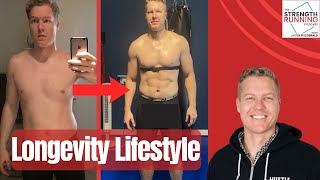
In this episode of the Strength Running Podcast, host Jason Fitzgerald interviews entrepreneur Sam Parr about his lifelong relationship with running, weightlifting, and health. Sam recounts his early years as a Division‑1 sprinter, his post‑college decline, and his recent resurgence through disciplined training, quarterly goal‑setting, and extensive coaching. He discusses injury prevention, the importance of consistent, high‑intensity work, and how tracking metrics (nutrition, weight, performance) fuels his progress. The conversation explores the parallels between athletic training and entrepreneurship—process orientation, incremental gains, and the psychological benefits of individual sport. Sam shares his "wellness stack" (coaches, nutritionist, apps, recovery tools, sleep tech) and his philosophy on nutrition, supplementation, and emerging longevity interventions such as GLP‑1 agonists and metformin. He also critiques the current focus on marathon training for the average adult, advocating for more short‑distance, high‑intensity events, and proposes a middle‑distance‑focused track meet for adults. Throughout, Sam emphasizes the value of hiring experts, embracing discomfort, and using fitness as a framework for personal and business growth.
Chapters
All right, Sam, welcome to the show. Glad you're here.
What's going on, man?
So, uh, you're definitely a unique guest for the Strength Running Podcast, but, uh, you ran cross-country and track when you were younger. You've since gotten into just incredible shape after not being in great shape, I think in your late 20s or so. Uh, so I think there's a lot to learn about why being fit helps you everywhere else and just bleeds into other areas of your life. But, uh, I want to hear more about you as a runner back when you were younger, because you were the only time that I've been able to talk about running like publicly, because you were not a slow runner, Sam. You were good.
Yeah, I was okay. I, I ran Division 1, so basically, uh, my brother was a cross-country 2-miler guy. He ran like 9:30 in the 2-mile, and so he was 6 years older than me. I thought I was going to be a distance runner, but I was always a little bit heavier. I was skinny, but I was just built different. And so my freshman year, I ran cross country. I ran like 18— I think I ran 18 flat. Uh, I might— I think I broke 18 in a 4-mile road race the winter after cross country. So I was okay. I think I went through the split in like 17:45. Um, and then that freshman year, I think I ran 4:42 in the mile and 2:04 or 6 or something in the 800. And I was like, all right, cool, maybe I could do this. And then I was like, let me try a 400. And I did good my freshman year. I think I ran 43. And I was like, let's do the 400. And then eventually I was like, well, let's do the 200 too. And so I graduated high school with like, I ran a little bit under 22 seconds for the 200. And then I ran, like, I didn't do that great my senior year in the 400. I think I only ran 50 point. But then college, but I ended, then I went to college and I ran Division I only for 1 or 2 years. And I didn't take it seriously. I partied way too much. And that's one of my big regrets. But I still broke 22-ish in the 200, and then I ran, like, I could, I was splitting 47s and 48s in the 400, but I think I had the potential to be like a 46 400-meter runner, but I never dedicated to the diet and to recovery. And so I'm like Uncle Rico in Napoleon Dynamite. I'm always like reliving like my high school days where I'm like, oh, I should have done it. I should have taken it seriously. But as a grown man in my 30s, in my 30s now, I, um, I ran 23 seconds in the 200 recently still. So I still train.
Yeah, that's, that's very hard to do. I think when you get into your 30s to try to touch some of the times that you ran when you were in your 20s, uh, but you know, look, it's, it's hard for anybody to be 100% dedicated to their sport when they're in college because college is fun. So, You have to have some fun when you're there too, right?
Yeah. I, I, my, my regret though is I wish I would have dedicated my time. I think I, for a while I was training to run under 50. I still have the speed to break 50. The problem is, is that my, I just get hurt and that's like the issue as you get older is injury and the difference I've noticed, I've been able to hang out with a bunch of Olympians and Leo Manzano, Josh Kerr, Meb Greflewski, all these guys. The difference between them and of other equally talented people is, uh, they don't get hurt as much. They're, they're able to just consistently train for a long time.
Yeah. And that's like the secret sauce, right? If you can consistently train without missing any time due to injuries or just laziness or your wacky schedule, whatever it might be, that's where all those gains really start compounding.
Um, yeah, like it makes a difference. Like, Some people, their biomechanics are just better than others. Like they're, they, they just have better genetics. And part of that genetic factor is like, they just don't get hurt. Like their Achilles, they never have Achilles issues or whatever other issues. And, uh, some people are just like, I think Nick Simmons is like that where he just doesn't have injuries. Um, and he doesn't have a body built for running, but he still could run 1:43 in the 800 because he doesn't get hurt and he could put the miles in.
Yeah, the Bison. That's his nickname because he does not look like a normal runner.
He looks like he does not, but he's the man. And he had a podcast with Nick Bare that I listened to that was awesome. And he's like, dude, I just don't— I don't get hurt for some reason. And Nick Bare is the same way. He just doesn't get hurt.
Yeah, it's pretty amazing because that is really almost like a superpower when it comes to running. You know, I was actually just having a conversation and I told someone I've only run 4 marathons, but every marathon I felt worse and worse afterward compared with the one before it. So me personally, my mechanics don't really work well for the marathon. It's just too hard for too long of a time period. And then afterwards my body's just starting to fall apart because it's so much pounding. Um, yeah, it sucks. Sam, I'm curious, like, like what your relationship was like to running back in the day, because it seems like you didn't really think of yourself as a distance runner because you very easily started running some of those shorter events like the, the 200 and the 400. You know, this doesn't seem like something you were just doing for fun after school. It seemed like you were really into it.
Yeah, I, I think I realized that I didn't have the potential to be an Olympian, but I still thought that like I could be, you know, if I— my looking back, I had the talent to be a 40 high 45, 46, 400-meter runner, and I never fulfilled my potential. But I was like, if I can do that, I'll be world-class in the sense of like 1% of the 1%. I'm not going to go to the Olympics, I'm not going to win a medal or anything like that, but I just wanted to be the best. And I think that what I loved about running in individual sports like swimming, running, weightlifting, boxing— not always boxing, but, uh, where a lot of these individual sports there's basically a very clear winner and there aren't too many politics that go into it. And it's just like the clock doesn't lie. The person who gets knocked out doesn't lie. The person who finished first, it's just, it is what it is. And I really admire those types of sports. And business is very similar to that where the numbers are the numbers. It's not like art necessarily where it's subjective and I really enjoy those sports. I also enjoy the pressure. So like I've run in a couple stadiums like in high school where there was thousands of people there. It was never like a football game where there was like tens of thousands, but there was thousands. And I just love, I love that pressure where you are on a starting line and it's you versus everyone else. And even if you win, you're going to suffer. And even if you lose, you're gonna suffer. And you know, that's one of the reasons I basically only pay attention to sports, UFC and track and field, because I love those, those things where it's like, these guys are gonna go through hell no matter what. And the best—
You might be the only person on the planet who's really into both UFC and track. They are so different as sports.
They're not, they're not. A lot of UFC guys are big, like for example, Paul Felder, who's this wonderful Felder, who's this great guy. Great UFC guy, he does triathlons and he is a professional, maybe a little bit. He's a master's professional triathlete. I mean, he'll break— I think he broke 6 hours and a half, which is pretty impressive, or maybe even faster. But like a lot of these guys can be pretty fast, these boxers and runners or these boxers and fighters, but they don't weigh, you know, 130 pounds necessarily like a good runner. But a lot of them are pretty fast. But it's a really similar mindset. And what's interesting is a lot of my friends are entrepreneurs. A lot of them were like, for example, Sahil's a buddy of mine who's a successful entrepreneur. He was like a baseball player in high school and college. And baseball players are typically the assholes of sports, right? They're the jocks who like are rude and they'll like call runners gay because they wear little shorts and stuff. And now he's like getting into running and he was like, this is the hardest sport on earth. Like, I can't believe I made fun of you guys. Like, this is so much harder than any sport there is. And I think there's a lot of high-caliber, highly successful people, and they appreciate running because of the suffering that you have to go through. And unless you're a genetic freak, there's basically no way to get better other than through, like, suffering for 2 hours a day or whatever it is.
Yeah, for sure. Have you heard that somewhat famous quote by University of Colorado cross-country coach Mark Wetmore?
And yeah, well, Running with the Buffaloes, one of my favorite books of all time.
There we go. It's from that book. And he says something to the effect of— I'm going to butcher this— but a football player goes into a game knowing that he's going to play football, but he's trying to not get hurt. But a distance runner knows they are going to experience hurt when they go and step out on the cross-country course. So it's not a matter of trying not to get hurt. It's just fully embracing that level of suffering. And that always was a great quote because it really just put into such a highlight of how difficult running is. And I'm glad that Sahil, maybe after 20 years, is finally giving runners the respect we deserve.
Yeah, well, it's in vogue now, and I think it's in— it's cool nowadays to be a runner because there's these guys who are doing combining weightlifting and running. And so like they're feeling like our primal need to like feel good by running. But also like to look good by weightlifting, like to look good naked and to feel good. Like that's like our primal instincts. And I appreciate how a lot of these like big jock macho guys are into running. And I think that that's like a really well-balanced life because there's a lot you can learn when you're hitting the miles every week all by yourself.
Yeah, there is a trend right now of entrepreneur-minded folks, business people who are getting into not just running, but really health and wellness and getting into great shape and really trying to optimize their body for feeling as good as possible. And you seem to be one of these people. I know you don't drink any alcohol, you stay in really good shape, and so it's just amazing seeing all these people really commit to this lifestyle. What is it about both business and entrepreneurship and staying in great shape? What is that relationship? Because These people are really going hardcore in both arenas, and I love seeing it.
So there's a few things. The thing that motivates me most and what I— the reason I like weightlifting, right? I always love running, but weightlifting, I've been seriously weightlifting for 3 years now, and I'm really into it. And I think that it's kind of the same thing, which is Business. A lot of people don't look at business this way, but it's the same thing. So like last year, my goal was to squat 420 pounds. So how do you squat 420 pounds? Well, you have to squat a lot or bench 300 pounds. You have to bench a lot. And usually the best way to do that is you do like, let's say, 3 to 4 sets per session of bench pressing at 5 repetitions. You do that 3 days a week. You make sure you eat 200 grams of protein and you do that. In my case, it took me about a year and a half. Other people, it might take 6 months. Other people might take 5 years. But you do the same thing with progressively getting harder each week and you do it for years. And I don't know for a fact that I'm going to be able to, to hit my goal, but I know I'm going to be in the ballpark. And in a lot of ways, it's the same thing with business, which is I know that if I make this many sales calls, I'm going to get something. I think I'll convert 3% of people. I'm not sure, but I think that if I do that and then I think if I do that for 15 years, I'm going to hit my desired outcome or be in that ballpark. And I think that once you learn that business is the same way, or at least if you have taste with business, you're like, oh wow, like practice works, putting in effort works. And then the awesome thing about working out is it's very It's very, uh, like there's no way to do it other than just by following your routine, doing this and doing it for decades. And then I think you get like ballpark results. And so I think it's really addicting. I think that once you figure out how to manipulate your body, you feel invincible. Um, and it's a drug and it's a high, no different than making money. And so I think that is like a really big component.
You know, I found, especially with running, is that I felt like I was building something. As a runner. I was building my fitness level. I was building my capability to complete a certain performance, whether it was a certain time or to be able to go run 20 miles. And I feel like business is very similar where being process-oriented is really going to give you a very big advantage because you don't know if your business is going to work out or not. You just know, okay, I've got this process. I'm going to, you know, stick to what I think is going to be what works the best and essentially commit to best practices.
You know, yeah, you control the input. I can only control the input and I just have to hope that this machine is good enough and I'll continue working on the machine to make sure that the input gives the desired output. But I have to give it the proper input. And once you start seeing results, both in business and working out, it's a high because it feels like you can kick your dent in the world. And that is a very addicting feeling to feel that you have power and control over things that most people don't.
You know, the first year I started running, I ran a PR in pretty much every race that I ran, just because, you know, I was a new runner and that's what happens when you're new.
What's your PR in the marathon? 2:39?
Yeah, 2:39. That wasn't in my first year, of course. But I found that the— almost the addiction I got from running was something that got me permanently hooked on the sport. And, and then when I got older, it was a little bit similar with, you know, starting Strength Running, my business. And it was, oh, getting a little bit of traction here and there and growing and committing to that process. And it was really exciting in exactly the same way that running was. And so I've always seen extraordinarily, uh, extraordinary parallels between both running and starting a business.
Yeah, and also it's lonely. Both are very lonely, and it's like, and it's like constant inner battles. Um, and so I think that I, I wish I had played some more team sports because I never did team sports, and I wish I had a little bit more— I had learned how to cooperate with one another. But being an entrepreneur is ultimately a, a, a single participant sport, and I think running is definitely prepares you for that. Like those things where you can't rely on anyone else. Um, and it's really lonely. Um, and I think that it's really nice to be comfortable being lonely.
Yeah. You know, it's funny because in hindsight, through this podcast, I've had all these really interesting conversations with, you know, all the people that might be around an elite runner, you know, the strength coach, the running coach, the sports psychologist, uh, the physical therapist, all the people who might help an athlete operate at the highest levels. And, you know, it's interesting to me because hearing from all these subject matter experts about kind of the benefits you get from being a distance runner, I didn't know this going into it, but I'm like, oh wow, building all of this self-efficacy and confidence, uh, learning how to commit to the process. And all these things really taught me that running and, and these kinds of individual sports are such a great preparation for not just starting a company, but, you know, being a dad, being, uh, you know, successful in, in just a normal job if you have one, because you're learning so many skills from running that transfer to almost everything else in your life.
Yeah, it's, it's badass. And, you know, uh, A whole bunch of my friends are former elite athletes. Do you know a guy named Nick Huber on Twitter? He's Sweaty Startup.
Yeah, I'm familiar with him.
So, a lot of people don't know this, but Nick was actually an All-American decathlete, Division I, and he got 9th at USA Nationals in the decathlon. Look at that. He was like, what's that, 6 spots away from going to the Olympics, and he's a freak. He doesn't look like it, you know, and I don't look like it either, but he's a, he's, he's a, he's a, he's a, he's an athlete. And, uh, him and I nerd out all the time on like the similarities of track and field and doing what we do now.
I'm curious, Sam, like how you went from being a pretty good college athlete, cause then I know you spent some time post-collegiately not really staying in shape and kind of letting yourself get out of shape.
What was the—
what was going on there during that time in your life?
So basically in college I was balancing partying and running, and then I quit balancing that and I only partied, and I developed a drinking problem. And for about 4 years I was like basically close to a homeless— close to being a homeless like loser. And I was probably— I think I did a DEXA scan. I was like 27% body fat, 220, and I was just lumpy looking and my body was depleted. And then I met my now wife. You know, we were dating at the time. And back then when I was a runner, I grew up in Missouri. Nutrition wasn't— so I quit drinking. I was like, I got to quit drinking. And I substituted drinking with eating candy. Which at the time my doctors were like, that's not like the way to go, but whatever. And it's like, we'll just trade a really bad thing for a less bad thing and then we'll figure out how to address it after a little while. And so I got fat and I met my wife and she was like, hey, you shouldn't eat that. That has like all this processed food or like, you know, you're eating a ton of carbs and you're like not eating any protein. And I was like, what the hell is a carb? Like, I thought like, I don't know, like, or what does processed mean? Like, I thought that like, if this says low fat, that means it's good for you. And she kind of taught me a lot about nutrition. And then once we started like getting hot and heavy and like, I was like, I'm going to marry this woman. I was like, I feel like an urge, like to be a man. And like, I'm not holding up my end of the bargain by being a slob. Like, you know, you're this beautiful woman and you're doing your half of the you're doing your half of the marriage by motivating me and supporting me and like being wonderful. And I'm not doing my half by like being able to protect you or being able to like work hard in the gym. And I feel like a slob for that reason. And so I got really motivated because of her to like get back into it. And I also like had this deep regret of all these missed times that I didn't like apply myself physically as a kid and fulfill my potential. And I was like, if I don't start now, I'm like just going to regret this forever. And so I wanted to become as elite of an athlete as I could as like a weekend warrior. And so I got really into weightlifting and then I hired a coach and I got super into it. And then I hired this thing called My Body Tutor. It's a basically a nutritionist that calls me daily or weekly depending on which plan I'm doing at the time. And they taught me all about that and about nutrition and creating a plan. And I got addicted to the fact that like I created a goal and every week I could see results. And then after like 4 months I was like, wow, I look like a totally different person. I got addicted to that and I got super addicted to like seeing my bench or squat like go up every week. And I was like, this is like the best feeling on earth. And so I got super into weightlifting and, and I still run. I just have to— when I run, I either sprint. So like, for example, last quarter I did an NFL Combine, so I was doing a lot of 40-yard dash running. Or I'll do 200-meter repeats, or I'll just do really, really slow hour runs, like 10 or 11-minute miles. And I just got addicted to like doing that. But I was like disgusting for a while. If you look at old photos, you could probably Google me and find old photos. It was messed up.
Let me go off on a little tangent here. It sounds like you're really into tracking things. Is that right? From weightlifting numbers to your running times to nutrition to your weight?
I track everything. I like looking at my personal finances like crazy. I'm super into— I'm into tracking. But really what I'm into is goal setting and achieving goals. And I'm super dedicated to setting, whether it's weekly, monthly, quarterly, annual goals, and being relentless about hitting them.
Tell me a little bit about these quarterly fitness goals that you have, because I think it's fascinating that you set a goal that was like, I'm gonna compete at the NFL Combine at the end of this quarter. So let me train for all the different things they test for. What was the thinking there? Were you just like, I wanna look like a, you know, potentially professional looking football player?
Well, a lot of it's rooted in like, you know, as a sprinter particularly, I was always made fun of as like the only white guy. And so like, or like nowadays I'm like a tech nerd. So people are like, oh, you're not athletic. And I'm like, No, I'm gonna prove to you I can, I'm gonna blow your expectations out the water. So a lot of it's like a chip on the shoulder, but I just, I think that goal setting and achieving goals is about building momentum and momentum is the key to like any type of success in any endeavor, business, relationships, whatever, fitness. And so I just get addicted to that and having like, I like having a beginning and a middle and an end because I like seeing the progress. And so usually I'm not doing it right now because I just had a baby. And so I guess my quarterly goal was just do the minimum amount of work to maintain while spending time with her. But typically every quarter I set a goal. So a few quarters ago I wanted to bench 330 and squat 420. And so I worked really hard for a quarter. I was already like weightlifting to do that. And then a quarter after it was like, all right, I want to do like bodybuilding training to see like how good I can look and how low my body fat can get. And then the next quarter it was, I want to score average for the NFL Combine for a wide receiver in the 40, vert, broad jump, and bench press. I previously had quarters where I was like, I'm just going to complete an Ironman, or it was a half Ironman, and I wanted to break what's like the threshold of like, I think it was 7 hours, which isn't particularly— was it 6 hours? I forget what it was. It wasn't particularly good, but it was good for me. Or I want to break 23 seconds in the 200-meter. Like, I set a goal every quarter and I set my training where I work backwards, where I'm like, all right, in order to be there on this date, that means a month prior I should be around this area, and the month before that I should be around this area. And I'm like pretty fanatical about like achieving that.
I love it. I love it. This is the kind of fitness nerdery that I just love geeking out on. Um, yeah, so I, I'd love to hear more about like your, your wellness stack, for lack of a better phrase, like the things that you use to keep yourself on track these days, you know, anything from coaches to recovery tools, particular equipment, you know, like how does Sam Parr stay in shape with all of the options out there? And, and what do you think is the most effective at, at keeping you on track with these goals?
So I have a gym that I go to. It's a little small private gym. There's not many people that go there. It's not like— it kind of looks like a CrossFit gym a little bit, but it's just weightlifting and fitness and stuff like that. But anyway, they, they— I have a coach there and he does my programming and he's the one we work together. It's called Central Athlete. My coach is Jesse and we just work backwards from whichever goal we want to achieve that quarter. And we use TrueCoach where I track my weightlifting. Or rowing or whatever it is. Sometimes my goal might be like break 7 minutes in the 200-meter row. And so we track all of it there. And then I use My Body Tutor, which is my nutritionist. My, my Essential Athlete bill, it's expensive. It's like $450 a month. And then I pay like $300 a month for My Body Tutor. And then I follow, like, if you look at my Instagram, it's basically just runners and like buff dudes because I believe that like—
Is your wife mad about this, Sam?
Yeah. She's like, she thinks I'm looking at hot girls and I'm like, no, if it's just shirtless ripped guys. Because I think that like, what's that phrase? You're the average of the 5 people you spend time around most. I think it's the average of the people whose content you consume. So I have a lot of that. I eat tons of meat and vegetables. I try my hardest not to eat a lot of processed foods, but I do drink Coke Zero a lot, and I try to avoid sugars most every day. I weightlift 4 days a week, typically. When I'm traveling, I have bands that I travel with. If I'm driving on a road trip, I always pull over on the side of the road at a truck stop, and I do bodyweight workouts. I use this app called Aptiv, and I like to do 6 60-minute bodyweight workouts or with bands.
So you're doing workouts like at a rest stop somewhere on the highway?
Yeah, all the time. I'll always do that.
I did a cross-country road trip 2 years ago in a Tesla and I was doing kettlebell swings at Supercharging stations.
Like, yeah, I do that stuff all the time and people are like, push-ups.
This is the craziest guy I've ever seen in my life.
No, it's awesome. Like, I usually plan, so like, I only stay at hotels or Airbnbs that have spaces to work out. So like, that's like a big part of my wife and I's kind of value system. What else is my stack? I have an Eight Sleep mattress, so I do a pretty good job of sleeping 8 hours a night. I drink a shit ton of protein powders. The experts would probably say it's best to eat your protein. But I don't really like eating a ton of meat. And so I drink either BPN Momentus or Ascent protein, depending on the flavor and the mood that I'm in. I do just water and protein powder. Usually I try to get 200 grams. I track everything. All of my diet is tracked on MyFitnessPal. Every calorie I consume, it's in there and it's been in there for, for years. What else for fitness? I don't listen to audiobooks or podcasts when I work out. I have no idea how people do that. That's so weird to me. I've got a bunch of friends who do it and I think they're serial killers.
Well, you did just recently say one of your friends, like, ran up like a PR in some race and they are not a slow person and they were listening to like a self-help book on tape.
Yeah. Nick Baier ran 2:39 while listening to like a self-help— I'm like, what are you— Freaking weird. What are you doing? Just like, that's like—
I couldn't imagine that.
It's like insane to me. I don't know what else is in people's stack. I stretch like crazy. My Achilles hurts all the time, so I'm always doing stuff for Achilles. And so I have these things for my calves, like it's like one of those braces that holds your calves like straight up for like an hour a day. I use that all the time because I have chronically tight calves. I've got a cold plunge. I cold plunge in the AM, so I pull punch this morning. I usually work out in the afternoon. I prefer working out in the afternoon. I think people who work out super early in the morning are serial killers. There's nothing more that I hate. Like, there's nothing more that makes me more sick to my stomach than like the air at 6:00 AM. Like, it's insane to me. It's really hard for me to do that. I'd rather run at 10:00 PM all day. I don't know what else. I wear Hokas, but I'm switching. I just— I'm trying out the new Is it Saucony's? Saucony's, uh, because they've got a wider toe box. And, uh, I subscribe to FlowTrack and I, and I don't know what else could I say. I go to Let's Run every day. I've been quote of the day twice actually on letsrun.com.
Oh wow, that's either a good thing or, or not a good thing.
They were both good things. One time, um, we did a beer mile in college and we had a thrower who was 6'6", like 250 pounds, breaks 7 minutes. And I made a video of it and we got on the quote of the day. And then another time I found Bob Kennedy's famous Atlanta Mile 5K where he broke 13 minutes for the first time and no one could find the video. And I did my internet sleuthing years ago and I found it and I made it on the front page of Let's Run.
Oh, wow. So you're a beer miler. We should have done a whole episode on the beer.
I was. But another thing that I like about running, I like collecting old spikes. So like, remember the Jasaris?
Mm-hmm.
So I got some old Jasaris that I've saved and I'm trying to like collect more old track and field memorabilia.
I mean, I have bought spikes just to have them, to never wear them just because they are awesome and they're iconic. I think I bought the Nike Myler spikes back in like 2004 when they were a certain style. So yeah, my track and field nerdery knows no bounds.
I can't wear spikes anymore. It hurts my calves too much, but I'll wear racing flats instead.
Well, for your Achilles, Sam, have you done any eccentric heel drops? Those are—
Constantly. Constantly? Constantly. I do those all the time. I've just got Achilles tendonitis like crazy. I'm doing— I'm trying BP-157, I believe it's called. It's a peptide that you inject. I'm trying that. I do everything. I've gotten MRIs. I do the Achilles drops. I'm doing everything. I think it's just a chronic tight calf thing.
Hmm. Well, you've surrounded yourself by a lot of different coaches and experts who can hopefully help you with that.
I do needling. I do massages. I go to Stretch Lab. Man, I do it all. I just, I think this is kind of like where I've realized that like, I think that it's, um, I think that, um, we want to believe and be optimist— that an optimistic person and think that like everything's possible. And like some people just don't have what it takes. And when it comes to injury prevention, I do not have what it takes. I am not built like a machine.
It's like that, it's like that Louis C.K. joke where he just goes to the doctor and the doctor's like, oh well, you just have a bad knee now, this is your life. And he's like, oh, that This is getting old. Okay.
That's how it feels like. But I've got other things like I can wake up out of bed and I could squat 400 pounds. Like, that's always come easy for me. So I, you know, I got to— you got to— you pick and choose your strengths or you don't pick and choose, but you— I follow my strengths.
Yeah. You know, Sam, one thing I've always been an admirer of yours for is the fact that you don't seem to shy away from hiring a coach, whether it's a strength coach, a triathlon coach, a nutrition coach. You seem to go out of your way to hire experts to help you with any of these goals that you have.
Constantly, with everything.
Do you do this in business too? Like, I'm just curious, like, what your perspective is on coaching and just getting that kind of outside feedback to help shorten that, that learning loop.
Well, I had a CEO coach for a long time. I also own a company called Hampton, which is sort of like business group therapy for entrepreneurs. So it's like 8 people in a group talking about issues that they have. And so, and I've hired, like if I want to, like for example, I last year my obsession was boxing, so I hired a boxing coach. Yeah, I hire coaches for everything. So anything I want to get done, I think that it serves two parts. One, it holds me accountable. So if I'm spending a lot of money on something, I'm more likely to appreciate it and work harder on it. And number 2, I don't want— I'm not trying to be the best at coming up with what workouts I should do. I'm trying to be the best at executing what I'm told to do. I don't want to spend money or spend my time thinking about what to do. So for example, I had a personal chef for a long time. Now I have— I do like meal kit stuff because I'm like, I don't want to think about what to eat. I just want to execute on the plan that I've created. And but, you know, rather I created with someone. And so like, I think that coaches are great for fitness and business because a lot of times people were soft and we think, you know, if I told you to do 400-meter repeats, I told you to hit 70 seconds, you probably would've thought that you could only do 75. It's like, no dude, I've told you to hit 70 because I think that's what you, what you're capable of doing and you need that push. And that builds a lot of confidence. And I'm not trying to like, I don't know how people make their own programming. I mean, and there's a reason why like There's close to no runners out there who are coachless that are good. There might be a few, but that's not normal.
Yeah. Even the best runners in the world are hiring coaches, uh, when they know what they pretty much should be doing on a day-to-day basis. And I think a big part of it is exactly what you were saying. It's reducing the cognitive load on yourself so that you can just go and execute. You don't have to worry about anything.
Yeah. I'm not trying to. I'm not trying to like, like, like, like, you know, if you do a sport for a long time, you understand the mechanics of it and you understand what works. But like a lot of athletes or people who are just like me who just wanna be a life athlete and just like in good shape, like I don't, I don't need to know why certain things work or I don't need to know that. I can just pay someone a very small fee and they could just tell me what to do. I don't need to necessarily be educated, although I get educated. I don't need to do that. I'm just gonna do exactly what I'm told to do. I'm going to try to be a machine about it. There's this amazing book that I've collected that it's hard to find now. It's called Train Hard, Win Easy: The Kenyan Way.
Oh yeah, I'm familiar with that.
Yeah. And I remember reading that as a kid and I remember thinking like, these Kenyans, they're like machines. They're like greyhounds, like before— they're like greyhounds in the gate before a race. Like in my head when I read that, I was like, they don't like, they don't necessarily have fear. They're just like, I'm going to run this fast for these first few laps and hopefully I can sustain that and then I'm just going to win. And because I remember being a headcase about track and field and I was like, I need some inspiration. So I read about the Kenyans and I'm like, you just have to be a machine to where like there is no emotions about this. You are just being, you are just doing what you are told. And I was really inspired by that book.
Yeah. I always found that that was something I could sort of get into the mindset of only deep into a season. It's like you need immersion for that to be totally, almost like fearless when it comes to racing. So it's this one of those things where, you know, let's say you're pitching your startup. If you're pitching it 3 times a day, by week 3, you're probably not going to be as nervous as week 1. And it's the same thing with. With running races. You know, when you're running 1 or 2 races a week, like you do in high school and sometimes in college, you just sort of get hardened to the fact that it's a very difficult thing that you're about to do. Probably a good side note of one of the amazing benefits of running is that you just view all of these very difficult tasks as not actually very difficult. And it's something that you can believe you can do.
And that's why I like boxing as well. Have you ever boxed or fought or any type of, Jiu-Jitsu or anything?
I had a hanging bag in my garage once. Does that count?
No, you like— all right, so I got really into boxing last year and I was training for a match, and then my wife like begged me one day when I got hurt. She's like, please stop doing this. So I kind of quit doing it. Um, but like, I've become friend— friendly with a bunch of UFC fighters because they listen to my pod. And like, you know, running is like a 6 out of 10, and then fighting would be a 10 out of 10 because you're in your underwear, you're gonna fight to the death in front of a million people. That's insane. That's crazy. And I love hearing about how they deal with that. I mean, that is like, um, that is a, you are a gladiator. You, that's the modern day gladiator. And I love hearing that. And so like how they, how they manage that stress. And when I hear about that, I was like, oh wow, my job is easy. And so I got into boxing and I would go in sparring sessions and some of the sparring, it'd be like, hey, let's, go at like an 8 out of 10. Let's like not hurt each other, but like we'll try to put each other on our knees by hitting each other really hard in the stomach, but kind of easier on the face. But I'm not like a tough guy, and there was days where I got my ass kicked, and I would have a bloody nose. And one time I kind of got knocked out a little bit, and, uh, which you're not supposed to be doing in sparring, but things happen. And I remember doing that in the morning, and I remember thinking I either kick someone's ass or I just got my ass kicked. Now I just have to go and make some business decisions. That's so much easier. Like, life is— the volume of life just got turned down drastically because I know, like, it could be a lot worse. And to some degree, you get that with exercise.
Yeah, I think that's probably why we're seeing so many business folks get into some of these sports, you know, like triathlon and marathons.
And who's a business guy that's doing triathlon?
Um, let's see. That's a good question. Uh, Nick Bare used to do triathlon before he got—
Dude, he was good.
He was really good. I mean, he's, he's a good runner. He's very—
He's a great runner. Like you want to hear, you want to hear a funny— I want to hear about who you've hung out with, but I'm going to like, I'll name drop a little bit because I have a crazy story. So I, um, Howie Greflewski. So he is a guy who listens to the pod and I become friendly with him. Howie's brother is Meb. Meghul Fleshy, the guy who, um, silver medalist in the marathon, former American record holder before Ryan Hall. So Howie owns an agency where he manages a whole bunch of runners, and I'm lucky enough where every once in a while he'll invite me to some of the dinners with the runners. And I got to meet, um, Leo Manzano, Trey Hardy, Matthew Boling, and then one time I got to hang out with Josh Kerr. Josh Kerr got gold in the World Championships in the mile. And Josh told me, he goes, when I was 17, I came over to America, I think from Scotland, somewhere in the UK, and I wasn't used to fast food being open 24 hours a day. And he goes, I got fat. And when I was 17, I weighed 200 pounds. But he's like a freak. And so he said, um, he goes, I was still training, but I was fat. And I broke 4 minutes in the mile that indoor season when I weighed 199 or 200 pounds. He goes, I think I've got the world record for the heaviest sub-4 mile. And he's like, and so I love being around these runners and just hearing stories about like Trey Hardy, who's a freak. And he's like, yeah, I hung out with all, you know, Justin Gatlin, all these guys and like small things. Like we'd be walking around and be like, hey, I bet you I could touch the top of that ceiling. And they jump like, you know, 3.5 feet in the air. Who have you been able to hang out with that's inspired you? Um, because they're freak athletes or freaks at working hard.
Yeah. You know, the interesting thing about living in Denver where I live and I go up to Boulder all the time and go on, you know, group runs and, um, you know, runs with all kinds of different people is that almost everyone here is like, it feels like is either an elite athlete or a sub-elite athlete. And so, you know, I'll be running with someone who is not an Olympian. They are not a professional runner. And they're telling me how, you know, they're running 130 miles a week. So I just love hearing those kinds of stories where people are doing just insane things on a regular basis, like running almost 20 miles a day or, you know, just competing at levels that are just insane to me. You know, there's clubs here in Boulder that are not professional running groups that you can't be a part of unless you can run under 2:35 in the marathon.
So crazy.
I, I've surrounded myself with these people who are not pros, but, you know, compared to the general population, they are just absolute genetic freaks when it comes to their abilities.
One thing in running that is not popular, but I think it should be way more popular. So a lot of people run marathons because because they think it's good for them. And in some cases it could be great. Some cases it could not be. And they also do it because it's easy to plan for, meaning there's lots of training, there's lots of coaches, and there's lots of races. One thing that has always bothered me is that there aren't more 200, 400, 800-mile races. Me too. And the reason that bothers me is because I think for the average Joe, I understand if you run a marathon because you're passionate about it, cool. There's a whole bunch of people there. But if you are running because you just want to feel good and look good, I think that preparing for a 400-meter race would be significantly better for you. Maybe for the average Joe, like if you're in your 40s, it would be like just break 60 seconds or something like that, which isn't a sprint. That's a, that's a fast run for most everyone. That, I mean, that's not even at all a sprint. But that would require doing some 100 meters, some 200-meter repeats. It would require doing aerobic stuff as well. So you would do, you could do like 3 and 4-mile runs. I always thought that like between the 30 and the minute and 30 timeframe for a race should be way more important than marathon running in terms of general health and wellness for the average person. And that's always bothered me why that's been a thing. It's not a thing because in order to do some of that training, you need a coach. There aren't a lot of people who coach that stuff. You need a race. There aren't many races and oftentimes you need a track. Um, and that's not accessible for most everyone, but I, do you agree that like the 400-ish to 800-ish should be like a thing that the average Joe trains for rather than the marathon for many people?
This is also probably gonna be an unpopular opinion, but I do completely agree with you. Um, I, I think. If we're talking about general health, which is not something I usually talk about on this show, this is a running podcast. Uh, I am such a, a glutton for this sport. I love it, but we have to separate the sport from general health, longevity, and those kinds of things. And so if we're talking about just, can you be the healthiest version of yourself? I would say, yeah, train a little bit more like Sam Parr, do the short and fast stuff. Lift more weight.
And it's not even that fast, by the way. A 60-second 400-meter is not fast. That's like, that's not a sprint for basically anyone.
Yeah, I mean, it's 4-minute mile pace, but it's only for a quarter mile. So, right, it's— I think if you're in your 40s, it might be challenging, but nevertheless, it's directionally the, the path that you want to take. It's in the right direction because it's much more VO2 max and strength and power oriented, where If you're training for marathons, it's just almost entirely this endurance equation.
Like zone 2. Yeah.
Yeah. You're doing a lot of zone 2, you know, even going up to zone 3.
And in order to be great at it, you don't want, you want, I mean, in order to be great at marathoning, which is not what most people's goal is, they just want to get better than where they are. You don't want to have muscle, you know, or at least you don't want a lot of muscle. You want to be, it's all about being lean and as light as possible. But I've all— that's always bothered me that, um, there weren't more outlets for people who wanted to do shorter distances. Every once in a while you'll see a road mile. That's awesome. Um, but you'll never see 200, 400, 800 races. And I've always been annoyed with that. I wish that there was an opportunity there to make that a thing.
I've been talking to some friends about potentially putting on an all-comers track meet where it's a middle distance focused track meet. Yes, maybe we'll have the 5,000 meters, but besides that, it's gonna be the mile, the 800, the 400, maybe we'll do some relays and get back to that. But that I think is really fun. And like you said, there just aren't that many opportunities for adults to compete in track meets like that.
I think I read some crazy stat. I didn't see their citation, so I don't know if it's truth, but it was something like, Someone was saying that like 95% of adults above the age of 30 will never run at full speed ever again.
I was just talking about this with a friend of mine. Yeah, almost everyone will never sprint again past the age of 30.
Yeah, and I was like, that's insane. That's insane. I think I've got this buddy, his name's Scott Galloway. He's like a popular podcaster and this great business person. And he told me, or he said on his podcast that he goes, my goal in exercise is to either to be able to kill and eat most everyone in a room or be able to outrun them. And I was like, I'm on board with that. That's the way to go. That's a real primal way of looking at it. And I appreciate that. And in order to do that, you got to know how to run far, but you also got to know how to run fast. And so I've always— it's always bothered me that running fast was not part of like— wasn't much of an option for non-competitive adults.
Well, this has got me thinking about more, more about general health and longevity. And I know longevity is sort of having a moment right now. I don't know if you were able to read Outlive by Peter Attia, which was a bestseller.
I haven't read the whole thing, but I read his blog a lot. And so I kind of have an idea.
Yeah. And so I read this a couple of months ago and I loved it. First of all, I think it was just really fascinating look at if your goal is to be as healthy as possible, for as long as possible, this is a really good blueprint for that. But one of the things that I was heartened to learn coming from a running background is if you were to basically boil down the whole thesis of his book is that you are going to decline physically as you get older. And if we can figure out the rate of decline, we can help you work backwards and get into good shape now so that your decline isn't as steep. One of the things that I loved was the fact that we're all declining from different points, right? And if you're— the point at which you start declining is really high, you have a big advantage. And so coming from a running background, if you start with a big high VO2 max, you are at an enormous advantage compared with someone who's just starting to get back into shape in your 40s. So that was like a big pat on the back as a runner. I was like, oh, this is great. But then it got me thinking, like, how do we modify our training now that, you know, I just turned 40 a couple months ago. How do I modify my training now? Because, you know, I'm probably not going to run the personal bests I did in my mid-20s in my 40s. And I'm curious, Sam, what you're thinking about in terms of fitness and your nutrition and health from a longevity perspective. Are you thinking— are you taking on any challenges that are a little bit more oriented towards you know, 50, 60-year-old Sam?
Oh yeah, yeah, yeah. I mean, longevity is like one of the main things that I, I joke with my wife. I go, uh, I want to feel good, look good naked, and be able to live to 130. Like, that's like the whole training thing. Um, and so that's one of the reasons why I like weightlifting. I think that, um, I think there's a strong correlation between how you feel when you're 80 and how how strong you are muscular, like in terms of your muscles, basically just from a very simple perspective of if you fall down, will your bones not break and will you be able to stand up? And weightlifting makes that stuff easier. You don't need— you don't have to be able to bench and squat crazy amounts of weight, but just can you like do pull-ups and push-ups and make your bones stronger? So that's one of the reasons why I like weightlifting. One, so, and I do lots of stretching, so like I'm crazy about mobility, so I'm stretching constantly. And then one of the reasons why I got super into avoiding processed foods, although you can see I'm drinking a Coke Zero, so I don't like follow that like religiously. I'm not trying to be perfect. I'm just trying to be mostly good. Like I'm pretty adamant about staying away from mostly hyper-processed foods. It freaks me out. So I try to basically only eat stuff that was alive or grew from the earth. So I'm really into that. In terms of— there's a few pharmaceuticals that I've always been fascinated by, and it's a really controversial topic because they're not proven at the moment, and it's— we're basically guinea pigs. But like the GLP, the blood— was it the blood glucose limiters? So like Ozempic, and I think the drug is called semaglutide. It's basically was used for diabetics and now it's a lot of people are using it to lose weight. But there's other things around that that are related to that, like metformin and basically these drugs that make your blood glucose limit, not spike, because I believe there's a direct correlation between the quantity as well as the quality. So how big the blood spikes are and how often they happen. There's a correlation between your blood sugar and how long you live, and you don't want that spike to happen a lot. So I've invested in a company called Levels, which tracks, um, um, your blood. And I think that some of those, some of those drugs, the verdict's still out. I'm not like saying that they're like the answer. Um, they could definitely end up being horrible for you, and we're going to figure that out in the next few decades. But I'm really fascinated by some of those drugs that could help limit your, your blood because The answer is definitely like eat healthy foods and like walk and exercise. But like in America, that's quite hard to avoid blood spiking foods constantly. And we do sit down a lot for our jobs. And so I'm always interested in supplementing and if those drugs can actually make people live longer. I'm very fascinated if that's going to be the case. I know a lot of like billionaires are taking metformin and drugs like that, thinking it'll make them live longer. So I'm super fascinated about that. What about— what about— what else for longevity?
I'm curious if you do any like other testing services, like to figure out, you know, if anything is outside of your normal range. Do you think like that too?
Yeah, I test my blood all the time. I do. I use InsideTracker, which is pretty awesome.
Former sponsor of the show.
Yeah, I like Inside Tracker a lot. What's his name? Bryan Johnson, you know, who's kind of controversial because he's an oddball, but I think he's mostly awesome. I think he's awesome as a person, but he has this thing called the Rejuvenation Olympics where you can get your blood tested and it looks at your— I'm not into biology, but I believe it's called— what's it called? The micro— what's— there's like a thing in your body where you could tell by how long they are and that predicts how long you'll live. Your micro telomeres. Yeah, yeah, yeah. Okay. And I don't know if that's proven, by the way. It's just like a hypothesis, I believe. And so I test those all the time to try to decrease my rate of aging. And right now I'm doing really well. What I'm— what else? Am I doing? I mean, I feel like if you just like basically eat— like, I try to order meat from a local ranch here, and then like you eat food that like is local and vegetables that are local, which means they're not processed, or they're processed way less in order to ship. If you do that and you walk 10,000 steps a day, you're almost like 90% there.
Yeah, I think you're right. Um, one of the things that I learned from Peter's book Outlive was that, um, you know, if you're going to be a runner and you're interested in longevity, you've got to prioritize the weightlifting too, because the weightlifting helps counteract a lot of the catabolic effects of—
well, haven't you seen Ryan Hall? Have you heard of it?
Yeah.
Um, and you should— I mean, I'm sure you've seen what he said, which is He's like, I basically, in order to be elite at anything, that means you should only be good at that thing and you're okay sucking at everything else like that. And that's the case with everything. If you're going to be the best business person in the world, very likely you're going to avoid your health and/or your family and/or other things like that's just how it is. Like we only have so many hours in the day. With Ryan, he weighed 130 at 6 foot tall. I forget how, how tall he is. He was super light. His testosterone dropped like crazy. He said he got sick and he felt horrible all the time, but he ran 2:06. I forget what— whatever he ran like, he's a freak. And with fancy cars, I've got a fast car. If it's fast, it don't last. That's usually how it works. The better performing something is oftentimes the lower the likelihood that it's going to last a long time. And so he was like, I felt horrible, so I quit. And now I lift weights and I'm like this strong guy and I look amazing. And he's like, I feel 1,000 times better now versus then, even though then I was the best in the world and I was happy to do that because I wanted to be the best. But in order just on my day-to-day life, this feels way better. And Nick Bare— Nick Bare is a popular fitness influencer, entrepreneur. He weighed 200 or 198, 195 when he ran 2:39 in the marathon. And he's like this big bodybuilder looking guy. And he was like, man, when I ran that marathon, I cut weight in advance and I quit weightlifting and I cut my calories and I performed well. I felt horrible. I feel so much better weighing like 205 and lifting more and running only 30 miles a week as opposed to 60 or 70 miles a week. And so I think that like the same way that the jocks would make fun of us cross-country runners, the cross-country runners would make fun of the people lifting weights. The reality is, is the answer is in the middle. Uh, like you want to be well-rounded if your intention is to just be a healthy human being as opposed to being an elite athlete.
Yeah. You know, I, I was thinking, I think a lot about Ryan Hall because I think he's done things to an extreme in both his professional running career and then his post-collegiate or his post professional career. And I'm glad that in the years since we have learned that you can't just ignore weightlifting, even if you're an elite level marathoner. And so a lot, you should be, you'd be surprised. A lot of very, very good marathoners now do a lot of weightlifting, not necessarily to build muscle. So they're still gonna, you know, essentially look like me, but they are going to be very strong compared to their body size.
Yeah. Yeah. Yeah. And strong bones. Yeah. I mean, weightlifting, with weightlifting, that it makes your bone density increase. Like your bones get stronger. Yeah.
Which is probably a reason for anybody to try it if they haven't. I know whenever you're talking to a group of runners, we'd rather log a couple miles than spend another couple minutes in the weight room. But I think the benefits are so clear that we just have to.
And what runners in particular hate at least from my experience growing up with cross-country runners, is they hate heavy lifting. And when I say heavy, I don't mean the weight. I just mean whatever you can do, but only for 5 repetitions. So like a lot of runners will do like 30 repetitions of something and I want to be like, no, no, no, you should put like enough weight on there that you can only do 5 and you do that for 3 or 4 sets and you'll get way stronger because they would say, well, if I lift heavy, I'm going to build more muscle. It's actually the opposite. If you do 10 repetitions or 15 repetitions, oftentimes you'll build bigger mass. But if you do 4, 3, 5 reps, you'll get way stronger. And oftentimes you can— for— it depends, but you can stay of similar size and you just get stronger. Um, and so I think that runners should lift more in the 3, 4, 5 range and really have high intensity. Lifts as opposed to doing this, like, you know, like when you're in high school, your cross-country coach tells you to do like running arms, like holding like dumbbells. It's like, dude, no, screw that. Like, lift heavy.
Sam, you have just affirmed everything I've been saying on this podcast for like the last 5 years.
So have you been saying to lift heavy?
Yes. It's so important for runners.
Yes, they have to lift heavy. And of course, whenever I say heavy, they're like, I can't put 300 pounds on my back. I'm like, no, that's not what heavy means. Heavy means just whatever. Whatever it's hard for you, but for 5 times. And it should feel like in most cases an 8 or a 9 out of 10. Like you should lift as if you can do maybe one more, like you leave one in the tank, but your 5th rep, you barely can do one more left. And that's how it should feel. And then you rest. And then another thing is they won't rest. It's like, no, you gotta wait 3 to 5 minutes in between your sets. Don't like just, you're not going a minute in. You've gotta, it's actually, it's the exact opposite of how a distance runner thinks like, no, no, no, you gotta like chill for a second.
I think that's been why it's hard for a lot of runners to embrace this because they, they want to treat the lifting workout very similarly to a running workout where, you know, what's a running workout? It's a cardiovascular session. It's a hard breathing workout. So when we get in the weight room, we don't want to rest a lot because we want to maintain a higher heart rate and we want to do a high volume of things because that's what we're used to as distance runners.
But.
We're training strength and power in the gym. We're not training endurance. So our approach has to be very different. And I love getting out of our comfort zones a little bit and doing weightlifting workouts or even some sprinting workouts that get distance runners to do some things that are just so different from our typical day to day, because ultimately it helps us develop and really build a wider variety of, of physical skills. That are going to help us on the race course.
And you don't need that much volume. So like, yeah, if you wanted to get really strong, you could do 5x5, so 5 sets of 5, but that's even— you don't need to do that. You could really do like 4 exercises with 3 sets, 5 repetitions, 2 to 3, 2 to 4 days a week, depending on your schedule. You do that for a little while and you make sure that you eat a lot of protein, you will get stronger.
I love it. So some good lessons from Sam here on lifting. I'm so glad you're not telling us to lift 40 repetitions at a time.
By the way, I don't like know what I'm talking about, but I've experienced, it's just like what I've experienced doing this for a while.
Well, you've had some good coaches too.
Yeah, like I see the patterns in my body and I can tell how it adapts.
So 2024, Sam, what's the fitness challenge now? What are you thinking about for, for this year?
I'm still debating. So I purposely gave Q1 where it was like just have fun, and, uh, I'm still adjusting to like what it's like to have a family. So I was like, I don't know my schedule is going to be. I think I might try— I can't decide if I'm going to do this, but 350 bench, 450 squat. I'm thinking that might be something I'd try, or Another thing I read on Let's Run, how the woman who won NCAAs either this year or the year before, how she did most of her training on an Arc Trainer.
Oh, Parker?
Yeah, yeah, yeah, Parker. Um, and I thought that's so fascinating, and I love long-distance running. I just get hurt when I put in all those miles. What I wanted to figure out is, should I buy an Arc Trainer and just lift 3 days a week and try to run like a decent 5K or something like that, but with only like 10 miles a week on the road and the rest on the Arc Trainer. And so I'm figuring out, would that be a fun goal? So I've got to set that goal. Another thing, a lot of runners make fun of— make a lot of hardcores make fun of Spartan races. Those are awesome, man. Those are so fun because you go with a group of friends. It would be fun maybe to like actually try and do one of those, like, as opposed to just goofing around?
I did a Warrior Dash back in 2012, which is similar, but it's a little shorter. It's only a 5K.
And I would love the 5K. That would be more fun than the 8— I forget what a Spartan is. 6 miles?
I mean, there's a lot of distances. You could do a half marathon, you could do a full marathon. Some of them—
I think I did a— I think I did it. I think mine was 6 miles. I forget.
Yeah, probably a 10K. I prefer the shorter stuff myself. And then when you're throwing in all those obstacles, it's, it's much more fun to keep it short, keep it intense. So you can really just sprint in between the different obstacles.
Yeah, those are awesome. I think those are really fun. It's a fun family activity and it's, uh, you have to be able to do a shit ton of pull-ups. So I love that stuff. So I don't know what my goal is, but it's probably going to be either finally doing a distance thing, running thing, or it's going to be a really heavy lift. I've always, I've always wondered what it would feel like to be a full-blown meathead and just like go all in. And, uh, and so that might be it. But the problem with that is, man, you have to eat so much food and that is definitely not good for you.
That's what I've struggled with personally. Whenever I've gone on some of these phases in my life of I'm going to try to gain weight and lift a lot of weights myself, I struggled with just the calorie consumption side of things.
It's definitely not good for your body.
It's not fun. It's like, I like food. Food is an enjoyable thing for me. And now I'm making it into a chore. This is awful.
Yeah, like, just— I try to do 200 grams of protein a day, just that amount. That's hard. That's pretty hard. That's like 2 pounds of chicken, I think, or I would have to do the math. But basically, it's like protein, like 2 protein shakes and then chicken for each meal and vegetables. So it's a lot of protein. It's hard to consume that much. Yeah. Yeah.
Well, regardless of what challenge you, you embark upon this year, Sam, I hope it's fruitful. I hope you get into even better shape. Um, I've got to show you some amazing trails. If you ever come through Denver or Boulder and want to lace up the shoes for a couple miles, I won't bring on a 15-miler or anything like that.
But I'll have to do it. I became friends with this guy named Ken Wright Out. Do you know Ken Wright Out?
Yeah, I know who he is.
He came on my pod and then he was like, hey, I'm in town. Do you want to go for a run with me? And I didn't tell him, but I'm like, dude, I can't keep up with like my— like I run like 10-minute mile. I was like, you— it would be so boring for you. So I had to like ride my bike.
And so like, I mean, he just ran like 2:27 in the marathon or something like that.
Yeah. And then he also did like the Mojave Desert, like Ultra, where he won. And I'm like, dude, it's like, it's, it wouldn't even be fun for you, like to do what I'm, what you did for me to keep up with you. So whenever I like hang out with my running friends, I'm like, look, I'll ride a bike alongside you. I can't, it won't even be exciting for you.
Well, either way, we're going to show you some amazing trails if you're ever here in Denver.
Well, I appreciate you.
Um, all right, Sam. Well, thanks for coming on the podcast. I know this is a little bit of a different show than you normally do and different for me too, but I love learning about how other people approach their running and their fitness and make it work for them. And, uh, you're certainly a role model for a lot of folks who want to use their exercise habit as a really good way to get better at other things in their life too, and learn how to set goals and learn how to accomplish them. So thanks for what you do, man.
I appreciate you. Thank you.










