Get LASER FOCUSED for 2024 (in 18 minutes)
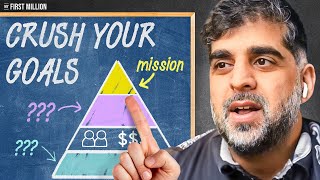
A step-by-step system for staying focused in 2024: raise your "yes" threshold to "hell yes" only, build your calendar in long uninterrupted blocks instead of fragmented meetings, and create a "Pyramid of Clarity" with a one-year goal broken into three categories: people, product, finance. Set a floor target and an aspirational target, then use monthly checkpoints to track weekly progress.
Chapters
You can do anything, but you can't do everything. And that is what I wanna talk about today. Ruthless focus, laser-like focus for 2024. I have not been great at focusing in the past. In the past, I have let myself get distracted. I have let myself set a goal at the beginning of the year, and by the end of the year I check in and I'm like, where the hell— what, what did I do all year? Why did I drift? And it's not something malicious. It's not like a total fail, but it's just this drift that I didn't like and I wanted to get better at it. I'm gonna show you what works for me. How do you get more focus? How do we get the laser-like focus that all the great ones exhibit, whether it's in sports and you see Kobe Bryant completely obsessed in entertainment, you see MrBeast, he's completely locked in and obsessed. In business, you'll see somebody like Mark Zuckerberg, laser-focused on one thing, trying to make that happen, and they don't let, let themselves drift the way the rest of us do. So here's the little visual. This is you, and this is all the things that you might do. So this is, uh, you know, some news thing that's going on, the election. This is Love is Blind Season 5. This is that investment somebody wants you to do. This is, um, that email you got from that person who wants to do a call and pick your brain. This is that side, side hustle that's not really gonna go anywhere, right? That's all the things. And then the blue thing is the thing you actually want. This is the thing that you would feel proud of at the end of the year if you made this happen. And so what we need is laser-like focus. We do not want the cone to be wide. I'm gonna show you how we do that. So first thing you wanna do, this is a before and after of how you can operate. And again, we have all the possible things that we could be saying yes to. And you wanna think about your yes threshold. So let's write that out. This is your yes threshold. And before it might be, you know, here. So you might have your yes threshold right there. And what you're doing is you're saying yes to anything above that line. If it's below that line, you're able to say no, but you're able to say yes to everything above that line. And the after, all we have to do, the first thing you have to do is simply acknowledge, bring your awareness to how low your yes threshold is and raise it. Raise your standard for yes. And so instead of saying yes to things that are pretty good, maybe interesting, might be worth doing, pretty cool, it needs to, you take your yes to a hell yes. That is the easiest thing you can do. So we're gonna raise the yes threshold, right? We're gonna take it from here up to here. And you know, this sad guy becomes this happy guy and he's taller. So you get 2 inches of height at least, and your, your yes threshold is even higher. All right, so that's the first thing you do. Bring your awareness to where's my bar today and take my yeses to only doing hell yes things. That doesn't mean you don't do, if somebody, you know, if your friend comes and says, we're going to Costa Rica and it's gonna be amazing. That might be a hell yes for you. Go for it. But make sure you are, you have a premium quality on your focus and what you're willing to do. All right. Next thing, time management. You may have seen this as a famous Paul Graham essay that I've turned into a cartoon. And the Paul Graham essay is basically come, uh, showing the difference between a maker, uh, uh, oh wait, I have these flipped. Okay. Uh, yeah, hold on. Let's reverse that. This is a manager's schedule. This is what their calendar looks like. And this is what a maker's schedule looks like. This is the artist, right? Somebody who's a builder. And so for a lot of people, they have this 9 AM, 9:30 AM, 10 AM, 10:30 AM, 11 AM, 11 AM. Oh, I'm double booked. Oh shit. And they end up just in a puddle of tears. They are overwhelmed. They're stressed. They sort of busy themselves to death. Why didn't I get everything I wanted to done in life? Why didn't I achieve my goals and my dreams? Because I was too busy. Listen to that sentence. That doesn't even make sense. You didn't do the things you needed to do because you didn't have time because you filled it with other crap. And so most people by default, especially people in jobs, you will be default opted into a manager's schedule. What you want to do is switch to a maker's schedule. A maker's schedule is basically long interrupted blocks of time. Usually in the morning, you need at least 2.5 hours of uninterrupted time. Usually 3 is ideal. A break where you're going to lunch, exercise, go for a walk, play with your kids, walk your dog, whatever you do. and then another uninterrupted sprint. For some people, the real great ones, they have a, another break and then they have a third night sprint. But you know, you don't have to do all that. Um, you need to switch to this maker schedule. And so the maker schedule is the, the one thing you could do with your time where in the same number of hours you can get more done. Why? Because when you get into these uninterrupted blocks of time, you get into flow states and you're able to actually lock in on knocking out one whole thing without distractions, without checking your emails, without being pulled into a call or a meeting about this and about that, you're able to lock in. And so whether you're an engineer and you want to build a product, you want to code something, or you're, you know, you're trying to be an entertainer and you need to write chapters of your book or a YouTube video that you're making, or you're just trying to come up with a new idea, not letting yourself, your day gets split. I call this the zebra calendar where you're just stripes all day. That is the next thing you need to do to enable yourself to come up with great ideas, right? You are setting up your environment. So the first thing we did was we raised the threshold of yes to a hell yes, so that we're just saying no to things that clear space. The next thing is we do the maker schedule versus the manager's schedule so that you have uninterrupted time blocks where you can be your most creative, productive self. Okay, next thing. Now we're going to clarity. So this is something I stole from Asana. Asana created this thing called the Clarity, uh, the Pyramid of Clarity. And the Pyramid of Clarity goes as follows. At the top here, you have your mission, and the mission is your big, the reason your organization exists. It's the reason you're even doing this. It's your big why. And so let's say you're Elon Musk. Your mission for SpaceX might be, um, you know, make humans an interplanetary species, a multi-planetary species. Um, or for Tesla, for him, it might be get the world off of using, you know, fossil fuels and get them to an electric future, right? So that's the big vision for what you're doing. Now you break that down, you say, so you write that out. And by the way, a little pro tip, because when I first read about this, I was like, wow, that makes total sense. You got to have this big audacious vision. But let's say you're not building rockets to go into space, or you're not trying to get the world off of fossil fuels to a fully electric energy system. You might just be building an e-commerce business that's designed to enable your lifestyle to be really great because you wanted money and you didn't have money, right? Like whatever it is, the key here is honesty because you could write a fancy mission, but if it's not your honest mission, it's not going to help. It's not going to do anything. It won't have any emotional resonance. So what I try to do is I try to be honest about the mission. So for example, with my company, We are building a company that is going to enable us to have an amazing lifestyle. Us, the owners of the business, to have an amazing lifestyle. We only have a couple of people in the business. It's all owners. And we want to have a lifestyle where we could do what we want, when we want, with whoever we want, and only work on projects that are, you know, intellectually fascinating for us, creatively challenging for us. And so we write that. That's what we're doing. That is the mission of what we're trying to build. We're building a vehicle that enables that. From there, you you want to go down to the 1-year goal. Okay, so this is the, the mission might take 10 years, it might take 20 years, but then you break it down to the 1-year goal. Where do we need to be at the end of the year for this to be a smash success? And specifically, I set 2 goals. So I have the, uh, what I call the FEI goal, and then I have the floor goal. And so I set kind of a range here because I don't like static single goals, binary goals, because you're then you're like, should I just be super ambitious? But then I might be disappointed, or should I be conservative? But then I feel like I didn't push myself. So I set both. I set an FII goal and a floor goal. The floor goal means you would be disappointed if it didn't reach this level, meaning this would be a solid win. Below that, you kind of feel like, ah, man, really? We didn't get there. And the FII goal is we're high-fiving, we're toasting to ourselves. I can't believe this is how good it turned out. And so you want to kind of set that range for yourself and say, all right, we have a minimum and then we have sort of a target that we're going to shoot for.
All right, everyone, a quick break to tell you about HubSpot. And this one's really easy for me to talk about because I'm gonna show you a real life example. So I've got this company called Hampton, joinhampton.com. It's a community for founders doing between $2 million all the way up to like $250 million a year in revenue. And one of the ways that we've grown is we've created these cool surveys. And so we have a lot of founders who have high net worths and we'll ask them all types of questions that people typically are embarrassed to ask, but provide a lot of value. So things like, how much the founders pay themselves each month, how much money they're spending each month, what their payroll looks like, if they're optimistic about the next year in their business. All these questions that people are afraid to ask, but well, we ask them anyway, and they tell us in this anonymous survey. And so what we do is we created a landing page using HubSpot's landing page tool, and it basically has a landing page that says, here's all the questions we asked, give us your email if you want to access it. And then I shared this page on Twitter, and we were able to get thousands of people who gave us their email and told us they want this survey. And I could see, did they come from social media? I can see, did they come from Twitter, from LinkedIn, basically everywhere else that they could possibly come from? I'm able to track all of that. And then I'm able to see over the next handful of weeks how many of those people actually signed up and became a member of Hampton. In other words, I can see how much revenue came from this survey, how much revenue came from each traffic source, things like that. But the best part is I can see how much revenue came from it. And a lot of times it takes a ton of work to make that happen. HubSpot made that super, super easy. If you're interested in doing this, you could check it out, hubspot.com. The link's in the description, and I'll also put the link to the survey that I did so you can actually see the landing page and how it works and everything like that. I'm just gonna do that call to action then, and it's free. Check it out in the description. All right, now back to MFM.
Okay, what's the next level of this? Now you have your overall mission clarified, and I'll show you an example in a second. You have your 1-year goal. Where are we want to be a year from now? And that's what you're gonna work backwards from. So then you work backwards and you say, okay, in order to achieve this 1-year goal, what do I need in terms of people? What do I need in terms of product? And what do I need in terms of finances? 3 categories. And so you break the 1-year goal into the— this is the output to the inputs. So for example, for my e-commerce company, we had a 1-year goal and we said, we're gonna try to go, we're try, we're gonna try to double revenue. We did about 17-ish million last year. We're gonna try to get to, um, you know, over 30 this year. So we said, what do we need in terms of people? Well, I needed to hire a CMO because today I was doing it. I'm not the best, uh, CMO for, for that business. I'm not full-time on it. So we, we set some people targets. We need to hire an amazing CMO who's done this before. Uh, we needed to hire a website developer who's gonna do XYZ, right? So you, you write down what are your people gaps, then you have your product gaps. So what does the product need to be able to do in order for us to hit our goal. So for example, when Elon launched Tesla, he set a product goal and he was like, how do we make a car that is, I think it was like faster than a Porsche and better for the environment than a Prius, faster than a Porsche, better for, better than a Prius, right? Better for the environment than a Prius. And that is a product goal. That is a benchmark that we were trying to achieve. Is it faster than a Porsche? And is it more, is it better for the environment than a Prius? And so Similarly, you wanna set some product goals for yourself, um, for, for to achieve your 1-year mission. And lastly is finances. So, you know, do you need capital? Um, you know, by, by default people think they do. You should question that assumption. Um, beyond just how much money do we need to do this might be your margins or might be your unit economics. We need to bring the cost down to this in order for this to work cuz we wanna be profitable and today we're unprofitable. And so within each one of those, you've now broken your 1-year goal. Into the different input metrics that if you did those correctly, it would lead to the 1-year goal. And then from there, you just break it out by month. You say, all right, in January, okay, what are we going to do? Well, we need to chip away at the people goal, the product goal, and the finance goal. So let's break those into a digestible chunk. And now all of a sudden it's like, you know, let's do 20 interviews and try to find, you know, 2 great candidates for the CMO role or whatever it may be. And so then you go month by month and every month you check in, you, you check in on the whole pyramid. You say, all right, as a reminder, our mission is X. By the end of the year, we're trying to do Y. In order to do that, we need to hit these, we need to do these 3 things internally, and then the score will take care of itself. And so to get there, we need to break this out month by month into what's, what's, what mattered last month. Did we achieve it? And what matters this month? You do that for 12 months straight, you are gonna stay on track. There will be no drift. Last thing I wanna share with you, I stole this from my friend Joel Omen. He's a listener of the show and I hope he's okay with me sharing this. I'll ask him. But he, he said he shared this, this simple slide that he made for himself and I loved it. It was a killer slide. It was one slide that gave him clarity on what is he trying to do and how is he gonna get there? And I like the way he framed it, so I wanna share it with you. So he had his goal. Or the mission that I called it on the last, last page. And his goal was to build a creatively fulfilling cash machine. I just love that. Creatively fulfilling cash machine. And he said, well, you know, I've done, I've done each of them individually, you know, I've built successful businesses, uh, cash machines, and I've built, I've done things, you know, he wrote like a fantasy fiction book, right? Something that was creatively fulfilling, but didn't make any money. And so he's like, this time, my mission is, to do this? Because if I did this, I would be blissed out walking into work every day, right? I would be at my happiest in terms of my professional goals. And so set a goal for yourself like this, and you want to use this as a bar for resonance, right? You know, this is a, this is a not a generic off-the-shelf goal, like be successful or make money or whatever, right? Like set it, set it for real. So maybe for some people it's, make 6 grand a month so that I can quit my job, make 6 grand a month out of my business so I can quit my job and be totally independent, not have to worry about how I'm going to pay the bills, right? I could be stress-free and then it's only up from there and write that whole thing out, write it out in a way that has some emotional pull for you that it's a compelling picture. All right. So the second thing, then you have your output, right? So what are those, you know, that's kind of like I said, the one-year goal, right? So in order to do that, we might need to do the following two things. Now here's the part I liked best when he says, I say yes to blank and I say no to blank. So for example, let's say for this podcast, I, you know, have a goal, which is I want to, I want to be one of those people that inspired me when I was coming up. That is very much why I do this podcast because growing up, I remember when I was in college, somebody gave me a book called The 4-Hour Workweek. And it blew my mind at the time. I had never thought about half of the concepts in there. And I was like, just insight after insight, page after page of inspiration and story. And I just said, that's how I want my life to be. I said, I called it catching the 4-Hour Fever. Like I read that book and for 4 hours I went into a fever dream and I replanned everything in my life. That was very impactful for me. Thank you, Tim Ferriss. There have been other moments like that, Tony Robbins and others where I've had these people who created content that really shifted my thinking, that made me have more clarity, more insight, more motivation, more firepower to go do what I wanted to do. And so my goal with this podcast is to do that. Okay, well, great. What do I need to say yes to in order for that to happen? Well, we break that big dream down to a 1-year goal, and then we break that 1-year goal down to the things that we're gonna have to opt into. So for example, for this podcast, You might say, well, I'm going to have to sit down consistently week after week doing my absolute best to create the most compelling content out there, the best wisdom for entrepreneurs. And when I do that, I have a, I'm saying yes to doing my best and knowing that the numbers are not going to change every week, that it might look flat for a long time, that I'm going to do that for years and I will not be discouraged. I say yes to doing that input, even though The numbers will take a long time to build up, right? So that's what I'm saying yes to. What's the second thing I'm saying yes to? Well, for this year, for example, we wanted to bring on higher profile guests. We booked a bunch of Tim Ferriss coming on. We booked Tony Robbins and a bunch of others. And so I said yes to doing something I didn't like to do, guest outreach. I hated begging people to come on my podcast and all that. I just, I don't know. I don't like when people ask me. I didn't want to ask other people, but I said, I got to say yes to that. I got to say yes to the discomfort. And the ego of continuing to follow up with people and try to get them to come on the podcast. And what do I say no to? So what are the things I have to say no to? Well, I have to say no to starting a company. I sit on this podcast every week and I come up with ideas for businesses. I gotta say no to actually going and doing them because if I now am a CEO of a startup, I'm not gonna be able to achieve this, this goal. So I have to say no to some very compelling good ideas that would make me millions of dollars. Write that down, right? So what are the other things I have to say no to? I have to say no to avoiding hard conversations. I have to say no to my old habit of blah, blah, blah. Right? I thought this was a very, very useful thing because it had both the— it was all about self-awareness. This is a self-awareness game. What is the goal that motivates me to get out of bed every single day and chase this above all other possible things I could be doing with my time and my talents? Second, what is it about me that I know I'm going to have to I consciously force myself to say yes to and say no to. And here it's the things that are not easy for you. You don't want to write the things that you already say yes to that are already just, uh, you know, trivial for you. It's, it's your nature to do that. It's here you identify what's against your nature and, uh, and write that down so that you're very clear in what you need to do. And to me, this is how you can do anything. You are limitless, right? You, nobody can tell you that you can't do that thing. but you can't do everything, right? So that you can do anything, but you can't do everything is a very powerful idea. And it gives you that focus as a superpower. People say that, but they don't tell you how you focus. So I hope today you learned a little something from Uncle Shawn about how you actually focus. This is something that frankly, I'm still a beginner at, right? I'm a, I'm maybe a blue belt in the, in the game of focus. Um, but I do know that it's important and because it's important, I'm working at it. And I wanted to share with you the things that I'm doing that, that tend to be working for me, the things that have helped me make some progress. Maybe there's some more things out there. I'd love to hear from you what works for you in the comments. But, uh, that's it. That's the episode.










