Grow Your Business By Thinking Outside the Box – Soylent Founder Dave Renteln @ Hustle Con 2016
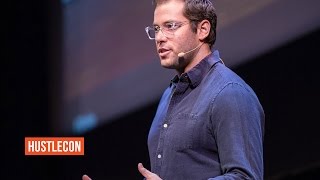
Soylent co-founder Dave Renteln explains how the company built a $3 million crowdfunding campaign by embracing its weirdness. CEO Rob Reinhardt lived on the powdered meal for 30 days, sparking 30,000 people to want to try it. Soylent leaned into polarizing ads and transparency about ingredients to build a devoted Reddit community.
Questions this video answers
Ideally there would be no deviation from normal ranges; a ‘win’ case is when metrics that were out of range move back into the healthy range after the Soylent diet.
Key factors were securing press interest before launch, strong PR relationships with key reporters, having an already‑engaged community to seed the campaign, and partnering with Tilt, which provided dedicated support.
Spirulina has potential but challenges remain in taste, texture, and scaling the protein extraction process cost‑effectively. Boron and other non‑essential nutrients are interesting, but Soylent’s current value proposition focuses on delivering all essential nutrients, so they are not a priority right now.
Chapters
Thank you, Sam. I appreciate that. So I'm David, and I'm a co-founder and the Chief Marketing Officer of Soylent. And what I want to talk to you about today is how sticking to your principles and embracing the weird aspects of your business can ultimately generate interest, uh, in the form of press, uh, community, uh, and ultimately sales. So, uh, if— for those of you who aren't familiar with Soylent, as Sam mentioned, uh, it is something that, uh, can sometimes be hard to describe. Uh, what we do is we make engineered staple foods. Uh, so those, uh, products that we make currently are, uh, powder and a ready-to-drink meal in a bottle. And so the breakdown of the ready-to-drink, for instance, which we're actually serving out here today, is 400 calories, and that's 20% of everything that you need in a day. That's carbs, fat, protein, fiber, vitamins, minerals, everything. And so that is 4— so 5 bottles of RTD would equal a 2,000-calorie perfect diet according to the Institute of Medicine and the FDA. And so a lot of people consume Soylent for breakfast, for lunch, dinner. I consume it for breakfast and lunch on the weekdays, so I'm about sort of a 50% Soylent diet. The percentage of Soylent that someone consumes in their diet is often sort of a subject of discussion, and so we'll get to that a little bit. So how do we get started? That's me a couple years ago when I didn't know any better. Essentially, I moved into a hacker house with a couple guys in Sunnyvale, California in 2012. And we were looking around and trying to figure out sort of how we could cut our costs. Our rent was as cheap as it could possibly be. The house was falling apart at the seams. We had to wash our dishes with the hose. The only good thing about the house actually was it had a pretty decently sized pool in the backyard. And so we thought, "OK, well, this will be nice. We can invite people over. We can have some pool parties, you know, maybe barbecue." The snag there was that the pool was covered in a thick layer of green algae. And try as we might, we could not get rid of it. We would pour chlorine, it would evaporate, the algae would come back. And so that was pretty frustrating, but more distressing than that was the fact that we were essentially starving, especially from a malnutrition standpoint. So we'd go to Costco and we'd get corn dogs, ramen, frozen pizzas, as you can see there, and we just were not feeling too good. You know, we'd go and we'd spend hundreds of dollars at Costco and just go through all of that food in just a week. And, you know, we'd be left feeling pretty sick. And so quite a few times, you know, we'd be sort of lamenting our misfortune and sitting in our backyard eating a frozen Costco corn dog, looking at the green pool thinking, "Why can't we kill this shit?" But, you know, more— you know, again, more important than the pool was we were hungry. And so we needed a hero. Enter Rob Reinhardt, our CEO. He saw our problem, and he went about devising a very ingenious solution, which was a scientifically engineered powdered food, right? And as you can see, that's Rob looking very svelte with one of the original glasses of Soylent that he made. And next to him, you can see some of the original ingredients, the different powders that we mixed together to create that original recipe, and of course, a scale that would be out of place anywhere except for a chemistry lab or a drug den. So what we did is Rob lived on that original recipe for 30 days, and that generated a ton of interest. What happened was we received an outpouring of requests. Over 30,000 people wanted to repeat the experiment where Rob lived entirely on Soylent for 30 days, and they offered to give their blood and do it under the supervision of a physician, the same way that Rob did. And so we thought to ourselves, if 30,000 people are willing to give you their blood, you probably have a business. And so what we did is we looked around and realized to produce Soylent at scale, we needed to be able to afford award a large-scale manufacturing contract. And so to put the money together necessary to reach that scale, we turned to crowdfunding. And ultimately, we went down to LA, and we filmed a crowdfunding video. And we worked with a company called Tilt. And we launched our crowdfunding campaign trying to break $100,000 to get that minimum order quantity. We were fortunate enough that within an hour we broke through our goal and ultimately went on to be the largest food crowdfunding campaign of all time, raising in excess of $3 million, which was really awesome. So today we are headquartered in downtown Los Angeles, and we have over 50 employees. We've served over 20 million meals to date. We've grown about 300% year over year since shipping. And, you know, as you can see from this shot of our office, we have, you know, people and large computers and high ceilings, which I'm told are all indicative of success. Whoa. Okay.
There we go.
So essentially what I wanted to talk about today is Acting against conventional wisdom and violating some of these sort of cultural norms can be very important to generating interest in your business. And so a lot of people, you know, would be anxious about sort of communicating how to consume a powdered food, or maybe you should consume a powdered food. And we were, but ultimately we really had no choice, so we had to realized that our solution was a little bit weird, and we had to stick to our principles, and— and so we went about trying to solve this problem: what to eat. And so we had this unusual product, and so, again, we were anxious about it, we were trying to figure out how do we communicate this message most effectively so that it makes people comfortable, so that they'll understand that this is really a very viable solution to eating when you're hungry. So initially, we got some reaction that was what we feared. Apparently, some people can't be bothered with food. "Soylent raises $1 million, reminds us what's wrong with Silicon Valley." What's wrong with Silicon Valley? "Rob Ryan Hartle's no eating diet probably isn't such a good idea." I'll let you read that caption on that photo for yourself. "Mm-hmm." So ultimately, we realized we were going to have our work cut out for us if we were going to try to communicate how normal and really soothing our solution was. So we decided we had to embrace the weird, right? There are just inherently weird things about our business that we shouldn't try to hide behind, we can't hide behind even if we want to. So instead of trying to sort of make excuses, we'll just go the extra mile. So I don't know, what could we think about that might sort of communicate the idea of a fictional foodstuff that is everything that the body needs and really great for survival? So, an allusion to a 1960s science fiction novel by Harry Harrison called "Make Room! Make Room!" which was ultimately adapted into a movie called "Soylent Green." Soylent Green is a fictional foodstuff that has everything that the body needs to be healthy. It also happens to have a secret ingredient that some people find distasteful, no pun intended, which is humans, right? So, as you can see, the reaction when naming this product is— is pretty strong. A lot of people seem to remember one of the adaptations of this sci-fi story in which the secret ingredient of people is, you know, is very sort of memorable. So ultimately, you know, this joke never gets old, right? And so every post that we put on Facebook, every ad that we put out was very polarizing, right, because of the sort of the harsh sort of nature of the name what it made some people think about. But ultimately, it drove a ton of engagement, right? You know, the number of comments that we have on every post, every ad, every time sort of someone who hasn't heard of us sees us for the first time, it drives this engagement, it drives this interest that ultimately is very valuable and drives a lot of impressions that we might not normally get otherwise. You know, these comments— my marketing team's favorite comments. I think one of them is, "Why didn't they Google this? Fire the marketing team. Fire the marketing team." Haters. So there's this old saying in advertising, you know, basically the concept is, you know, if you're trying to sell glue and all else fails, glue a car to a wall. So that's essentially what Rob did when he lived on Soylent for 30 days, right? He did this stress test, this, if I can live on this for 30 days, then certainly I can use this to replace a meal or a series of meals or replace meals for several days in a row. And so this was an extremely compelling and very important part of our start and something that ultimately drove tons and tons of engagement, and it was just essentially invaluable. And so— and so he blogged about his experience as well, and further drove home violating these cultural norms around food and how people saw food. So, you know, saying things in, you know, in blog posts, in interviews like, I don't understand why people want to eat as if they were cavemen. We have supercomputers in one hand, and then we're shoveling leaves into our mouth with the other, right? And that is, you know, a little bit strange and contradictory. And so the idea of why can't a food, like every other problem, be reduced into its constituent parts? And so the idea that you know, an apple is more than the sum of its ingredients, is something that, you know, we wanted to challenge. So along those lines— so along those lines, you know, we used scientific principles to design our formula and design our ingredients. And what we ultimately wanted to do was to use the best tools for the job. And so to us, we're ingredient agnostic. I don't care if we get our protein from whey or soy or rice. What matters is the amino acid profile and the amino acid ratio. The source is less relevant. So, you know, in the case of something like GMOs, this is very unusual again, right? Because it's contradictory, uh, from what a lot of other food companies do. If you walk into a Whole Foods now, you see vegan, natural, organic, non-GMO. And really, you know, what our belief is that consumers have been taught, because in the past food companies have been dishonest historically, and consumers have been taught that these labels are proxies for good health. So if I see something that says natural, I can be confident that it's healthy. But things like hemlock are natural. And that doesn't always end up so great, you know, when you consume that substance. So things like GMOs are very, very important for the future of agriculture, and there's an entire debate around them which is too long to get into right now. But our corporate stance is that we're very pro, and by taking out billboards and not trying to sort of get away with anything, being very straightforward and open about our preference, that was something that also generated more interest. Again, another thing: being transparent about our formula. People said, "Don't tell people what's in your food product, they'll copy you." Well, that's fine. People did copy us. And we also engaged with and created a community around making Soylent and making their own Soylent. And so this was very, very powerful for us because it drove a lot of traffic to our forums and our subreddit and helped create a conversation and convert more people to our manner of thinking. Again, ultimately was very, very good in terms of driving traffic and ultimately sales, right? Then we sold food exclusively online, only e-commerce. At the time, a little bit uncommon and something that people said, you know, you're a food product, you need to go into stores, that's the only way that people will buy you. But, you know, from our perspective, we wanted to be passing on as much value to our consumers as possible. And because of all the financial implications involved in being in a store, um, it wouldn't allow us to charge the affordable price that we would like to charge, uh, you know, as we scale and make sure that we're actually passing on as much value to our consumers as we'd like. And ultimately, again, this was a good decision because it enabled us to generate cash flow to continue to scale and invest in R&D, which I'll get to in a second. Our marketing. Some food products want to tell you that they will make you superhuman. I will not promise you that. I will tell you that if you drink Soylent, you'll be healthy and you'll be able to get more things done. And so that is a message that has very much resonated with our consumers and something that, you know, ironically, I think by keeping your clothes on, you can generate more attention sometimes. Iterating our product like software. We had a lot of ideas about where we wanted to take our product and what the ideal vision of our sort of end product would be, but we had a crowdfunding campaign, we had customers waiting, and we couldn't iterate and make it perfect. And so, in software, this is very common, right? You release versions, but in food, a little bit less common. And so we put out our first version, Soylent 1.0, and that had an oil bottle associated with it. And that's because saturated fats, as many of you likely know, are solid, often at room temperature, And so if you want a high monounsaturated fat profile, then often, you know, you need to resolve to consume liquid fat. Ultimately, by Soylent 1.4, we were able to work out a deal with a supplier to generate a custom starch microencapsulated fat blend that enabled us to throw away the oil bottle and keep everything in one pouch. Much more convenient. Ultimately, we got to the ready-to-drink. Again, we have samples here. So then, just high level, as you can see, the more unusual things that we did, not by being deliberately unusual, but by sticking to our principles and understanding that we could go one way or the other, and we might as well embrace our weirdness, enabled us to generate a lot of interest and drive press and drive our community and, again, ultimately, drive sales. Quick word about our Reddit community. So our Reddit community is a fine example of all of the sort of different communities that we have. And the Reddit community actually receives more hits per month than our website sometimes. And so that's an extremely powerful resource that we have. And we look to them for ideas. And we are able to engage directly with our customers. And because we have such a vibrant community, It's really been quite beneficial to us, you know, in a number of ways throughout the history of our business. So— okay, sorry. There we go. So a quick word about being unusual and being weird. So it's not all rainbows and butterflies. Sometimes some really frustrating things happen. So that stress test that I mentioned earlier, really, really effective for us as a business, really important, one of the most important things that we did, right? Stress testing, showing that our product could stand up to a very high-pressure situation. Generated a lot of interest, but then people were so interested they continued to replicate it and take it further and further. And so people wanted to live on Soylent for 30 days and recreate that experiment, and journalists wanted to do it, and it was a very interesting thing, and people were very interested in it, and we think that's great. The product's designed for that, why not? However, that led to a mistaken assumption that we're still combating a little bit today with regard to what Soylent is used for. Some people still regard Soylent as something that, "I'm on Soylent, all I consume is Soylent, I don't understand why someone would want to live that kind of lifestyle," when of course Soylent is a tool that you can use as needed for you. So of course if you can live for 30 days, you can certainly use it for breakfast. So that's, you know, that's just something to be aware of with some of these sort of tactics. But ultimately, you know, we don't really regret anything as far as being a little bit weird, being a little bit unusual, and challenging some of these cultural norms. So I just want to reiterate that I think it's better to disagree with conventional wisdom if you know that you're right. Ultimately, you'd be surprised how it can actually benefit you. So as far as what's next for Soylent, we released 2.0 last fall. Again, we have samples here, so if you didn't eat breakfast, there's no excuse after this to go grab a Soylent. You'll thank me later, trust me. And with regard to the far, farther future, this is an example of an industrial fermentation tank. So 30%, roughly, of Soylent 2.0's calories come from algal fat. So that is lipid oil, or oil that's extracted from algae in a tank such as this. This is sort of a pilot facility. So think about like a brewery that has a tank full of algae, and then you French press it, and you take all of the really healthy, very clean, very efficiently made fats. And then you can put it into food products such as ours. So we strongly believe that the future of ingredient production is through microbial engineering, so ingredient production through microbes. And so instead of two-dimensional farmland, you really have these three-dimensional tanks that can grow in warehouses that you can stamp all over the world. And that's something that we're really focusing a lot of our time and effort and R&D spend on. So again, we want to provide nutrition to the world, and so we are not afraid to be a little bit weird and leverage the power of science to make sure that we can accomplish that and make sure that everybody has enough to eat. Thank you very much.
All right, two quick things. So just kind of as the day moves forward, this is where we're going to be doing Q&A. So if you guys do have a question, just kind of work your way down. We have time for about 2 here. Second thing, if anybody needs a business idea, make better clickers. Sorry about that, David. But I actually have a question myself. So, you know, obviously we had somebody live off Soylent for 30 days. You guys did it as well. I know we had our guy do a blood test before and after. What would like someone's blood test look like after living off your product for 30 days?
Just kind of curious. Well, ideally they shouldn't deviate at all from the norm. And so, you know, what we really like to see in sort of a win case, but that's sort of when the deck is stacked in our favor, is someone has metrics sort of outside the healthy range, and then after the Soylent diet they're within it. And so, you know, I think it's one of these things where no news is good news in that case.
Thanks for your presentation. You described briefly the crowdsourcing that you did. Would you be able to elaborate on why it was so— why you think it was so successful and characteristics of it that you would recommend to include or not include during that process?
Sure, yeah. I think with regard to crowdfunding, I think, you know, some of these I think are well-catalogued at this point, and so I'm not sure if I'm doing it justice. But for us, you know, things like ensuring that we had press interest before launching the campaign, making sure that our PR and our relationship with some key reporters was good, having a community who was already interested in the product that was able to help us seed that campaign, working with a great partner like Tilt that took a special interest in helping us succeed, I think were sort of the critical factors there. I'm curious if you guys looked at spirulina as a protein source, what you think of that, and also maybe some non-essential elements like boron, what merit they have in nutrition, especially performance enhancing. Sure, yeah, I think that's a great point. So, okay, so first question, spirulina, super interesting, definitely has a lot of potential with regard to incorporation, but one of the things that we really have to consider is taste and texture, and also of course if we're talking about spirulina either— it depends what nutrient. I assume you're talking about protein, and so the protein extraction process at this point hasn't reached industrial scale and isn't very cost-effective, something that we could potentially be interested in driving towards ourselves. With regard to things like boron, other sort of quote-unquote non-essential things, I think that, you know, with regard to these products that we have out on the market right now, our value prop is really to provide everything that's essential and And so with regard to some of these non-essentials, it's definitely something that we're interested in. But with regard to something that we sort of have to have in our product, it's not something that is super critical for us right now. Thanks. I'll tweet at you later. Sure. All right.
That's all the time we have for questions. Thank you, David.
Yep.










