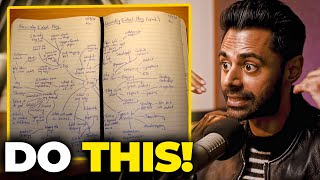
Hasan Minhaj breaks down how comedy works: start with a clear take, then tag the premise to build punchlines. He studied The Daily Show and SNL to learn structure, mapping out beats for longer pieces. Now he's learning to improvise and riff on stage, balancing discipline with spontaneity.
Chapters
And how did you get good? Like, when did you go from suck to non-suck? Like, 'cause everybody starts, I believe, at suck. That's like the Pixar way. I don't know if you've heard this before. Pixar has a philosophy, which is all movies start at suck. Our job is to like remove the suck.
Yeah.
So there's non-suck left at the end. Yeah.
Yeah. And, uh, so I took that approach, man. The Daily Show changed my life, man. Seeing the way Jon Stewart worked and especially that institution, both Daily Show and SNL, love them, hate them. They're part of their comedy institutions. SNL for 50 years now, Daily Show 25, you know, that are these pedigree boot camps for understanding the process about how to think about comedy. Right. And one of the things that I realized is what Jon taught me and Trevor showed me, you know, Jon really unlocked the code. But it's like, it's all about your take. What is your take? And being able to back it up. So it's not even being funny first. It's what is the take? What am I trying to— what is the take? What am I philosophically artistically trying to say. And let's give an example.
You had in the show last night, you're like, you met this guy who's a private equity guy. You're like, what the fuck is that? Yeah. He's like, oh yeah, we do like LBOs.
You're like, yeah, what is a leveraged buyout? It's like, well, we use debt.
As you get to the bottom of it, you're like, so you use other people's money to buy other people's companies and then you ruin the people's lives in them by firing them and gutting them, making them profitable, and then you flip it to somebody else.
Yeah.
You're like, yeah, I'm not cool with that. Like, I think that's a little bit of a fucked up way to win is to like, yeah, this kind of like vulture. Just legal stealing.
Yeah, yeah, yeah. That was never your money to begin with. Yeah. Oh, so it's, it's, it's stealing. Well, it's legal. Oh, just, just because it's legal doesn't mean it's ethical.
Right.
You know, Bill Cosby got off legally. Right. We all know what it is. And so like, that is what the joke I would start with. That's my take around leveraged buyouts and vulture funds. Right. Then you start tagging it. You can do that Bill Cosby tag. He got off legally. It's not right. We all know it's unethical. Whatever. What he did or whatever.
The glove didn't fit O.J.
Yeah. Right. Right. So you must have— what?
Okay.
And then you start tagging, and then the funny just starts flowing from there. And then you go, that's like this. And then you can just— And what are you doing?
You're sitting in a room with like a few people, you just spitballing?
Riffing, bantering, just like that. Yeah. And then eventually you got to put pen to paper, right? And you got to start writing the Act 1. And you start to see— when I watch Weekend Update, or when I see an Act 1 on The Daily Show, or any of those desk segments, I now see the matrix. I now see, oh, I know how to construct a 7.5-minute piece. Last Week Tonight, Patriot Act, I know how to do a 27-minute piece on it, right? I know the beats and the flow of that. And what was really cool was it just gave me that, that central kind of like philosophy. How do I do this? And so the first 10, 11, 12 years of my career, I was just trying to be funny. And what Jon in 2014 really helped me unlock was like, no, no, no, you need to have like, there needs to be an actual process and purpose to what you do. Now, I'm not saying this as a virtue thing. No, just you just need to be like, even if you're doing dick jokes or even if you're being silly, there needs to be— you need to understand the game and how to heighten it comedically, right? Even stupid, silly jokes, you know, are like that. And so that was the unlock for me. And then just reps, trying to get as good as possible. Now, my next thing that I'm just working on the most is the jazz part of it. Like, yo, just have fun. That's always been one of my weaknesses because, like I told you, like, I'm a Kumon kid.
You're structured.
And so, and so we're so built around fear. And so there's these moments that I try to have on stage. I don't know if you saw, I was just like, I'm just kind of unhinged. Like the first like 3 or 4 minutes of the set, I'm just, I'm literally just riffing.
Yeah.
When I was making fun of the kids' shorts, there was a kid in the front row of the show, just short shorts. Like, yeah, Zayn. Yeah. His thighs were just like all up on the chair and then like the seats in the back and, you know, seeing people come in late and then riffing off of that. It's pure jazz. Now, jazz has structure, but there's also play, right? And then you can go back to it and like, it's that organized chaos that I'm trying to like start to tap into.