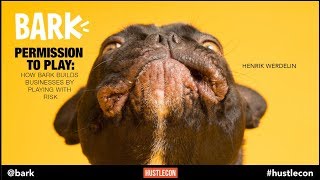
In this Hustle Con 2018 talk, Henrik Werdelin recounts the unconventional founding of Bark (originally BarkBox) and explains how the company grew from a hand‑crafted subscription service for his own dogs into a 400‑person business that continuously launches new pet products. He frames the story with a quirky first‑meeting anecdote on a cruise ship, then outlines the dog market’s size and shifting pet‑family dynamics. Werdelin emphasizes a "fail‑fast, low‑cost experimentation" mindset: building a WordPress mock‑up, taking credit‑card payments via Square, packing boxes at home with friends, and testing ideas like Poopaganda or rent‑themed ads before scaling. He describes how each new concept is treated as a mini‑startup within Bark, with dedicated full‑stack teams, to keep product half‑lives short. The talk showcases two upcoming products – a playful dental‑hygiene subscription called Chompers Club (tooth‑cleaning toys with enzymatic toothpaste) and other novelty items – illustrating the data‑driven validation process and the cultural tension between rapid launch and brand protection. Throughout, Werdelin blends humor, personal affection for dogs, and a pragmatic belief that reducing the cost of failure is the key to sustainable innovation.
Chapters
Hallo! Ich normalerweise wirklich nicht erzähle die Story, wie wir die Firma gegründet haben, weil es irgendwie komisch ist, aber es hat einen Punkt zu den Dingen, die ich heute reden möchte. Also hier geht's. Ich habe meinen Co-Founder das erste Mal gesehen, als ich auf in a heart-shaped bed on a cruise ship in my boxers. And so the PR folks don't enjoy too much when I tell that story, and I kind of had to take the hand over the duvet and say, "Hi, my name is Henrik." We were at a conference, and if you're a little bit of the cheap hustler, then you could pick a ticket where you were basically randomly paired up with somebody else, and I had picked that ticket, and so had my co-founder Matt. And so he went to bed early. Before he kind of came to the room, I thought— they had pushed the beds apart, but I thought it would be hilarious to put the beds back together. So he went to bed early, I went to bed late, and so the first time we ever met was in this very romantic setting. The reason why I want to tell this story is because that I think it's really changed the way that we built Bark. We never really thought it would be a very big business. I really wanted to work with Matt and my other co-founder, Carly, and we had these dogs that we really loved, and we didn't think there was any cool thing there. But we thought, you know, how big is the— how big can that market be? Probably not too big. And so we kind of just did it for our own dogs. It turned out that we stumbled into an industry that hadn't seen a lot of innovation for a very long time. There is a ton of dogs in the US. Roughly 48% of households have dogs, and it's an industry that really haven't seen a lot of innovation. So in the last few years, you've seen some very big transactions coming out of that space— Chewy being bought, Blue Buffalo being bought, and what have you. And so we walked into this industry where there was a few dynamics that have changed. It was very big. It hasn't— they hadn't seen a lot of innovation, and And then, you know, like, we felt that we could do something there. What also changed was that people had really changed their relationship to dogs. Dogs are no longer just a pet that lies out in the garden. It's really a pet that is part of our family. And so maybe I can just, like, a raise of hands, who have a dog or used to grow up with a dog? And any cat people? If you could leave the room, please. Sneaky cat people. So the relationship that we have with dogs have really changed. You know, they now live in our bedrooms. A third of all dog owners lie in an uncomfortable position to make sure the dog is having a good time. My Labrador kind of like lies on the bed, it's kind of like spreads all over. And 83% of them kind of see their dog as their best friend, as I certainly do. And so that was really like how our business grew up over the last 5 to 6 years. I have a little video that I think gives a good impression of what we are doing beside the box I'd like to play for you. Dogs.
Waggin', sputin', beggin', tootin', tuggin', doofin', fetchin', stretchin', snackin', scratchin', lickin', diggin', sniffin', snuggin', smoochin', huggin'.
Dogs.
They make life better. Every person thinks they have the best dog in the world, and we agree with all of them. We're Bark, the company dedicated to making dogs as happy as they make us. And dogs make us really happy. Bark was started by these guys because of these guys.
Love those guys.
In 2012, they created BarkBox.
You opened the BarkBox without me?
The first subscription service made just for dogs.
BarkBox came?
5 years and 60 million products later, we're making way more than the box. Bark helps pup parents make good, healthy decisions for their dogs because everything we ship out must first be playtested and approved by upper management. Bark makes the most original, cutting-edge, state-of-the-fart dog stuff imaginable and the most thoughtful, trustworthy, lip-smackin' dog snacks on earth. Look, we're just a bunch of crazy dog people, and like you, we know that dogs are way more than pets. They're family, and they deserve the best. The best toys, the best treats, the best life we can give them. At Bark, we want to be the people our dogs think we are. So we're gonna keep our eyes on the ball and follow our dogs' lead by always remembering what they've taught us. Be good, make time for play, And for dog's sake, treat yourself.
Bark. Thank you. So here's to the serious part of the conversation. Because we never thought it would be a big thing, we kind of built in an assumption every time we do something new that it won't work. And I think that's very much different than a lot of the other startups that I've been part of in the past, where you kind of sold this big dream to a lot of different people and therefore it kind of has to work. But if you take a little bit like an academic approach, what really happened there is that you have a core thesis and then you go out in the market and you try to see if that thesis is actually valid or not. And so that's very much the approach that we have. And so what I brought today was a few examples of ways of how we try to kind of assume that we will fail, but that also allow us to create a lot of new products very quickly and not be too sentimental about them if they work or not. And so we have a very good way of, I feel, taking kind of extreme creativity and a very data-based approach and then really merge those two together. That gives us the opportunity to become more creative because we are very kind of ruthless about things that don't work, and then we move on from that. And so the most depressing stat I could find was basically this one: we're going to fail. Whatever we do, the stats are pretty bad. If you read like a book like Obviously blanking on the book's name right now. Thinking, Fast and Slow. They make a very good case, I think, about how most projects will kind of like have a rapid regression to the mean. And so we shouldn't have too much bias to think that we can change that. What we can do is that we can reduce the cost of trying so that really the opportunity and the investment is not as high. And that's like a principle that we very much taken to heart. And so we really try to have this mantra of trying to reduce the pain of failing and then really trying a lot of different things by reducing the cost of trying. I brought a few examples. Basically how we built the box first. I'll tell you a little bit about the first few days of that. I have two new products that we haven't really announced. A lot of the projects that we built, we basically don't go out and make PR around them. We test them. With data before we think they're kind of ready. But these two is kind of ready, so I thought it'd be fun for you guys to see them. And so I'll go through it different then. This is the first site. It was called Doggy Bag. I'm from Denmark and my English is not that well. And so I thought it'd be funny to call it Doggy Baggy. And my co-founder told me that you can totally not say that in the US. And so it became BarkBox instead. This was the first version that I had made. It was basically a WordPress template that I'd hacked together. And so the way that we got about making the— starting the business was that I made this template, showed it to a few people, and most of the time when I was showing it to people, they would say, hey, that sounds super cool, please sign me up when you're ready. Now, I also had Square on my phone, so I was like, you can just give me your credit card and I'll be good to take your money right now. So the first 67 accounts or something like that was was really just signed up on Matt, Kyle's, and my phones. I didn't really have the technical skill to understand how to implement a payment system, so this was basically my own little mockup, balsamic mockup. Went to, you know, renderdesigner.com and got it to make it look pretty and then put it on a WordPress template so we could show it around on our phones. This next kind of, like, I think, interesting thing about scaling and preparing to fail was that everybody then was asking me the question when we had started then actually taking money from people is like, how are you gonna scale packing the boxes? And I said, well, I'm gonna pack them myself. And most people say, well, that won't scale at all. And I kind of was, I understand that might be a problem, but right now I have 68 accounts and it's relatively easy. And all the way up to the first 2,000 accounts, we would have these packing parties. This is my dear wife on the left that I'm bribing with red wine. On date night. And so we would basically invite our friends on the last Thursday of every month to come and drink wine and eat cheese, and then there'll be that little surprise that they also had to pack a few boxes. Funny anecdote: I don't spell very well either, so I wrote "happy hollidays" with two Ls in 2,000 boxes, and my co-founders thought I was an idiot. But I think it kind of like makes the point. We didn't assume that this would be a very big thing. We didn't try to think about how to get a 3PL, which is the pick, pack, and logistics center that we now need when we're shipping, you know, hundreds of thousands and millions of boxes. And I think this idea of really saying, well, let's just go out and test some of these things is a good and a valuable exercise. We take that into kind of like even a micro level. These are our poo bags that are coming out this summer. And so we thought it would be fun to make kind of like poopaganda, which is basically like these statements where you can put the hand in the poo bag and then you can make a statement before you're picking up shit. Now, I don't know which one of those are most funny. And so we will often sit in meetings and have this very kind of like conversation about what is funny. What is not fun. And what we tend to do is that we say, well, let's just try to test it a little bit. Let's assume that we don't have the answer and let's assume that nobody will actually like any of it. And so what you can see on the top is a little ad campaign that we've been running just on the mockups for all these different products. And so these different, I think these are some of the kind of like rap kind of inspired stuff, or maybe these are the poop again. Anyway, these are some of the different, oh yeah, actually I remember the first one. We were doing— we're doing this localized. And so, for example, the top one that's called Rent, that was a statement about like the rent is too high in, in New York. And so probably the same in San Francisco, I hear. And so that is the one that was performing the well. And it goes back to this kind of like general principle of like, let's not assume that what we are doing is working. Let's find a way of making sure that we can test it as quickly. As we can. The final thing I wanted to show you is this idea of Chompers Club. Chompers Club is another product that we haven't launched yet, and I'll give you a little bit of the background around that. A lot of you who have dogs know that you should be brushing the teeth of your dog every day, but we don't really do that. And so we wanted to try to come up with a new way that we can create dental hygiene for dogs, but in a fun way. And so we came up with this idea of basically creating toys that had this basically toothpaste inside. So when the dogs were playing with the toys, then they can do that. Now we're obviously a bigger company now. We're 400 people. And so even if we feel that we are still a startup, you start to get like the dynamics of a bigger company built into the DNA of the organization. And so you will have like our marketing team getting very nervous about how when we launch something new, we can protect our brand. You'll have the tech team that's very nervous about how this will work into their roadmaps and stuff like that. And so we take a very deliberate approach of launching everything as their independent units. And so each of these new things that we're launching, they are basically startups within our startups, and we hire new full-stack teams to basically launch them. And we do that because we think there's a very decent chance that these things will fail. And so we have a lot of those conversations internally, and to be honest, often like it creates a little bit of kind of like a bad dynamics because people get a little bit frustrated that we take one part of a business and turn it into a new thing. But we feel really in today's age where the half-life times of products and marketing campaigns are getting so short, your really key competitive advantages is to be able to launch something very quickly and take decision very quickly and empower teams to really move as quickly as they can. And so we do that other thing. This is, as mentioned, called Chompers Club. It's a new product we have coming out. If you search for it online, you'll find it, and we've had it up and running for 2 or 3 months. You'll notice that there's no Bach branding on it at all inside, and that is really because that team is a completely separate team that we're running independently. And first, when we think that we have the product completely right, that we have the Cactail TV in the position that we really want, then we integrate it back into the family of brands, and then we And we kind of like push the pedal to the metal on that. But let me show you a little bit of the product.
Puppy breath? Aww.
Dog breath?
Offensive. Dog breath stinks. And that's just the beginning. Here at Bark, we hear from millions of dogs and their people every day. They have a lot in common: a love of snacks, a hatred of squirrels, and dental problems. Serious dental problems. These dental problems can be prevented by brushing your dog's teeth daily. But you're not doing that. No one is. Over 90% of dogs get severe oral disease in their lifetimes. Woof. Gross dog breath is often a sign of deeper problems: tooth decay, gum disease, serious infection. Safely treating your dog's dental health problems can easily cost $1,000 per year. Let's clean it up. Introducing Chompers Club. We're making it easy to keep your dog's teeth in tip-top shape.
Hmph! Go off!
Wrestle with a toothbrush? Bribe with treats? Nah, you don't need to work that hard anymore. With Chompers Club, canine oral hygiene is just another flavor of fun. Here's how it works. We've developed a convenient subscription with an innovative new toothpaste for dogs. It's enzymatic. Translation: it's loaded with tons of special tummy-safe enzymes that break down the bacteria in your dog's mouth that cause tooth decay and oral disease. It's also delicious. We designed special dog toys engineered to scrub your dog's teeth while they play. You apply the enzymatic toothpaste to the toy and give it a toss. While your dog is busy chewing, our toothpaste is busily eating away at the tartar and plaque on their teeth. That's it. You're done. When you join Chompers Club, we send you everything you need as often as you need it. Give your favorite chomper healthy teeth. Chompers Club.
So a lot of these things are now— we make them as human-grade. I have actually brushed my teeth in this, uh, It is different to have a bacon-flavored toothpaste than what you're normally used to. It is pretty delicious, but the most popular right now is the chicken. So, so that's the one we're sending out. And so I think really for me, yeah, this is the site. And as you can see, there is none of the branding in there. And it's definitely one of the things that's created some conflicts. But we very much believe that the way that we've been able to continuously build new products, get them out in the market, is to have this a little bit kind of non-conventional methodology on how we do it and assume that we're going to fail before that we at least fail a few times before we come, we succeed. And so basically the core kind of like message you have, the three, what, three of them, uh, the three kind of stories was I built this company together with two friends and we kind of assumed because, you know, we didn't know better that it might not work. At least I really adore my co-founders and so Every day that's a little bit hard, it's really enjoyable because I can think back of lying on a hardship. But no, because that I can enjoy how cool they are. I think really taking data-driven design and find a way of minimizing the cost of putting new products out there is something that's worked very well for us. And then I think you need to increasingly see yourself as being a system of, of a creative systems thinker when it comes to launching new things, because that products lifetime are getting shorter and because new channels and how you grow is becoming easier and easier to copy. And so we see our business very much as somebody who really loved dogs and then really created like a very cool platform for building a lot of things that will make dogs happy. I hope you enjoyed the presentation.










