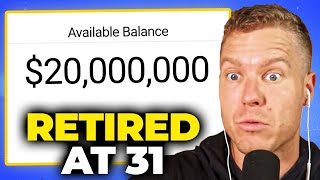
In this interview Sam Parr explains how he achieved his self‑set goal of $20 million net worth by age 30, ultimately reaching it at 31 after selling his company. He describes discovering the FatFire subreddit, where members post their wealth and moderators verify net worth, and how he used a $60,000 monthly burn‑rate benchmark (derived from asking a wealthy acquaintance) to calculate a $20 million target using the 3% safe‑withdrawal rule. Parr recounts his early earnings—paying himself $2,000‑$70,000 a year as his startup grew—and his frugal housing hack in San Francisco, subletting a $4,500‑per‑month four‑bedroom house for $400 rent by striking a hands‑off agreement with the landlord. He saved aggressively, made angel investments, and earned a $300,000 salary in the year of the exit, while his wife’s Airbnb stock options added to the wealth. The conversation contrasts FatFire’s “ball‑out” lifestyle with traditional FIRE’s extreme frugality, and references the Reddit “Confessions of a Hectomillionaire” series where ultra‑wealthy users are verified. Throughout, Parr reflects on envy of corporate peers, the rapid shift from poverty to wealth, and the psychological impact of seeing others succeed.
Chapters
So there's this subreddit that I go to and I love it. It's called FatFire. And the idea is people who want to retire relatively young with a lot of money so they can live a fat life without working. And so basically, if you post on there a lot, the mods, the community leaders of the subreddit will verify your net worth to make sure you're not full of shit.
By the way, did you have a goal like this? Like, I want to retire by X age or I want to be like, yeah, this wealthy by this age. What was your like, how did you phrase your goal?
I wanted to have $20 million by age 30.
Gotcha.
All right. That's what I wanted. That was my goal. I created that goal when I was in my— when I was like 19 or 20 years old.
I mean, I can't confirm or deny, but, you know, mission accomplished is what I would say.
I sold my company. I achieved it at 31. I sold my company at 31.
Right.
And so that was my goal because I asked a rich person who I knew, I asked him, how much money do you spend a month? And they told me $60,000 a month. And at the time I was like, I don't know, like, I can't imagine there's a world where I would—
Yeah, yeah.
I'm like, that just sounds crazy, but whatever. Like, I asked like 8 people and this person had the highest number and I was like, okay, I'll just do that because I'll be conservative. And then if you withdraw only 3% of your $20 million, that gives you like $600,000 a year to spend there. That's where that number is. So I just—
FIRE philosophy, and FIRE stands for financially independent, retire early. So that's—
Yes. So you can, you can, you can spend, uh, a percentage of your port— of your liquid portfolio. And basically it continues to grow.
Have enough money that the earnings of the, the, the, the sort of compounding earnings on the money being invested in something safe, like the stock market, S&P 500 type of thing, can, um, can cover your burn rate. So there's two things that matter. What is the, what is the amount that I have invested in and what is my life burn rate? That's why a lot of people who like FIRE, they go move to like, you know, bumfuck, you know, middle of nowhere. And they, they're like, oh yeah, I got rid of my car and it's great. Now I can, you know, I got rid of everything I own and me and my wife, we only eat apple cores and now we are retired. It's like, but FatFire is different. FatFire is like, nah, I kind of wanna ball out. I'm not trying to like skimp on my lifestyle. So okay, what do I need to achieve and what do I need to optimize while still not giving up like what I find to be enjoyable in terms of lifestyle?
Yeah. So that's how I made up that number. And I don't even— I spend $15,000 a month. I mean, when I sold, I had saved a, like, 7 figures. Of course, that includes my wife and I. And she also worked at Airbnb. And so Airbnb went public and she had worked there for a long time. Airbnb went public in December. I sold my company in February. So it was like December 1st and then like February 1st. It was like that. Those 2 or 3 months was like massive. Right. And so, but prior to that—
or that— take her out because we don't want to put her business out there. So let's just talk about you. You in your early 20s, what were you making?
So from age 22 to probably 26 and 27, I paid myself something like $2,000 a month. So in the brain, so the first year of business, I probably paid myself $20,000 for the first year, and then I paid myself $40,000 for the next 2 years and then $70,000. And then the last year—
that was $24K a year and then $40K a year. And then you said $70K roughly.
You know, it was like 20, 40, 40, 70.
Yeah.
So that's 4 years in. And then the year we sold, I paid myself close to $300,000. Right. And I had a few other investments, like some angel investments and like some weird things that kind of paid off. But basically, like, for the longest time, I mean, I was living— the way I rigged it was in San Francisco, my rent was only $400 because I rented out this big place. And I only had $25 grand in my name, and I spent all of it to rent out and furnish this place. And then I rented it out to people who basically subsidized it for me. So I was living like a poor person. And, um, so I was able to save a little bit of money.
Living like a, like a wealthy person, really. You were living in a place and it was only costing $400 a month, which is great example, by the way, because there's a lot of people that will be like, I want to move to San Francisco, but I can't afford it. All you're saying to me is I lack creativity and resourcefulness because what you did is available to everybody. Go find a place that's at market or slightly below market price. And what you did, I think, is you cut a deal with the landlord. You were like, I'll never call you for anything.
Yeah.
Toilet breaks, I'll fix it. You, I think you lived there for like a decade or some shit and you never called the guy.
Like 7 years.
Yeah.
You never spoke to the person. Yeah. I never saw him. I had, I not once have I ever seen him after.
If he showed up at the house, you wouldn't know who the heck he is.
I would not. I don't even remember what he looks like. I couldn't even tell you what he looks like. I think his name was Chris.
And so you cut this deal and you were like, look, I'm— you basically became the landlord.
Well, I showed up and I was 22 and it was a $4,000 or $5,000. I forget how much was it, $4,500 a month for a 4-bedroom house. And he goes, is it just you? I go, look, it's just me right now, but I'm gonna get like some friends to move in. I'll like sign a lease, a sublease with them and I can have you approve it. But basically like, I'm gonna pay you on time all the time. And my, the preferred relationship you and I have is I never see you again. And are you okay with that? And he goes, yeah. He goes, don't, don't be late. And I go, okay, deal. Anyway, yeah. And so at this point, yeah. So it was a slow build. It took like 5, 6, 7 years. But then what's crazy is I'm 32 now. I started hustling at age 20, probably 20, like making like real money on my own, like livable money. And at this point, at age 32, I'll make more this year from a couple like side investments, like a real estate deal that I did, I'll make more this year than collectively all of my salaries combined while working at The Hustle.
Exactly. And that's, that's the exact same, same case for me. And I think that's actually really common. And I think the reason I bring that up is because A, it's interesting to me. B, I think that's really comforting to people. 'Cause when you're in it and you're not making any money and it looks like other people are all making hella money, it feels, it could feel very bad. And you can question if you're on the right path or not. And this doesn't mean you're definitely on the right path, but it means when this path of entrepreneurship works, that's commonly what it looks like. So don't be surprised. Um, all right, so let's get back to—
which, by the way, um, when I was getting going, I was always so envious of other people, like my friends. I'm like, "Fuck, you got a job at Google? You make $150,000 a year and you have all these benefits? I haven't been to the doctor forever. This is awesome.
I'm so jealous." So, you'd come to my office and you'd be like, "Dude, this is your office?" I'd be like, "Yeah." And then we'd be eating something and you'd be like, "Is this cheese just always available? Whose cheese is this?" "They just bring you out cheese?" I felt like I would bring up— You'd be like, "Look, this cheese is from Whole Foods." "This is expensive cheese." I'm like, "Bro, stop talking about the cheese right now." But it was like, I remember you were noticing all those things in a funny way.
I was like, you guys have an espresso machine?
Yeah, you just got a woman's bathroom.
What the hell is this espresso machine? Yeah, I remember I was like freaking out that you had an espresso, espresso machine. I was like, what the hell is this? And I remember like I used to take food to go. Um, so anyway, um, yeah, it accumulated quickly. And I think it, for most people, it's, I mean, it like I think that it's basically, it's like you're poor, you're poor, you're poor, and then it's like suddenly it's like, "Oh, holy crap. I'm not anymore." And, you know, you have that moment. And there's this subreddit called FatFire, and they talk a lot about that. And there's this guy who has a series of threads called "Confessions of a Hectomillionaire." And he's doing like 8 parts, and I linked to it in there.
I see part 5 here. Yeah.
And the mods have basically, um, approved it. So basically, the mods have— like, this guy DM'd him, DM'd his accountant's or account information or something. So they like verified that he's as wealthy as he is. But basically in the beginning thread, he says, you know, I'm worth north of $100 million. I got wealthy originally because I was an employee at a tech company that made me $30 million. And that was like 15 years ago. And then I invested in this and then I did this and then I did this. And I'm going to answer a lot of the questions that I think a lot of people ask here. And the mods have approved that I am who I am. And I'm gonna tell you all about work and purpose, my time and routine, why I keep a low profile, how relationships are, are complicated, what I spend on a monthly basis, um, what my investment in portfolio management is. And it's incredibly fascinating. I love this stuff where you get behind the scenes of people who you normally never have access to. And so it's a great series. It's a great thread. Uh, it's awesome.