How Sam Bankman Went From 0 To $27 Billion In 4 Years
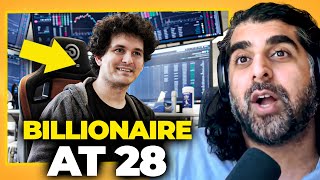
Sam Bankman-Fried built a $27 billion fortune in four years by exploiting a 10% daily Bitcoin price gap between the US and Japan, making $2.5 million per day. He used those profits to launch FTX, a crypto exchange, and donated $5 million to Joe Biden's 2020 campaign, driven by his belief in giving away at least half his earnings.
Chapters
This one is very interesting. Have you ever heard of this guy before? Don't Google. I want to tell you the story, so don't Google this guy. Let me tell you the story.
I googled them. I'm just thinking, oh, wow.
Okay.
Yeah.
Young guy. Young guy, 29 years old.
I don't know who he is.
So his name is Sam Bankman-Fried, I think is the way you say his name. And if you heard him talk, like, I actually want you to listen to a YouTube video for a second because he sounds like an absolute dweeb. And I loved it. I was like, oh, this guy sounds like he would be a self-made billionaire. By the age of 29, because he sounds like a genius. He sounds like a tech genius.
Have you brought this person up to me before?
No, I just discovered him like 2 days ago. Okay, so what's this guy's story? So this guy, I'll just call him Sam for short. So this guy Sam, he's a young guy. He's very smart. He takes a job as kind of like a hedge fund trader or something like that with a group called Jane Street, I guess. And I don't know, forget these details. They don't really matter. Guy's got a job in finance. and he leaves and he starts something called Alameda Research. And it's called Alameda Research because he needed it to sound as legit as possible and not like what it actually was. So what was it? So what this guy did was he was into crypto and there was this known thing in crypto where as crypto was getting popular, this is around 2017 when the first big run-up happened and Bitcoin went from $3,000 to $20,000 and it crashed later. But During that time, 2016, 2017, 2018, Bitcoin was emerging and there was this, as any new thing, there's these like kind of, uh, it's like the Wild Wild West a little bit. And so there was this thing where in the US the price of Bitcoin was, let's say, $10,000 of Bitcoin. And in other countries where, um, the exchanges weren't built or the, the country had some regulations or whatever, there was like a premium for Bitcoin. There was more demand than there was Bitcoin available to buy in those countries. Because you need, like, let's say, like, in Korea, there was a famous thing called the kimchi premium. And the kimchi premium was that in Korea, there wasn't kimchi like the food. So this was known as the kimchi premium. And basically, it was like, whatever Bitcoin was selling for here, let's say it was $10,000, in Korea, it was trading for $15,000 because it was that big, about 50% premium. And it fluctuated, obviously. And I think 30% was kind of like the average of the kimchi premium. Over time. So everybody wanted this. So everybody, you know, any smart person saw, oh wow, there's an arbitrage. What if I could just buy it in the US for 10 grand and immediately sell it in Korea for 15 grand or for 13 grand? And so you had this like ability to flip it. And so a whole bunch of people were trying to do this, but there was all these problems, right? Like, well, the reason, you know, the reason it wasn't easy, the reason there was this premium is because it was hard to buy Bitcoin in Korea. So one idea was you buy it in the US off a US exchange. You go to Korea and you sell it, but you're going to sell it in the Korean won, which is like the local currency. But now you need to, like, for the arbitrage to continue, you have to convert the Korean won back to dollars to go buy more Bitcoin in the US. The problem was you can't convert the Korean won back to dollars easily because the government was very tight-fisted regulations. You couldn't funnel large amounts of money from the Korean won back to dollars very easily. So a whole bunch of people were trying to get this piñata of money and they couldn't crack it. And what this guy did was he was like, okay, fuck the kimchi premium. He went for the Japan premium, which was far less appealing. It was only 10%. But he's like, still, if I could trade a US Bitcoin for 10% more in Japan every day, I'm making 10% compounding daily. And so he went through this odyssey where for a year, All he's doing is setting up this trade. So he like, actually, by the way, first when he was trying to figure out, could I capture the kimchi premium? He was like doing calculations. Like if I filled up, if I chartered a private plane and I filled it up with 100 people and I flew, you know, they buy Bitcoin in the US and I flew them all to Korea and then they, you know, sell it there. And then I could, each one of them could convert some amount of that money and I could fly them back. And every day I could fly this plane back and forth between US and Korea. Like, could I make it work? And he was like, I don't think it works.
Wait, so you had to be there physically?
It's not that you had to be there physically. You have to do all legs of the transaction. So you have to be able to buy in Korea or sell your Bitcoin in Korea at the premium. But now you have Korean won. Now you need to convert that to dollars. And so how do you do that? You need to convert it there. But there's caps. They won't let you convert it because the way he described it is like, look, he's like, what I wanted to do essentially was to be selling $5 million of Bitcoin for the local currency and converting $5 million of local currency back to US dollars every day. He's like, if you just go to Korea, go to Japan, go to wherever, and you say, hey, I'd like to— it's like a one-way flow of money. I have $5 million of your local currency. I'd like to convert it to dollars and exit the country. And they're like, okay, but where are you getting all this money? And why are you doing such a large amount? And what is this? He's like, you know, if you, if you go to bank school 101, that's like money laundering. That's what money laundering looks like. That, that is what money laundering, that is exactly what money laundering looks like. So he's like, even though I'm not money laundering, I'm buying and selling a good that's differently priced in different regions to them on the ground, to the bank on the ground where I need to do these conversions.
It's shady.
It's too shady. They won't let me do it. So he spends basically a year of his life where he's like, goes to Japan, Now he's got to find— he's got to do— each one of these was hard. So anyways, the net end of this story is this guy's arbitraging $25 million a day of this currency. He's making a 10% compounding margin every single day. And this guy, in the 3 years, basically he's become a self-made billionaire. He's worth $10 billion now, which is a combination of the money he made from the arbitrage trade as well as he then created his own exchange. Um, and like, you know, so he has a trading company that's, you know, has made hundreds of millions of dollars on this arbitrage. And then he built, he used that to create an exchange, which is worth billions of dollars on paper. So anyways, this guy's worth $10 billion.
So he and his, cuz, uh, the currency is called FTX, right?
That's his exchange. His exchange is called FTX.
Sorry, sorry. Exchange. And, uh, that is, is that basically an alternative to basically a more higher end?
It's a more sophisticated coinbase. A base where you can do like derivative trades, option trades on all different types of coins internationally.
And that's like a proper company.
It's a proper company with like— so Alameda Research made hundreds of millions of dollars in the span of a few months just doing this one trade over and over again every day. So I'm going to describe a couple things, but he got on people's radar because he was the biggest donor to Joe Biden this year in the campaign. He wrote like a $5 million check at the last— like at the 11th hour. That let Joe do as part of this last-minute blitz they did on TV ads in all the swing states. Because this kind of interesting, this guy's like very— his whole business philosophy is this thing called effective altruism, which is basically like, go be a greedy capitalist, go try to make as much money as you can, and your goal is to give at least half of it away while you're doing it. So he's got like— it's not like a philanthropist giving away 1% of his money or 10% of his money as a tithe. His goal is to give away like 50% of his liquid net worth that he makes every year. That's kind of like his mindset.
Where did he get the money to start this?
So he started it with a very small amount of money and it just compounded very quickly because he's basically getting 10% extra every day. So I don't know exactly where he got the initial seed capital or how big it was. He hasn't specified that, but he did say at the max they were doing $25 million a day on the trade. Which is basically like a $2.5 million profit per day that they were making on the trade. And so he describes that, okay, so he's like, basically, if you want to do this, you have to break it down into small chunks. He's like, okay, so I need on one side, I need to be able to go buy a shit ton of Bitcoin in the US. So how do I get an exchange in the US that's going to give me really high limits even though I'm this dorky kid who's got no track record and I have no collateral or brand name. And so he finds a way to solve that problem of being able to buy $25 million of Bitcoin in the US. Then he had to go to Japan and he had to be able to sell a huge amount of Bitcoin there. Then he had to be able to convert it from the Japanese yen or whatever to US dollars, and he had to do that all in the same day and wire transfer it all back to the US to buy it again the next day, to buy the full max amount again the next day. So he's just cycling the money every day. And so he described, like, they would just— the way that the timing worked, it was always in the last hour of the banking day that he would be trying to get all the wire transfers done to get the money back to the US so that they could execute tomorrow's trade. And any day that they couldn't—
what does he sound like? You said he sounds crazy. Like, I'm looking at pictures.
Oh my God, he sounds extremely genuine, humble, high-pitched voice, kind of like just a nerdy guy, um, who was like— he accounted for about 10% of all the Bitcoin trading himself, his Alameda Research, during that time period, I believe, which is just like insane because he was moving so much money.
Dude, I love these people. I love, I love freaks.










