How to boost your social status with a $100 party
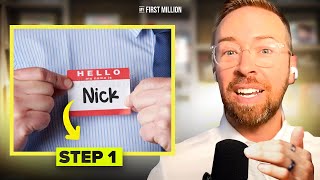
Nick Gray shares his N-I-C-K framework for hosting networking parties on a $100 budget with 15-22 people. Name tags work like team jerseys, quick intros surface useful details, and structured rounds let guests leave with actual takeaways like local tips or media recommendations. He built Museum Hack partly through hosting these events.
Chapters
I understand you have something called the Nick Method. I don't know what the Nick Method is. What is the Nick Method for hosting a party?
The main thing I want your listeners to know is that I found that interesting people want to meet people that are doing interesting things. And the fastest way to become interesting was for me to host my own events. So we talked before about those business ideas that you don't need a lot of capital for. Hosting events is kind of the same way. You can do it with very little money. Each party should cost you less than $100. These strategies start from beginner to advanced, and I've helped hundreds of people to host their very first party using this method. So the Nick Method to host a party will absolutely level up. I'm gonna do harmonic on this. Because if you do this one thing, you will level up your events to be so much better. And the reason is that the bar is so low for a successful event. Think when somebody invites you to like a company happy hour. You're just people standing around at an open bar. It's like bad. That's a, that's the old way and the future can change if we bend our will to make it do that. You can do that with the NIC method when you host events. N-I-C-K, like my name. The N stands for name tags. Fill out the name tags, first name only, big block letters. The name tags I like are the Qualfec 300s. I also like the Avery 5424s. The QualiFact 300s come in 6 different colors. And you guys may know those. They discontinued the 5426s, which was really sad, actually.
It's the vintage.
That's a good year. You should completely make up the model numbers, by the way, and just see if anyone ever finds out and be like, I've been waiting. I have an envelope for the— it's a golden ticket. It's like for the first person that realized that I was completely making up the model numbers of these name tags, you are my fellow nerd.
I may have got those model numbers wrong.
Why do the name tags matter? Because I I went to a party of yours and at first I was like, okay, this is second grade, this is cheesy. But then it was kind of useful, obviously, because I don't remember a lot of people's names, but it seems like there's more to it than that. What is the, like, what's the why behind the why?
The why behind the why is it's like a sports jersey to show everybody that we're on the same team. Have you ever walked into an event? It's the first time you've gone to something and you figure that it's me walking into something else. Everybody else must know each other. They must all be friends already. I am the outsider. When you have name tags, you show that you are all on the same team. This is not a party of cliques. We're all here together. By the way, if you host meetups, you absolutely have to do name tags when you host at a bar or another public spot. So, you know, who is there for the meetup? Have you ever gone to a meetup and it's at like a beer garden and you're like, well, who's here for the meetup? Like, oh, these people. It's like, great. I guess I'll just figure it out on my own. Amateur hour.
All right. And name tags. I'm in. I buy.
Yeah. And his name tags. I stands for intros or icebreakers. When I wrote the book, I called them icebreakers, but there's such a cringe reaction to the idea of icebreakers and that word. So now I call them intros. And this can be in small groups. It can be your whole group together. But what's the first thing that everybody asks when they meet you? What's your name? What do you do for work? We're going to get that out of the way by having everybody say it real quick. I think it is important, by the way, to say what people do, especially for listeners of this pod, because you never know who's looking for a job, who wants to network, who's working on growing their business. But those rounds of intros give you an excuse. It's a conversational crutch for your guests to go up and start new conversations. Your role as the host—
great way to do that. Like, is there a better and worse way to do those intros or icebreakers?
My man, of course there are, dude. I've done more icebreakers. I live and breathe icebreakers. You have come to the right spot. Welcome to Nick Gray's Party Icebreaker Therapy, because I've spent a lot of my life doing icebreakers. Here's the deal. There's two different—
Do you know, do you know Stefon from SNL's Weekend Update? You are Stefon right now. That is you.
That is you. I'm so passionate about icebreakers because I've seen so many bad ones. You know, an example of a bad one is, all right, everybody, team meeting. Let's go around and say one fun thing. Fact about yourself. That's a terrible icebreaker. So much of my work involves making people that have social anxiety or consider themselves introverts to feel more welcome. And I know that some of them are going to hate this idea of intros, but ideally what they like is to be able to know what to expect and minimal surprises. And so a green level icebreaker or intro at the beginning of an event when there's no social rapport, when people are new and a little uncomfortable. Is just an easy one that doesn't take time. The exact question that I have most people do is, hey everybody, real quick, let's just do a round of intros. You gotta say the why. The why is that there's a lot of interesting people here and I really want you to go meet somebody new. So we're gonna have you say your name, say what you do for work or how you spend your day. And then tell me one of your favorite things. One of your go-to things that you like to eat for breakfast. Now that's a bit of a red herring, cuz I actually don't wanna know their breakfast. I wanna know what they do for work. But we take away the attention. We make them think about the breakfast. The breakfast one works because it's easy. It's subjective. People don't judge you for it. And it's not hard. You don't get locked up in your head. A bad example would be, hey everybody, let's go around. Name. What do you do for work? And tell me your favorite business book. Favorite is definitive. It is your absolute favorite. People are going to judge me. Oh my God. Favorite. What's my favorite? What's my favorite? So we start with a very easy one. So you could do the breakfast. If you want to make it a little edgier, you could ask people and say your favorite vice, or say, what was one of your first online screen names and why did you choose it? Or what was one of your first jobs that you ever got paid cash money for? Now, those are beginner-level ones. I want to tell you an advanced one, but I want to check with you guys. Can I keep going?
Yes.
Yes. Keep going. As you continue the event, about an hour later, you want to do one more advanced round of intros, and this is what I call a value-additive intro. Value-additive means that everybody's answer adds to the benefit of the room. And so for Sam, for example, who lives in Connecticut now, say that he was hosting this in Westchester, you would say, hey everybody, we're going to do our last round of icebreakers. Your question is going to be, what is one of your Westchester pro tips or life hacks or Little secrets. What's a small business you support, a dog park you like, a hiking trail you enjoy? What's the best coffee shop in town? Tell us one great thing in town that you like and want to shine a light on. Okay. So that's one example. One more example, if you don't want to focus on your town, would be, hey everybody, we're going to do a last round of intros and I want you to share a great piece of media that you have consumed recently. What's a movie you watched, a documentary, a podcast like My First Million? Like and subscribe, gentlemen's agreement. Uh, what are some of those things that you liked and you want to share? Okay. And then you go around the room and you do that. Why does this work? It works because every answer gives somebody value. Oh, I've been meaning to go to that restaurant. Oh, My First Million.
I love those guys.
Oh, I, I heard about that book. I want to check it out. And you do it towards the end of your event. So at the end, people get all these new ideas, they've met all these new people, and they leave with a feeling of value. They leave feeling that they're better than when they showed up. That's what a good party is.
You did something at a party I went to of yours where, I don't know, you were like lurking around or you were hopping from convo to convo, but then when you brought everybody back together, you go, James, will you tell people that amazing What's the email trick that you did that really improved your open rates? And the guy said something that was like so useful to me that I was like, that one thing alone made this party worth going to because it's like you had eyes and ears around the room so you could pluck the best kind of like pro tip that you heard and you had 2 or 3 people go and you just had them share with the whole group in that moment. I thought that was pretty awesome.
That's an advanced tip. You should be going through life collecting the interesting people that you meet. And why is this helpful? Well, it helped me launch a multimillion-dollar business called Museum Hack that was launched on the back of the network that I built up from hosting all of these events. I hear from a lot of people, oh my God, I'm gonna do a startup party. I'm gonna do a launch party for my new app. I was like, awesome, perfect. How many events have you hosted? Or when was the last event you hosted? Oh, I've never hosted anything. I'm like, bro, you have a cold list. Like nobody knows you, like no offense, but like in real life, nobody knows you. Nobody cared. This is not going to be a successful launch party. You need to start building up and hosting these little events. By the way, the perfect size for a happy hour, in my opinion, is about 15 to 22 people. I could talk forever about this, but a small plug. I wrote a book called The Two Hour Cocktail Party. That is really more like a workbook or a step-by-step guide that helps you actually do it. And by the way, if you want to go through a cohort or something, you give me $100 at the end of hosting the party. I'll give you the $100 back. That's how it works. But hosting the party, it might change your life.
The book made you like the king of the introverts because I had so many introverted friends who like read the book and they started hosting Nick Gray parties and I would be like walking around Austin at like 7 o'clock at night. And in Austin, all the bars are outdoor bars. And I would see, I would, I swear to God, there was this one, one-mile walk through East Austin of like where all the bars are. And I would see multiple Nick Gray parties happening, harmonicas all throughout downtown Austin.
No, it is in the night.
They would be in a circle and they would, we, I call them, we would call them name tag Nick. So they always had, uh, Nick's name tags and they would be in a circle and I could see the person in the middle pointing exactly like he tells you to do in the book. I swear to God, on one 1-mile walk, I saw 3. I saw one at Lazarus, one at Whistler's, and one this other bar. It was 3 Nick Gray parties. It was insane. It's like you were the introvert's king for a handful of months when I would in Austin. So many people were doing it.
The reason we're doing this is that people are hungry for in-person events. We're all digitally saturated. We want that human connection. And I found that you can add value to people by introducing them to other interesting people. If you're looking for a business idea, if you're looking to raise your status in the world, you have to start by adding value and hosting a party, introducing the interesting people, you know, that is a way that you can add value. All right.
If you like that clip, there's a full conversation with a lot more, just like that. Just follow my finger. It is right here.










