How to Get Your Product in 10,000 Retail Stores - Hustle Con 2015
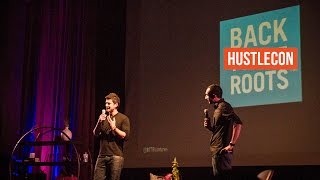
Back to the Roots co-founders grew oyster mushrooms on coffee grounds in a dorm room into a brand in 10,000 stores. They got into Whole Foods by accident, landed Home Depot through cold emails, and launched products on Kickstarter and in Costco. They share how cold outreach, in-store demos, and relationships with buyers made it work.
Chapters
Hello!
Hello!
Hi! How are you guys? Amazing. It's good to be here. So we're super excited to be here with you guys and thought we'd take some time to share just some fun stories about what we've learned from mushrooms, fish poop, breakfast cereal, and what that's taught us about selling in a retail and retail distribution.
Yeah, and to take a quick step back, tell you a very summary, quick summary of our story. We started out of my fraternity kitchen. And actually before that, we were sitting in a lecture of about 250 people, heard that you could grow mushrooms on coffee waste, led us to then growing some buckets. Walked that bucket into Whole Foods, got $5,000 from our chancellor, and ended up giving up investment banking and consulting to instead become full-time mushroom farmers. Along the way, have now, through an incredible journey alongside this amazing man, maybe boy. Give me a hug. Love this guy. And these amazing products, which are ready-to-grow, ready-to-eat products, a mushroom farm, a water garden, a garden in a can, and now organic breakfast cereal and breakfast toppers that are now sold in over 14,000 grocery stores around the country and Canada, Australia, and Russia as well.
So we thought we'd kind of walk you guys through a handful of these products and a handful of the stores we've got into and just kind of tangible stories of how it actually happened. To start off, we want to start off with our main account, the first account we ever had, which was Whole Foods. And I want to go back to those buckets Alex was talking about. So here we are, last semester in college. We had just heard this random fact. We had met up, kind of fell in love with this idea of growing food off of waste, and planted 10 paint— like, literally Ace Hardware paint buckets of mushrooms in his fraternity kitchen. And this is right before spring break. And we come back from spring break, and —were moments we'll never forget. And that 9 of these buckets were just totally contaminated, nasty mold growing on them. But one of them, like literally that bucket right there, was the only bucket that grew this beautiful crop of oyster mushrooms. And by that time, we had no background in food, let alone mushrooms. I remember Alex was like, hey, Nick, are you trying those? Like, dude, there's no way I'm trying these. I'm like, you trying them? There's no way I'm trying them either. And so we were like looking at ourselves, like what do we do? And we're like, what's the best restaurant in town? Well, Chez Panisse is pretty close by. And I literally didn't, at that point, even know what that meant. But we're like, let's take it over there. And we walked that paint bucket of mushrooms into Chez Panisse. And Alice Waters happened to be there. And I think we had our two Berkeley shirts on, so she actually listened to us for a second and gets her head chef over. Literally says, hey, Cal, you want to try these? And he sautés half of them up. And it's like, Alice, these are actually really good. And it was kind of that moment where we're like, hey, we might have something here.
And partly, we were kind of upset at the fact that he had taken half of the mushrooms that we had grown. I mean, we were like, shit. Literally the only thing that we have, but we took that bucket, that 5-gallon Ace Hardware bucket with half as many mushrooms, and we just walked it over to the Berkeley Whole Foods, actually about a mile and a half away, and first produce guy we saw, just went up to the guy and said, "Hey, we think we figured out how to grow mushrooms on coffee waste," and that was actually the story, I was like, "That's all we've got," and then he was like, his eyes lit up though, and he then calls over his team leader, he grabs a few other people, gets this bucket, Right, puts it in the middle of the store, and then he's like, "Alright, well shoot us an email." Well, we took that same bucket, we were like, we don't know if that's actually gonna turn into anything. We took that same bucket, walked that into every single grocery store in like a 15-mile radius. From Andronico's, every Andronico's in Berkeley and Oakland. We went to Farmer Joe's, we went to Berkeley Bowl. At the time there was only one Berkeley Bowl. We walked to Rainbow Grocery, walked to all these other grocery stores. And craziest thing is the only retailer that actually reached back out to us was Whole Foods. We got this email, it was a one-sentence email from Randy DeComan, he was the regional coordinator of produce at the time, and he just said, "This is pretty cool, here's my cell phone." And ended up giving him a call, this is from my fraternity room, and both just put it on speaker, ended up talking to this guy for about 45 minutes, and we, like, he's like, "Alex, stop talking to this guy." He's like, "If you figure this out," he's like, "I'm gonna blow you up in Whole Foods." He's like, "This is the most innovative shit I've seen in produce, taking coffee waste, growing mushrooms." He's like, "I love it." Just, he's like, Wait, what the hell were you guys doing before this? We're like, investment banking and consulting. He's like, nah, give that up, give that up. So we're like, OK. And he's like, yeah, yeah, I'll make sure this works out somehow. And turned that buyer's belief into getting a $5,000 grant from our chancellor at UC Berkeley. And got some buckets, got a few more racks, got an $800 van to be able to collect coffee waste. Started collecting coffee grounds, walked around different cafes and picked up every morning, would then harvest the mushrooms, sell them at farmers markets, sell them at the Berkeley Whole Foods stores and Oakland store.
Yeah, so the Whole Foods too. So we started selling fresh mushrooms. This is about 6 months after we graduated. Just spent 6 months trial and error trying to figure it out. Finally figured it out and started growing mushrooms like that. And I was at this moment where we kind of realized we're in about 30 Whole Foods, just NorCal. But saw an opportunity to kind of start taking some of our passions and trying to develop products with retailers too. And it's one step to go into a store, another step to kind of try to build that relationship. And we had this idea where like a lot of people are getting really excited about not just what we're growing but how they grow, because those mushrooms grow in just 10 days. And so we had this idea for this little grow-at-home mushroom kit, and we decided to go and present it to Randy, who was our NorCal produce buyer. And the first thing we presented him was that bag on the left. And imagine that with a sticker we printed off from FedEx. And this is honestly, we were in there in a meeting talking about like fresh mushroom production and demand forecasting and had this thing in a bag underneath the table, like waiting for the perfect moment to pull it out. And as if it was the next, you know, Apple iPhone, we had just like so much energy around it. So we finally end the meeting, take this, we're like, Randy, we got something to show you. And pull out this bag, unveil this beautiful mushroom kit, and he literally falls out of his chair. He's like, that's the most disgusting thing I've ever seen. No one's putting a bag of fungus on their kitchen counter. It was this moment where we kind of realized, A, it was a really cool opportunity to have one of our retailers give us that kick in the butt. And what's now become a pillar for us is design. We got that from our retailer and started developing this with them and went through this crazy journey of design of how to actually take this concept and make it look good and bring it into homes and turn that into what is today our first main product, the grow-at-home mushroom kit. So you pop it open, and in 10 days you get about a pound of fresh mushrooms right out of the box.
This one was unique. We put this in one Berkeley Whole Foods store. Within 3 months, we were nationwide with Whole Foods, every single store in the country. And at first, very exciting. You know, 2 guys that never sold a single thing in a retailer. So we thought we had made it. At some point, we're like, dude, this is sick. Like, we're in every store. It's so easy. And then we got displays a little bit like this around the country. At the same time, especially this is about 3.5, 4 years ago, get a call again from Whole Foods around the country. They're like, guys, you need to demo this. This isn't selling. We're like, what do you mean? But you already bought it. He's like, yeah, we bought it. But come and do some demos, dude. We're like, OK. I guess that's what it takes. So it was kind of a realization that there's one thing about getting in the store. But the other one is about getting it to the consumer. And it was us two working. We had an 800-square-foot warehouse still that we somehow managed to get enough production nationwide. But at the time, right away we said, all right, cool. We'll get a flight, one-way flight out to Washington, DC. Nick Hill took the West Coast down to LA. And we just demoed as soon as the Whole Foods would open until it would close. And we'd go from store to store to store. We rented this car on the East Coast, this purple hideous car. I was paying $17 a day, though. So it was amazing. DC down to the Research Triangle, drove all the way across to Atlanta, then drove it all the way back up to Boston, New York, and then flew back out right after Christmas to be able to barely make for the 25th dinner. But I think the reality is I think it's taking so much real effort for us to actually start building a movement around people to be able to say like, hey, I can actually put this in my kitchen. It was hand-selling the crap out of these. It was one consumer at a time. And one grocery store at a time, one produce department at a time. And now it's been amazing to even see where— I think about 2 years ago, Walter Robler, co-CEO of Whole Foods, was like, I think Alex and Nick have visited more Whole Foods than some of our team has. And so it was very cool. Yeah.
And as we started growing with Whole Foods— and this is kind of jumping to our next retail partner. So this is a couple of years ago. We had just kind of built out this Whole Foods distribution. And at that point, still didn't have an office, an 800-square-foot warehouse in Emeryville. And so we'd go there, plant in the mornings, and then go— actually, this is the Emeryville Home Depot, and right next to it is a Starbucks. So that was our office for like 2 years, with the Starbucks, you know, open it up, close it out. And every morning, we're working at that Starbucks, and right across from us is this Home Depot with this beautiful lawn and garden center. And we're like, why do these mushroom kits have to go in there? How do we get these mushroom kits in that garden center? And after enough thinking and trying to figure it out, we're like, let's just take that same approach we did with Whole Foods, and decided to walk into that Emeryville Home Depot with a couple mushroom kits. It was funny, we asked that store's buyer to introduce us to his regional buyer, and at that point he's like, "You guys are two crazy kids trying to grow mushrooms on coffee grounds. I can't do that." But he did drop his buyer's name, and he wasn't willing to introduce us because he didn't want to put his name on the line for two people he didn't know, but he gave us his name and we said, "That's all it takes. There's only so many variations of that email address that can be." So we tried first name dot last name, you know, every— first initial, last initial. Literally, I think it must have been 20 things he sent over to him. One of them actually came through. It was just this incredible response. And Tim was like, "Interesting. I'm down in San Diego. Do you want to meet?" And Alex jumps on the next flight down there and meets up with Tim.
Of course I'm in San Diego.
Of course. Yeah, he thinks, "Oh, of course I'm in town. Easily." And make that— not trying to sound desperate at all, but make that trip happen. But literally, that one email address, those 20 attempts turned into a meeting with Tim. And it's just crazy to see how one meeting One email can start cultivating a relationship. And actually, just this week, we're excited to announce that Home Depot expanded us nationally into 850 stores nationwide with displays across the country. But that started off with a cold email to the buyer.
So aquaponics. Aquaponics, that is the second product that we created. We created a mini aquaponics kit. And the way we developed actually was out of just mere curiosity. We were doing farm tours. We ended up doing a farm tour with Whole Foods in the Midwest. We went up to Milwaukee and visited this farm that was taking— and we had never seen anything like it. Have any of you heard about aquaponics? Oh, dang. That's a lot. So I'll say this was about 2 and a half years ago, 3 years ago. So that was even less people. At the time, I had never heard of it. But I went up to Milwaukee, saw this, and I was completely blown away. The craziest thing. You were in the middle of one of the toughest areas of Milwaukee, and this farmer, Will Allen, had turned this into this most amazing urban farm. They were taking all this fish poop, pumping it up, using it as a fertilizer, organic fertilizer for the plants up top. So they were growing from lettuce to basil to cilantro, everything. And the craziest part of it all is that that fish shit was actually the fertilizer for the plants, and then the plants were indirectly cleaning the water, bringing it back down for the fish. So it was this really cool ecosystem where the fish would feed the plants, plants would clean the water, and the system was using 10 times less water, less energy. And Nikhil and I looked at this, and we were like, this is the coolest thing we've ever seen. Like, how come we had never heard of it? And we're like, can we create the smallest system ever? And we got a picture from Will saying like, there's already a kit out there. And he sent us this picture of something that was like 4 feet by 4 feet, $500. And we were like, that is not— It's not an aquaponics kit. And we spent a big leap of faith, you know, injection molded plastic product that we'd never even come close to creating. The first one was mushroom farming, a mushroom kit. But we went out there, leap of faith, and we made a slight mistake in that we didn't present it to our buyer to begin with. And here we just went at it, went all in, and went back to say, show the prototype to Whole Foods. And he said this time, he's like, guys, I can't launch this. This is a fish tank. Go to a pet store. Well, how do you do that? So we said instead, decided to go with Kickstarter. We said we had a community that was passionate evangelist consumer through our mushroom kit. We had such— and I think we've been building such relation by going every single store, all those customers that had bought the mushroom kits. And put this up on Kickstarter. We had a $100,000 goal, ended up doing $250,000 in 30 days of preorders. We took that momentum took it over to our website, another quarter million dollars. So this is half a million dollars of pre-orders without even creating the damn thing. So we took that buzz and went back to Petco, went back to Whole Foods, went back to Nordstrom, and for the first time ever, those three retailers took this product on nationwide. So we had a national launch with Whole Foods, national launch with Petco, national launch with Nordstrom. And Petco actually put a little fish coupon inside because obviously Whole Foods is never gonna sell a fish Or Nordstrom's not going to sell fish. And we were able to use that coupon for anybody that bought it anywhere in the country.
They could go to Petco. But so here you are launching into all these retailers. And I think this is a lesson learned we, though, right away. It was just kind of still not getting caught up in that momentum and how to say no to buyers too and take the time you need to take it. In this case, we actually ended up rushing our launch into retailers with this packaging. At the time, we thought it looked gorgeous. We're like, it's symbolic. It's artistic. It hits the stores and we're like, People have no clue what this is. It's a big red fish on this dark little looking tank. And wasn't moving, wasn't selling. We're like, crap, we just totally bombed this packaging. We spent all this time developing a product, and now we can't communicate it in stores. And ended up actually having to do an urgent rebranding of this packaging. And all that goodwill we had built up with stores, now here we are calling these produce buyers saying, can you guys please take these off the store, off the ground, and actually putting these new ones in? Crazy learning curve of like how to build momentum, but at the same time have enough kind of fortitude to say no and take the time you need to take to launch it right. And ended up redesigning it to what it is today, a much more like bright, vibrant, colorful packaging that actually stands out. And luckily learned that lesson with Kickstarter and Whole Foods, who was really flexible with us, and learned it in time to be able to do it right in Costco. But that was, um, it's learning for us about this balance of retail, of building momentum And yet taking your time to do it right. Because you can make one mistake, it can put you out.
Yeah, and as we grew distribution and grew partnerships to— we were in a few thousand retailers at the time. But more importantly, we were starting to build, I think, just genuine, authentic relationships with our buyers directly. And I think we started to have a voice and care about very particular things. And we developed pillars to what we wanted Back to the Roots to stand for out in the community, out in the world. One of the most important things there is, you know, we really started taking big bets with our retailers, and we approached Whole Foods and Costco and Amazon in particular. And Whole Foods, from just the inspiration of how to grow food in a much more sustainable and just better way for the— for society, and had an opportunity to meet with the executive vice president of purchasing and sat down with them, with the head of produce, head of grocery, and The first thing he said is, "Alright guys, go and visit some more farms, learn more about food because you guys don't really know that much yet." We said, "Okay." So we took the opportunity to go with local foragers all around the country. We ended up going to farms from Hawaii to Chicago to New York. One of those was this top right. That is actually, believe it or not, that is an avocado. Over 1,000 varieties of avocados in Hawaii, and we're used to eating one variety mostly, for the most part here, a Hass avocado. And through learning about heirloom varieties, just became more and more curious, more passionate about just how food used to be grown in the past, how our grandparents used to eat, how they used to cook and all that. Visited, you know, saw totally different kinds of bananas, these little baby bananas that are huge in India, huge in Latin America, but you never see them in a grocery store here unless you go to an ethnic market. And all that led us to a wheat farm.
And that wheat farm blew our minds, honestly. It's one of those moments where you visit this farm and you see something you're eating every single day, probably since the day you're born, almost, and we quickly realized we had no clue how wheat actually grew, or how it turned into all this food around us. If you'd asked us how a stalk of wheat turned into a cracker, a bread, a cookie, we couldn't tell you. We were like, that's insane. And then B, we started learning all this crazy stuff, what happens to wheat based on our industrial milling system. All this stuff is taken out of wheat, all the nutrients, the bran, the germ, the endosperm, it's broken up. And we started asking ourselves, how else did wheat used to grow, and how else did it used to be milled? And it led us down this incredible exploration over the last year of visiting all these different ancient milling practices and kind of started honing in on this really cool practice of stone milling grains, where 100 pounds of wheat goes into a mill and 100 pounds of flour comes out. Nothing's added or removed or fortified or broken apart. It's just this really pure grain and really pure flour. And we're like, how can we bring this back to more people today and bring it back to our generation, something we were doing 100 years ago? And we started looking at all these different categories around stores, like where are grains used today? Where is wheat used today? And started really focusing in on this aisle. And we're like, here's this monstrosity of an aisle, right? 100-year-old category, 100 years old, $10 billion industry. And there hasn't been any innovation from packaging to ingredients to branding. It's either these really brown, boring granola boxes or these bright pink desserts dressed up as a health food. And we're like, can we bring this innovation to it? And ended up working really hard over the last few months to kind of undo this category, like Alex was saying, taking it back to to how it used to be done and developed for the first time the first US-grown, 100% stone-ground breakfast cereal made with just 3 ingredients and packaging it in an entirely new form factor and putting that actually brand new organic stone-ground flakes, which we launched exactly 1 month ago now, alongside a whole new kind of line of convenience customization to the entire category of these breakfast toppers. And it's just been this incredible journey for us of how do we— start co-developing these products alongside of our partners, actually. And, uh, it's led to some really interesting learnings. This is literally over the last 5 weeks.
Yeah, this is all happening as we speak. So people still— a lot of people still think we're nuts, we're crazy for going from mushroom farming to fish poo farming to now wheat and cereal making. And, uh, you know, through that, we've— you know, as I briefly mentioned, we developed this alongside Whole Foods from the learning of how food grew to wheat farming. But we worked with Costco at the same time And it was a GMM of Costco for— we worked— I mean, this was a 9-month in the process, in the making. We worked with Amazon because one of the problems is they're losing so much money delivering this to the home because a cereal box has 40% to 50% air. So you're shipping half of the cereal you're selling is being shipped with just air. So we worked on having for the first time, it's 100% recyclable box, but it's also 90% fill rate. So you can use 25% less packaging as well. But one of the challenges we had is 2 weeks before we're hitting stores, the AGMM at Costco ends up retiring. And we're like, OK, whatever. We're going to continue this momentum. And fortunately, the momentum wasn't fully there. They had no idea what was happening. And we had 2 weeks to somehow get her excited about something we had worked on for almost 9, 10, almost a year with. And what we did knew and what we did know ahead of time is one of our strengths has been demoing. Learned it firsthand. And we said, listen, has anybody demoed cereal in Costco? And they're like, no, we've been selling it for 20 years here. Nobody's ever come in and demo. We're like, done. Let us demo the crap out of that thing. We'll go out there and make sure we prove it. It's exactly what's happening today and what we've done in the last 5 weeks. We're the number one selling organic cereal in Costco nationwide. We're selling right now in the Bay Area. Thank you. Just had the humongous honor of meeting with the daughter of the founder of Costco in San Diego 2 weeks ago. We're going to be launching down in San Diego, Colorado, Arizona, and Los Angeles regions of Costco. And it all has been just off trying to find a key opportunity for us was being able to just demo the darn thing. And I will say through that it's led us to Whole Foods also being a key partner. Walter Robb actually putting it up on stage where there are hundreds of people there saying that this cereal could actually change the game with 3 Goliaths post-Kellogg's GM running the show. They own 90% of this $10 billion industry and it was pretty amazing to see his support. We talk about some successes. We can't leave this stage without talking about a lot of failures. One of those is Safeway. We've been trying in and out. We had opportunities with the floral buyer. We were super excited. Launch was completely flopped. We tried demoing. Didn't work. Went back to our roots in a little bit, you know, in some way, went back, we had cold emailed the Home Depot buyer, we said, "Hey, how about let's cold email the president this time, let's see what happens," and got a chance, and this is still in the making, we still have not a real strong relationship with Safeway, but at least that gave us one more opportunity, and we're now working with the buyer for produce and looking to see if we can do it better. We took that same, we'd done it with Kroger, and we're now just met with the Kroger buyer last week, we're gonna be launching at 800 Krogers in October, We cold emailed the CEO and we said, hey, this is what we're doing. We can't wait to be able to partner with you. And he wrote a really nice note back. And ultimately, at the end of the day, it's just turned into how do we create products that we're so passionate about and get it out to everybody. Try to find advocates in every corner. And if you lose an advocate one way, just keep on swinging.
And I guess to wrap up on this whole talk right now, I think if there's one thing I think that we've learned, it's that Number one, of all this stuff, reaching out, finding advocates, finding customers, doesn't really matter if you don't stay true to what you believe in. That took us a long time to kind of really find that and hone in on it. And I think now we feel more clear than ever. And for us, that's developing products that are well-designed with a kid focus and a real big focus on sustainability. And people ask us, how could you launch a mushroom kit, a fish tank, and now a breakfast cereal? And I think for us, it's because that underlying theme, we've stayed true to it. And that's the biggest lesson we've learned is staying true to yourself. And for us, it's— connecting families back to their food, and simplifying it, undoing it through this really fun design lens. At the end of the day, though, there's this— I think we step back, and there's one thing I want to leave you guys with. It's that retail and retail distribution isn't magic. There's no secret sauce. It's a lot of hard work. It's like Alex said, you got to keep on swinging and finding those advocates. And it's a little bit of luck. And at the end of the day, it's I think we always challenge ourselves with it's, let's keep on swinging, keep on outreaching, find those partners. But then once you find them, latch on like hell and don't let go. And keep on trying to co-develop with them and see what you can do together. And I think we're learning firsthand right now that by going deeper with these partnerships too, it can lead to some really incredible things. And we're super excited for this next few years ahead, being able to take this brand and expand from what started off as an urban mushroom farm and really try and ask yourself this question, like, what would craft foods look like if it was invented today? By our age group, by millennials, and with this focus on sustainability, transparency. And it sounds like a really big question, but we think as long as we find those partners and do it together, we can hopefully do something pretty exciting. And thank you guys for letting us share this story. So appreciate it.
Great. Thanks, guys. If you have any questions for them, come on down. Oh, they have to come around.
Yeah, that's fine.
Hi, guys. Thank you so much for the talk. I really enjoyed it. My question is kind of purposefully broad, so please feel free to answer it however you like. I'm curious. How you look back on this journey that you've been on. And obviously what strikes me most is that you have such a passion for this, and that that passion has obviously grown, right? You found out about things that you never thought you would be finding out before, like a fascination with flour, for example, right? Your investment banker selves of the past probably would have thought you were crazy, I'm sure, being like, you're gonna be fascinated in 5 years about how flour is made. But obviously at the same time, growing these mushroom kits, there was a fascination that you guys had with that. And I'm just curious how you think about, or how you see looking back, what that real fascination was and how you we're able to cultivate it because I think it's something similar to what the Pandora founder was talking about before and that magic that really can't be bought or gotten other than just by really feeling it.
I could just bring up one thing which we talked about a little bit, but it's just curiosity, I would say, is at the core to a lot of these things and curiosity in our, curiosity in banking. I love finance. I had a true genuine interest in it. And I think Nick Hill has had amazing experience himself building different things in college and basically valedictorian of our business school himself through just putting himself out there and asking the questions. And I think now as we continue to grow, the big challenge and the big question we're always asking our team is continue to be curious. And I think that leads to so many things. And that's ultimately what's led to the—
Yeah, and I think even our brand, just quick build off of that, is we've really tried to focus our brand not on this idea, especially with food where it's so personal of saying what's right or wrong about food, because to be frank, we're not smart enough to know that. I think it's such a complicated answer. We're like, how can we build a brand that's not around teaching what's right or wrong? It's just about trying to get people curious to ask that question themselves. Like, where does this come from? And I think it started off because we knew so little about food. It's almost like we didn't know that going into it, but we knew so little about food starting, all we could do is ask questions. And now it's turned into a big part of our brand. It's just like, we got to make sure we're just focused on education, but on curiosity.
Thank you.
So in the interest of time, we'll take just these 3.
Hey guys, I really like your story. This is kind of like a question and also like a recommendation. Because again, I really liked your guys' story. And it really— I was able to connect with it. So I wanted to ask, are you guys interested in potentially reaching out to Food Network and going on— what's it called? Food Fortunes? It's like Shark Tank, but for Food Network. Sure. More publicity. And to share your story.
Have you guys considered that? Yeah, sounds awesome.
Oh, OK. Do you guys have any plans that you'd like to share with the crowd? Like with Food Fortunes? Wait, what? To get on to Food Fortunes on Food Network.
Are we auditioning now?
I mean, I think that'd be totally cool, wouldn't it?
That sounds like an awesome—
It's a question and a recommendation.
And the question is, do we want to— yes, absolutely.
Like, have you guys considered it? And like, are there any plans? And if there are any plans, I'd love to hear them.
Oh, to go on the show?
Yeah, to kind of like have like your—
I'd never heard of the show, but it sounds awesome.
Yeah, you should totally check it out. Food Fortunes on Food Network. Food Fortunes. Yeah, it's like Shark Tank. OK. Yeah. Yeah. All right.
Sounds dope. Cool.
Thank you. That's good fortunes.
Good fortunes. Look into that. So it sounds like you've had a few products where you've just kind of gone out there and done it. And you've launched with more or less successful designs. But have you found any more lightweight ways to test whether it's design ideas or product ideas in the offline market rather than just kind of going out and seeing if it sells or not?
Great question.
Offline markets meaning?
Just online you can do a kind of test, see if anyone's clicking or having general pickup interest very quickly. Versus offline, you're just waiting for results to come in in terms of sales. Have you found any?
So one way I could talk about in terms of— definitely it's very important to us. Key. I think the Water Garden is a really cool example of putting on a Kickstarter. We had no idea. We ourselves weren't even sure we could actually launch this thing, if there was a demand for it. There was a gut feeling. Put it out there, and that was a really cool way in which we almost very much soft launched it, where we had the preorders before even creating it.
Even with the cereal, we've gone through so many iterations on taste and flavor to get to where it is today. So the cool thing is even working with our partners, we're able to go into demos in stores. We're demoing other products. But have these different variations of cereal and just for months in advance get taste profiles, get gut checks from customers. Like, hey, do you like this? Blind taste test. So we've tried to find ways to leverage the community we built with other products to now kind of get that gut check earlier. Because I think even now, the larger swings we take, that's the more risk too. So we launched our cereal first into Costco. And with the water gun, we launched on Kickstarter. Launching this thing first into Costco means we couldn't mess up. We messed up, we were out of business. So we had to kind of feel really confident about it beforehand. If that answers your question. Hey, so I was really interested in learning a little bit more about the manufacturing process. I don't think you guys touched on that. Yeah, so, yeah, two quick— I'm glad you asked. That's something so, so, I think, what we're so passionate about. So we started off actually, quick story in terms of one lesson, in terms of finding things you're really good at. We started this company doing everything ourselves. We wake up at, literally, in the morning, collect coffee grounds, come back, plant the mushrooms, harvest them, sell them, do repeat, rinse and repeat for, you know, literally a year and a half. But through that way, we kind of realized one thing, which is that we sucked at growing mushrooms, to be frank with you. We were not very good at it. And, you know, one summer we kind of, I think, overheated thousands of mushroom kits because we didn't know how to mess with the fluctuation in summer heat. Just like all these learning curves. And along the way with this mushroom farm up in Sebastopol, Gourmet Mushrooms, the first guys 30 years ago to grow gourmet mushrooms in North America. And they were mentoring us for a while. And finally we got to the scale, they were like, hey, it might make sense for us to try to incubate these for you. And at first we were really hesitant because that was our baby. We were farmers. We were producing stuff every single day ourselves. We were hands-on with it. We knew what we were doing. And finally we were convinced to let them try some out and try growing them. And the first batch came back. Quality consistency was just like night and day from anything we were able to do. And it was kind of like that lesson learned of like, Let's find partners who are better at things than we are and let them do it. And after seeing the success of finding a partner to grow our mushrooms, we've taken that now to all our products. But the key there is finding the right partners you really believe in, because at the end of the day, that's everything you have is the quality of that product. And so with the Water Garden, this last story, it's an acrylic injection molded item. And we had tried to source all these different manufacturers. And 95% of manufacturers for that kind of stuff are overseas. Spent a lot of time trying to find, can we find one here locally? And actually found a partner in Union City, one of the few injection molders, called Jaco, who's been just an incredible partner. So that product is actually a 100% US-made, NorCal-made thing for an injection molded plastic piece, which is pretty rare. But it's become so core to us. Let's find partners who we can visit, we know, and we know who's making it for us. Cool. Thanks.
Thanks. Thanks, guys. Thank you.
Thank you, guys.










