How To Make $15,000/Month With A Vending Machine Business
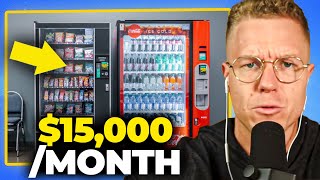
Quinn Miller, 27, runs 27 vending machines after ten months and makes $15,000 monthly with a 65% profit margin. He buys machines for $500–$2,000, stocks them with Costco products like Coke at $0.33 and sells for $1, and negotiates placement in apartments and motels with no rent split. Working 20 hours a week, he's proven the math: $50,000 startup, high-margin repeat purchases, and route optimization.
Chapters
I see vending machines on our thing and I think that a vending machine business is probably the most predictable, simple, understandable, guaranteed type of business you could do. Is that what you're going to?
Yes, so these two folks came to me and they pitched this idea they're raising money for. It's a vending machine business for, it basically is mostly female products, so tampons and stuff in bathrooms. And oddly enough, I had another guy email me a deck about a vending machine business and I'm not gonna do that one, but this first one was kind of intriguing. They've got some traction, they're making money. It's kind of intriguing. And I started doing some research and I tweeted out, who knows everything about— who's the person you need to talk about vending machines? It got a ton of traction for some reason. I think it's a lot of people are interested in this. This guy named Quinn Miller reached out to me and I did a call with him this morning. Very fascinating. He worked— and I just want to bring this up because this is the exact opposite of what we were just talking about, right? But it's oddly as compelling and as interesting, even though it's The two totally different, uh, parts of the world. So this guy, he's 27, he worked in software sales, he quit about a year ago to start this business. He's got a vending machine business and he gave me all of his numbers and he said I could reveal it. So he's about 10 months into the thing. He's currently doing $15,000 in monthly revenue and he's doing that across 27 machines. His startup costs were $600, $500 or $400 to buy a machine and $200 to fix it and move it to the place where it had to go.
By the way, this is our weekly Blue collar side hustle. This is the perfect blue collar side hustle. Yeah.
So on the $15,000 in revenue, 65% is profit. So he's doing around $9,700, $9,800 a month in profit so far. Total investment into the biz so far after he already bought his first machine has been $50,000. Time involvement per week, relatively high, 20 hours a week because he's actually delivering all the stuff. I asked him all about it. I was like, how does this work? Because the reason I reached out to this guy was I was like, hey, "there's this like tampon startup, it kind of looks interesting. What's your, tampon vending machine startup, what's your opinion?" He goes, "Yeah, I mean, I obviously don't know anything about that, like too much, but basically my opinion is the world," he goes, "America runs on Coke and Monster Energy drink." And I was like, "What do you mean?" He goes, "Let me explain. So I put these vending machines." I love that.
So let's slow down. So the guy basically buys vending machines like you and I are used to, just a snack vending machine, nothing innovative there.
Well, he does one, innovative thing. He puts a— he installs a credit card machine on them for about $250. You can get a credit card machine.
So he gets his vending machine. He says, all right, people aren't carrying quarters, so I'm going to take cards. He puts them— he puts them— so he buys each machine, you said, for $500?
The first one was $500. He has 27 machines with $50K. So whatever that math is. So what's that?
$2K a machine, roughly.
Yeah.
Okay. So he buys a $1,000 to $2,000 machine. He puts it in places like what? Office buildings, apartments?
Yeah. So he cold calls lower income hotels, motels, assisted living places, and low income apartments. Okay. So sorry, low income apartments, dash, or comma, motels, comma, assisted living places. Okay, great.
And so he goes and he basically says, hey, put this here and he— there's a revenue split or he pays rent?
How does that work? So most of these businesses, the way that they work is they give 10% to to 20% to the real estate folk, right? Uh, this guy, he goes, I actually am— because I sold software, I'm pretty good at sales, and I do what's called a value sell. And he goes, basically I say, look, your tenants are— are— if I just improve your tenant experience by just a small percent, maybe you're going to make more money because someone will want to stay or want to rent here. He gives them nothing. He gives them nothing. So he keeps— and so he's got a bunch of machines in like 10 different locations. And he just cold calls them. And then it's so unsophisticated. Where does he get his stuff? Costco. So he buys a can of Coke from Costco for $0.33 and he charges a dollar for it. Right. It's very simple. Not complicated at all.
By the way, my grandfather used to have a vending machine. So this was probably the first business I ever encountered was I think I was probably 5 years old and my parents, you know, they worked. So my dad would work in an office building and he needed me to be babysat. But then, like, you know, old people also kind of need babysitting. So my dad went for a two-for-one. He basically bought or rented out a little, like, kind of like a corner store inside, like a little deli inside of the office building. And, and then my, my grandfather ran it and we used to go like work the register at the age of, you know, 7. And he was like, baby, see, baby, see, he basically, he occupied his grandparents and his kids without having to like do any pay for any caretakers. In fact, it made a little bit of money. And then my grandfather had this vending machine that we used to go and do this exact refill. We would go to Costco, buy the Cokes, put it in, he would collect a bag of change, and then we would go to the bank and exchange the change. And I remember being like, what is this? He had one vending machine as his business.
It sounds awesome. And I asked the guy, by the way, this guy's name is Quinn Miller. Give him a shout out. Quinn Miller. I asked him, I go, how big can this get? He goes, look, I'm not trying to be offensive or anything, but the operators of these businesses typically are pretty hillbilly. Um, and so they're pretty unsophisticated, which doesn't mean they're dumb. They're just not sophisticated in terms of like technology or anything like that. And they like, do this, want a low-key, easy life. He goes, but I met a guy in Palm Springs who had about 1,600 machines and he was making anywhere from $5 to $10 million in revenue with about half in profit. Right. And I was like, well, that's pretty amazing. How else can it get big? Like, what else is big? And he said that there's a company called Canteen. And I looked it up. I think it's public, but they do like $15 billion in sales of this. And they're the largest vending machine company in America.
They operate them.
Yeah. And they do distribution. So the thing is, is like what this guy does, Quinn, he finds his route. So he finds a route. So he's like, all right, if I go from destination A to B, It's a straight line. I'll do everything in between. And so I try to find locations on the way so one truck can do all of it in a, in an easy short amount of time. And he's like, I'm very specific about where I choose. And that's where you make a lot of money is you can be very efficient with your time. And so basically that's what he does. And he said this company Canteen just does that on a huge scale. And they're ultimately at the end of the day a logistics company and a bit of a supply chain company. But at this point, Quinn told me he was like, I rented a small warehouse now because I'm getting so much freaking coke. He goes, the reason I like doing that. And so back to tampons, he goes, you have to like look at what the repeat purchase rate is. He goes, if I go to like a lower income area, these folks love Coke and love Monster to the point that one guy will drink 5 Cokes a day. I'm getting $5 from him. You have to ask yourself, can you get that for tampons or other products? And he goes, in fact, a lot of the vending guys, once they move from Coke and Monster energy drink, they're starting to go into what's called honesty market. So basically at a WeWork, you know how they like, you swipe your credit card and you only take one sandwich for $8. Yeah. He's like, that's where the money is right now. Huh. That's interesting.
And yeah, that's— so it's almost like there's whales for the vending machine. It's not like everybody buys one every 3 days. It's like one guy drinks 9 Cokes a day or, you know, 4 Red Bulls, you know, a week. And that's where you make your money is on the like 10% of the residents who buy like 90% of the goods or something like that. Probably.
Yeah. This guy was interesting, man. He's only 27. He's the— he lives in San Diego, worked in tech sales. He told me that he goes, like basically I'm a pretty— he goes, I'm pretty— I was pretty good at selling software. I'm not the best, but I'm pretty good. And this industry that I went into, they're just kind of not that great at that many stuff. And I could outsell relatively easily. I could kind of outwork relatively easily. And so anyway, fascinating story.










