How Walt Disney Turned Disneyland Into A $3.8 Billion/Year Empire
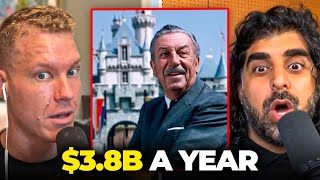
Walt Disney built Disneyland from a $17 million construction financed through life-insurance loans and an ABC TV deal, turning it into a $3.8 billion-a-year park. Opening day was chaos: counterfeit tickets caused overcrowding and plumbing failures. Within seven weeks, a million people had visited.
Chapters
So Disneyland does about $3.8 billion a year of revenue. Every day, about 50,000 people come to the park. So, you know, just roughly speaking, they make about just over $200 per guest per year. And that's, that's not counting the hotels, the flights, and the— and a bunch of the auxiliary stuff. So a ticket into the park is like $120, and then you spend like another $100 on food and merch. So what happened? So Walt Disney basically His story is kind of amazing. So he, he grows up and he, he's actually from your, your hometown. I don't know if you know this, you probably do, but he's from Missouri.
And I didn't know that.
Apparently there's a place in Missouri called Electric Park. Have you ever heard of this?
No.
Because this is the inspiration for Disneyland. When he's 8 years old, he goes to this place called Electric Park. And Electric Park was kind of known for two things. One, it was, it was an amusement park. And the second is it was really clean. And that's like one of the biggest things about Disneyland is Disneyland is really clean. So imagine having 50,000 guests over to your house, but somehow everything stays really, really clean. Um, and that was like, he's fanatical about this. So he goes to Electric Park and he wants to be a cartoonist. He, uh, ends up working at an ad agency and then he creates his first business. It's called Laugh-O-Grams. And he's basically doing these like kind of like animated, uh, cards. But you know, a bad business deal leads, it starts working, but then he cuts a bad business deal where, uh, he's owed a bunch of money by one client, and then they don't pay him, and, uh, the business goes under. And so he says, okay, let's go to Hollywood. And, um, and he tells his brother, let's go to Hollywood and let's create another business. And so they go and they create Disney Brothers Cartoon Studio, and this is where they create Mickey Mouse. This is where they create Snow White. That's the first big hit. So the company goes from, like, in debt or making no money to making millions of dollars off of Snow White. That was, like, the big win. And so he's like, okay, um, this is kind of working. And, um, the business is doing all right. It's not going gangbusters. Um, but it's afloat and he's working on his next stories. He's working on Pinocchio. He's working on a couple other stories. And he's always had this crazy idea about amusement parks ever since Electric Park. And he takes his daughter to the local merry-go-round and he's like, ah, this is like so boring. Like, why isn't there something more grand than just this merry-go-round? Like, my daughter loves this, but like, this is so boring for the parents and this is just one ride. Like, what if I made a place that was, um, you know, what if I made a place that was fun for both the parents and the kids to go to? Uh, which is like a similar theme with all Pixar movies and Disney, Disney movies, which is like the movie is enjoyable. Toy Story is enjoyable to an adult and a kid. It has like two layers to it. Both can enjoy a different piece of it. And so he's like, and so what, how did they actually come about this? How did they actually like figure out the idea? So they started by doing research. They went to every theme park they could find. They went to the World's Fair, they went to a whole bunch of places getting inspiration and ideas and mesh and thinking about what is bad about this experience, what can be made better? So things being dirty, blah, blah, blah. And he's like, okay. Um, and he starts thinking about the design of the place. And Electric Park had this, um, train that went around the whole park. And so if you go to Disneyland, that's still the thing. There's right when you enter, there's a train and the train will take you around the whole circumference of the park. And he's like, all right, I'm gonna build, and he used to tell people, one of these days I'm gonna build an amusement park and it is gonna be clean. And he takes two guys off of Pinocchio, and he says, hey, listen, um, I want you guys to start, uh, start working on like Secret Project X. And, um, he's like, you know, it's a shame that when people come to Hollywood, there's nothing to see here. Like, people all around the world have heard of Hollywood, they come here, there's the sign where it says Hollywood in the letters on the hill, but there's nowhere to see Hollywood. So he basically is like, uh, guys, if anybody came to even see our animation studio, they just see a bunch of dudes hunched over drawings. It's not very, not very impressive. Let's build something amazing in Hollywood. And the guys get super excited. They start doing research, but then reality hits. They have to, they're working on Pinocchio. They gotta ship it. They're working on Fantasia. They gotta ship it. Then World War II happens. So all of the, all of World War II happens. And then he comes back because he hires this guy Kimball to work in his studio. And Kimball's like this junior kind of animator guy and Kimball invites all the co-workers over to his house for like a barbecue or a birthday party or something like that. And in the back, in the backyard of his house, he's like, oh, by the way, you guys don't know this, but my hobby is I build these little trains, almost like the steamboat style train, but like it's like a life-size thing. It was very small, uh, it's like, you know, one, one, uh, like whatever, one link of a train basically.
Have you— his— this guy's name is Ward Kimball. If you Google him, he looks like a cartoon.
And you can see his, his train too. So Walt goes to this thing, he's blown away. He's seeing the train up close and he's like, dude, Ward built this thing? Okay, we're— the whole Mickey— he says, he comes back to the office, he sends a memo, he says Mickey Mouse Park is back on. And he tells the shareholders, shareholders say don't do it, movie studio is already on, on edge, this sounds like a big distraction, it's against the charter of the company. Uh, we don't want you doing this. He says, okay, um, no problem, I understand, I'll create a new company. So he just creates another company to create the park. He's like, I'm still gonna do this, but if you don't want in, I will— I'll do this myself. And, um, and he calls it like, uh, Redlaw or whatever, something like that, which is like, you know, uh, Walter backwards, uh, is kind of the neat way he names it. He starts working on it, and so he's like, all right, how do I fund this thing? He thinks it's going to take $5 million to build Disneyland. And in actuality, it ends up taking $17 million to do it. And so he's like, all right, how do I fund this? He, uh, he takes his, um, his life insurance policy and he takes a big loan against that. That gives him like, you know, a hundred grand or so to, to go do this. Then he sells a house that he had in Palm Springs. So it, that's like the next seed money. Uh, like he goes through that pretty quickly. Then he, then he goes, all right, I need some bigger money. How do I go get millions of dollars for this? Okay. He goes to ABC, the TV network, and he says, hey, ABC, You're struggling right now. You don't have much TV programming. I will create this, this program called like, whatever, like the Wonderful World of Disney or something like that. I'll create a TV show for you that'll air every Sunday if you invest in my park idea. So Disney basically puts down half a million dollars plus another about $6.5 million of loans and bonds, and they own 34% of Disneyland. And so that's how he got the next $7 million. And then he did the same thing with two other companies, and then he sold some sponsorships. He, he like accumulates together the $17 million, hustled his way. He hustled his way into doing it. The other thing that he did was he was like, all right, um, you know, this, this thing works because, um, he's like, I gotta hire— I gotta have like the, uh, the rides work automatically. And so he created this thing where if you go to Disneyland now, you sit in a ride and you go, and it's sort of like a, it's like a stage play that plays out, but it's all synchronized. When you're little like roller coaster cart enters this room, the lights go on, the character makes a sound, and then when you leave the room, it all folds back into its thing. And that's called animatronics. And so basically audio animatronics was like the thing he wanted to do, which was like, he wanted live animals, but it's too much work. So instead of live animals, he created these robotic animals and he said, I'm gonna synchronize the movements to music on a loop. And there's this one guy who was just working on only this and he was kind of in front of a green screen trying to make this like puppet do this thing synchronized to music. And eventually they finally figured it out and that was like the big breakthrough. So, okay, let me fast forward a little bit. They open the park, they build the whole thing in less than one year. They open the park and he only invited like 1,500 people to it or something like that. Uh, like invite only launch, but somebody counterfeited the tickets. And so double the number of people showed up with counterfeit tickets on day one because double the number of people showed up. everything breaks. The plumbing breaks cuz there's too many people using water in the park, more than the load was able to handle. So he, the, they come to him, they're, Walt, we got a problem. The plumbing is broken. You have to make a choice. Toilets or water fountains? He's like, toilets for sure. And so he, uh, there's no water, there's no drinking water that day. The asphalt was still so freshly poured that like women's high heels was getting stuck in the cement.
Oh no.
Uh, cuz it was like caving in. It was basically a giant disaster. And he does some PR. He basically says, look, um, we, you know, we had to work out the kinks. Give me a month, and basically they give me, give me some time and this thing will be smooth. And sure enough, within a month, the, the baby is, you know, humming. And in 7 weeks, he does a million visitors. So it was kind of an immediate hit once he did it because it was such a great idea.
Disney, right off the bat, or at this era, at this point, how famous were they? They were like, I mean, they were a big deal.
They weren't like a semi-famous. They hadn't had like I mean, nowhere near what they are now, but like they were semi-famous. Really, the ABC show, which he was doing while he was building the park, was almost like the hype video for the, for the park launch.
Was he just grinding the whole time?
Yeah, a crazy amount of work. And so he, he creates this thing and, you know, it's basically the 6th or 7th most visited tourist destination in the world now. And, um, you know, it's kind of a nice crazy place.
I think which is kind of shocking. I think Disney, or the theme park division prior to COVID, was the most profitable part of the company, wasn't it?
Except for— well, not profitable because they had a lot of expenses, but in terms of gross profit, yes, because they had a lot of revenue and a lot of expenses. Um, but now Disney+ is like the bigger thing because Disney+ is like pure profit. Disney+ basically took all that IP that people loved and created a streaming service.
But before that, before COVID before Plus, I like Disneyland. It wasn't Well, it wasn't a project, it was, uh, like a major value creation. A lot of value was created there.
I wanted to know, is this a— is this a loss leader or is this a, um, a cash cow? And it's— it's more like a cash cow. It's hard to tell because every company's like accounting makes everything look like it's like losing money, you know what I mean? Like accounting can make something look amazing or terrible regardless of it. But you know, the parks division, Parks and Resorts, was doing, you know billions, like, I don't know, like $30 billion a year or something crazy like that. So it was, you know, obviously became a smash success. When he wanted to do Disney World in Florida, he creates 5 stealth companies cuz he's like, Disney was a hit. He's like, I'm looking for the second location. If anybody finds out where I'm looking, the price will go up. So he creates 5 shell companies. He starts buying up land in Florida. Sure enough, it leaks out the day after it leaks. The price per, I think acre went from like $180 an acre to $18,000 an acre. Basically, he couldn't buy anymore once the news leaked. And, uh, and, you know, he had this like kind of like inspiring vision. So he's like, Disneyland, I want this to be the happiest place on Earth. And he's like, I want people to have no problem, no problems with their hair. I want this to be an escape from your problems, you know, um, in real life. And Disney World, he's like, he created this thing called Epcot, which, uh, I don't know if you've ever heard of Epcot, but Epcot is basically Government agency? No, it does sound like it though. EPCOT is like right next to Disney World. It's this huge dome-looking thing and it stands for— it's an experimental— what is it? It's Experimental Prototype Community of the Future, uh, something like that, of tomorrow. That's what it stands for. Um, and so what he did was EPCOT is basically like— it takes the cutting edge of what the future looks like and it creates like a mini simulation of the future. So you can go and see the latest, what the future is going to look like in terms of technology Did you go? I've been once when I was a kid. Yeah. And it's kind of amazing. And so, um, and he's like, you know, did, but all of these projects, he, he, I'll, I'll read you some of the quotes that I thought was pretty great for him as like an entrepreneur. He goes, um, I want this to be, uh, the happiest place on earth. I want parents and kids to have fun together. He goes, um, with, when it came to Epcot, he's saying, um, where is it? He goes, I want this to be a living blueprint of tomorrow. I want this to be an always evolving thing. Epcot is never gonna finish because tomorrow will always be different. Than today. Uh, Disneyland itself will never be completed. It will go— it will go on as long as there is imagination left in the world. And so since then, you know, they built the park for $17 million, but obviously they pour in like hundreds of millions of dollars every year to upgrading the parks, changing the, the rides and the themes and all that stuff, um, in order to, to kind of keep it continuously evolving.










