Jason Calacanis shares his business tactics – Hustle Con 2016
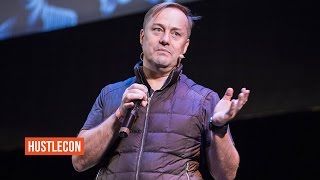
In a live Q&A at HustleCon 2016, angel investor and entrepreneur Jason Calacanis shares his hard‑earned lessons on startup investing, market cycles, and hustle. He explains his strategy of being the first check in companies like Uber and Thumbtack, defines hustle as turning two nickels into a dollar of value, and warns that the post‑tourist‑season market will be tougher but less competitive. Calacanis critiques modern PR, arguing that journalists’ credibility has eroded and that targeted digital channels (social, paid media) now deliver better ROI, with Zillow cited as a rare PR success. He discusses virtual/augmented reality, emphasizing that the technology is finally viable, but startups must keep burn low and seek paying clients for early projects. He champions Amazon Alexa as an open, fast ecosystem that will dominate voice interfaces, urging everyone to adopt it. He cautions about regulatory boundaries, contrasting harmless disruption (ridesharing, Airbnb) with high‑risk sectors (healthcare, fintech) where cheating can lead to legal trouble. Finally, he reflects on his blunt, iconoclastic personal brand, arguing that candid honesty builds trust with founders and investors despite occasional controversy.
Chapters
How many people in the audience are entrepreneurs? Raise your hand if you're an entrepreneur. Okay, raise your hand if you're an angel investor or investor of some type. A couple of those. Okay, raise your hand if you just stumbled in here off the street. Okay, that's the rest of you. Very good. All right, so I'm an angel investor and an entrepreneur. Sam asked me to come out to HustleCon, and I said, "Great, what format should we use?" He said, "Well, you can give a talk, or you can do Q&A." I said, "Let's do Q&A," because I like to actually hear what people are struggling with, trying to figure out, and help them a little bit. I get to see about 500 companies a year in person and talk to them about what they're building, and I've done that for 5 years. Before that, I was an entrepreneur myself. Now I'm an angel investor. I've invested in 150 companies. I invest in 40 a year. I try to be the first money in, so with the cab company, I was probably the third or fourth investor, Uber, and with Thumbtack, I was the second investor. So I try to be that first check who believes in you before anybody else, when everybody else is doubting you. And in fact, when I invested in Uber, I emailed 20 different VCs and angel investor friends. 2 of them said yes, 18 said no. I was just at a board meeting with one of the people who said no. He is really depressed. I mean, like, Really depressed. He's like, "I should have just listened to you." And I said, "Yeah, you should have." I'm a gambler, high-stakes poker player, and I'm a hustler. And I believe the great entrepreneurs are the ones who can take 2 nickels. Now we got 2 microphones? Check, check, 1, 2? Okay. My definition of hustle are the people who can take 2 nickels, rub 'em together, and get a dollar of value. That's what I see in my portfolio when I meet startups that do really well. They tend to figure out better than their competitors and their peers how to get more with less. That is the secret. Now, we've lived in very heady times. The last 2 years have been what we call in the industry tourist season. Everybody comes to Hawaii from December 20th till January 10th, and they destroy the island. That's sort of been the tech industry for the last 2 years, and during the dot-com bubble, everybody rushes in, "Oh my God, I'm gonna make an app, I'm gonna make a billion dollars." All the rent goes up, you know, the office space goes up, developer costs go up. But thankfully, we're at the end of tourist season. The next couple of years are gonna be tough, they're gonna be hard. Just like it was 5 or 6 years ago, and that's actually good for the real entrepreneurs. So it's going to be hard work over the next couple years to be an entrepreneur, but you'll have less competitors, you'll be able to gain market share, and it's going to be back to the sort of new normal, is what I'm seeing. So I guess a question? Hello.
Hi, Jason. Marisa Harrison, Liftoff Communications. So I've been around, I've launched over 100 startups, had a PR firm in the '90s, lucky enough to sell it to Omnicom. Did a few, my most recent thing was my own startup, did an e-commerce startup, but now I've come back to the communication framework, but much more in a growth marketing sense. So the question to you is, what's with the PR haters? And I'm talking about the, I get that we're an engineering-driven culture up here, But there is a whole lot of, I guess there's a lot of articles and a lot of, there's a sentiment that PR is more fluffy than ever. And I'm talking really more about the narrative piece, not the getting press. And I'm just wondering what you think of that and if you can comment.
Yeah, it's actually a very good question. Why do people hate PR? And PR people by extension. No offense. So as a former journalist, I can tell you PR people are super annoying. We all know that. They send like the same email to 100 different people, and they don't know who they're emailing, and they send a biotech company to somebody who covers mobile, and a mobile company to somebody who does medical devices. So, but what's happened recently over the last couple years is how good a product is is largely determined by the audience. And not by PR people and their cozy relationships with journalists. So it used to be you had to go through Walt Mossberg at the Wall Street Journal to get your gadget anointed. Then my last company, or 2 companies ago, we launched Engadget, and then it became, you know, you get Walt Mossberg from the Wall Street Journal, then Peter Rojas from Engadget, and so PR was still really good. Um, but today people go to things like Wirecutter, or Twitter and social media, um, or to Amazon, and they look at the ratings, and they pick companies based on how good they are, not by these intermediaries. So the whole value of PR people was their ability to shape the narrative with journalists, and people don't trust journalists anymore, people don't listen to journalists anymore, there's a huge credibility problem, 'cause journalists don't spend much time on stories. And at the same time, other channels opened up, like Facebook custom audiences, email, and targeting through Twitter and other services, Google, YouTube. And these other channels were much more effective at finding your customers and converting them. So the idea of PR people going and, you know, spending 15K a month on a PR firm you probably would be better off buying clicks or acquiring customers with these other platforms. So I think PR can work. A great PR company, a great example of that would be Zillow, which had a PR team that went after very local markets and the local television stations and the local newspapers, and they did a really good job of providing local data and they did a data play where they really educated local markets, and that worked out really well for them. But it's a good question.
Okay, I'm not allowed to respond. However, you're talking about the lowest, you're speaking to the lowest common denominator of PR people, and I'm just wondering why that happens. You don't have to answer here, 'cause it's kinda like there's bad companies, bad VCs, bad angels.
Yeah, I think it's because the majority of PR people are bad. Next question. Listen, there are like 6 PR people who we don't hate. I don't hate, like, they do a really good job, but the majority, 98%, do a bad job. Next. Hey, my name's Chris. I'm working as a developer in the city. I had a profound experience using Google's Tilt Brush the other weekend, the 3D painting application. I see that there's huge, huge potential. I'm wondering what your— what areas or industries, what opportunities do you see VR having the greatest impact? And a way we can get into that space? Great. Um, so venture— uh, virtual reality, augmented reality. Um, this is probably the 5th or 6th time virtual reality was gonna change everything. The first time was VRML. Anybody remember VRML? Okay, some old-school people here. Uh, Gen Xers. That was Virtual Reality Markup Language. We were all gonna go to Yahoo and click on the directory and click on arts and then go to, like, photography, and then pull out a drawer, and then pull out Ansel Adams photos and open them up, and then people realize that's really stupid, um, and didn't work because of GPUs. Now we have this incredible device which has GPUs that are just demented. Um, and so there is going to be an opportunity. I think that this is the time. It's not a false start. I think sometimes fifth, sixth time is a charm. If you look at web video, there were hundreds of companies that did web video, and it was It wasn't until YouTube basically used Flash syndication and the lowering cost of bandwidth to actually make it free and work. So I think it's a similar analogy, which is now is the time for VR. Of course, it's $600 for a headset, you need a $2,000 computer, so, and it's fragmented. So you have to be very careful if you're building a startup right now to not run out of money because there is not gonna be enough there are not going to be enough consumers to actually make a viable business, just like there's not enough Apple Watch users yet to make a viable business. So that's the opportunities to get in there and learn, but you want to keep your burn rate low and experimentation high. I was an investor in a company called Riot, R-Y-O-T, that was doing journalism in 3D in virtual spaces. So they went to Syria and they did this like on-the-ground journalism. It's really, really powerful for that. It's gonna be really powerful for education. Obviously, adult entertainment and video games are no-brainers on the platform. But I do think AR, augmented reality, which is when you see the real world and put information out there, is also gonna be very powerful. So, perfect thing to invest your time in, figure out, and have paying clients. And actually, that company Riot has done pretty good by having people pay them to create experiences. So I would look for customers to underwrite the experiences because when a new technology like this comes out, every brand, every publication, everybody with money is like, "We have to have a VR strategy." Go take their money and learn on their nickel. That's my best advice. Get the money. Hey Jason, I'm Brian, a big fan of the podcast. Curious to hear your thoughts, if you were running Amazon, what you would do with Alexa and why. I'm addicted to Alexa. How many people have Alexa? Oh my God. Alexa, play Girls Just Want to Have Fun from Spotify. That's what I do with my 6-year-old daughter every morning. Alexa is amazing. I think for those of you that don't have it, go buy it. Like literally get on your phone right now and buy it. It just works, and it's an open ecosystem. It's everything that Siri should have been. Every week they release new little scripts, little recipes that you can do on it. And some of this stuff is obvious, like set a timer, play music, play a podcast, but it's quickly going to be on your desktop, and I would make it an open API that's on your desktop so you can say, Alexa, set coffee with Jason at Wrecking Ball Coffee at 2:00 PM on Friday, and it goes and does it. Talking to computers makes you feel really stupid, because it never works, right? Like, you're like, "Siri, do this," and she's like, "No." She's like, "I can't figure that out." And Apple has completely dropped the ball in this regard by making a closed ecosystem. And Amazon is going Android, open, and it's really starting to work. So if you don't have it, absolutely buy it. It's, it's really going to be trouble for Sonos as well, because the amount of time it takes to play something on Sonos is like 40 seconds, and the amount of time it takes to play it on Alexa is like 4 seconds. Now, that doesn't seem like a lot until you compound it to hundreds of times a month, and that's really— when you see a 10x lift like that is when a technology can really have a major impact. I think Alexa is going to be huge. And they're doing everything right with it. If you don't have it, just buy it. It's super cheap. I think there's like a $150 version of it now. And it really kicks ass. Good question. Hey, Jason. My name's Ben. Hey, Ben. There's— yeah, how's it going? There's, uh— How you doing? Yeah, yeah, this is pretty fun. Yeah, it's a pretty cool theater. There's definitely industries where there's regulation that can't be circumvented. Healthcare, fintech, do you have any great stories for, say like, ways to hustle? Well, let's start with how not to hustle. Breaking rules is fun, disrupting is fun, until you're dealing with people's blood, and testing, and then making medical decisions. So an example of what not to do is to tell people that you can take a pinprick and then tell them what diseases they have, because you might go to jail. That would be Theranos. Now, if there is a law on the books about how many nights a year you can rent your house, and how many guests you can have, and if you need to be in the building or not, and it varies by town to town and city to city, well, maybe, since nobody's being hurt, Airbnb can be a little bit aggressive in reinterpreting laws, reinterpreting laws that might be 10, 20, 50, 100 years old. And if you get people on your side, in other words, you know, Uber had customers who really love ridesharing, Uber and Lyft had people who love ridesharing, and Airbnb had hosts who would go to City Hall and fight for them. A company like Zenefits, which had a couple of mistakes they made. Still a great business. Full disclosure, I'm an investor in that one. But they work in insurance, and they created a little script you may have read where you could kind of cheat on getting licensed. That's an area where you do not want to hustle. Healthcare, compliance for insurance, where people's lives can be deeply impacted. Now something like ridesharing and, you know, housing, the laws can be interpreted and it's fine. You just really have to be careful, 'cause there's some people who are quite humorless in our society, and government agencies tend to be one of them, especially when more is at stake. So if you look at computer crime, like literally we could all go across the street, kick in a door, take the cash register, punch the person in the face, and get 6 months or 6 weeks in jail. Or a suspended sentence. If you hacked into their computer system and took 1,000 credit cards to see if you could do it, you'd go to jail for 8 years. It turns out, because cybercrime scares the public so much, you know, the Attorney Generals really want to make an example of those people, the Feds, you saw what they did to poor Aaron Swartz, rest in peace, like, they really were gonna like, take a kid who stole a bunch of publicly available documents, and they were basically pushed him to kill himself because it was just too horrendous to consider going to jail for 10 years. Be very careful which tiger you poke, and be prepared for the repercussions. I think this disrupt culture, you know, it's fun to think of, but in practice, I would be very careful. And, you know, there's the gray area. and if you operate in the gray area, and you help consumers, people will forgive you. So lowering the price of taking a cab, allowing more people to rent their homes and make spare income, you're kind of on the side of the people. When you cheat on an insurance test, like the kid from Zenefits built that script to do, you're kind of like a dick who's trying to make money and cheat, and people don't like cheaters. And that's a really fine line of like, are you working for the people to make the world better, Or are you cheating to make yourself more money? So I would look through the lens of that when you're thinking of when to dance along that little line. Thanks. Peace. Okay. How's it going, Jason? It's going pretty good. How you doing? Good, man. My name's Austin. What's up, man? Question for you about how you present yourself sort of like to the industry and the market as a whole is one of the things I've noticed is you tend to be more iconoclastic and you aren't afraid to step in the middle of controversy or say something unpopular. Sometimes that works out, sometimes you're right, sometimes it's not. I'm wondering if that's an intentional thing that you've cultivated and with an advantage in mind, or if that's just who you are and you've decided to run with it. Okay, it's a good question, especially 'cause it's about me and my personal brand, I like that. As a narcissist, I endorse your question. Thank you. In all seriousness, I grew up in Brooklyn. My dad's a bartender, my mom's a nurse. What's up? And listen, people didn't want me in the industry. I had to fight my way in. And as a journalist, I found that the more blunt and candid I was, just like we were on the stoop in Brooklyn when we would talk shit to each other and we'd bust each other's balls, I got rewarded for that. And when you get rewarded for something and being who you are, you have a choice when you actually arrive and you get some success and influence. You can either say, wow, you know, I got here by being blunt and candid. And you know what? Now I'm going to change. I'm going to professionalize a little bit and maybe not say Theranos is probably a fraud. It seems like a fraud to me. Seems like they handled everything like somebody involved in a fraud would. Doesn't mean it is a fraud, but I kind of— my, my radar says this is just a full-on fraud. Now I'm very careful how I say that. I don't have firsthand knowledge it's a fraud, but anybody who is doing fraudulent behavior would act the way they've acted, and anybody who had an actual real technology would just show it because it would end all discussion, right? So I said this on CNBC, you know, and I say it when I talk, and I'm kind of blunt blunt and candid about it, at least when people work with me, they know what you see is what you get, right? So I think it's very important to be authentic in who you are, and if who you are is you're blunt and you're candid, yeah, sometimes I put my foot in my mouth, but most of the time, it can irk some people, sure, but I can also grow on people, like a fungus, if you will. It's what one of my friends told me. He said, "God, I hated you when I met you, and then you grew on me, and now I love you. I love hanging out with you." I said, "Well, thanks, Chamath." He actually said it on stage, but it's— I think you got to be candid and blunt, and the world is full of bullshit, and our industry is specifically full of a lot of bullshit, because here's the thing about angel investors and VCs when you meet with them. If I tell you, "I don't— you know, your business doesn't make sense to me for these reasons," and I'm not sure if you're executing at a high enough level, as an entrepreneur, you actually now respect me, because I may have helped you by being honest. But if you figure it out and you make a bunch of money, some VCs think you're gonna say, well, fuck Jason, he didn't believe in me in that first thing, and he told me like my product didn't look good and it wasn't designed well. So I might lose my ability to get an investment into your company later. I found the exact opposite. But VCs will never say no. They're like, let's keep the dialogue open. Let's keep the dialogue open means I don't believe in you. Hey, can you keep me updated on your progress? That means I don't believe in you. So what I just tell founders when I meet with them is, here's everything I think about your business. But before I do that, I say, you want the red pill? You want the blue pill? And universally, everybody takes the truth pill, which I believe is the red pill. I think blue pill keeps you in the Matrix, and you can start living your delusion that, my God, you're going to change the world with your shitty design that looks like it was done with Microsoft Paint, you know, like— and some VCs are like, oh my God, this has such great potential, but I don't want to give you money. It's like, well, if you think it has great potential, give me money. So I just think being candid at all times is a really good strategy for life. Right? And that's sort of the way I try to live my life. Thank you. Okay. All right, that's all the time we have. Thank you, guys.










