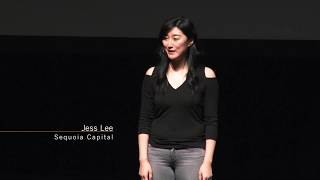
Jess Lee, partner at Sequoia and former CEO of Polyvore, left Google for a small startup after learning to ignore sunk costs and seek discomfort. She learned every role at Polyvore, from coding to marketing, and now runs Female Founder Office Hours to support women entrepreneurs.
Chapters
Hi everyone. Hey. Wow. Hi, I'm Jess Lee. I'm a partner at Sequoia Capital, and before this I was the CEO and co-founder of a company called Polyvore in the fashion tech space. Thank you, that's so nice of you. And then before that, I was a product manager at Google Maps, back in the days when we used to print our driving directions and carry them around in the car. So it's a while back. And I think I'm supposed to tell you a little bit about my life story in 10 minutes and sort of share some of the lessons that I've learned. So I'm gonna take you back to high school. I grew up in Hong Kong. I was not a very popular kid in high school. I was super into art and drawing and anime and manga, and my goal in life was to be a go to art school and be a graphic novelist. That didn't work out. My parents are Asian, and they said, "No, you can't go to art school." So I didn't. But I was— I did get pretty good grades. So I wasn't very— maybe I was like, if you think about the totem pole and how popular, maybe I was in like the 35th percentile of popularity. But I was— I got good grades. And one day, one of my teachers, my English teacher, came to me and she said, "Hey, why don't you take the AP English exam?" And I was like, "Oh, but I'm not in the AP English class. I don't qualify." She's like, "Why does that matter?" And so she encouraged me to take the test because she thought I was good at writing, and I aced it, and I got a 5. And who cares what my actual AP English score was, but I think that was an important lesson for me because that teacher taught me that sometimes there are rules around what the requirements are and how you're supposed to be qualified for something, and you don't really meet them, you should still go for it anyway. And so that's what I did, and that was a very early important lesson that has carried through the rest of my career. So let's fast forward to college. I ended up not at art school, but at Stanford, where I was really excited. I was moving to the US for the first time, and I had gotten pretty good grades in high school. In fact, I think I was probably in the I think I was valedictorian. I had the best grades at my school. But I got to Stanford, and I realized that every other kid there was valedictorian of their high school. And so, for the first time, I felt like, "Oh my God, I'm so dumb." I remember feeling like I didn't understand, I wasn't as well-read, I wasn't as articulate. I was also fresh off the boat. I had just moved from another country. I didn't understand any of the pop culture references or jokes that were happening in my dorm. and I just felt completely out of place, and I wondered if it was a mistake that they had let me into Stanford. But it was also at Stanford that I learned about this thing called duck syndrome. And I think it applies not just to Stanford, but to all of Silicon Valley, where you look at a lake and you see these ducks floating along, and they look really peaceful, and they're like swimming along. But underneath, they're paddling furiously, and they're working really, really hard just to stay up and look calm. And that's what I realized Stanford was like. Everyone there felt a little bit like, "Oh, I'm not the smartest person anymore. I don't get good grades anymore." And all you have to do is you have to just work really, really, really hard. And I ended up majoring in computer science, and I don't think the main thing I took away from my computer science degree was actually any of the theory or the problem sets. It was actually the ability to force yourself to work really, really, really hard and be a duck. That's something I've always carried with me because I think in Silicon Valley in particular, there's sort of this feeling of like, "Oh, how are you doing? How's it going? How's it going with your company?" And there's this pressure to feel like, "Yeah, yeah, I'm doing great," or "I'm crushing it," but nobody's ever really crushing it. And that was a lesson that I learned at Stanford. So I killed myself trying to get my computer science degree at Stanford, and it was my senior year. I had accepted a job as an engineer at a company called Intuit, and I was like, you know, that was my path. My parents were happy again that I was not going to be a graphic novelist, and I was going to go be an engineer. But then I got a call from Google, and this is in 2004, and they said, "Hey, we would like you to interview for the Associate Product Manager program." And I had never heard of a product manager before, but because it was Google, I was like, "You know, maybe I should just take the interview and see what happens." But I remember feeling really bad about it and feeling like, "Oh man, I accepted this other offer, like what should I do with my life?" And so I actually said that to pretty much all of my interviewers, which is probably not a good thing to say in an interview, but I just genuinely didn't, I mean, I had really interviewed I hadn't interviewed very much before, so I asked all my interviewers, I'm like, "Well, you know, I spent 4 years studying computer science, and I was supposed to be an engineer, like, should I do this product manager thing?" And I remember one of my interviewers looked at me funny, and then he got up and went to the whiteboard, and he wrote 2 words. He wrote, "Sunk cost." And he was like, "Do you know what that means?" And I was like, "No." And he said, "Sunk cost is you've already given up those 4 years killing yourself for your computer science major, and you're never gonna get that time back." "so you should really just optimize for your future," which is really great advice. He's like, "Don't think about that. Don't let the past decide your future. Just do what you think is best going forward." I was like, "Wow, that was a really smart guy." My second interviewer was Bret Taylor, who was— Woo! Bret Taylor fan in the house. Bret later went on to become the CTO of Facebook, and I just remember as I met him, he was a computer science major like me, smart, and just seemed kind of comfortable in his own skin. I was like, "Wow, I kind of want to be like that. I want to be confident and cool." And so I just remember thinking, "Maybe I should just go be near the awesome people, and then I will absorb their awesomeness through osmosis." But that was a lesson. I thought, "Okay, I have to go and find— be around the awesome people." One of my later interviewers was Marissa Mayer, who was at the time a director of product at Google, and then later went on to become the CEO of Yahoo. But at the time, she ran the APM program at Google. And I asked her the same thing, "Should I take this job?" And she said, "Okay, well, when I look back on my life and I think about all the times I had to make a difficult decision between two paths, I always tried to pick the more challenging path because at least I would learn something and I would grow even if I failed. So I would encourage you to pick the more challenging path." And so I thought about that, and I thought, well, I know how to be an engineer. That's what I trained for. But there's this exciting product thing, the sunk cost, being around awesome people, and doing something challenging. So that's what I did. I ended up at Google, became an early PM for Google Maps, and I had an awesome time there. I learned so, so much. Then one day, someone showed me Polyvore. Polyvore was actually created by 3 ex-Yahoo engineers. And it's an app where you can mix and match products and express your sense of style, and it was so much fun. I became a heavily addicted user, using it 3 or 4 hours a night. And I decided to write to the founders and give them some of my suggestions and complaints. I said, hey, there's this problem. Can you fix this? I have some suggestions. And then they wrote back and said, hey, these are all great. "Hey, why don't you just come work here and fix all this stuff yourself?" And I was like, "Oh, you know, I— interesting." So I met with them, and I really liked them, and I felt like that was another set of really awesome people that I wanted to go be near. And I thought, "Okay, when else are you gonna find an opportunity to work on something that's like you're in love with, where the team's really, really small?" I ended up going to Polyvore, and I remember still, again, being very nervous about this decision, and then when I resigned from Google and I went to talk to the VP of Product, Jonathan Rosenberg, he said something to me that was very interesting. He said, "Don't worry. You can always come back." And then I realized Google hires like 100 people a week. I could go back, right? And so that was a really important lesson. When you have that choice between something that feels kind of once in a lifetime, you should grab that, because oftentimes, the other path will still be available to you in the future, right? So anyway, that was another important lesson. So Polyvore, it was 3 people when I joined, and we had so much to do, and I had never managed a human in my life, but I just kept volunteering to do things. By virtue of being maybe, I think as a good PM, what you do is you just try to volunteer and do whatever needs to get done to move the product forward. So in the beginning, I wrote code, I washed dishes, I answered the phone when advertisers called, I wrote our blog, just kind of did whatever, because I was the worst engineer on the team, and I thought, "Hey, if there's something that needs to get done, I should probably let the real engineers write the code, and I'll just do the other stuff." And over time, what happened was I picked up these responsibilities, never felt qualified to do them, like running marketing, but what I did was I learned just enough to be dangerous, and enough to hire someone who was awesome, who I wanted to be around me to help teach me how to be excellent at something like marketing or sales. And so the team grew and grew and grew. And fast forward, eventually all the groups in the company were reporting to me except engineering, 'cause I'd hired so many people. And it was at that point that some of the original founders came to me and they said, "Hey, you know what?" "We've always thought of you as a co-founder, and you've always acted like one, so we're gonna start calling you co-founder, and we're gonna give you some of our shares." And that is an incredibly, incredibly generous thing to do, and I will say that I have been mentored by many great women and by many great men, but I will always be grateful to Jining, Pasha, and Guangwei for that very, very generous act. So I became sort of an official co-founder, and then eventually I became CEO. And as CEO, I learned a lot of lessons about startups. The primary one is that startups are really, really hard. And again, I felt that duck paddling, that duck syndrome, because I looked around and I read TechCrunch, and I read all these different blogs, and I felt like, "Man, everyone else's company is amazing, but I have a lot of problems. My VP left, I had to fire someone." Our traffic is down this week. I just felt like I was paddling furiously. It turns out that that's true of most startups, but we just kept growing and growing and growing. Eventually, through lots of ups and downs, I learned a lot about how to be a CEO. The first, I think, and most important lesson was that at the end of the day, team and culture matter so much. You cannot always control the outcome, You'll go through ups and downs that are totally outside of your control, but you're on a clock. You have money that you could run out of, your funding, and you have the patience of your team. If you treat your team really, really well, and you build a culture, and you surround yourself with awesome people who want to work together, they will give you just that little bit of extra time. When it looks like probably everyone should just leave, it's not really working, they'll be like, "You know what? I really love this culture, and I really love this team, so I'm gonna stay." stick it out for another month or two, and then you sort of turn the corner. And so we kept going, and eventually we were acquired by Yahoo in 2015, and it was actually a successful outcome. Phew! But, again, the entire time I just felt totally unqualified to be doing that job, but it ended very well. And so that brings me to today. I have thought about what to do next after Polyvore, and I realized that all those lessons I had learned along the way brought me to where I am today, and I decided to go be an investor and join the dark side. And as I was thinking about that, I thought, maybe should I go do something? Should I try being a founder again? I spent all this time working on being a founder, and maybe I would do it slightly better the second time around. And then I thought about sunk cost, and I thought about, well, I could always go back to that, right? Now that I've done it once, maybe there will be options going forward, so I should do the thing that seems what seems more difficult, more challenging, where I'm gonna grow and learn the most. So I decided to go be an investor. I chose Sequoia because I felt like if I'm gonna go and learn the art of venture capital, I'd like to learn it from some of the best people. Every person I met there was more awesome than the next and seemed like there would be a lot of great osmosis for me. And then, you know, one of the things I'm passionate about is helping women in tech. I was a female founder working on a product targeted at women, and it was hard to raise money sometimes. So one of the projects I work on now is this thing called Female Founder Office Hours, where the goal is to get all the female founders together, let go of duck syndrome for a little bit, and just really share the stories of how hard it is and really help problem solve. So that's femalefounderofficehours@femalefounder.org. So that's my story. I don't know what the next chapter will be, but I will say that The interesting thing is when I look back on my entire career, I have felt pretty unqualified for almost every role that I've ever been in. Like I'd never done it before. I'm a first-time founder, first-time PM, first-time CEO, and first-time investor. But what I realize now is that feeling of being unqualified is exactly what you're supposed to look for. I go back to Marissa Mayer's advice, and she said, "Pick the more challenging path. Go where you're gonna grow and learn." And learning feels like being totally unqualified. So now I think that when I think about my career, I always try to think about how do I go find that really nauseous feeling where I'm like, "Oh, I don't know how to do this. It's really uncomfortable." And that's really the advice that I mostly wanted to share with the group tonight. Go seek out that feeling. If you feel really comfortable and like you know exactly what you're doing, it's probably time for you to do something different. Thank you.










