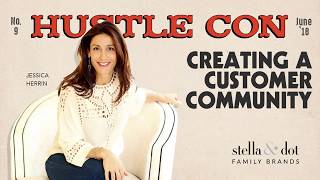
Jessica Herrin built Stella & Dot, Keep Collective, and Ever by treating customers as tribe members instead of sales targets. She scaled to 50,000 independent owners across six countries and $500 million in revenue using door-to-door acquisition, limited-edition scarcity, and transparent inventory. The model funds women's education while staying bootstrapped after the initial venture round.
Chapters
Good afternoon. Hey, first of all, I'm extremely impressed with you. If you want to talk about hustle, it is the people that will show up in a dark room when it's totally gorgeous outside on a summer Friday. So I am very, very grateful that you're here, and over the course of the next 20 minutes or so, I hope that I can serve you in some small way where you get some nugget of wisdom for something that will help you on your entrepreneurial endeavors. I can tell you that I'm gonna share what I have done right and what I have done wrong. Both have been equally valuable, and that was a good intro. I hope that, is anybody here familiar with the Stella Dot family of brands? Oh good, thank you, I'm so glad. This is, we're about a lot more than accessories. We're really a family of brands across different women's lifestyle categories. We have 2 accessories brands and a skincare cosmetics brand, and we have 50,000 independent business owners in 6 different countries that have earned over $500 million in flexible earnings. By selling our products on our social selling platform. So it's probably not what you were imagining in terms of an old-school direct sales business. That was the goal of this business, so by way of introduction, I want to just talk about what I mean by community, which is really business that's there to serve a group of people, a movement. When I think of community, I don't think about a Facebook group, though we certainly use many of them, but when I think about being community-driven and purpose-driven, it's about having a business with a different center that doesn't think about Of course, we think about profitability and everything else that a business should, but it's not our primary purpose. So this is how we began. I know what you're thinking, that those children are adorable, and boy, that looks like a dump, and those are both true. I had been an e-commerce entrepreneur before, and I can tell you the journey from one to the other was kind of crazy. I think every overnight success story takes about 7 years, and that's certainly what it was for me. I was here, I feel so, it was easy for me to be an entrepreneur in many ways, and I know that easy and entrepreneur don't typically go together, but when you think about the stars aligning in the grand history of time, I was born, you know, in this country, I graduated from Stanford in 1994 at the advent of the internet, the first time that women were earning degrees equal to men, and everything was a startup. So I went into technology startups, and I did what a lot of entrepreneurs do. I then went back to Stanford Business School and dropped out to start the company that would become weddingchannel.com. And I went at that business with my head, and I looked at every framework and said, where's a large addressable market space that you could disrupt with technology? This was the early days of e-commerce, it was about aggregating price and availability to bring wedding gift registry online, and that business worked. And it worked so well, we were on Oprah for being great entrepreneurs, and all these women reached out to me and said, you know, it was an Oprah-ized view of the story, so it was like, 'cause she loves shopping, so she started this business. This is actually not what happened. But people reached out and said, how do I start this business? And I honestly thought that all I could offer was I had raised over $120 million in venture capital, I worked 7 days a week, and all I could think was, I don't run this business, this business runs me. I'm honestly, I'm like this business's bitch. Like, I can tell you what you should do is don't do this. And I really thought to myself, how could I be so successful in what you're supposed to be pursuing as an entrepreneur and actually feel like a fraud. And every metric that you wanted to check off, the business checked off. So I said to myself, hold on, I'm wired to hustle for sure, I'm an entrepreneur by trade, I look at the world and I just see the way that I want it to be instead of the way that it is, and I become endlessly obsessed with making it so, but if I'm gonna do that, it better be for a purpose, and that purpose better not be to just create liquidity for the different people on the cap table. So I decided to go at it again, very differently, and being mission and community driven, and really saying, what are my passions? And for that, and at that time, I had this serendipitous experience of discovering direct sales. I was staying at the Adolphus Hotel in Dallas. Has anyone been there? It's kind of old and creepy, a bit like this theater. But like, the elevators are this big, so if you were in the elevator, you were like making out with the other person in the elevator. Like, this is intense. And I was there with these women that were pink caddy drivers. They were women with Mary Kay, they had sashes and tiaras, and they were clearly very, very successful. It was clearly a community. It was a business where it was about more than makeup, it was clearly about people, and I could see their joy and their expression, and I was in this business in this world where all it was was about growth and challenge, and even if we were growing, we weren't growing enough, and I thought to myself, you know, that's the business I wanna be in. It's the people business, and I'm so curious about it. Now I thought, that it was like a pyramid scheme that was stuffing inventory into closets and had a lot of false promises, and honestly, a lot of that was actually accurate, and it scared the crap out of me, meaning I thought there's no way I could go into a business like that because what would people think? Right, here I was, the poster child for e-commerce, and then I was gonna go start this crazy industry, but I realized that that wasn't the reason why I shouldn't do it, that was the reason why I had to. And I wanted to change it, and I wanted to use what I'd learned as an entrepreneur and really go in and reinvent what that meant. I went to this conference, this industry conference, and learn, to learn about what is, you know, how do I do anything in direct sales? And I think that's what you do as an entrepreneur, right? You crack a book, you go to a conference like this, you talk to people, you ask questions, you soak it in, 'cause you start knowing nothing, and then you just figure out a little bit as you go. And what really got me was when I went to this conference, it was all supposed to be about the mission. Everybody's tagline, every mission that was painted on every car, corporate office's wall was about being the company for women or serving this, but then when you talk to their executives, it didn't really feel that way. It didn't really seem authentic. And I just continued to do more research about the industry, and these are big companies, I mean, these are $100 billion global industry with lots of multi-billion dollar companies in it, and I looked at it and I said, you know, the founding story of this business is really important, and it's not gonna look like going to raise venture capital, which is a good thing, 'cause I don't wanna do that anyway. So I think the first way you really create a community is with total authenticity. You don't start, by being a community leader, you start by being a community member. So for me, that meant being someone, the business is ultimately to serve, it's really not what you're thinking in terms of, you know, 80% of our business owners have other full or part-time jobs, they're doctors, they're lawyers, they're teachers, they're not just the stay-at-home mom that is really how the industry started in the '50s. These are very much professional-level women that have a side gig, it's their side hustle. But what I realized is I needed to start this business, this founding story needed to be me, working another job, nights and weekends, out of my living room while I was pregnant with my first child. So it may have seemed crazy, and in a way it was, but that, the actual authentic roots of our business, now anybody who's doing this, and I can understand their struggle because I've been there and I've done it. So that was really important. And that also allowed me to bootstrap the business, so unlike the first company, I decided to bootstrap this one. We raised nothing more than $2 million bucks. I funded it myself for a while, and then I brought in a couple other investors but with all the concept of being an LLC and buying and holding the business, and we've, we're over a couple hundred million dollars in revenue, we've been profitable ever since, and we never took more than $2 million in capital to build the business, because it was community-driven. And community-driven, when you think about how do I go acquire a customer, and so often you think to that about like, well, how do I acquire a customer, how am I gonna get them online, how is it gonna be viral? I'll tell you how you acquire a customer in a really viral way, you walk into their living room, and you go door-to-door. And I really literally mean that. When I started and was a community member, I started with the product trying to sell it, even though, you know, and so I think that's really, really important is to always be a member and stay a member and have authentic interactions. The other thing about being a community is you have to be simple to join and quick to connect. When you have a user or a registered email or even a customer with a first-time purchase, see them as a member in waiting. Nobody connects with a cursory introduction. They really bond learned when there is a true connection. So as a, as a tribe of sellers, these 50,000 people, again, in 6 countries, and the things that we do, right? If you're walking into a Stellandot conference or Keep Collective conference or an Ever conference, we would use every tactic and device that's a part of human nature to connect them to the tribe. There is a dance that we learned. There is a song that we learned. It is as close as you can get to having a secret handshake, because if you're inside of a community, you're a member, you feel like you belong. It's like what church is. About, right? You sing songs, you have a ritual. If you live in a particular town, you know things that people that don't live there don't, you know, don't know. And so that's, that's really important about when you're thinking about the community is the community can't just be about a commercial purpose. It has to have rituals and customs and things like that. So, so that's the other thing that we're really doing is that recognizing that in real life really matters. I think you've probably seen and read all the statistics that people are more connected than ever, but actually lonelier than ever. Do you know that bowling is up as a hobby, but more people are bowling alone. This is very sad, sad but true. And so in real life is really critical. The more we are, we're a tech company as much as we're a people company, so we build these social selling apps that allow them to connect. A lot of our businesses are driven online, but we do a lot to do things, uh, to get people to meet up in person because that community element is really, really valuable. And I know that's why the, the Hustle does this conference here and it really matters. So the other thing to think about that's so counterintuitive to what you think about is in business, everybody's heard about the Pareto principle, and that it's the top 20% that will drive your revenue, that you gotta focus on the matter, but if you're gonna be a real community, you gotta worry about the 80%. A community isn't a group of people, it's about the one. If you can make that one person feel celebrated and special and included, when that one person does something small, everybody else watches and knows that you truly, truly care. If you only celebrate the heroes, the top contributors, the top sellers, the top leaders, then everybody else feels unimportant. And you know who the top people are there to impress? Everybody else. So you really can't have people that thrive as outliers in a community without loving the one and loving the whole. And really our whole business is built on that because we're there for gig income, we really focus on funding meeting a need. So there are people who will come in, earn some money to pay for fertility treatment, and then they're out. And we see them as equally successful as the woman who earns $500,000 a year, and we celebrate each of those successes, really, and I think that's really, really important. Be transparent, fair, and easy to forgive. You can't really outsource managing community to other people, and I'll make this too, like, if it's personal, it's personal. If you're a member of the community, you gotta stay a member of the community. And with things like this, I'll give you a very tactical and specific example. We've had things, Keep Collective is a charm business. You'd be amazed at how large that type of business can be. One of our charms, and I hope you love this, is it's a collectible, it has a lot of heart and humor, and does anybody know what a red Solo cup is? Does anybody not know what a red Solo cup is? Okay, so we have limited edition charms. One was a red Solo cup, just like our working snow globe, it sells out like hotcakes, and then will like turn up on eBay for a great premium. But this red cup that goes crazy and sells out, people love having scarce things. They love it about the product, but they're furious if they've lost a sale because of it. Our community was going to be outraged that we kept running out of stock of these items, even though collectability was the point. So we bring in our leaders and we teach them inventory planning. We give them total visibility to the buy process and the ranking process. So if you can bring your community truly on the inside and treat them as a business partner and be transparent, and when you send out an apology, you don't make a memo, you go live with video and you let them see that you're sorry. When they're stressed, you feel the stress, but you give them the why, they'll be on your side. And that's a really important element of community. So then the last thing about community that is, is really important is that business is nothing more than people. Business would be so easy. I thought if I wrote a book about business, it would be Dr. Seuss style, and it'd be like, I've got problems here, problems there, problems everywhere. Because the reality is, if you've got products and you've got people, you have got problems. But without, without either, you also don't have a business. And people, if they come together, they can solve all those problems. But people are these incredibly, beautifully complex, in crisis, often people. And so they come into your community and they'll vent and they'll do crazy things and they'll, you know, out loud complain about things. And so that can lead you to want to censor. So in our community, I'll give you an example. In our, in our skincare brand, right, we have a phenomenal product. It's clinical grade. It has lots of efficacy. It's award-winning. It's got all these other things. But in any large sample size, you're gonna have somebody who has a rash to this ingredient, and you guarantee that person's gonna post the picture. In jewelry, we have the industry standard, industry defect rate is 14%, ours is 3%. We overinvest in quality, but the entire 3% seem to come online and post a picture, robbing everybody else of the confidence in the quality. But you have to continually message the numbers and the statistics saying, Yes, thank you so much for sharing that photo. We want you to know, here are the numbers, here's the stats. Because you have to protect the community, but without censoring it, because censoring will backfire. This is a world of a glass house and transparency, and if you censor here, a private community crops up over here, and you lose the trust of your community. So we live in a world now where it's truly power to the people, and you've gotta have all your dirty laundry is out there for everybody to see, and you just gotta be out there, and you've just gotta own it. Then the last thing I'll say about the community is that when you have a community and it's personal and you love it, you'll lose people and they'll come and go. And when they do, you have to do nothing but show gratitude. And when they complain, you have to show nothing but gratitude, because in the end of the day, your best mentor is your customer, and your best critic has got a gift to offer you, that if you listen with a sense of we win on offense instead of defense, then your community will be the people that guide you and it's not just not having a vision on your own and giving them what they don't even know they want, but if you truly listen to the naysayers, you know, there's something to learn. You don't let them sit in the front row, you don't let them dominate the conversation, but you can't ignore them either, and most importantly, it's to help you really learn to shape so that you can serve your community better. So I hope that with all this today, you got something out of it that can serve you and your business together, and then the last thing I'll tell you, if there's other lessons that you wanna know, they're in that book, and the entire proceeds of the book go to supporting women's education. So thank you so much for being here, and I hope you enjoy your hustle.










