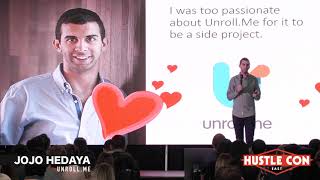
Jojo Hedaya built Unroll.me from zero technical background into a product managing 3.7 million users and 125 million emails daily. He shares how a one-click unsubscribe tool and viral "4Share" mechanism drove growth, why he hired for character over credentials, and how guerrilla marketing stunts at conferences beat traditional pitches.
Chapters
All right, so happy Hanukkah, everybody. So my name is Jojo, and I'm the founder and CEO of Unroll.me. For you, for those of you who don't know what Unroll.me is, we're a consumer app that shows you a list of all your newsletters from Facebook to LivingSocial to Groupon. Whatever you don't want, it's a one-click unsubscribe. Whatever you do want, but you don't want cluttering up your inbox, you can combine into a single daily digest that we call the Rollup. And this is my unexpected journey. And yes, that is me as Bilbo. I let my designers do that, and hopefully I don't regret it. So I was a college kid living with my parents in Brooklyn. I was studying philosophy at Brooklyn College, and I thought that HTML was something you need to get vaccinated for. I seriously went into this industry not knowing what HTML was. But everyone starts somewhere. You don't need to have an amazing degree. You don't even need to finish college. You don't need to have a tech background or come from a wealthy family. And this is my adventure as an entrepreneur. So chapter 1, it all starts with the idea. Despite my lack of tech chops, I was always fascinated by the web. I was amazed that you can build a website and millions of people across the globe can see it. And at the time I thought it was like a push of a button. I didn't understand what scaling was, but that really fascinated me because if I wanted to open up a coffee shop, let's say open a coffee shop down the block from here, I would need one coffee shop here. If I wanted to be in LA, I I mean, it was so operationally intensive to get it over there. So tech really fascinated me. I actually started my first business in high school as a spammer. Not actually a spammer, but my friend Charlie and I got together, and I come from a very small Jewish community in Brooklyn, and people wanted to advertise to the community members but had no way of doing it online. So we went out and we collected Thousands and thousands of emails from people in the community hustling in every way possible. I went through yearbooks to get email addresses on the back of yearbooks. I went to conferences and got people's emails from conferences. And we— if someone wanted to build an ad, we had an ad and we sent an email from— to them. So I went from sending people emails for a living to helping people get rid of emails. And now back to our story, the beautiful Jerusalem. This is my best friend Josh, and this is what brought us together. And yes, that is a BlackBerry. How many people here had a BlackBerry at some point in their lives? That's a nice amount. So we were in Israel together, we were about 100 people, and only 2 people in the entire school had a BlackBerry, me and Josh. So our rabbi came to us, he said, "Guys, I got a little bit of advice for you." And you know, when your rabbi is telling you, you want to be a good Jewish boy, you're going to listen to your rabbi. And he's like, "Jojo, Josh, you both have BlackBerrys and you both like business. Be friends." And we laughed, "Alright, we'll give it a shot." It was love at first sight. We figured out that our birthdays were both December 30th, 1989, and we stayed up the entire night watching the first season of Gossip Girl. Later on, we ended up going to Burger's Bar for breakfast, lunch, and dinner, and we really became very good friends. 2 years later, we decided to— that slide's broken, but we'll go with it anyways. We decided to start a company together, but instead of building one company, our idea was we're gonna build 12 companies in one year because 99% of startups fail. So chances are better if we build one company a month. We had no idea how hard it was to build a company. But we gave it a shot. So we hired a couple of engineers off of Craigslist, and we thought, we're entrepreneurs, we're gonna make it happen. Our first startup was called Wearing Social. We connected to your social media accounts and helped you wear your identity. So we took, for example, all your profile pictures and created a big Facebook like sign. It failed pretty quickly, but the concept's still cool, and maybe one day we'll bring it back in action. So Josh and I were emailing a lot back and forth to try and figure out startup ideas, but this guy would not answer any of my emails. Seriously, he would get pissed at me if I'd answer one of his emails, but we were sending ideas back and forth together and it just never got answered. So I remember I called the guy up and I'm like, Josh, you want to start 12 startups in a year, but we can't communicate because you're not answering my emails. At the same time, Josh went to a conference and someone told him, "Help me unsubscribe with my emails. Do something to help me unsubscribe with my emails." And light bulb went off, and that was the first logo of Unroll.me. Right, the yarn ball, I still love it, and we have to bring the old t-shirts back because I don't have any more. It actually took us a full month to come up with a name for Unroll.me. We thought that we would have 12 startups in a year, one startup a month. It took us a full month to come up with the name. It's impossible to find a domain name these days. Every.com is taken, and we tried everything. UnsubscribeMe, Unsubscriber, every single possible domain name was taken if we wanted a.com. And then we figured out, okay, you enroll into emails and you unenroll from emails, and bam, we just went for it. First thing was it had to be simple. I wanted every single person to be able to use Unroll.me, no matter what device you use, no matter who you are, and no matter where you live. But I really wanted to make sure that this lady can use it. And that beautiful lady is my mother, and she is the best. And she is now a power user. My mom has trouble turning on her computer, but she is a power user. So on one of our biggest outages, everyone's emails are hitting their inbox, my mom sent in a support ticket. And if you can read it, it says, "A lot of emails that I put in my rollup are coming into my inbox. You know when my mom's complaining, we're in trouble." But at least she gave me a, "It's JoJo's mom, LOL." You know, thank you, Mom. And now it was about looking at the competition. Who's out there? What are they doing? What are they all about? So first we saw unsubscribe.com. They were the biggest in the space. They raised a few million dollars. We had to download a plugin. It only worked on your desktop. I was using email on my phone and it wasn't the right solution. Fun fact, James Siminoff, who started unsubscribe.com and ended up failing, started Ring years later and sold to Amazon for over a billion dollars this year. So it all starts with email, guys. Then there was other inbox. Other inbox is a lot better, but it was all about moving messages from your inbox into an other inbox folder. And we still thought that wasn't enough. So this was the first prototype of Unroll.me. And this logo never went live, the prototype never went live, but it gives you the basic idea. Microsoft, Dell, Apple, you just click what you don't want, right? You click what you don't want and one-click unsubscribe. And then we get you to inbox zero. And that was it. That's where it all started. Now on to chapter 2, but let me grab a drink of water quickly. Everything was great until it wasn't. We decided to launch our alpha site and make it invite-only because that was the cool shit back in the day. I remember like 5, 10 years ago everything was invite-only, but we also used this to our advantage, and this is what we did the entire— throughout the entire lifecycle of Unroll.me. So we wanted to create buzz and we want to get a lot of press for our launch. So instead of just emailing TechCrunch and Mashable and Lifehacker like, "Hey, we're launching a startup with no funding, but it helps people with email," we said, "This is a closed beta and is invite only, but the first 1,000 people that come via the TechCrunch article, the Mashable article, the Lifehacker article get in free and cut the line." And this really helped us have a huge launch, and it really was enormous. We were covered all over the place, right? Our servers crashed. I didn't know what HTML was, but I had to like come in and try to be an engineer to solve these problems. And I would say is like when everyone here is going to try and get press, when you're trying to get— think about a TechCrunch writer, how many emails are getting every day. Figure out what you can give them to get their audience excited that's more than just your product. There's always something that you can give to make your launch really successful. And I remember, you get on TechCrunch, I thought I was— that was it. I'm going to retire now. I'm on TechCrunch. You know, it was invincible. And then we went and decided to present at New York Tech Day. And New York Tech Day is an amazing conference that had a couple hundred startups in science, in a science fair-like atmosphere presenting. And we were probably the least impressive startup at the event, but we came to win. There were VCs, there were judges, There are reporters, you know, people looking for jobs, and we're like, what are we going to do to stand out? How are we going to make it that every single person that is at that event is going to be talking about EnrollMe? And how can we be unconventional? Because everyone goes and they give out the credit card holders and the stickers, but what were we going to do that was going to be different? So I had my friends come in and dress up in costume. We had my friend Jimmy dressing up as a trash can. We had someone dressing up as Mr. Spam. I had a friend dressed up in like, you know, Captain Underpants costume to help kill spam. And then we went one step further and we replaced all the toilet paper at the conference with Unroll Me branded toilet paper. And seriously, this was what everyone was talking about. No one was talking about our startup. No one was talking about any other startup. They were talking about, "Unroll Me is crazy." replaced all the toilet paper in the conference with our toilet paper. And we ended up winning. We did it, right? Again, well, I was that excited that I lifted up the trophy, dropped it, and it had a big crack right down the middle. But it's all about the memories. But seriously, the next time anyone here is presenting at a conference, We probably spent the least amount of money on that event. We bought 20 rolls of toilet paper and went to Party City to get some costumes. Think about doing something different that's gonna let you stand out. How do you be the company that people are talking about at the conference? So after the conference, we were so hot. We had 40,000 people on the waiting list. I was ready to buy my Ferrari, pop the champagne, I thought Steve Jobs was gonna call me up and ask me to take, you know, charge. And we decided, obviously we weren't that cool, but we decided to go all in. And I was in college, I was, I had, in my senior year, I was actually studying for the LSAT. I didn't actually want to be a lawyer, and thank God I'm not because now I just get sued all the time, and not what I wanna do. But like, I'm a Jew in New York, I faint every time I see blood, so if I'm not gonna be a doctor, I guess I'm gonna be a lawyer. And it was time to do it. I dropped out of college and I still have 3 classes left that I promised my wife I'll finish, so I'll make it happen at some point. But I was just too passionate about Unroll.me for it to be a side project. It's very important to be passionate about what you're doing. Like, you see that heart over there? That's how passionate I still am about Unroll.me and what we were doing. And I was building the company with my best friend. Having a great co-founder is super important in being a successful startup. There are so many ups and downs. There are so many things that you're doing, and this is a person that when there are ups, you're celebrating with, but when the inevitable happens, there are downs, that you're bringing each other up. It's very, very important. Josh trusted me with the product, and I trusted him with the business, and it really worked out well for us. So make sure that that you have a great co-founder when starting a company. So again, we were riding high until we talked to the guys with the money. And it really hurt, guys. It really did. They told us, "Your startup sucks. You can't make money. This will never grow." You guys have enough yet? Because we didn't. We kept going for more. They said, "You're not going to scale past 100,000 users. You need a technical co-founder." And I'm sure a lot of people here hear that. And you don't need a technical founder because we didn't have one. No one will invest. This is a tool, it's not a product. And we kept hearing the same things over and over and over again. And it was very, very hard. We always thought, if you build it, they will come. You'll worry about everything else later. But again, we kept hearing the same things. And imagine I had to go into the team and they knew we had these VC meetings, but I had to tell them, "Sorry guys, we're 0 for 15, didn't raise a single dollar." We thought we were on top of the world, and now how do we overcome this? We really believed in what we were doing. And I know this sounds obvious, but if you are not fully bought into what you're doing as a founder, as an early employee for a startup, things will get hard. There's no— no one has instant success in the startup world. You're gonna get turned down from some VCs. You're gonna have points where like your servers just crash and you have nowhere to go. You're gonna have times where it's like, "It just feels so hard. What the hell am I gonna do to get over it?" If you believe in what you're doing, it'll make this process so much easier. So now into Chapter 3, The Breakthrough. So we were scrappy and we were determined. We were gonna prove them wrong. We were gonna do whatever it took to make sure that we can go back to these VCs and show them everything that they said were a problem we solved. At the same time, we had to listen to their feedback. You know, VCs are smart. They know what they're talking about. They see thousands of startups a year. But they told us so much. You gotta build a product. You gotta grow fast. You gotta make money. Engage your users. Like, we're 4 people on the team. How are we gonna do that? And that's when we learned how important it was to prioritize correctly. Everyone has limited resources. No matter if you're a 2-person team, a 50-person team, a 200-person team, you can't do everything. You need to focus and you need to prioritize well. So we decided to focus on 2 areas: on making the best product possible and to grow super fast. And we said, if we have a great product and we're growing super fast, we can go back to the VCs and finally raise a round. And that's what we did. First, we looked at our data. And we were surprised to find that people only unsubscribed from 30% of their subscriptions. We're like, everyone's telling us that they have thousands of emails that they don't want and they want to unsubscribe from all of them, so why are they only unsubscribing from 30%? And we spoke to them and found out that people didn't want to miss the deals for all their subscriptions. They were scared to hit that unsubscribe button, but they still didn't want it in their inbox. And that's when we came up with the concept of the rollup. So the roll-up combines all of your emails into one daily digest. So instead of getting 50 emails, you got one, and you never miss out on a deal again. That made us from a tool into a product. The next thing was, how are we going to grow? I was never a believer that people just share a product because they love it. There are certain people that, that are active on social and they're going to share things that they love, but people like my mother, people like my wife, even like myself, We don't just share things that we love on social media. How are we gonna get there? So we look for inspiration, looked at Dropbox, looked at the Ubers of the world, the Lyfts of the world, and they were offering, you know, if you share, for every user you get to sign up for Dropbox's free space, for, you know, Uber and Lyft you get ride credits. But we were a free product. What were we gonna do? And I also didn't like the fact that it was a— it wasn't instant, that I had to wait until someone actually signed up for me to get my credit. So we thought very hard and we came up with the 4Share. We thought, what if instead of having a paywall, we had a sharewall? Will users hate it? Can we get users to share? And we said we were gonna try, but we were nervous. Every advisor we had said this was gonna be the death to Unroll.me. They said people are gonna hate it, you're focusing on growth more than focusing on the product, it's gonna be the end of Unroll.me. but we're like, let's let the data give us the answers, and that's what we did. We found that once a user sees their subscriptions and unsubscribe from 5 newsletters, that they felt the magic and they were willing to share. At the time of launching the 4-share, 90% of users who hit the share wall shared. And I was like, what are they sharing on, Facebook or Twitter? It was 50/50 at the time, but for every 100 users, that would share on Twitter, you would get 1 user in return, versus every 100 users that was sharing on Facebook, you'd get anywhere between 80 and 150 users in return depending on how many were sharing at the same time. So we switched up the design, and if you can see here, we had the share on Facebook and then or other options. This brought us from 50% sharing on Facebook to over 80% sharing on Facebook and took Unroll.me viral. So when we were able to get one big burst, you know, a TechCrunch article, a Today Show. We had so many people sharing at the same time that it was at the top of everyone's newsfeed. If I had to pick one thing for the success of Unroll.me, it's the 4Share. We figured out a way to get majority of our users to share the service within the first 5 minutes of signing up. Right, so I made that sound easy, but what would I do today if I was trying to design the next 4Share, and you know, across industries? The first thing I would do is find the social incentive. What can you give to your user that's going to incentivize them to share? If you're a free product, maybe you unlock features to share. If you're a paid product, I would challenge people here, instead of doing the typical model of, you know, you have to invite someone and once they come, then you'll get credit, give them instant gratification. You share, you get a 5% discount. You share, you get $1 off. Give them something right then and there because again, the people aren't just gonna share you because you have a great product. You gotta, you gotta give them a push. The second one is make sure when you— before you push them to share, you're finding the earliest time in the process of once you gain their trust. For us, it was they see the magic of the subscriptions, they start seeing that Unroll.me is working by pressing the unsubscribe button, and now they trust us to go and ask them to share and they're more likely to share it. So do some research, look at the data and make sure that you're asking the users to share once they trust you. And move beyond Facebook. Facebook took us viral, but Facebook is very different these days. It is much harder to go viral on Facebook. The algorithms have changed, the usage on Facebook has changed. Look into alternatives like WhatsApp, Facebook Messenger, look into, you know, just text messages and email. So now on to Chapter 4. After the 4Share, we were adding thousands of users a day. We had our first million users, and things were looking good. The problem was, how the hell were we keeping up our servers without being able to hire? We were an unfunded team, just had a friends and family round, Trying to compete with hiring against Google and Facebook was practically impossible. So we really had to think differently of who we were hiring. It's all about the people, right? I am very passionate about my team. I love my team, and they're the ones that built Unroll.me, not me. I help guide them through the process, but building a great team is the really way that you could succeed. Just like I said, you have to love what you do and To me, it's even more important to love the people you work with. And still to this day, I love the people that I work with, and it brings me to work every single day. Our main philosophy at Unroll.me is fuck resumes. I never had a resume. Hopefully I'll never need a resume. But we're not looking for the typical person. I want to look for the diamond in the rough. I don't want the person that's going to go work at Google. We can't compete with that. I want the person that maybe didn't study computer science in college, right, and took a coding class, but really wants to do something different and really wants to hustle and work their butts off to take it to the next level. And that's what we did at Unroll.me. And one of the perfect examples is Jack, who's in the audience today. Jack, you're the best. Jack was an intern for us, and he ran product for us for years. He's one of the most important people at Unroll.me, and he did it the Unroll.me way. He came in, he worked hard, He went from answering support tickets to sending t-shirts to people on the, you know, to some of our users, to seriously leading product. And that's the way we did it. And I would say same for everyone here. Look for alternatives. Look for different ways to hire people. Look for that diamond in the rough. Take chances on people. It's worth it. And basically hire smart people you want to spend time with. Because we love to spend time together. You know, like, we're a family. We're a family first. You know, we had a Thanksgiving meal together where everyone brought in a dish from their house. It was a lot of fun. And I can seriously talk about my team forever because they mean the most to me, but I am going to— I'll move on on this one and get back to the story. So we were doing pretty well and the tables really turned. And remember all those VCs that turned us down? Every single one turned us down. They all came back to us. And the landscape changed. The odds were in our favor. Not only were we able to grow super fast, now the value of having users' email data started to really perk up. There were companies like Slice that raised over $30 million to try and build the Nielsen of online. Companies like Procter Gamble were able to see what Huggies is doing versus Pampers at the Walmart stores, but they weren't able to see what it was doing online. So Slice built a company to extract information from email receipts and help brands with market research data to understand how they're doing in the market. And we were the ones with the users, so we ended up being the swing state. So now we had to decide, do we partner with one of these companies, do we raise a VC round and try to, you know, monetize ourselves, or do we get acquired and just focus on the user? And we chose acquisition. Main reason for choosing acquisition is we wanted to do what we did best, and that is user, user, user. Let someone else figure out the business model. And seriously, our acquisition story is like a freaking movie, and I still can't believe what happened and how stressed I was, because I was going on my honeymoon at the time also, so it was really stressful. The first company that we signed a letter of intent with, we were in due diligence for over 3 months, and it wasn't a good fit. Now they're great people and I respect them a lot, but we just didn't see eye to eye. They didn't see us— they saw us as a number, the number of users. They didn't see the value in the team. They wanted us to come in, rip up the culture, and do things their way. But what really took it— what really pushed it overboard was how they were treating our people. I remember the first week after signing the letter of intent, we asked them— everyone on our team was getting underpaid. 'Cause unfunded startup, how much can you pay people? So we said, we need to get people to market rate. And they kept pushing that conversation, pushing that conversation, pushing that conversation until 3 months after due diligence where they sent everyone their offer letters and it was like raising people by 5%. So I got on a call to try and push that and change it and it didn't work. And they said, Jojo, as long as you come, we're happy. So what did we decide? We're a team. See you later. And we walked away. And that was hard because I had to go into the team and tell them this thing that we were working on for 3 months, it's gone. We're walking away. But we were in it together and we made it happen together. So was that the end of the road? What would happen next to Unroll.me? We found the right partner. We saw that a company Slice got acquired by Rakuten. Seriously, all we did was email the founder saying, "Congratulations guys, we're so happy for you." 5 minutes later, get a phone call from Harpy and Scott, two of the founders. Jojo, Josh, you guys still available? We're like, I guess so. Like, give me a number. This was a Thursday. Give us until Sunday night and we'll have a letter of intent for you. So first things first, we gave them the salary numbers that we wanted everyone on our team to have, and they approved it on the spot and said, this is your team, your decision, we trust you. And they went for it. And then we We gave them a number that we thought they wouldn't reach. They said yes. On Sunday night, we had a letter of intent, and the rest is history. It's been amazing for us at Racket and Slice. They really let us continue to be entrepreneurs. Even though Scott, Harpy, Eric, and Ben were founders that have done this multiple times, they're all teachers at Stanford. They're now partners in Eric Schmidt's fund, Innovation Endeavors, have sold multiple companies. But they trusted these 24-year-old hustlers with no experience to run the company and let us do what we wanted to do. They mentored us and they really let us grow into who we are today. But most importantly, they cared about the people and we were very aligned on the people. And it's been an amazing experience for me. So what do we do post-acquisition? We went and finally launched our iOS app. It's crazy that it took us like 6 years to launch an iOS app, but we did it. And we did it the way that we always did it, the unconventional way, and we wanted it, we came in it to win it. And we ended up being bigger than Gmail and Snapchat for one week at the top of the App Store. We were 8th overall in the App Store. So we went from not knowing what HTML was to 8th overall in the App Store, and we used a joint project cross-country with the Slice team and the Unroll.me team coming together and building a product. And it was really, really awesome. It's been an awesome adventure for us, and Unroll.me is still going strong. We have over 3.7 million active users. We've been mentioned in the press over 5,800 times, and we process over 125 million emails per day. So now what? What lessons can you take from this? First one, and I'll keep repeating this one even though I feel like it's pretty typical, Believe in what you do. Startup life is tough, right? Major, major rollercoaster ride. And if you don't fully believe in the company that you're working for, when things get hard, you're not gonna be the ones that are able to like jump past it. Make sure you believe in what you do. Be unconventional. I would challenge everyone here, the next time that you're at an event, do something different, right? If it doesn't work, the next event do something different. What's gonna make you stand out? And don't overthink it. Have someone freaking dress up in a costume, all right? Do your own version of the toilet paper stunt, all right? Stand out. There's so many startups these days, it's so important to be able to stand out. And share. Figure out a way to get your users to share in ways that people aren't doing. Take a chance. Don't just look at what's out there and do it that way. Take a chance and be unconventional. And surround yourself by the right people, most importantly. Make sure that you work with people you love. People that you want to fight the battles with, people that you're going to celebrate with, people that you're going to cry with. These are the people that you're going to be with every single day. From your co-founder, who is like a spouse, to your team, who's like your family, to the people that eventually will acquire all of your companies out there. Make sure you surround yourself with people that you love. Thank you everyone. Again, my name is Jojo. Feel free to reach out to me. Guys, because I'm not taking questions, I'll be around for for lunch, so if anyone has questions, you could tweet at me, email me, or just find me over here. All right, thank you everyone, and thanks for letting me speak.










