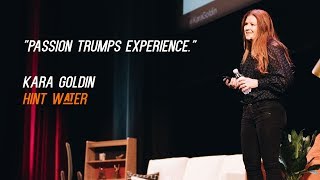
Kara Goldin, founder of Hint, started the sugar-free flavored water brand to solve her own Diet Coke addiction. She learned that great entrepreneurs solve problems first, not chase ideas. Big incumbents like Coke and Pepsi become aggressive when threatened, but hiring people passionate about the problem beats hiring industry veterans.
Chapters
Thanks for coming out this morning. So I want to talk for the next 17 minutes about how to win no matter what category you're in. So, and I want to start to really by saying something that I've noticed about great entrepreneurs, and great entrepreneurs don't start out by actually saying, I want to go start a company. They actually start out by saying, I want to solve this problem. Problem, no matter what industry they're in. So I'm the founder and CEO of this company, Hint. How many have had Hint before? I can hardly see you out there, but I believe you. So I started Hint about 12 years ago out of my own interest to get off of a little-known soda called Diet Coke. So I was drinking Diet Coke every day religiously. I think you could fairly call me an addict to Diet Coke. And I realized that Diet Coke, after eliminating Diet Coke, was doing lots of not such great stuff to me. So I was 50 pounds overweight. I had, for the first time in my life, developed terrible adult acne and no energy and trying to figure out, after going to see a number of doctors, what was wrong with me. And then when I actually went and eliminated the Diet Coke and started drinking plain water, I thought, wow, in 6 months, 50 pounds were gone, the acne was gone, the energy was back up, and it was that simple. So I'm gonna talk a little bit about, you know, 4 things that I really see sort of in my own journey of looking at, you know, what it really was and what allowed me to win. I'm still winning along the way, but definitely, as I started to look really at what is it that helps me to sort of do what I'm doing today. So first of all, I looked at solving problems, and as I mentioned, this was the biggest problem for me. And when I started to look at the soda industry as a whole, I, I really looked at Diet Coke as well as Diet Pepsi and thought that that these are large public companies who are really out to actually get me to drink soda. They were not interested in actually helping me get healthier as a consumer. They really wanted to continue to sell me stuff by getting lots of celebrities and athletes to sort of show me that they drink those products, and therefore they're going to be— that's going to help me to get healthier. And so if I really wanted to actually have change, I couldn't rely on those guys to actually go and develop this product for me. I'm going to actually go and figure out how to do this product and get it out on the market. So I think when I started to think about developing Hint, I go back to what I originally said, which was I never thought I want to go run a beverage company, I want to go start a beverage company. I make college students feel really great by telling them I was never that person who said I want to go found the next big energy drink company or soda company. I really want to do something that makes a difference. And what I started to see was that if I actually went out and started this company, that I could make a difference, not just in myself and in my family's life, but also in a lot of other people's lives and helping them to get healthier. And so that's what I decided to do. So I think a lot about other entrepreneurs in lots of different industries. This is probably one of my favorite photos of Steve Jobs, who's a big idol of mine. Or somebody that I really admired over the years. But I think that something that great entrepreneurs do is that they not only search for why and sort of their— in how they're developing their own product and ultimately their own company, but why are their biggest competitors, potential biggest competitors, actually doing what they're doing. So somebody like Steve Jobs wasn't actually going out to start a company. he was actually trying to create a better computer. And other entrepreneurs like Mark Zuckerberg, for example, was not out to develop a company. He was actually trying to create— trying to solve a problem around community. And there's others. Sara Blakely, another one of my favorites, who decided to launch a product really around pantyhose and solving a problem. So it might not be your problem that these great entrepreneurs are trying to solve, but they're actually trying to solve them for themselves first, and then move on to try and solve them for other people. So talking about my own situation when I went— when I was really trying to look at solving a problem, and going back to Steve and sort of other people that I look at and admire, I ended up launching Hint at Whole Foods in San Francisco, And after a few months realized that I really didn't have a clue about what I was actually setting out to do. So things like shelf life, things like distribution. I had grown up in the tech industry. I had launched AOL's e-commerce business way back when and developed it into a billion-dollar business and left in 2001. And was really looking at, like, I thought, okay, I can go and do this other industry. It's really interesting. It's solving a problem for myself. But after a few months I realized, oh, shit. I have no idea what I'm doing. And so a friend of mine said, hey, I have this friend that is an executive at Coke, and he was telling a major executive at Coke about what you guys were doing, and he said he'd be happy to chat with you. So my original intent was to really get this guy on the phone and just understand how do I actually create a shelf life in a product that is more than you know, 6 weeks basically. That was the initial thing, that was the initial product. And so as I got him on the phone, the, the conversation quickly turned into a few different sound bites in my head. Number 1, he went on to tell me, as I started to describe my company and, and really the product that I was, that I was looking to launch, it was really around no sweeteners. And so you think about it now, it was sort of a silly conversation for me to have with a Coke executive, especially 12 years ago, because he was hearing me saying, "I live in San Francisco, there's lots of people like me that don't want sweet and really want to drink water, but aspire to drink water, but they just can't get off of the sweeteners." And so he continued to talk to me about how how I was wrong and how, you know, consumers really, really like sweet and that the key thing was to get consumers to believe that it's not really about sweet, but it's really about zero calories. And I, you know, for a minute thought, well, I think, you know, he's wrong, but instead I just let him talk. And I let the competition continue to talk for a while, and then I realized that he was really believing all of his bullshit. And basically, I was so fortunate to be able to have this conversation with him. And so I also realized that he was headed down one river, and I was headed down the other river, and that he had a lot more money than me, and so I should just keep going down my river and paddle as fast as I can, while he's got his big ship with lots of dollars going down that river. And this leads me to point number 3, that these large companies and companies like, you know, the big soda companies that I go up against, once they actually start to realize that you're a real threat and that you actually may have been right, They'll be your biggest naysayers out there. They'll, they'll do everything to basically try and undo everything that you're trying to do. So everything from walking into, you know, large stores like Target or Walmart and throwing your product out in the garbage, things like that that are, you know, really annoying. But I think at the end of the day, what they can't do is actually undo the problem that you're trying to solve. And what I also realized is that the ship metaphor really goes along with these large companies, because if they see that you're focused and actually trying to solve a problem for the consumer, that it's very hard to turn that ship, and especially if they're focused on something that is not actually solving a why and solving a problem, but instead just believing their own stuff. And again, you see this over and over again in every single industry where you have great ideas, great problem solvers, and the large companies, when it's too late, are having to try and figure out, how do I turn the ship around? So large companies, you know, such as Xerox and Kodak, and lots of them that have been in my lifetime that have really tried to turn the ship around and have, you know, really had a tough time doing it, and it's just been too late. So I think that the key thing— sorry, I have to grab a— grab some hints as I'm going along. So other key lesson, probably the fourth big lesson that I've learned the hard way, is passion trumps experience. So I heard over and over again, you came from the tech industry, you're, you know, this little chicky out in San Francisco who's doing your thing out there, and, you know, tech ignorance, tech, you know, obnoxiousness, whatever, you know, the saying was that they came up with in the beverage industry. So I started to believe it, and I thought, if I can just, actually hire those people from the large soda companies, then I'll actually be able to, you know, start my big company and really get the right distribution and really solve all of my problems. And so my worst problem was actually hiring people that had gone so far down a path with one of these large companies, because I spent more time undoing the way that they had been taught to think. My best employees today are the ones who have been passionate about a problem and have really identified that it is a problem. So sugar and sweeteners are the problem. And if they— and people that really want to go up against these large companies are the ones that I found to be the best people in your company, and often the people that that really save you a lot of time because you bring these people in who think differently about things. You can teach them in our industry how to sell beverages. Not that hard, not that complicated. It's really about just thinking differently. And again, going back to many of the other great entrepreneurs, I think that they would say exactly the same thing, that you want to hire people that are really thinking differently about things and are most passionate. About the problem and how you do it. So I think just in closing, I look at, you know, in building this company and sort of the position that I was in as an entrepreneur, and again, going back to kind of the why. So often I talk to entrepreneurs and I ask them, "Why did you actually go and start this company?" And if the reason is that they wanted to get out of working for the man, or or not really being that excited about being inside of a large company, then entrepreneurism might not be for you, because it's a really hard thing, right? Many of you are entrepreneurs out there and have started your companies. It takes a lot of time. It takes a lot of energy. It takes a lot of chutzpah. You have to conquer lots of things. You have to raise lots of money in many cases. So I think it's really— it's just really a— it's a tough road to go down. But also, if you can turn around in a few years from now and say that me and my team actually solved that problem, and that there wouldn't be this company, there wouldn't be this category, there wouldn't be this industry, then I think that that's such a valuable thing to be able to say that you were a part of. So thanks so much.










