Live Q&A With My First Million (Austin Live Event)
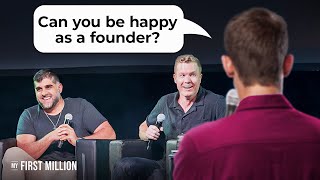
Sam Parr, Sean Frank, and Andrew Wilkinson answer audience questions at a My First Million live event. Podcasting has 62% U.S. penetration and $2 billion in revenue but could be worth 20-100× more if monetized like FM radio. Andrew emphasizes betting on the entrepreneur, not the idea, and shares how founders' partners provide emotional stability during crises.
Chapters
I think at this point, Nick Gray—
Yes, we're ready for questions.
All right. So what we're going to do is we're going to do a little Q&A, and we'll riff on some of that stuff.
Fantastic.
Let's see.
Please, can I have house lights? And I would like to see hands up for questions for the panelists. I see one here in the center. I see one over here. Thank you guys. I'm gonna ask you to raise your hands again and we're gonna try to go through these fast. Please say who your question's for.
Uh, my question's for Sam. Uh, where do you think podcasting will be in 10 years?
Positive or negative?
Uh, questions stress you out.
What's man's role in the universe? I don't know, like you wanna have some light discussion? Uh, where will podcasting be? So when It was Sean's idea to start our podcast. He came to me and he's like, I've got this finished episode, will The Hustle publish it and be our publisher? And the original version of MFM was not what it is now. It was him interviewing people and it was still good. And then one day someone didn't show up to studio time that we had already paid for. And he's like, ah, just come in and do the thing that we do. And that's kind of how it came to be.
And by the way, you know that story's not true, right? No, that's not actually how it came about.
I did not know that.
'Cause I heard you tell this, I'm like, is he telling this 'cause he thinks—
I thought a guest bailed.
No, I told you that. What happened was, it's a good time to come clean, right? In front of us and our 500 closest friends. What happened was The Hustle wasn't promoting the podcast enough. And I was like, how do I get them to promote it? Maybe I could tell 'em what's in it for them. Maybe I could make better content, or maybe I could just invite Sam on the podcast and he will for sure make them promote it. And so you guys are launching trends. And I was like, hey, come on and let's just bullshit about upcoming trends and startups. I was like, they have to promote that episode because it's like, that's their thing. And I was like, let me do that every Friday.
And that became the pod. They call this the prestige.
Yeah, yeah. You honeypotted me. It worked. My point being, when we got into this, I thought it was a— I thought podcasts were stupid. I was like, it's played out. There's too much. And what I've learned, I'm not gonna entirely answer your question cuz the answer is I don't know, but I'm gonna try and get around to it. What I've learned is I think it's the most powerful medium that we've ever come across. So like, because when you're in, this is, it sounds weird, but when you're in someone's ear, it's like literally the headphones matter when you're in someone's ear for like 40 or 50 minutes per session, like 3 times a week. It's insane how, what people learn about you. It's way better than like an 8-minute YouTube video. So where do I think you— I don't know, Andrew, where do you think it's going to go? So Andrew owns a podcasting company.
Yeah, I own a company called Supercast, um, and we help, um, like Huberman and other people monetize their podcasts. I was talking to the guy who runs it actually yesterday, weirdly, and he said that podcasting, there's 62% penetration in the United States. So like 62% of people are aware, but there's only $2 billion in the market. So all that advertising dollars and stuff. And you think about like FM radio and how big that market is. I would just look at FM radio and be like, okay, how big is that? And if every podcast was monetized like FM radio, it's probably that big. So it can probably like 20x, 50x, 100x. I don't know.
Would you agree that podcasting is the hardest medium to grow?
Yeah, for sure. I think that it has the benefit of what you said. That people become really loyal very quickly, but it's the hardest to grow. So you can go on TikTok and you'll get a bunch of followers, but if you said, hey, we're doing a live show in Austin, you're not going to get anybody to show up. In fact, there's funny TikToks of these TikTokers doing meet and greets that no one shows up to because they thought if I have 100,000 followers, for sure people are going to show up. And so, you know, the trust is what matters, not how many fans you have.
Well, also I'd say it's, I'd argue it's the best medium to have subscribers on because someone will see it in their app and there's no algorithm that's going to get in your way where whereas on YouTube or something, yeah, you've got the same monetization opportunities of doing events and promotions and ads and all the other stuff, but it's so easy for the algo just to go away from you and you forget about the person.
The problem with it is unlike blog articles and things like that, you can't fake it. I can fake a blog article and get you to click on it. Podcasting's very hard for that reason. And I always joke, but I'm like, the best way to circumvent someone's bullshit detector is to not bullshit. And it's like the best way to get successful in podcasting is to be talented or be really good. And that's super hard because you don't actually have to be good at a bunch of blogging and even newsletter writing. You should have to be pretty good, but you can kind of be pretty bad and still succeed. Podcasting is a lot more challenging.
Who else?
Hey, this question is for Sean and Sam. I'm building a website called askthepod.com. It's meant to be AI companion for podcasts. So you can listen to the episode and go back, ask questions. What are the books mentioned? What are the links mentioned? So is it okay to add My First Million on the platform?
The pitches are later.
This was your moment.
Yes.
Next question. All right.
Who's got a question? I want to see one from over here. Hand up. Pass the mic down, please.
Hey guys, thanks so much. Love the podcast. My question is for Sam Parr. I'm a copywriter and I'm just wondering what your number one tip is for getting better at writing persuasively and specifically copy.
These are some boring questions, guys. So copying word for word other people's work. So what I like to do is I print out, like, whether it's a movie script or a great, like, blog article or a really good piece of copy that I like, and I copy it word for word. And it's almost like learning music. You, like, play other people's music and you, like, see the texture of what makes greatness. And then you like steal from a bunch of different places and make your own. And that's what I like to do. Spend 6 months doing that, 1 hour every day. You'll get pretty good.
Awesome, thanks. Should we get people to line up maybe just so that there's no delay?
Sure, yep, I'm open to that. If you have a question, which we would love to hear questions, come and meet me on this side of the stage over here.
This guy. I can tell. This guy's got a good question.
Where have you been all my life, man?
Maryland.
Womp womp.
You're one joke away from getting this next seat on the stage here.
So, I mean, he said I love the podcast.
I hate the podcast.
My fault. But, um—
You hate podcasts?
Huh?
You hate the podcast? No, sarcasm. Oh. It's shitty though. Can we fuck?
Hey, excellent question. Come on up. Next one is Austin.
Alright, this question's for Andrew. What have you learned the commonalities of the bottom 20% of investments that you've had versus the top 20%? What differentiates the bottom 20%, top 20%?
The big ones that I do.
The big— the biggest mistake I would say over and over and over again is when I bet on the business, not the jockey, right? So I get really excited about the business and the business model and I go, oh my God, this is a great idea. If I ran this or someone like me ran this, this would be amazing. Even if I don't believe in the entrepreneur. And I've realized that betting on the entrepreneur is 100% of the game, right? Because they'll figure it out.
But don't you wanna have a business that any idiot can run?
Oh yeah, for sure. But I'm saying like the ones where I've lost, I actually haven't lost that much money in businesses where I'm buying the whole thing. Almost all of those work. It's the ones where I'm doing venture or I'm betting on something or I'm trying to start a business. That's where I lose all my money.
Excellent, next question.
Hi, Massie. So I wanted to ask, how do you feel about community building? Obviously it's become really big for creators.
How do you see it in the podcast genre?
Sort of that async communication with your fandom and building those super fans?
Yeah, I think for podcasts you don't really want to build a community as such. You want to build a cult. So, so basically you're like, what is it that we believe that not everybody believes? And let's put that on blast. And then a bunch of other people who believe that too are gonna be like, finally someone said it, or like, finally they, they do things the way I do things. Like For most of you here, I would bet, like, hands up if you consider yourself like, I'm a real fan. Like, I truly love the pod. I feel like when you guys are doing the pod, I could be sitting there right with you guys kind of bullshitting. I bet, like, leave your hands up for a second. Put your— leave your hand up if the following statement is true. It's not that you learn that much from us, but it's kind of like you feel like you're hanging out with us, that we are like you, and that if we just happened to have met we would have been friends. So like, most people leave their hand up, right? I kind of confused them, but it's— that's kind of what you go for. I think most people when they do content, they're trying to be in for heavily informational, and they think they're talking down to people, they think they're educating them and whatnot. What we do is we just talk about stuff we're interested in that we think, and then it just happens to attract a bunch of other people who think the way we do. And that's kind of like more like a cult than it is a community of people where we all gather around and serve each other.
Huberman is a great example of that where, like, we were just talking about this backstage actually. He does these 2-hour crazy podcasts on like weird nerdy science stuff, but he makes these subtle little comments about his dog and he seems like a real sweetie and all these things, and people connect with him and he's handsome.
What does he look like shirtless?
Ridiculous. Ridiculous. Okay, so Mike, me, Huberman invited me over to his house and he goes, let's do a sauna and a cold plunge. I've never met him before. And I was traveling with my girlfriend and I was like, "Oh, like, Zoe, do you want to come with me and we'll go to Huberman's?" She didn't know who he is and she's like, "No, I'm good." And we get there, he takes his shirt off and he's just shredded. Like, you could like shred cheese on his chest. 8-pack, bulging arms, tattoos. And I'm there and I'm just like folding myself into a little ball. And I was like, "Thank God I didn't bring her." Our software is the worst.
Have you heard of HubSpot?
See, most CRMs are a cobbled-together mess.
But HubSpot is easy to adopt and actually looks gorgeous.
I think I love our new CRM.
Our software is the best.
HubSpot. Grow better.
We'll do 2 or 3 more. Yeah. All right.
Next question. Hey, guys.
My question is, what can partners of founders do to support them on their journey?
I see that some of your wives are here.
Just wondering.
Yeah, let's hand the mic to them. Let's see what they have to say.
We don't do it. Everyone, we've gotten the requests where people are like, bring your wives on, and we're like, no, we're not doing that.
This is the one thing I have. Don't give it to her.
My, I've done a good job of partnering in business and in relationships with people who are very emotionally stable because I am not, and that, And that has been awesome. And so basically, like, there's been many, many, many times where I'm laying on the floor and I say, fuck this, I'm out. This sucks. I'm bailing. I'm going to quit. And she'll just like sit there and be like, okay, okay. And then just like not really reply other than like, all right, you done now? And that has been like pretty wonderful to have someone who's like emotionally stable to balance out someone who's pretty neurotic.
Um, for me, I remember when we were gonna— like, I always say, oh, we sold Bebo, as if it was like this easy thing that was for sure gonna happen. What actually happened was the business wasn't really going the way I wanted, and I was like, I gotta just do something else. So I said, I'm gonna try my best to sell this business, but if it doesn't sell, she's gonna shut it down. I don't know what I'm gonna do next. We're gonna just— I'll figure something else out. I just gotta change it up. And I went to my wife Sonya, who's right here, and I said Hey, I'm thinking about doing this. We were pregnant, pregnant with our first. And it was like, hey, how do you feel about me either selling this or more likely it's just not going to work out and we get zero. We have no job, no health insurance. And like, I don't know what I'm going to do next, but I just kind of failed for 5 years straight. So that's the track record I got going here. And she was like, let's go for it. Like no hesitation was just like, I believe in you. Let's do this. Um, like no, kind of like go the go for it. Go for the upside and not worrying about what happens if things go wrong. That really helped me 'cause I was like, oh cool, like even if we strike out, I don't have to, I already beat myself up. I'm not gonna get beat up more if things don't go well. And I don't have to keep hedging and say, it's not gonna work out.
She's just like muttering like, broke ass motherfucker. See ya.
So I would say, I would say there's 3 things. So number 1, empathy. But empathy without understanding is useless. So like in previous relationships, it would be like, oh my God, you know, this person at work has given me so much trouble. And the reason is that they want stock options and that means this or whatever. And the previous partners would glaze over and they'd go, oh babe, that's so hard. But it was like hollow, right? There's no understanding. And so what I found really works is actually not like going into business and like obsessing over it, but just making a bit of an effort to understand the actual problem. And like, you know, for example, like my girlfriend will listen to My First Million, or my girlfriend will read—
You mean our girlfriend. Our girlfriend.
Not their girlfriend, exactly. Or so she'll make a bit of effort. And then what was my third thing? Shit, brain fart. I'll remember it later, I'll tell you later.
Great, so for those that are in the line, I'm gonna walk down, you're very quickly going to say your question. I'll try to do 5 or 10 real quick. They will not be answering them. But they may give an answer later. First up. What was the reasoning behind going public, taking Cattiny public, and what was the biggest lesson learned? Excellent. Next question.
Question for Andrew.
I was curious about your follow-up to your kind of personal episodes about your dip emotionally and what that's been in the last like 12 months, for instance.
Awesome.
A few more.
Andrew, how did you start and grow your agency business?
Excellent.
Next.
Yeah, for the panel, uh, built a few businesses that did millions. Now I find myself complacent, lacking purpose.
Yeah, just like to know your answer to that. Okay.
All right, next one.
Without turning it into Billy of the Week, Andrew's impressions on meeting my boss's boss's boss's boss, Michael Dell, this week. The stuff that you didn't put on Twitter already. Let's pause. Let's answer that question. Yeah, do we pause this?
Yep, we're gonna pause. For those of you that are standing waiting for questions, take a seat and we'll do another round of Q&A soon.
Thank you.
I think the first one was going public and why And I would say that going public is— if you're an investor, it represents the greatest opportunity, right? You can raise capital at a great valuation. You can buy it back when it's cheap. You can use your equity to buy businesses. Those are just kind of boring business reasons, to be honest. The reason kind of relates to my dip. So over the last like 2 or 3 years, I went through a bit of a funk and it came from this feeling of like, I don't know why I'm making more money. I don't have a thing, right? So when I started, it was because I was like, okay, I want to wake up whenever I want and I don't want to have a job. And then it was like, okay, I want to have a sweet house and a car. And then it was like, okay, I got a sweet house and a car. Now I want to pay off my parents' mortgage. And then after that, and then it was like, okay, I want enough money that I can be fine and stop working. But after that point, which I reached 7 or 8 years ago, I just didn't know what to do with it. And I tried all these different things. You know, I would go and like, you know, buy wine and fancy cars and go on fancy vacations and all these things. And nothing really made me happy. And so over the last couple years, I've been trying to figure that out. And I tweeted about this earlier, and I mentioned this, but I've been really admiring people that do two things. One is they use money to live life in a very interesting and creative way. So Nick is a great example of that. Nick's a multimillionaire. He exited his business. He's done very, very well. And he just has an investment portfolio on autopilot. Um, invested in Tesla really early on. And now he just focuses on meeting interesting people. So that's one piece, and I've done a lot of that. Just meeting interesting people. And then two is figuring out how to give it away and actually impact my community. So like I did that local journalism thing I think you guys know about. And going public in Canada, it allows me to actually give my shares to my foundation. So I can actually do that. So it enables that.
Andrew did the biggest flex on us when we saw him for dinner the other night. We're like, oh, what have you been doing? And he goes, philanthropy. And we're like, oh, okay, okay, big guy. And then he didn't pay for dinner. He didn't dedicate, uh, donate to the Sam and Sean Foundation. Yeah. The $500 dinner. And the other question was about Michael Dell. You met Michael Dell this weekend.
Yeah, Michael Dell. He was so— okay, so like Michael Dell is like what you hope capitalism is, right? Like I met him and he was the nicest, most down-to-earth, engaged, pleasant guy. And I've met a lot of rich people. I've met billionaires, multibillionaires. He's worth 50. So he's worth like 10x any of the other people. And he was just really genuine and nice, and I asked him like, "Okay, what are your vices? Like, how are you not like, you have like a super PAC, like some weird libertarian island where you like hunt and kill people? Are you building like penis rockets to Mars? Like, what are you doing?" And he just goes, "No, I got a couple nice houses, I've got a jet, I just like to work and build my business, and I give it all away to my foundation." And I was like, "Okay, that's pretty cool." He's like the human version of a Dell computer, basically. Yeah, yeah.
It's like the most basic computer.
Totally. But like a nice, a nice computer that works well for you.










