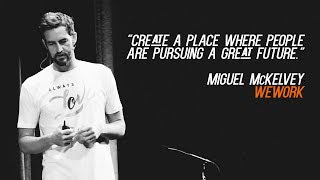
Miguel McKelvey, WeWork co-founder, shares five lessons from building the company with Adam Neumann. They built consensus by never leaving a room without agreement, involved the whole team in opening new locations to break silos, and chose strategic partnership over valuation. McKelvey emphasizes healthy culture over hustle mythology and describes WeWork's 120,000 members as part of a 100-year vision for personal growth.
Chapters
Ladies and gentlemen, Miguel McKelvey. Oh, come on now, people, let's get on the ball and work together. Come on, come on. Good morning. That's a really huge picture. Actually, I told people to never use that picture ever again because I've seen it so many times and I'm tired of looking at it, but I guess no one got the memo. I'm super happy to be here this morning. I don't know if I've ever spoken to a group this large, but, and this beautiful of a place, so it's an awesome opportunity. The other part of this is that I don't normally prepare for these things. I like to just come out and kind of like, seems like Casey did, just talk about the things that are on my mind. But in this case, these guys challenged me to say something that's actually meaningful and relevant to you guys. So I've tried to put together something that will have impact. We'll see if it works out. But there is a little bit of organization, which I'm not used to. So a little bit about me. I'm an entrepreneur from the early dot-com days. I started my first company in, I think, '98. It was a social network for people learning English as a second language. It still exists. It's called English Baby. And so really I came out at a time when, you know, much like today where entrepreneurs are celebrated, and while I studied architecture in school, there was kind of a feeling that anyone could start a company no matter how smart or not smart or experienced or inexperienced you were. And I got a very early experience with starting something and going through the process of trying to create something from the ground up. And I think that was an incredible opportunity to explore myself and figure out who I could be, but it was also an amazing challenge because there was no mentorship, there was no one to help, there was no one with any instructions. It was a time when you had to figure everything out for yourself. I've always remembered that time, and a lot of the spirit that you have at that time is self. It's you trying against the world in a way. You trying to make something happen, trying to bring something new to life. And when we first started WeWork, we felt like we could create an environment where we could remove some of that isolation, where we could create an open place and a supportive place for people who wanted to do these things in the world. And we believed that we would all be stronger together, that if we were open to each other, if we were interested in each other's journeys, if we wanted to lend a hand and there was a forum and a community that would allow that to happen in an ongoing way, whether it's, you know, through events like this or just, you know, in an afternoon over a cup of coffee, that creating that rich environment would be better for all of us. So hopefully some of you guys have heard of WeWork. Hopefully some of you guys are— well, actually, hopefully all of you guys are members. That would be awesome. If you're not, join tomorrow. Best advice for any business of any size. But we started about 7 years ago, and we've achieved some success so far. We're in cities all over the world. We have over 120,000 members. I think, you know, one of the coolest things that we've achieved is we have united a community that is in China, Korea, Australia, all over the US, across Europe, Tel Aviv, and now in South America, coming soon in India. And what we're finding is that people like you, people like us, people who are connected to this idea of being creators, of trying to bring new things to life, that they're everywhere, and it's a bond that we share when we're at this place in our life where we want to take hold of our future, and that bond is something that crosses all boundaries, I think, from political to cultural. When you have that in yourself, it's something that allows you to connect with others. So WeWork is hopefully a platform for anyone who's in that position. We've been lucky to bring people together. In business context, many different kinds of business context. We started with small entrepreneurs and startups, but now we're working with some of the biggest companies in the world, from big tech companies to banks, etc. We're all trying to unite this same spirit of innovation and creativity and really just positivity for these challenges that we're all facing. To get a little more specific about who I am and the journey that I've been through to get where I am now and really where we are now as a company, I have a few sort of specific lessons. And the first one is that my co-founder and I, Adam, are extraordinarily, extremely different people. I came to New York City from Oregon with a an idea that I wanted to achieve something in the world. I didn't know what it was, but I felt like New York was the place to do it. And one random Saturday afternoon, I met this guy who was a brash Israeli who— well, I'm from Oregon, and for those of you from the West Coast, especially from here, you know we're like chill. and like, for the most part, relaxed, we have our own vibe. And I go to New York City and I run into this guy who's like the exact opposite, literally all energy all the time, always hyped, always excited, and with tons of exuberance and really no fear whatsoever in any context. Willingness to do anything at any time. And when I was exposed to him, I had certainly a lot of discomfort, but I also knew that— well, a lot of discomfort. But what I also knew is that there were things that he could do that I could never do. I was clear from the start that there were things about him that especially in a business context, there was no way I could do. And one of those things certainly is sitting in front of a group of investors and asking for money at a $100 million valuation or $5 billion valuation, $10 billion, you know, now we're above that. I knew I would never be that guy, but I knew in him that he was, he had a certain capability. And so this profound difference was attractive to me, but I also knew that it was going to be hard for us in a business partnership. Because we approach things from totally opposite ends of the spectrum. And so one of the things when we decided to come together and form the company, we knew this about each other, we knew that we were gonna approach things differently, and so we agreed early on that we would always agree, that we would always come to a decision where we would consider each other's perspective and we would not necessarily meet in the middle, but we would make sure that we were both in a place where we were comfortable with the solution. And what that did, which was profound, was that because we knew the other one would have to agree, and we knew that we couldn't move forward until we agreed, it meant that we were always thinking of the other's perspective before the other one even said it. And so we would almost walk into the room offering each other the opposite person's perspective. It's like we'd already thought through it so much that we'd already come to a resolution. And so over the last, really, well, 10 years that we've been working together, it's been almost always smooth sailing because we never, we already had worked through it and come to the right middle ground before. And so I think that's an important thing, especially when you're looking for a business partner, a co-founder, close executive team members. One, to look for people that are different than you, that have different perspectives, that are gonna infill some of your your deficiencies, but then also create a structure that respects the fact that you're different, and in our case, you know, create a structure that ensures that you're going to be able to move forward. And so the lesson here is, you know, never leave a room without an agreement, and to add to that, never let conflict go beyond the conversation, go beyond the moment, because no one wants to carry negativity and conflict. Once you come to a decision, be willing to live with it and move on so that therefore the business can too. Second thing, which of course if any of you guys are engaged in the struggle, you know it's hard, and certainly when you're in the early stages of a company, there's people doing a lot of things on their own, so you might have have, you know, one founder, one key team member totally responsible for an entire component of the business. You might have someone working on product, you might have someone working on sales, someone else on, say, finance or marketing. Or even two founders, just three founders, whatever it is, split in half. One person doing this, one person doing that. And it's really hard sometimes to see the other person's perspective if you're not working on it, if it's not your world. And for us, one of the things that was challenging early on is that we had, you know, the product side, we had— we were building out these buildings, and we wanted to make them really cool, we wanted beautiful design, we wanted the best, you know, sofas you could get in our spaces, but we also needed to build extremely fast. A big part of our business model and the success of our model was to build quickly and to execute really quickly, and so there was always this tension between how do we get the best product, but how do we do it extremely quickly, and how do we deliver the best experience to members, but how do we ensure that no matter what, we open on the first of the month when they're gonna move in? And so we would have arguments about, you know, very specific things that affected that back and forth, and what we found was the most, important thing for us to solve that and to get through those challenges was to involve each other in them more specifically. And so for us, the cool thing is that we have these openings, you know, well, in the beginning every 6 or 8 months, and now we open anywhere from 10 to 15 buildings a month. But the opportunity there was to involve each other and involve the whole team in these openings. And so you had people in every part of the company taking part, whether that was painting walls, whether that was, you know, making coffee the morning that members moved in, whether it was taking the mugs out of the box and putting them on the shelves, whether in some cases it was doing art projects, painting murals, but it allowed someone who was working on finance, someone who was in legal to take part in this collective, and it broke the silos between us, it allowed us to to understand each other better and to see each other in a different context than the normal day-to-day work environment. So I think the lesson that's important is you can do better as a group when you know each other better, when you experience each other emotionally in different ways. And the best way to do that is to get everyone involved at some time. So look for the challenges in your business where you can actually assemble a group and take it on together. The third thing, which this one was a funny one to remember, was when we first started, we were lucky enough to start WeWork with our own money, for lack of a better term, and we were brash, we were pretty confident in ourselves and what we could accomplish, and we did pretty well in the beginning, our buildings were really successful, members came in and joined us, and the buildings were profitable, you know, in the way that they operated, so we were confident in our model, and we were lucky to get support from some early sort of angel investors, and so one day we got a call or an email, but anyway, so we get this inquiry from this guy who says, hey, I'm with Benchmark Capital, I was visiting one of your buildings today, some of my portfolio companies were in your building, and I really love the environment, you know, are you guys looking for investment? And we're like, Benchmark Capital? I don't know, like, we look at their website, oh yeah, Benchmark Capital, they're like legendary VCs who have obviously now are supporting some of the best companies in the world, certainly their history, you know, they were one of the earliest supporters of eBay and made billions, etc. And so we're, you know, they invited us to come out and pitch to them and Adam and I, we thought it was pretty cool to go to Silicon whatever it's called, the valley, and pitch. But it wasn't like, we didn't feel like we needed them, we just thought it was a cool opportunity to pitch and go to Sand Hill Road and do that whole thing. And so we So we made the pitch, and apparently they liked us because shortly after, they said they wanted to invest. And we were thinking, what's the valuation? You know, what should we say? And I think round number, $100 million sounded good. But then, you know, just because we always want to push it, we said, I think $110 is better. You know, 110%, right? That's what we should be aspiring for. Benchmark, I think, was more thinking like, eh, $70 million, I don't know, $75. So we had some distance between us, and there was a moment through the negotiation where we were, you know, we had been back in New York, we kind of forgot how cool it was to sit in front of them, and we actually were considering, you know, if they're not going to agree with our $110, we're, Maybe we just won't do it. And because we felt so strong and so confident in our business, and we were confident in who we were, and we also felt like we impressed them so much, the fact that they wanted to invest at all meant we should stick to our guns and try to get the $110 million. And I remember the moment where Adam and I sat down, and something came over me, and I realized with all this ego and all this feeling that we should win this, that we, we're probably missing what's really important. And we're probably missing the fact that the value that Benchmark will provide as a partner is so much more important than this valuation. And in that moment, it was a total flip. It was like, we should indulge in this opportunity and think of it as something that's part of a much bigger picture and that that this valuation, when we get to where we want to go, when we're as big as we want to be, when we feel like we're taking on this global opportunity, that this negotiation isn't going to matter. And I think this was, you know, an 11 PM discussion that it really just switched everything. I think we said yes, we did actually not agree with their valuation, but I think we were $100 million post-money, which is still pretty good. For anybody who gets to $100 million valuation, I think you would feel pretty successful, but for us, I think, again, thinking really big, we always believed it was just a small step towards something much larger. So my time is running out, so I'm gonna speak much faster. Actually, I'm gonna blame the microphone failure and take an extra minute. But one of the other things that's important, you know, especially at HustleCon and with this idea of hustle is that when you're an entrepreneur, when you have this burning fire inside of you to accomplish something, to solve a problem, you know, you have fuel, you have something that probably is pushing you, you probably wake up in the morning feeling like you're gonna change the world, that you're gonna make an impact, that you're gonna do something that means something to the world. And that can be overwhelming both for you and for the people who are around you. And for us, Adam and I were both the people who had no off switch. I mean, Casey mentioned sleep. I've been lucky enough to not sleep much for the past 20 years. I think Adam is able to sleep intermittently depending on, you know, what, what, what's going on. What few minutes his 4 kids and huge business allow him to find that time to relax. But what we realized early on was that this unlimited energy that we had, it was inspirational to the people who were around us, and people followed us and loved to be a part of it. But then a month, 2 months, 3 months into it, they would come, many of them would come and say, My whole life is falling apart, oftentimes in tears, and because I'm the like West Coast chill dude, they're mostly coming to me with that conversation. So I would be, you know, in this position of saying, you know, I'm sorry, I'm sorry this is so hard for you. People would be saying, I've sacrificed my entire life for this company, you know, I broke up with my boyfriend or girlfriend, you know, my relationship with my family, I haven't seen anybody, I haven't I haven't taken vacation, I'm overwhelmed by this. And what we realized is that no matter who we are as founders, and for those of us who are true hustlers and may have that unlimited energy, the culture of the company has to be healthy. You have to start with a way to balance that. You need it as part of who you are from the beginning. You need to give people of diverse backgrounds, of diverse family situations, the opportunity to be their authentic selves in your context. And so you need to figure out how to create that environment that's gonna help them be successful. And it's something you should think about from day one. What is the culture you're trying to establish and how do you make the people on your team feel valued and valued as whole people, as their full selves, not just for what they can contribute for business objectives. And the last one, and this one is I think simple but also important, is that when Adam and I started, we had done other things. Adam had started other companies, like I said, I started one, and I was working as a designer and architect, and we started WeWork, we felt like we had an opportunity to pursue our full potential. You know, when you're starting a company, you can think of it as solving a problem, and that's great. If you can find a problem to solve, and maybe you can create a company and then sell it, Okay, there's something to that. But a better aspiration for you would be create the company that best reflects who you are and what your capabilities are and what your potential is. Make it a forum for yourself to grow and change and evolve and learn, because who gets to create their own job? It's very few people in the world get to form their own work environment. Almost everybody works for somebody else, but if you start something, you can make it the best place for you. And if you think of it long-term, you could imagine your journey being for life. And so when we started, we said this is a 100-year adventure. We're also pursuing life extension, so that way we can get to the 100 years. But for real, from the start, we felt like it was our last job. And what that did was it said this is a journey, this is not a destination. We're not trying to raise a certain amount of money. It's not about Series A, B, C. It's not about going public. It's not about IPO, it's not about exit. That's never been part of our dialogue, never. And instead it's been who are we as people, what's the path that we're on, how are we growing and changing, how are we evolving, and how are we creating the context for us to be our best selves. And then similarly for our team members as they join us and they become a part of this, how do we make it the best place for them, for them to find their path towards towards self-actualization, for them to become their best selves in our context. And that's truly one of the best aspirations you could have as an entrepreneur, is to create a place where people are pursuing a great future for their— for theirselves, for their families, for their being, and for the world. So thank you guys for having me, and hopefully these 5 things are helpful to you. Oh, I forgot, we're opening in Oakland. My team will kill me if I don't say that. Coming, I think, in December. So thanks, guys.










