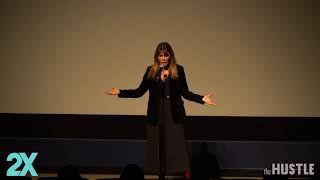
Nanea Reeves grew up with an addicted mother and found stability through meditation with her therapist Victoria Riskin. After her husband died of terminal liver cancer three years ago, she co-founded TRIPP, a platform combining video games with mindfulness, to align her work with compassion and what matters most.
Chapters
Okay, I'm first. I'm Ninea Reeves and I'm CEO of Trip. And thank you. I'm going to tell you a little bit about my story. When I was a little girl, my mother was a heroin addict and I had two younger sisters and I felt like the weight of the world was on my shoulders. And I was so angry to have so much responsibility at such a young age, and that anger fueled a lot of self-destructive behavior in me and my sisters. And by the time I was in my early teens, I had a complete mental breakdown that put me in the hospital. And through that experience, I met a woman who was a very kind and compassionate therapist who taught me how to meditate. And it was in that safe space that she created that I was able to quiet the noise in my head and see a new vision of myself and of my life going forward that had hope and optimism for the first time. But my sister couldn't do that. She could only see herself through the lens of being damaged. And by many, many years of that noise in her head just getting louder and louder, she ended up dying from a drug overdose in 2012. And she lived out the life I was supposed to have, the same life that my mother lived. But I started to make different choices in my life, and it got better. And I met a man who was handsome and funny and smart, and we were crazy about each other. And at the time, I was an artist and— very bohemian, living a life of self-expression. And he took care of me, and we got married, and we bought a house. And then one day he got sick, and he couldn't work anymore, so I had to go get a real job. And I went to go work at a web development company in an office, which is pretty much the worst thing you can ever tell an artist to go do. And I thought I was gonna die, and I had taught myself how to code websites, back when it was actually kind of hard to do. And I'd always been technical. I was this weird little girl that took apart the TV and put it back together to see how it worked. And when I would play games at the arcade, all the boys would go, "Whoa." And I loved playing video games because they helped me escape my life, and I could be a hero and a builder and a maker when it seemed like everything was falling apart around me. And so I took that skill that I had and this love of technology to work with me in that office, and I loved it. And who knew that building software with a team of people could be so much fun, even when it was challenging, but just so incredibly amazing when you built something as a team together that actually worked. And so that illness that my husband had, which I thought was taking away my ability to pursue my dreams, actually gave me a career in tech I didn't even know I wanted, let alone would love as much as I do. And that, that small company I went to go work at, it got bought by a bigger company, and I started to meet everybody in LA tech and people in Silicon Valley, and they actually, they really liked me. Because I had a lot of moxie, and I had a bullshit detector that can only be had by someone who's been through a lot of bullshit. And I had this weird ability to get very hard things done. And it came from being that little girl who had to step up and take care of her two little sisters when her mother couldn't. And that same little girl who had to figure out how to do things way beyond her years. Because of neglect. So that childhood experience that had scarred me, it actually laid the foundation for what would be some of my strongest attributes. And my career started to advance. But being a woman in tech, as mentioned, is not always easy. And especially when I went to go work in the video game industry, I often felt like I wasn't being heard and that I was dismissed or shut out of the boys' club. And I was working at a mobile game company that was just starting to really take off, back when people said no one will ever want to play a game on their cell phone. And some of you are doing that right now. And I packed up my office one day in such a state of rage, and I took the boxes down to the car with tears streaming down my face, and I made a phone call to a friend, and I said, "I can't do this." "they don't treat me right." And he said, "Nene, you can't leave. That company's on the verge of going public in about a year. Do you know how many people would kill to be in the position you're in right now? You have to stay." And I knew he was right. And I said, "Well, I guess anybody can do pushups in their cell for a year, I can stay for a year." He said, "Let me make another suggestion that if you are gonna stay, you show up with a good attitude, even if you have to fake it." And so I did that. I put my game face on and I went to work and I showed up with a good attitude. And what a surprise, when I changed, they changed. They liked me better, I got promoted. And when my initiatives actually started to make a real difference on the company's success, I got a seat at the table and not just the seat they give the girls. I got a real seat with real power. And I almost walked away from all of that. And what I could see was, one, it's really important who you take advice from. And two, I wasn't playing the game, the game was playing me. And when I flipped that and showed up like a team player and said, "How can I help us all win?" I started to get the same cash and prizes that the boys got. Provided that I negotiated as hard as they did, which was a very painful lesson to learn the hard way. But I will say that, um, that company did go public, and had I rage quit that day, there would be someone else standing here tonight, right now. Having success in business doesn't make you bulletproof from life. And 3 years ago, my husband got diagnosed with terminal liver cancer. And he had a very healthy attitude about dying. He was a very deep meditator. And he insisted that we all be joyful around him during the last few months of his life. We were told that we had 8 months together and we only had 8 weeks. And we all came together around him with joy and love, and it was hard. But as a result, when he did finally die in his meditation room, which is where he wanted to leave, he was surrounded by all of us who loved him, and it was beautiful. And had I made that moment about me caving into my sadness at the thought of losing him, he would have seen in his last breath the person he loved the most in complete despair. And I would have missed the most profound and meaningful moment of our relationship, which was to be there with him with love and gratitude for the journey we had had. And I definitely had a lot of time to cave into my sadness during the past 3 years. It was a moment though in my meditation that as I started to emerge from it that I realized I needed to give myself compassion and to make the choice to look at my future without him with hope and optimism. And so I started to make some decisions about how I wanted to rebuild my life. I got a dog. I never had a dog. I decided that I only wanted to work with people I really loved working with, and so I love working with my co-founder of Trip, Zach Norman. This is our fourth company working together. And I wanted to take the three things I love the most—video games, meditation, and compassion—these things that have saved my life and put them together in a company. To do something wonderful and unique. And I also decided that it was time for me to stop being number 2 and to step up and be a CEO. And, um— Thank you. So that little girl who's been spending her whole life taking care of everyone else has finally started to take care of herself. And I would just like to end with one thing, 'cause it was such a strange realization yesterday. That woman who helped me, that therapist, therapist, she was also a screenwriter, and her name was Victoria Riskin. And she went on to become the very first female president of the Writers Guild. And now she is in the later stages of her life as a— living as a human rights activist. So I'd like to thank her for her kindness and compassion to me, and for being a fine example of what it means to be a badass woman. And a fine human being. So thank you very much.










