Ramit Sethi Shares Bootstrapping Tactics for I Will Teach You To Be Rich – Hustle Con 2016
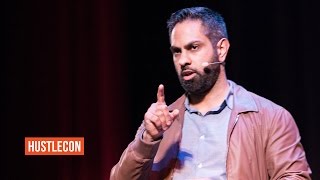
In this keynote at Hustle Con 2016, Ramit Sethi walks the audience through the unconventional decisions that turned his modest personal‑finance blog into a business with over a million monthly readers and 30,000 paying students. He recounts early failures teaching free classes, the pivotal $4.95 ebook experiment that taught him to charge despite fear of backlash, and how he scaled to high‑ticket courses ($500 to $10,000) while deliberately rejecting low‑price market pressure. Sethi explains his pricing philosophy—focus on the best customers, refuse applicants with credit‑card debt, and “de‑Ramitify” the brand—backed by data showing higher engagement from paying students. He details his product‑development process, emphasizing narrative, qualitative surveys over pure numbers, and the use of live, high‑touch experiences (e.g., in‑person copywriting sessions). He shares a conversational script for following up on “nos,” turning rejection into insight, and highlights the importance of listening to customers at every stage. The talk also covers personal principles: maintaining strict boundaries to avoid burnout, advising young professionals on networking through persistent outreach, and positioning the business as a trusted advisor rather than a transactional seller. The session ends with audience Q&A covering topics from the relevance of “getting rich” to burnout management and career advice.
Questions this video answers
Sethi says he hates Wall Street, emphasizes that his brand is about a “rich life” that includes relationships, health, and location, not just money. He’s redefining richness per individual while still teaching personal finance.
He stresses setting strict boundaries—defining work start/end times, saying no to most opportunities, and protecting time for students. Boundaries are the key skill to combat overwhelm.
Use college as a secret weapon: email CEOs weekly, track rejections, treat each email as a learning opportunity, ask many questions, and pursue internships or free work to gain experience and relationships.
Chapters
Alright, do we have any I Will Teach readers in the house? Let's hear it. Yes! Wow! Wow! I did not expect that. Do we have any I Will Teach students, anyone who's joined one of our premium courses in the house? Wow! In the front row! Total nerds! Okay, so I wanna talk to you today about some of the unconventional decisions we made that allowed us to build an unconventional business. I'm gonna take you through the business, I'm gonna take you through two key decisions, just two, that we made that I think are really important. And I think that if you get these two things right, your business is off to a solid start. So this is me. I used to teach personal finance classes. This is completely misleading because this is probably the most people I ever had in a room, ever. The average number of attendees was zero. And the way I got into personal finance was when I grew up, I came from a pretty big family, and I needed to get scholarships to go to college. So I did, and the first check I got was for $2,000. So like any 17, 18-year-old, I took that money and I invested it in the stock market. This is like the worst decision you could possibly make because I lost half of it immediately, and I was like, "Ah, shit, this is not a good start to my financial career." So I started learning about personal finance, and I started learning about psychology at the same time, and I was studying technology and psychology at Stanford. And you remember that book "The Emperor Has No Clothes," right? And they kind of call the emperor out. That's how I felt about financial advice. And everyone out there was saying, "Don't spend money on lattes and keep a budget." And my friends didn't give a shit about that. They wanted to go out, they wanted to have a good time, they wanted their money to work for them. So I started teaching these informal classes for free in school, and usually zero people came. And that didn't work. So for a year and a half, it was really hard because I felt like I had something the world needed to hear, and I knew that it was the right information, but for some reason they just weren't listening. And I later learned that you might have the best product or the best information, but the way you communicate it is so profoundly important. And so I created a simple blog, and I decided instead of trying to convince people to come to my classes, I would let the right people come to me. This is a super ghetto blog. It was some template that I found. I didn't even know how to create archives. I didn't put any ads or anything, but this is the blog, and I just started writing. So fast forward until now, it's expanded far beyond personal finance, and we now have over 20 successful courses. I'm really proud of these courses. Many of them take us years and years to test and develop, and you can see that we've covered the gamut of How to Have a Rich Life. There's, you know, everything from starting a business to copywriting to social skills. I'm very interested in creating a parenting course. As you know, there's nothing parents love better than to hear theories about parenting from non-parents. So I'm going to hold off on that one for a while. A little bit about the business, we have about a million monthly readers. We have over 30,000 happy customers. We recently shared a post on Tim Ferriss's blog, my friend Tim, about how we had a $5 million week and all the math and methods behind that. So, kinda wanted to let you know the scale of the business, but I'm less interested in talking about the financial side of it. In fact, we really never talk about our revenue or anything like that. We prefer to brag about our students and our decision-making behind the scenes. So I wanna start How do you go from that to this? This is the first product I ever sold. As you can see, I have a thing for titles. And it was a $4.95 ebook. And I had been writing my site for free for about 3 years. I just decided I wanted to try and see if anyone would actually buy anything. People were saying, "Nobody pays for content." My biggest fear was charging for something and then people calling me a sellout. Has anyone here had the fear of actually charging for your product? Just look around. It's a lot of people because you put it all on the line. So created this ebook, sold it for $4.95, and to tell you the truth, the worst of my fears actually came true. Let's take a look at a couple of these comments. It's from that day. Ramit, I've been a big fan of yours up to now. The first thing I suggest to people is to lose the unnecessary subscriptions, and yours would be one of those such subscriptions. Just knifing me in the heart. Ben, sounds like Ramit figured out how to earn some extra dollars on the side. I Will Teach seems to be more of a product pitch platform now. Go fuck yourself, Ben. I'd been writing for 3 years, never charged a cent, and I'm getting comments like this. What was fascinating was I kept getting comments like this, but quietly over here, people were actually buying. And they bought 100, then we had 500 sales, just, you know, it was a modest number of sales, maybe about 1,000 in a year. But what I learned is those people were way more engaged, their email open rates were quadruple the non-buyers, and they were just better. They were just better students overall. So I'm like, okay, this is a pivotal moment for me. I could listen to complaints like this and basically say I'm never gonna charge again, or I'm gonna lower my price, or I'm gonna go to an an ad model, but I wanted to listen to what the market was telling me. This is a pivotal moment in business. You get feedback, but you don't quite understand what's going on. You have complainers over here and buyers over here. So I decided to keep going. I wrote a book, which did pretty well. I went on book tour and I asked people what they wanted to hear. I came back and I started learning about product development and building courses. We built this course called Earn 1K on the Side. It's an awesome course. Any Earn 1K students in here? Awesome, look at that. Earn1K, we charged $497, so 100 times more. This time, we still got price complaints. People said, "That's outrageous. Maybe if it was $14, maybe I would consider it." And yet we still had people buying it. In fact, we noticed that the conversion rate was so high that we actually doubled the price of the course and we never lowered it again. So again, we're kind of listening to the market. What's going on here? Then we created a different course later, much more high-end. This was around $10,000. For this one, more people than ever saw it, and we received fewer than 5 complaints about price. So how do you go from a group of people who complain about a $4.95 ebook to a group of people who are delighted to pay tens and tens of thousands of dollars? How do you create a community of 30,000 loyal, happy customers? These are consumers, these are people like you and me, they're in this room, and they are spending thousands of dollars once and then doing it again and again. And in fact, when they buy, their top criteria, not even their top 5 criteria, is about price. That's what I wanna talk about today, is how do you build that kind of loyalty? And I'm just gonna focus on 2 key decisions. Before I go on, the thing that I'm most proud of is these students, and I'm also proud of our team. So I'm sort of uncomfortable speaking out here because it seems to be very Ramit-focused, and I really don't like that. We have a term inside the company, de-Ramitifying, and I think that's really important. So recently we've started to share photos of our team and share different case studies, et cetera. The team is 100% remote. They're amazing. and they're what makes this possible. These are the things that we prefer to focus on: our successful students, our readers, and our team. So the first thing I want to talk about is price. So there are two politically correct ways in American culture to say no. Let's say your friend invites you to— he's having a birthday party, he wants to do a scavenger hunt, right? It's like, "Dude, I don't want to go to scavenger hunt, I'd rather be sitting in bed reading Reddit." I can't really say that. So what do you say? You say, "Ah, man, would love to come. Happy early birthday. Unfortunately, I'm really swamped this week. I can't make it. I don't have time." Totally get it. We're all busy. So time is the first politically correct way of not taking action. And the second one, of course, is price. And it's interesting, you usually won't see people saying, "I can't afford that." Instead, they'll say, "That's outrageous." "That's too expensive." "How dare you, nobody would ever pay that." Anybody have this experience? It's very interesting. And in fact, that's exactly what we see in the data. We do a ton of research, we collect hundreds and hundreds of thousands of data points. This is one, we asked people, "Why did you not join our course?" Look at the comments. "It's too expensive." Another pivotal moment here. The world will try to drag you down in price. Silicon Valley will try to drag you down in price and say, "Nobody would pay for that. People don't pay for insert blank topic here. And if they do, they'll only pay $5 a month." Well, we don't believe that. We actually believe that there's room in the market to be the best. And we mean build the best products, select the best customers, and service them in the best way. We have no intention of playing in the $5, $50, $100 market. I'd rather give away our content than play in that market. So how do we do this? The key insight I learned was don't just listen to the first response, 'cause that's politically correct, that's what they'll tell you. But when you build something that is so good, it solves such a big burning pain in their life, then price is a mere triviality. And if you think about it, we all, we intuitively know this. We all have something in our life that we would pay anything for. Maybe it's a business class ticket for your mom to come visit you so she can stretch out her legs, right? Maybe it's a beautiful leather jacket. Maybe it's a bag of chips, you just love these chips, whatever. We all have something we'd pay anything for. And the same can be true for your products as well. So how do you build a product that solves that big of a pain point? I just wanna walk you through a couple of examples and you can use these in your product development. This is a survey And when we start off our product development process, we kick it off, we know it's gonna take years, 'cause we go through the process, we test it, we run cohorts, et cetera. This is a very, very early survey that we would send out, and you can notice we're not asking about our product. We don't even know what our product's gonna be, but look at the questions. What would this mean to you? Paint me a picture of what that would look like. Tell me how it would make you feel. And then we say, here's an example. First, I'd be able to do X, on and on and on. Why are we asking questions like this? Number one, we noticed that in product development, people, especially here, are super overly obsessed with quantitative feedback. We don't give a shit about quantitative feedback in the early stages. We want to know the stories. Tell us the emotional stories. I came home from work, I have two kids, I had to hold them both in my hands, so I can't crack an egg. I need something I can put in the microwave that just Works. That's interesting. So we ask them, and then second, you'll notice that we're showing them how to answer questions in the right way. I think if you just ask people, what do you like to eat? They'll be like, chow mein. Who cares? That doesn't tell us anything. So we actually show them how we want them to answer a question, and it turns out people are more than happy to answer questions if they know that you're going to be listening. Okay, so that's like the early part of the funnel. It's really, really open and we're just trying to learn. So the second part of commanding a high price is your product of course has to be really good. So if you are commanding a high price, then you can do things that others cannot. We have a course called Zero to Launch. Any Zero to Launch students in here? Awesome, okay. So Zero to Launch helps people create and grow their online business. In many other courses, there's a section on copywriting and they have like, 5 Ways to Write Better Copy. We decided to fly students into New York and rewrite their copy right there on the spot in a full New York video studio. Just imagine the difference between a $50 value and this course which is much more expensive. So our competitors are charging $17, $47, $97. One of our best-selling products is $2,000. Again, reinforcing the point, there's room in the market for the best. Um, 98% of our material's free. We'd rather not play in that market, we just give it away. Um, and the thing I'm most proud of is that we don't accept anyone with credit card debt in our flagship courses. So this is all about your values, and I don't believe that if somebody in credit card debt had all the information and motivation to understand interest rates, et cetera, that they would join a multi-thousand dollar course. So we just tell 'em no. And we tell 'em, use our free stuff, come back when you're ready, we're gonna be here. Today, tomorrow, 10 years from now. This decision, it cost us millions of dollars, but I believe it's the right thing to do, and it trickles to every part of the org. The customer service is better, our metrics are, everything's better. So main message on price here, if I had listened to what everybody told me, I would've been sitting, creating $2 iPhone apps on the side of a road in some ditch. I don't wanna do that, okay? I don't wanna do that. So, that's price. The second thing is dealing with rejection. Who here has felt some sort of rejection in the last 30 days with your business? Come on, don't bullshit me. Everybody does. And you know the crazy part is they won't tell you the truth. They'll never say, "You spent the last 4 years of your life building a photo sharing app, And the truth is, I don't really care if my photos aren't organized. They'll never tell you that. Just be like, ah, I think the price is a little high. Remember that $5 ebook I created? I had people who were like, Ramit, love the ebook, but I don't trust PayPal. But I do trust the US Postal Service. So if you could set up a PO box, in fact, I'll buy 2 copies. And naive Ramit in 2006, I was like, Okay, so I actually set up a PO box and I was like waiting, like where's my bushel full of checks? And over the course of an entire year, I received one check for $4.95. Don't make my mistakes. The thing is they'll never tell you why. They'll never tell you why. So I wanna show you how we handle nos. Here's a script, I'd like to show it to you. This is from a student of ours who applied for a program, he was accepted, and then he didn't join. Let me read it to you. Hi Karthik, I noticed you were interested in testing blah blah blah, and you filled out the application, but you didn't sign up. How come? The course is closed now, but I just wanted to reach out and find out what's up. So this is written very intentionally. First, people don't like to be told, hey, you said you were gonna do something and then you didn't do it. They don't like it, but we still want to find the answer to our question. So we did a couple things in this email, and we've tested this. One, we kept it really short. Two, it's super conversational. Notice the phrases, "How come?" or "Let me know what's up." Sometimes we say, "Out of curiosity." We're not saying, you know, we're not being super corporate about it. And then third, we have to be really clear, we're not trying to sell. In fact, the course is now closed. We cannot collect your money, we don't want it. We get massive responses. So if you have had people who are on your email list or in your customer base, they have not bought something from you, you're sitting on a goldmine. The type of answers we get from this are amazing. They'll say things like, well, I'd love to join, but course looks awesome, but I'm in Australia and I can't fly to New York. We're like, dude, it's an online course. But that's not their fault, it's our fault for not communicating that. Or we get people who say, "This course looks amazing, but it's really expensive and I can't convince my husband or wife to buy into it." That's actually really valuable, so now we can add that to our FAQ. So we collect these data points at every stage of the customer experience. Before the product, in the product, if they refund, et cetera, et cetera. I can't tell you enough, you have to listen to the customer. One more insight, by the way. This one was a little surprising. Sometimes I learned that people just aren't ready to buy and that's just the way it goes. Like we had people that have been on our list for 6 years. They've seen some of these products be launched like 7, 14 times, and then one day they'll just buy randomly. And I see it come across my dashboard. I'm like, what is this? So I'll email them, hey, notice you've "Join finally after 7 years, what's up?" And they're like, they'll tell us the most interesting things. They'll be like, "Oh, well, I tried to do it on my own, it didn't work, so I'm finally ready." Or, "Oh, I paid off my debt," or just because. And so my key lesson from that was just to be patient. If you've put the right process into place, if you've selected the right customers, if you've built the best products, you have the best marketing, our philosophy is it's just a matter of time. Okay. So the last point I wanna make is what this is all really about. You don't see this in your Google Analytics, you don't see this in your A/B testing when you're split testing colors or whatever. You should do all that, you should know your metrics down cold, but these are some of our successful students, I'm very, very proud of them. They were able to change their lives and lead rich lives. We did this by changing from a transactional relationship to a trusted advisorship. A trusted advisor, think about it, how many people in here have a trusted advisor you can call up and you know no matter what, they're gonna give you the right information? Right? So, surprising, there's a lot of people in here. As you get older, that becomes more and more rare. People get busy, they may have an agenda. We wanted to be that trusted advisor. And sometimes that means telling them no when it's not even in our best interest. Don't join, it's not the right course for you, you have credit card debt, et cetera. After running this business for 12 years, I think I learned, I think my beliefs changed. I believe now that the world will always try to get you to be vanilla. The world wants you to do everything like them. They want you to lower your prices, The world will pull you down. They want you to make your website look like everybody else's. Easy, fast, secure. And the minute you do it, they abandon you. The world wants you to look exactly like it, and the minute you do it, they will abandon you. The second thing I learned is that there is room in the market for the best. The things that we do in product development and growth and customer service, and all the groups that we have. It's about craftsmanship. It's about spending whatever it takes to build the best product. We do test. We do A/B test. We do all of that. But taking the time, because when we launch something, we know that it has to be the best. That's how we honor the students who joined our programs. There's room in the market for the best. Don't ever let the market pull you down. You should pull the market up with you. Okay? And the final thing is, You're the CEO of your business. You decide. If you want to run a McDonald's type of business, awesome. McDonald's is an amazing company. If you want to run a Louis Vuitton style type of business where you're focusing on select customers, you can do that as well. Don't ever let anyone pressure you into one decision. You are the CEO and you decide. Thank you very much. I think we'll take a few questions over here. Hey, Ramit. So with the rise of like social entrepreneurship and, you know, the kind of build something, change the world, change people, have you found that, you know, I want to help you grow rich is becoming outdated at all, or have you changed your mind on, you know, is growing rich kind of like a Wall Street fat cat kind of like old style mentality, or is it still kind of something that is, you see from your customers? Well, first of all, I love the question, and I hate Wall Street. One of the things that I'm very proud of in my site and my book is I name names. So all the books out there tell you about banks, I name names of the best and the worst banks. And I believe that there's incredible trust in someone who you trust actually telling you the best companies and the worst companies. Most of Wall Street doesn't like me. I will tell you one cool story, and I'll answer your question. I found out from an internal friend that I'm on a Bank of America influencers list, except it's a negative influencers list. I've never been prouder. I've never been prouder. I don't like Bank of America. I think I Will Teach You to Be Rich, you know, I don't know if I would pick the same name today. I started it out, I was focused on personal finance, but Getting up and talking about asset allocation doesn't drive me. It's about a rich life. So since day one, I've always said money is a small but important part of living a rich life. Um, but I certainly think there's many, many more important things. Like for me, um, relationships, health, where I live, all those things are way more important. So we've tried to redefine what rich means, and I think person by person, we are slowly getting there. Um, I hope we are. Thanks, man, keep it up. Thank you. Hi, my question is more about lifestyle, if you will. So to hustle, as all of us do, takes time and it takes energy, and I'm curious if you have advice for people on how to deal with burnout, how to deal with overwhelm, how to have enough brain left to do the thing that they're trying to do, even if they have the time. Almost every time I hear from someone who asks about overwhelm, and I dig in, I find out that there's almost always an inability to set boundaries. Almost always. And that means being able to say, "This is what time I'm gonna wake up. This is what time I'm gonna end work. This is what I'm gonna say yes to and no to." The reason that most people never see me speaking at a conference is that I just say no to every single one. And I happen to love Sam and I love what everybody's doing with HustleCon and I wanted to come out here, but I almost never speak. I never do most things that entrepreneurs do because I'd rather take all that time and spend it on our students. The biggest skill I would say in combating overwhelm is developing the skill to set boundaries. Every top entrepreneur I've seen is ironclad about what they're going to do and they wanna do and what they're not going to do or they're unwilling to do. Cool. Thank you. Thank you. Hi, Ramit. My name is Jake, and I'm, I'm a college student, so of course I'm trying to, to establish myself in certain communities with, uh, with networking, getting to know the right people, but my problem is I don't have the real-world experience right now, and I was wondering how What would your opinion be about how I could sort of build up that experience and meet the right people in order to see that professional growth? Great question. The fact that you're here means you're ahead of most college students. I think you should use your secret weapon, which is actually being in college. When I was in college, I would send out emails every week, and I had a tab that was called "failures," and if I didn't get enough rejections, then I knew I wasn't emailing I wasn't emailing enough people. So I started to build a network of emailing CEOs. Here's the magic part. CEOs will almost always meet a college student, 'cause they know how it was, and also they wanna stay on the cutting edge of what young people are doing. So you actually have an incredible advantage, and I would use that, and you just go there and you just basically get their brain dump. Listen. Out of 30 minutes, I would spend 28 asking questions. So that's one. Second thing is internships. Internships or free work. The more you can do that, the better your skill set will be, the better your relationships will be too. Thank you, Ramit. Yep, thank you. So you spoke about a parenting course. Your mom and dad aren't getting younger. When are you gonna be a good son and make them some grandbabies? What the hell kind of question is this? That's the last question? Hold on, actually, speaking of that, can I take a picture for my mom and dad? They couldn't be here tonight. All right, 1, 2, 3. 3. Oh my God, amazing. Okay, thank you guys for that. And I'm not going to answer that horrible question. Thank you for that. Thanks everybody.










