Sam Parr | The CEO of HustleCon.com Shares How He Writes an Email That is Opened by 1,000,000...
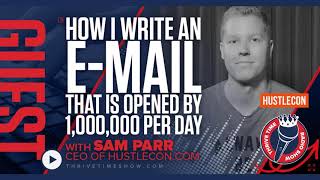
In this episode of the Thrive Time Show, host Clay Clark (joined by Dr. Zeller) interviews Sam Parr, CEO of HustleCon and founder of The Hustle daily newsletter. Parr recounts his entrepreneurial path, starting with a college hot‑dog stand in Nashville, moving on to a roommate‑matching app called Roommate, and eventually creating HustleCon, a conference‑style event for founders. He explains how he leveraged the conference to launch a daily email newsletter that now reaches over one million opens per day, describing the content mix (business and tech news presented with a witty tone) and the monetization mechanisms: high‑ticket conferences, native advertising within the email, and a premium research publication called Trends. Parr discusses scaling the company to about 30 full‑time employees and additional contractors, highlighting the emotional challenges of rapid growth and his approach to work‑life integration. He shares personal idiosyncrasies—abstinence from alcohol, a peanut‑butter‑heavy diet, and rewriting books or scripts by hand—as part of his learning process. Influential books such as Ron Chernow’s Titan (Rockefeller biography) and Stephen King’s On Writing are cited as shaping his mindset. Parr offers advice to aspiring founders: focus on the first actionable step, avoid paralysis by analysis, and treat business as a war while remaining humane. He outlines his vision to reach $100 million in revenue by 2025 by expanding the audience, reinvesting profits into new ventures, and continuing to grow the email platform. The interview concludes with a motivational “BOOM” mantra encouraging listeners to persevere through adversity.
Chapters
Hello, Sam.
This is Clay Clark and Dr. Zeller with the Thrive Time Show. How are you?
Hey, what's going on?
I'm doing great. Dr. Z and I were just doing some pre-show meditation. We like to get ourselves ready, stretching, kind of drink a lot of water, get ready.
I mean, because, you know, some of these get pretty aggressive, some of these get just pretty, pretty crazy.
Is that supposed to be your meditation music?
That is, yeah. That's the best we've got.
Usually, yeah, on Tuesdays.
Thrive Nation, on today's show we interview Sam Parr. Sam Parr is the CEO of HustleCon.com, and on today's show he shares with you how he writes an email that is actually opened by 1 million people per day. That's right, he writes an email that is opened by 1 million people per day. Sam Parr is the CEO of HustleCon, an organization that is backed by the legendary blogger, author, investor, and podcaster Tim Ferriss. His company's also backed by Tim Chin, the founder and CEO of NerdWallet, and if you can believe it, Scott Belsky, the founder of Behance. Scott is also the Chief Product Officer and Executive Vice President at Adobe. Scott is essentially the man who's responsible for the product management and engineering for the Adobe Creative Cloud products and services. For Adobe Spark, Behance, and Adobe's community of 10 million creatives. My friend Scott Belsky also oversees Adobe's design team, which is responsible for the experience and design of all the Adobe products. And why would these three legendary investors team up to back today's guest? Well, that is a great question. On today's show, we answer that question And we also deep dive into the time when today's guest, Sam Parr, made 2 hot dogs each for Kenny Chesney and Tim McGraw.
Real quick, time out here.
I'm doing a show.
Hate to do this, but were there 2 hot dogs total that he served to Tim McGraw and Kenny Chesney, or 1 each?
A total of 4 hot dogs were served. 2 to Kenny Chesney and 2 to Tim McGraw.
Well, those were not the words that were communicated out of your mouth just moments ago. Replay the tape, but we'll move on. I just— accuracy is what matters to me. Accuracy. Back to you.
Whatever. Let's continue. On today's show, Sam Parr also shares how he's been able to monetize his platform, how he manages a team of 30-plus people.
All right, stop the tape right now. Again, you're doing it again. You just said he manages a team of 30-plus-sized people.
I did not say that. I said he interviewed— he manages a team of 30-plus people.
Well, the devil's in the details, and that is what I focus on as the new auditor of the Drive Time Show.
Your days are limited if you keep interrupting me during my reads. I'm serious, I'm tired of it.
Uh, Clay, let me say this.
Who hired you?
About a character by the name of Zippy Longstocking.
What?
She used to zip it.
You—
I'm serious.
Now, shh, shh, shh. You need to listen to a new hit song. The song is called Zip it. Zip it good.
Is it possible to kill this man? Is that allowed in the state of Oklahoma? Can we kill the man? Who hired this guy?
Current law in Oklahoma states you cannot kill a man.
This guy is killing the mojo here.
Now, death is typically frowned upon in most of our 50 states. However, dude, the state of Oregon, one can kill oneself with the assistance of a trusted individual.
Let me finish the read. Let me do it. Come on.
Can I real quick before we get started? Have you seen the movie The Shawshank Redemption?
Yes, I've seen the movie.
Well, there's a scene in that movie that takes place in jail, and that's where you'll be going if you kill a man.
Can somebody get him out of here? Mute his mic. Okay, thank you. Thank you. I just want to finish the freaking intro. Can somebody cue up the meditation music real quick? I just need to kind of reset. I need to get myself ready to introduce Sam Parr. Oh, Billy. I need to get myself ready to introduce the founder, the CEO of HustleCon, Sam Parr.
Oh, Billy.
Okay, I'm ready.
All right, Thrive Nation, on today's show we are interviewing the CEO of HustleCon.com, Sam Parr, about why he believes that Ron Chernow's book Titan The book about Rockefeller, the Rockefeller biography, absolutely had a massive impact on his life. Why he writes down every single expense in a little journal called Ledger A. And all this and more on today's interview with Sam Parr.
Get ready to enter the Thrive Time Show.
Started from the bottom, now we here. Started from the bottom and we'll show you how to get here. Started from the bottom, now we here. Started from the bottom, now we're on the top. Teaching you the systems to get what we got. Colton Dixon's on the hooks, I break down the books. Z's bringing some wisdom and the good looks. As the father of 5, that's what I'm about. So if you see my wife and kids, please tell them hi. It's C and Z up on your radio. And now 3, 2, 1, here we go! We started from the bottom, now we're here. We started from the bottom and now we're right here. Yes, yes, yes, and yes! Thrive Nation, on today's Today's show, we are interviewing the man, the myth, and the legend, the CEO of The Hustle there, Sam Parr. Welcome on to the Thrive Time Show. How are you, sir?
You guys have the best intro I've ever heard.
You're probably right, Sam.
That's all we got.
That's it.
Let's wrap it up.
That's it.
Okay, great show. All right.
Now, Sam, Sam, seriously, you have started a variety of companies, a hot dog stand in Nashville. To a roommate matching app, to an annual conference for founders and entrepreneurs. Is it okay if I focus on the hot dog stand for a moment here?
Oh yeah.
That's the most exciting one.
Okay. Where did, where in Nashville did you start it? Where did you have the idea? Where did you source the meat? Walk us through it.
I, you guys might know this. Um, do you remember that TV show American Pickers?
American Pickers?
Yeah. Yeah.
Yeah. I got it.
Uh-huh. I, I didn't watch it all the time, but I think I caught it once or twice.
That's right. Um, I— it was, it was like on after Pawn Stars on the History Channel. I used to work for that guy, uh, on the show, the main guy on the show. And, uh, there was always a long line of people that would come to our store because that's where we stole— would sell the stuff that he bought on TV, whatever. And I decided to open up a hot dog stand out there because there weren't a lot of people, or well, a lot of places to eat. So I had hot dog stands, um, in the Gulch, which is a popular neighborhood in Nashville. And then at nighttime, I would work the bar circuit, so I would do all the bars at night. Um, and, uh, so basically I, I would— I was in college, I would work my— I had my hot dog stand from like 11 AM to like 3 PM, go to class from 3 to like 9, and then from like 9 to 3 AM do the bars at night.
And what college were you at?
I went to this school called Belmont University in Nashville.
Belmont University. Now I want to ask you this, and again, if you don't want to give me the hard facts, that's fine. Z will dig in for more.
Oh yeah, I got a show.
Belmont University, uh, when the students have consumed a lot of alcohol, do they tend to have more or less restraint when it comes to buying hot dogs late night?
Uh, you can double the prices, that's for sure. So I would doubt you— the daytime prices are $3.50, nighttime prices are $7. And I mean I could make $1,000.
Are you serious?
Yeah.
Now what's the biggest order you remember? I mean, I'm not trying to paint you into a corner, but what's the one where there's a guy, he's a— he hits the gym. I can see him now. He hits the gym a lot. He's a clubgoer. He's jacked and he's had 17 beers or 14 beers. He's had enough beer where he no longer can feel his face, and but he can still sort of say stuff like, I want a hot dog. And you're like, did you— what did you say? You want a hot dog? And so what's the most hot dogs you've sold a man at one time? The most regrettable hot dogs? The most where you said, it's too many.
I'll tell you this.
I'll cut you off.
I'll tell you this. So I don't have a good story for that. I mean, people would give me $100 and just say, keep the change. But because it was in Nashville, I had a lot of cool people stop by. I mean, I had Tim McGraw and Kenny Chesney came together and bought from me. They were just hanging out. And that was probably the coolest folks who came. Came by and bought something from me.
What were you—
did you make your hot dogs real slow for them so they could kind of hang out the stand? I mean, you're like slow-mo, like, hey, what's up, fellas?
I'm just—
oh, I definitely, I definitely was, uh, chatting up with them. I think they gave me $100, so I can't complain.
Oh no, that's cool.
Was Kenny Chesney shirtless and wearing, uh, overalls?
They were dressed exactly like they do on stage. It was— this was the night— was— it was CMA Fest. Which is like the big country award show or something like that. And they were— they pulled their truck over and got something from me. So they were dressed like they just left the award show.
Z, now a lot of people would build a hot dog stand, sell a hot dog or two to Kenny Chesty and Tim McGraw and say, fold it up, boys, I'm retiring.
That's it.
I'm a DJ.
No better than that. But this guy continued to press on. You pressed on to— what was it? Was it a roommate matching app? How did that work?
Yeah, so I started this hot dog stand in college and it was pretty good. I was making money, but then I decided to try to make it work on the internet, make something work on the internet. And so I left school, moved up to San Francisco, and I started a roommate matching app, which is basically, at the time it was like Tinder but for roommates. And this was before Tinder was even popular. And I obviously should have done Tinder for Tinder, but we did it for roommates and we sold the business though.
I'm in the middle of my plan. Please explain when you say it was like Tinder for roommates.
Hey, how you doing?
Please explain to me what this was, and I'll get my— I'm gonna have my boo button ready.
No, it was, uh, just like people who all had similar preferences for where they wanted to live would show up, um, on your phone, and you would swipe left or right if you wanted to meet them. Nice. It's very simple. It was very simple.
But, uh, so it was just—
it was just based upon— they only had one element of match, and that is where you wanted to live.
And your budget and things like that.
Yeah, okay, well, yeah, budget's kind of—
we absolutely should have made it so, uh, it was like who you wanted to date, because that would have been way better.
Now, what was, what was this, uh, kind of a passive-aggressive way to date them, right?
I live with them, you know, just like, hey Sarah, how are you, roommate? How you doing?
What do you, uh, what was that app called?
Roommate, that's what it's called. It doesn't exist anymore, uh, the acquiring company shut down, but it was called Roommate.
This just didn't shut down.
That's an innovative, innovative name.
So when did you move on to HustleCon? HustleCon. And what is HustleCon?
Let's get to the hustle.
Do the hustle.
Yeah, so I started, um, after I sold my first company, I was kind of looking for something to do, and I just started to host this event. I made it up called HustleCon. It's basically like a TED Talk but for entrepreneurs. And in order to make it popular, I just started blogging and created an email. And the first event— and I mean, I was doing this just to kill time and meet people who I could partner with and just kind of brainstorm with. And it was just kind of a project. I didn't expect it to make money. But the first time I did it, it made like $80 grand in 6 or 7 weeks, which is pretty good. And so I was like, that's interesting, let's do it again. So I kind of did the same thing again where I created this email list where I would blog and write emails about the speakers, and this time it made like a quarter of a million dollars in 80 days.
What?
And, uh, that's kind of how, uh, Publicon started.
Now I understand your newsletter now is opened by over half a million people. You have a daily newsletter with over half a million subscribers, but it's open.
No, uh, it's open by over a million people.
What? What?
Nice.
Well, you just have, you just have to.
Is that double the size of half a million?
This just did. So yeah, so when we were doing HustleCon, I made it popular by creating an email, and I was like, well, I don't really wanna be a conference guy, I wanna create a huge, massive business. And so we said, well, email can probably be pretty big, let's try that. And so that's kinda, we kinda like fell into this whole daily email thing, and yeah, now it's well over a million people a day read it.
Okay, so I'm gonna recap. You have sold a hot dog to Tim McGraw and Kenny Chesney. How many hot dogs did they buy each?
Uh, 2 each.
2 each.
Nothing fancy.
And you have it— how many people every day open this email newsletter?
Uh, a million a day at least.
And what's in this email? Is it Chuck Norris jokes or—
No, it's basically— I taught myself how to write and I would write in a kind of funny way. It's basically the way I described to my parents. It was like, I was like, it's kind of like the Wall Street Journal but for 28-year-olds and it's in an email instead of a website. so business news and tech news.
What kind of stuff can people get inside the emails from you that they can't get somewhere else?
Uh, they can get a lot of the information in other places. I mean, we have reporters who go out and get some unique stories, but we just tell it in a more interesting way, uh, and we also deliver it straight to your inbox. And so, uh, the whole theory was people have a lot of information out there on the web. How do we just tell them exactly what they need to know first thing in the morning so they don't have to search anywhere else?
So how do you monetize The Hustle? What website? How do you make money with thehustle.co?
Well, it's not a website. The website doesn't make any money, but I'll tell you, we make money in 3 or 4 different ways. The first way is we have conferences still. So like last year we had something like 20,000 people attend our conferences.
Wow.
We built a whole— so basically when you go to like Huffington Post or BuzzFeed or BusinessInsider.com, you see advertisements. On their website. Well, we built our own technology, so when you're in our email, you'll see highly relevant ads. And so we make, uh, well north of, uh, 8 figures a year just off of that, off email advertising. And then we also own this thing called Trends, which is a premium publication. Basically, our team of analysts, we do research on, uh, where it's almost like Harvard Business Review. We do different case studies on different companies, and we have technology that shows fast-growing trends in the world of business, and we charge money for that.
And where are you located? Like, where's your home office?
Well, I started the company where I live in San Francisco, but we have about 30 employees, and most of them at this point are actually in Austin, Texas.
So do you live in the San Francisco area or Austin?
I live in downtown San Francisco. I spend a lot of time in Austin, but I live here.
Okay, okay. So you now are— I think the listeners are starting to get some context here. So you have an email that's been opened, that is opened by a million people a day, and you, you've monetized this. It's an 8-figure business now. What, what's the vision for the company? Where do you see this thing going?
Well, when I— I'll tell you, it's simple. When I got into the business, I just wanted to create something huge. My goal was to create a business that could do at least $100 million in revenue by 2025. So in terms of like numbers, that's definitely what I want to do. But the, the— our strategy is to build up this massive audience of people and to monetize with ads in the email and to use all of those profits to launch more businesses and then to tell our audience about it to get more customers and to keep on building and starting and growing new companies. I mean, that's ultimately my goal.
So what's the hardest part? What's the hardest part been for you of growing this community?
So the actual growing of the product has been quite easy. I mean, I think it's easy because I'm, naturally good at it, and I just worked hard to perfect that skill. The really hard part has been the emotions of growing a business. I mean, growing headcount from— I mean, we haven't taken any venture capital, so growing a company from zero to X amount of people and X amount of revenue, um, it's really hard because I started the company when I was 24. It's hard to do it, uh, emotionally. Like, I— you— there's all these new challenges that you've never experienced before. You don't know how to deal with certain things. You don't know what's normal, what's not normal. That has been the hardest part, is the emotional part.
For the listeners out there that don't have any, uh, context here, um, and if you don't want to share a specific number, that's fine, but are you managing dozens of people or hundreds of people, or just so they kind of understand the emotional toll of doing that?
Well, so we have, let's say, 30 people, and then we have like another 20 or 30 contractors. So I mean, we've hired a lot of people, dozens and dozens of people over the last few years. I at one point have managed most people. At this point, I manage one person. I manage my president. He's the president and he manages, uh, everyone. So I, I, I'm really good at starting businesses. I'm not great at managing people. So I, as quickly as I could, I outsourced that and hired someone to manage the people.
Um, you know, entrepreneurs sometimes struggle as they grow a company to find boundaries. Do you, do you work 6 days a week, 5 days a week? Uh, how many days a week are you working?
Well, I, I, I, I'll, I'll address, I don't know if that the premise of the question I even agree with. I don't really have work-life balance. I kind of have work-life integration or something like that. Like, my— it's maybe like a professional athlete. Like, you're, you're kind of always— like, you're always eating or sleeping a certain way even if you're not, like, exercising or running. So for me, my work, my life is my— I mean, they're the same thing. And so, uh, all of, like, my best friends are all somehow associated with my business. And so, um, I would say that I tend to do downtime on Saturday where I won't use my phone at all, um, when I hang out with friends Saturday night or Sunday day. They're, they're, they're my type. They're friends who I invest in other companies with. So we're always kind of scheming and talking about work. And so I would say Saturday is my only real down day, but a lot of days feel like down days. They just maybe don't look like it to the outsider.
Okay, that makes sense. I'm a guy with 5 kids and I am working on something in some capacity 6 days a week. That's kind of my flow. And I was just curious what you do there. So you're saying you just kind of are constantly in a flow state, but you turn the phone off really on like a Saturday.
Yeah, on Saturday and Sunday I try not to use electronics too much, and at night I try not to. I, I use the pencil and paper a lot and just write down ideas. I'm always making notes or making frameworks for things. Yeah, so I don't know, like, so in terms of like when people say like they work 100-hour weeks or a lot of our, our week, I'm in the office from maybe 9 or 10 AM and for about 8 or 12 hours a day. But I'm always thinking about what I call scheming. I'm always scheming. I scheme 24 hours a day. I just can't help it. I love that.
That's Dr. Z's phrase. He's always scheming on a new business idea. Come on now. Okay, so Josh, what is your question here for today's guest, Mr. Sam Parr?
Hey Sam, thanks so much for taking my question. I guess what I would ask is obviously you had the tremendous success of selling hot dogs, Timber Grill, and Kenny Chesney, and then the Roommates app, and then, and now The Hustle. So a lot of folks out there hear the, the success and, and the things that you've done, but they're not seeing the behind the scenes of the work that goes into it. I think everybody loves the, the fast cars and the beautiful houses and the money and all that, but what, uh, what advice would you give those folks out there trying to build something or trying to start something? Or what would, what would be the foundational things that you would start with there, Sam?
I think that what I've noticed when I hire people and we launch new products, the biggest I notice this with people who I hire and I pay them money to launch things, and it's not their money on the line or anything like that, and yet they're still afraid to launch something. I think it's because a lot of people have an idea, or I'll have an idea for something, and I'll think, "I want to launch this conference. Maybe one day I'll be like Ted Turner and I'll own CNN and have all these other things." Then they say, "Oh, but there's no way I can get there." They think of like what step 1 is, and then they think of what step 10 is, and they don't understand step 2, 3, 4, 5, 6, 7, 8. And what I always tell people is like, don't worry about step 8 or 9. Only worry about step 1. What's step 1? How do we get that done today? And they'll say, well, I want to launch this one thing, but that won't help me get to step 3, 4, and 5. I'm like, who cares? Just go into step 1 and just start it and do that for a long time, maybe a short time, but maybe a long time. And I bet you, you'll figure out what the next figure out what the second step is. And then after you get the second step, you might figure out what the third step is. Because a lot of people get held back thinking about steps 2, 3, 4, and 5. They just get too— it's like paralysis of analysis. They think about it too much. And I just think that most people don't understand that the people who have built things that they admire, they didn't expect it to get as big as they did. They just started doing and it kind of happened over time. So I think that the biggest thing to get started is you just got to do it. You can't— Worry about what steps 3 and 4 or 5 are, just do step 1 and step 2. Some— it's what I've learned doing this for 15 years. It tends to reveal itself over time. It's perfect.
What is, uh, the website you would encourage everybody to go to if they want to, you know, just test out the waters and learn a little bit more about you?
About me?
Yeah, about you or what you're up to. I mean, where's the best spot for people to get kind of the— to deep dive into all things Sam Parr and the whole thing?
Yeah, you can just Google Sam Parr Twitter and you can follow me on Twitter. That's where, that's where people can learn a fair bit. Or go to thehustle.co and sign up. Or if you just Google my name, you could probably find a bunch of videos where I kind of say the story of what's going on.
We've interviewed a lot of successful entrepreneurs. We've interviewed Wolfgang Puck and John Maxwell, and each person we interview, just like Steve Jobs, they have their own, they have their own idiosyncrasies. Like John Maxwell wakes up every day at 4 AM and writes. Steve Jobs wore the same thing every day. Do you have an idiosyncrasy or some sort of superpower that others find to be odd?
Well, I have a lot of things that people find odd. I wouldn't call them a superpower. Okay. Some idiosyncrasy, I mean, maybe like I don't drink any alcohol. I haven't had any alcohol in 9 or 10 years. I don't drink at all. And I'm kind of a wild guy, but I'm 100% sober and don't drink. So a lot of people are kind of surprised by that. There's days, I do this a lot, and I have to like, I'll eat only peanut butter for many, many days in a row. I will say one more thing. What I tend to, the way I learned how to write, and I do this all the time, is I'll rewrite books and movie scripts by hand.
Hold on, let's get back to peanut butter. Are you crunchy or smooth, Sam? Or you— Smooth. Smooth, oh wow, okay, just checking.
I wanna make sure that I didn't black out there for a second. You're saying that you rewrite movie scripts? Like what kind of movie scripts?
Well, I'll do SNL when I wanna learn how to write comedy, but like The Catcher in the Rye, like if I wanna learn how to be a classical, or not a classical, but like solid writing, you could rewrite Stephen King. The way that I see it, we're really good at learning new instruments. So if you pick up a guitar, but you don't, if you grab a guitar, you're not like, going to first thing go and write a song, you're going to like copy Green Day or Guns N' Roses or something and like learn. And you're going to do that for a long time. And then you're going to be like, oh wow, like all the cool songs are using this structure, or a lot of them have a riff after they have like the chorus or something like that. With writing, you see the same thing. In great pieces of writing, you can start— you can like rewrite it and feel the texture and see the commonalities and the differences. And you're like, well, this book makes me feel this way, Well, I'll rewrite it. Now I understand the language and how that author made the reader feel that way.
That is awesome. And let's go back to your theories on peanut butter. Crunchy or smooth again?
No, smooth. He's smooth.
Smooth.
Smooth.
Smooth.
Yeah.
And is this— was this introduced to you at a young age? Was it kind of a dark period? Was it a positive thing? Or what kind of— I mean, seriously, how often do you go into these peanut butter phases?
No, I mean, like, I don't know. I'm not like most days, like a lot of many days at work, that's literally all I will eat.
I love it.
It's a beautiful thing. I'm, uh, everyone know, everyone who knows me knows that that's just what I eat. And I, they bring it to me all the time. I, I just have a really, uh, odd diet. Like, so Sam is salami and peanut butter.
I'll eat all day celery or crackers or anything with it, or just, just peanut butter.
No, like I, I dip it. I have like my own spoon here at the office and I just dip the spoon in there.
What's your favorite brand? Are you a Jif?
So if I want to be healthy, I eat Adam's Nature's, like the healthy stuff. Sure. But I prefer the cheap stuff, which is Jiffy.
Oh, yeah. Oh, he's a Jiffy man.
Perfect.
Hey, real quick. I know we kind of passed over it earlier, but I know there's a lot of inquiring minds out there that are just dying to know the answer to this question. That is, was Tim McGraw a ketchup or mustard guy?
I have no idea.
Oh, man.
Oh, I. We were— I was still drinking back then and I was into having a few while serving hot dogs. So I have no idea.
The mystery continues. Oh, the mystery.
We'll never—
we'll never— we may never know.
We may never know. Now, Sam, what are a couple books that have had a big impact on your career? Is there a book or a few books that you'd say, yeah, I've read a lot, but this is one or two you'd recommend?
Yeah, I read a lot. I read a lot. And I used to have a book club, so I'm very active there. Titan, the biography of John Rockefeller. That was my— that changed my life. Really? Um, On Writing by Stephen King is the second one. Uh, but that Titan by John Rockefeller changed my life.
You know, my wife bought me that book for my birthday years ago, and it absolutely— I mean, there's so much wisdom in that book. It is just great. Uh, it's Titan, the life The Life of John D. Rockefeller by Ron Chernow. How did that book impact your life? What things did you learn from it where you thought, whoa?
Well, if you read it, you know, I mean, John D. is an incredibly rich character. I mean, he was mostly incredibly honest. He was for sure a wonderful father and a wonderful husband, and he was a ruthless businessman. And I think that— I don't have children yet, I'm recently married. I think that what I was trying to— what I learned from him is I can be a ruthless businessperson but I could still treat people respectfully and be a good father and a good husband. And, uh, be— I mean, he definitely, he definitely had some flaws and there were some times where he wasn't honest, but he was mostly very honest over a very long prolific career. And I think that that's great because a lot of times you'll— people will vilify Zuckerberg or Bezos and all these other people. And the reality is, is you can crush it and knock it out the park and be the best, and people are still going to hate you no matter what. But you can get there and be kind and ruthless at the same time. You can be honest and ruthless at the same time. You can get and become incredibly rich and create tons of values while also being a really good person.
Yeah. His, his book of things that jumped out of that book to me was that he wrote down every single expense and every single—
I do that too. Yeah.
He did that. That was crazy. Uh, that was awesome.
That's what he called it.
Yeah. And then he had, uh, this little red notebook he carried around where he would like write things that need to be improved upon. That was, that was interesting. His ability to—
I do both of those things now, and it was because of that.
Yeah.
See, I carry my clipboard. I stole from that. The one thing I thought was crazy, too, is how— if you remember the part of the book where he was talking about the rioters and the looters, he had these people that were picketing.
Yeah. Yeah. I believe they were protesting like a union or something like that. And I think a mine maybe.
Yeah. And they were like— and they were burning equipment and they were starting— and they were starting to destroy his factories and stuff, the refineries, correct?
I forget exactly, but he wasn't like that upset about it.
Yeah. And he was— but I mean, it was just like his ability to like have this— his factory being destroyed, but not really worry about it. And then at the same time, be the guy who's known for oil and gas, who essentially built the National Park System. He started buying all this land and then he gave it back in a trust to the government. I mean, it just— that book is mind-blowing. It was like 10 lifetimes, that guy.
Not only did he do that, so John D, he, he owned 90% of the US production of oil, so he created the modern oil, but, uh, oil business. But he also, uh, created the National Park System. He's the one who created the first ever university hospital. So he— John D launched, uh, University of Chicago, which was where research hospitals started. He helped cure a lot of diseases because of this. Uh, they opened Spelman College, which, uh, was the, uh, was the college for Black women, which was very uncommon at the time. I mean, he was very, uh, prolific.
I— the one part of the book too that stood out to me was he would talk to the pastor after the church services in Cleveland, and basically if someone were— someone was praying for money or needed money, he would always give insane amounts of money to this church but would never let anybody know where the money came from. So over time, I've read multiple books about Rockefeller. People, he started attending the church thinking that this is where the miracles happened.
Sure.
Not knowing that he was the one who was funding a lot of these things. I mean, it's just, that book is great. Thank you for mentioning that book. That blew my mind. I, I, I wanna read it again.
Yeah, I've read it a couple times. It's a really significant, uh, uh, piece of work because a lot of people don't realize how impactful, what the reason he, he's so impactful to our, to modern society. But you don't know because he didn't want his name on anything. Everything.
True.
He put his— his son is the one who created Rockefeller Center, and that's really one of the few things that he allowed to have his name on, but he really fought that. Um, but like, there's so many things. Like, like I said, University of Chicago, John Rockefeller created that, and he didn't want it. He didn't want anyone to know.
It's unbelievable.
It's unbelievable. We need more men like that out there. And, and it's a great— it's a great moment you just said, because I think a lot of business people struggle with— I mean, getting ready— that's, that's who listens to our podcast and our radio show, is that people that want to start a business, have a business, want to grow a business. And so a lot of people out there really struggle with this idea of being— what does a ruthless business person mean? And that idea that, you know, when you start a business, it's like— it's not like all your competitors are going to come together and say, hey, we're so glad you're here, oh my gosh, here, here's some of our customers, here's some of our stuff, we just— let's just all share and work together. No, it's, it's, it's, it's war. It's, it's, you know, business is war. And if you don't have that mindset, that doesn't mean you can't be a great father, a great friend, a great husband or wife or, you know, you feel—
family is war.
I mean, you got to put that hat on when you— when you pick up your lunch pail and get your shovel, put your hat on and go to work. I mean, it's— you have to be ruthless. And that's— I'm so glad you mentioned that because here again, that's that concept. That mindset is so lacking. I think that's why so many businesses are failing out there.
Sam, I have one final question for you before we let you drop the mic. You have had a lot of success. You obviously are going to continue to have more success in the future. Our listeners are wanting to know, what's that one piece of wisdom, or that maybe that one thing you want to share with all the listeners? Is there, is there a website you want them to check out? Is there, is there a quote you want to leave them with? Is there an action step? What's the one final thing you'd like to share with, with the Thrive Nation?
Um, I would say, uh, one, one thing that really changed my life was when I met some of my heroes. I met some of my business heroes, some of my athletic heroes, And one thing that I learned that I made the mistake of was I put people I looked up to, up to on pedestals. And once I realized that the people who built all these amazing things, that they're not much better than me, I realized it kind of freed me and taught me I can do whatever they did and maybe better. And so I would say to anyone who wants to do something great, don't put the people you look up to on pedestals because they have flaws and they're people and they just, do the job, and that's the only thing holding most people back.
Mm, Sam, you are the man with a plan. Thank you so much, and I hope you have a great rest of your evening.
All right, thank you very much.
Thrive Nation, if you are out there today and you are just feeling stuck, like you just can't seem to overcome the adversity in your calendar today, I want to encourage you, you can do it. You can do it. You can go from having a hot dog truck to building a multimillion-dollar company. You can do it, but you've got to believe that you can do it. You see, you gain your strength through struggle. You gain your strength through struggle. You're going to have to push through adversity. Failure is a prerequisite to success, which is why you have to bring the BOOM every single day. Now, BOOM stands for Big Overwhelming Optimistic momentum. That's big, overwhelming, optimistic momentum. And so now, without any further ado, let's end this show with a boom. So say it with me now. 3, 2, 1, boom!
If you don't understand you're the one, you won't understand why you're being attacked like you're being attacked. Whenever the enemy knows that the one is coming, he always sets traps to stop them from succeeding because they're the one. And to him whom much is given, much is required. And so the text starts out talking about Abraham because Abraham is the one. And Abraham had to move out from his country and away from his kindred because he was the one. So he was a misfit because he was the one. So he didn't get to stay because he was the one. So he had to live in isolation because he was the one. So he probably was lonely because he was the one. Because he was the one, because he was the one.
New city, new state, it's gonna be a mean race. All the sins that I have done, I'm grateful for a clean slate. Felt like I was different, I ain't never try to prove it though. Stack your chips, get on your grind, you'll never make excuses, bro. Solid as a rock, loyalty is all I ever know. Doing what you've always done, then homie, you can never grow. Conversations with the Lord, I ask him would I ever blow. Told me I got dead weight, some friends I gotta let them go. We don't Make it. I know they think hating, it's all in they faces. We destined for greatness. I said I've been patient. I know it's my moment. No stopping, we going. This thing is in motion. What you gonna do when your back's against the wall? You gonna stand up like a champ or you gonna curl up in a ball? I'm the one. I've been chosen, so I'm riding through it all. Gotta keep your faith up so you can rise and never fall. Let's go.
And Abraham had to move out from his country and away from his kindred because he was the one. So he didn't get to stay with with his kinfolks because he was the one. They are always on the hit list because hell knows that he is the one. I want to talk to some people that have been up under crazy attack. And to him who much is given, much is required.
The devil's been attacking, I ain't stressing from it, cause every time that happened there's a blessing coming. Obsessing over problems that you can't change, I had you going crazy, learn your lesson from it. Remember when they cut my water off, homie, man, reflecting how they cut my lights off too. I had to move back in with my mama, had me feeling like a failure. That's what life would do. Gotta get up on your grind. I had to make the right move. Ramen noodles every night. I had some beans and rice too. Execution is the key. Don't tell me what you might do. Favor from the man above. No other God is like you. You can knock me down, but I promise I ain't staying there. Feeling like I am the one. We just begun. Make it clear, me and Clay clicking up. Y'all don't even get it, bruh. About to be colossal, taking over when we rip it up.
Hey, and Abraham had to move out from his country and away from his kindred because he was the one. So he didn't get to stay with his kinfolks because he was the one. They are always on the hit list because hell knows that he is the one. I want to talk to some people that have been up under crazy attack. And to him who much is given, much is required.
Work.
Started from the bottom, now I'm here. Proven that success after 23 years. Got the dragon energy, got another gear. Got a superpower, man, I call persevere. Cuz I never have a thought people call fear. I never stop grinding when the future's not clear. We're going to be dead soon, and I'm just being real. So why be paralyzed by the thoughts that we feel?
So you'll stop begging for people to come into agreement with —so you'll stop doing polls and census and trying to get everybody to come into consensus with your vision, so that you won't need nobody to say amen when you preach, because you already know that you got heaven saying amen.
The power of one. Listen to the entire T.D. Jakes sermon, Grasping the Moment, by visiting T.D. Jakes' YouTube channel. Simply named T.D. Jakes. You're getting ready to flow. I feel the glory of










