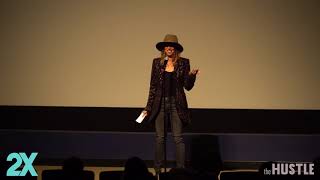
Samantha Scharff spent 11 years at Saturday Night Live as a production assistant and producer, taking on impossible tasks like a million-dollar animated segment with no budget experience. She was sued by Disney and Michael Jackson, survived a dead-air disaster, and later founded Giphy Studios. Her lesson: saying yes to fear-inducing work builds the fearlessness needed for creative careers.
Chapters
Woo-hoo! Hi, guys. I'm Samantha. I'm the CEO of Giphy Studios. We launched Giphy Studios 2 years ago as a creative agency and production studio to make original GIF content for brands, celebrities, TV networks, film companies, and music labels, and more. I'm not going to talk about Giphy or tech today. I've spent some time in a few startups, but at my core, I'm a producer. And that gave me the foundation to really thrive in these startup environments. So everything I ever needed to learn to survive in business, I learned at Saturday Night Live. I spent 11 years in the ultimate boys' club. Where many of the rules were: drink lots of alcohol, exist on very little sleep, showers are optional, and most importantly, work your ass off, don't take no for an answer, push boundaries, take risks, and be fearless. So today I'm going to talk about taking risks and being fearless, which is funny because I'm quite fearful of public speaking. So please bear with me right now. I have some Cliff's Notes right here. So I started at SNL at 21 years old as a production assistant. I was bright-eyed and eager and kind of jaded as I entered the holy grail of comedy. You see, comedy really wasn't my thing. I just wanted to work at the Oprah Winfrey Show. So despite that, I did understand the brevity of where I was. And it was drilling. I would stand on set and hear the stage manager count down, "And we're live in 3, 2, 1," and I would just get like butterflies of excitement throughout my body. And I can't say I didn't get starstruck. Of course I did. I got to meet everyone and party with them. I went from drinking wine at 5 in the morning with Eddie Vedder to ending up at after hours at Tracy Morgan's where strippers were waitresses. And it would be like, how is this my life right now? But the first day that I started at SNL, someone told me, whatever you do, don't talk to celebrities and don't look them in the eye. I think they were trying to help me, but I just spent the next year walking around like a hummingbird on steroids being like, can I talk to that person? Did I look at that person the wrong way? I got stuck in the elevator with Lorne Michaels like on my third week and just I stood there frozen like, "What's the protocol here? Am I allowed to look at him?" I just looked down and it was the longest elevator ride of my life. So I jumped into this super competitive environment and high stress environment with very little skills other than an internship at VH1 and some college classes. I really just had to say yes to everything and I made it up as I went along. It was either like I go with it or I get eaten alive. So I took a lot of risks. By my second year, I was asked to produce an animated segment with a million-dollar budget. I said, "Yes, of course, why not?" Despite the fact that I had no idea how to do a budget. Math was my worst subject. I didn't know how to use Excel and I certainly didn't know how to produce animation. But I mean, I grew up watching cartoons so I figured, How hard could this be, right? Wrong. There were a lot of variables and it was near impossible. And to make it even harder, I was really young and doing a really big job, so a lot of people didn't take me seriously. I had to work extra hard to gain trust and respect, and it was constantly like pushing a boulder up a hill. I wish that I could say that SNL was the only place that I experienced that, but it's probably been almost every job I've ever had for the sheer fact that I have boobs. I mean, am I right? So, anyway, let's see, I forgot what I was saying because I just talked about boobs, and now I'm gonna move to, right, okay, farts. My first day as a producer of TV Funhouse, I walked into this recording studio, And I opened the door and I heard a loud fart, a loud fart, and I thought, are they going to think it's me? I was really embarrassed and I sat down and then there was another fart and I was like, what the hell is going on here? Then I realized that we were doing a cartoon and I spent 4 hours choosing fart sounds from a fart library for a cartoon. From that point, I went from fart jokes to penis jokes at my next recording session where I went to the Ambiguously Gay Duo with Steve Carell and Stephen Colbert. It then became my job to discuss how phallic the animation was allowed to be on SNL. So that's how I became frenemies with the NBC standards department, otherwise known as the censors. So not only was I pushing, taking risks, doing things that I didn't know what I was doing, but I— we also were taking risks by the content we were making. We were being provocative and we were pushing boundaries. And there was a whole department there to make sure we didn't go too far, and this was the standards department. And TV Funhouse had a lot of risks, so I was number one on their speed dial. And I would get messages that would tell me the exact words that I was allowed to use for private parts and the exact words that I wasn't allowed to use. Let's just say these conversations were NSFW. The standards department and Robert didn't really agree all the time on what was allowed to air on SNL. So they would tell me we couldn't air things, and we would do it anyway. The hope was that we would air it at dress rehearsal. See, there was two live audiences, a live dress rehearsal audience and a live broadcast audience. And the hope was that if it was funny enough, Lauren would fight for it and it didn't matter that it was controversial. I was basically the sacrificial lamb. So since it was my job to get these scripts approved, it was also my job to tell Robert we couldn't actually make these things. We would run our cartoon at dress, and I would walk off the set feeling really high from all these people laughing and it doing really well, and I would hear, "Samantha! Where's Samantha?" bellowing down the hallway. I had no choice but to run and hide. Fortunately, most of the jokes got pushed through, and I didn't get into too much trouble. There were a few times, though, where our risks didn't go as planned. We had a couple of cartoons that did get pushed through and aired and then got pulled from broadcast because they were so controversial. We did get threatened by a lawsuit from Disney. I got sued by Michael Jackson for slander. My parents were so proud that they framed it on the wall in the living room. Yeah, they finally thought I had made it. So I really learned the most about taking risks from Robert Smigel. He was the ultimate risk taker, and he never took no for an answer. And by default, either did I. But there was one time where risk almost destroyed my career. So we would air our cartoons in dress rehearsal, and between Dress and air, we would often edit based on if the jokes played well or notes from Lorne Michaels. And we did this about 10 blocks away. And we usually had about 2.5 hours to edit based on where TV Funhouse was in the rundown. So one time, Lorne decided that we should take our cartoon and cut it up and have part of it be the cold open of the show. So when you see that person that's saying, "Live from New York, it's Saturday night," He wanted our cartoon to do that. Now, we had often spent these 2 hours editing things, and I would be really cutting it close, running in New York City in heels with the tape, barely able to breathe— I had asthma and would always forget my inhaler— showing up to NBC at the control room, usually with about 15 minutes to spare. Now, in this case, we only had an hour to chop up a 5-minute cartoon, do a new voiceover, try to get the lip sync correct, and we were 10 blocks away. It was really scary. I was looking at the clock every minute. It was just counting down, counting down, counting down. And it would have been our fault for the first time in history since 1975 for SNL to open with dead air if we didn't get the tape there on time. Dead air. For those of you who don't know what dead air is, it's when you turn the TV on and you see those colored bars with a really annoying high-pitched sound. Not a good look. I would have been fired immediately. So I was really panicked. And at 11:08, we just had to call it. It was going to take us at least 15 minutes to get back to 30 Rock. So we lay off the tape, get in the car, running with the tape. Robert sprints down the hallway. Gets to the control room, loads it in, it's 11:27. We made it. Phew. Except there was a problem. There was no audio. We were fucked. It was really, really bad. Robert thought on his feet and went and got Darrell Hammond, who basically can do every impression under the sun, and had him do Pat Robertson. That's who we were opening the show with, gave him a script, and there were those words again, "And we're live in 3, 2, 1!" Only this time, there were no butterflies of excitement. I was shaking in fear. And Darryl started reading the script live, watching the cartoon, looking at the lip sync, making sure that his words matched the lip flack perfectly. And then it got to, "Live from New York, it's Saturday night," and went to the music. And I collapsed in my chair. I mean, my heart was in my throat. Somehow we pulled it off. Um, yeah. I've taken a lot more risks since my time at SNL. I veered away from TV into the YouTube biz when it was really, really new. And I took a chance at a startup. Called Maker Studios. Most of my TV friends and my agent all thought I was crazy. But it ended up being a really good risk because I entered the Wild West of startup culture and digital media. And it's led me to where I am now on a completely different path than wanting to work at the Oprah Winfrey Show. I find it much easier to get tripped up now that I have— like tripped up with fear now that I have more responsibility. In my 20s, I had nothing to lose. I had no fear of repercussions or what people thought of me or, God forbid, fear of failure. But now, with a career and a family, the risk seems much greater and the fall from failure seems much harder. So whenever I find myself struggling to take a risk, I step back and I ask, "What would that badass from SNL do?" And I dive right in with nothing to lose. Thank you.










