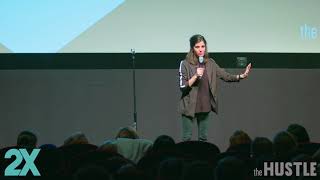
Sarah Singer went from teaching special education in a Bronx basement to running Mic's video team at the World Trade Center. She covered the Unite the Right rally in Charlottesville with a small crew that unexpectedly became part of the story. She shares three lessons from teaching that shaped her as a manager: stay flexible, bring your whole self, and focus on the present moment.
Chapters
Alright, woof! Okay, cool. Hey everyone, my name is Sarah Singer. I am the executive producer of Mic. Mic is a digital news company. That's what we are, we're a digital news company. Okay, um, what I'm here to tell you guys today is this kind of crazy, kind of weird story that started on August 12th. 2009, that was just a few weeks after I had graduated from college. I was getting myself so pumped up. I was getting ready to enter what was going to be my first year as a special ed teacher at a high school in the Bronx. Um, 5 years later, August 12th, 2017, I was in Charlottesville, Virginia with a small film crew covering the Unite the Right rally, which going down there we thought was gonna be this small little thing, turned out to be, as I'm sure you all know, the alt-right's kind of emergence into the mainstream, at least into the mainstream news cycle. Needless to say, I'm really short, I'm a petite person, I'm a Jewish woman, It was a good fit. It was the right story. I was welcome there. But those were just about— those were 5 years apart or 4 and a half years apart or 4 years apart. And oh my gosh, what a journey that was from being a special ed teacher. My classroom was in the basement to what is now running the video team of Mike. We are on the 82nd floor. Of the World Trade Center. What a journey. So what I'm going to tell you guys tonight are 3 lessons that I've learned that actually I learned as a teacher that have made me a better professional, that have made me a better manager, that I think about every single day. And this is about that evolution. Number 1, and this is going to sound obvious, but this is harder to do than it is to say, be flexible. I studied English in college, um, literature major, love writing, love student journalism, all the things with words, non-fiction, fiction, you name it, poetry. So when I showed up the day before the first day of school, um, but the day before my first year as a teacher, I got my class rosters and my class schedule, and I was teaching two classes of earth science. This was special. This was not perfect. I actually had never taken geology myself. So this was the moment of reckoning. My mother in the room can say there were lots of tears, there was lots of panic, there was lots of not chillness. But I was stuck with this schedule. The kids were coming in in 12 hours. What was I gonna do? We gotta roll, we gotta teach some Earth science. So that was it, like I was teaching, so this was a high needs school, and we're not gonna go into education policy right now, but the upshot of it is there was no curriculum. I was teaching two self-contained classes, which just means that 8 to 12 kids, varying levels of needs, everything from learning disabled to developmentally disabled, we were teaching Regents-level Earth science. This was not an ideal situation for anybody in the room. But we rolled, and my God, did I become obsessed with earth science. So that experience, I finished that first year of teaching thinking I could do anything. You take an English major and plop them into geology with students who are special needs students are amazing people and just like amazing learners, just it's very hard sometimes to break down material in that way. We're gonna make it work. Okay, so the upshot of it is be flexible. How that has, at Mike, which used to be called Policy Mike, in the 4 and a half years that I've worked at the company, we were counting this just at dinner right before this event, I had 7 different, 7 different, jobs in the past 4 and a half years. And I'm sure the folks who worked in startups or are entrepreneurs or have worked in very quickly growing companies can kind of validate that experience or can live that. And as somebody who was a writer and an editor of words who's transitioned into visual journalism and video and self-taught editor of motion graphics and of just film in general, oh my god, we just roll. OK, so that's number one. Be flexible. Number 2, and this is where we get a little zen. This is the idea of embracing the whole you, right? And at face value, being a special ed teacher and being an executive producer are two completely different jobs. But pull off one layer, and what you're doing is telling stories, and you're connecting with audiences. And the same skills that enable somebody to be an effective teacher, breaking down new information, figuring out what's gonna make it exciting to somebody, relearning it yourself, knowing your audience, an earth science class, for example, is gonna look different at the college level than it is at the high school level than it is at the middle school level. Those are the exact same kind of, skills or like practices that we have in journalism, right? The content is different, but the goal is the same: break down stuff happening out in the world, figure out who your audience is, how can you best translate what's happening in the world to that audience, and how can you kind of motivate them to action. So rather than looking at the differences between these two jobs and saying, oh my God, I'm going to discount all that education stuff and start and start from scratch as a journalist. And rather than kind of putting up barriers around our different careers, whether they're at the same company or at different companies, using those two, your divergent paths, or like the unique experiences that make you you, and turning those into a collective kind of like whole self, and that whole self that can only be you, That's what makes, like, I feel my coworkers at Mike say, "Teacher Sing," my last name is Singer, "Teacher Sing, Teacher Sing, teach us how to do video, teach us how to do whatever." And like, that's the realness because I channel so much of that same practice that I did in the classroom as I do at my job now. And like, that's what makes me me, and that's the whole you, the whole me. Okay, great. Number 3, here we are. Now this is the real zen one. This is the one that I'm most excited about. And this is the idea of finding your daily zen. And this is the hardest thing, especially us in startup world. It is the hardest thing to do because startups are roller coasters. Some days are the best days ever. We're making it. We nailed it. Our company's the best. No problems. Everything's perfect. Some days are the worst. Oh my god, it's all ending. We're done. It's the last day. I'm so sorry. I'm so sorry, everybody. We tried really hard. I'm at peace with it. OK. So the upshot of this is— I'm going out on a limb here, but I think I know this is something that I worked really hard at. As a woman, and I think many women in the room can kind of empathize with, we hold on to a lot of stuff. It's very kind of intuitive to say, to neurose over something that happened yesterday, to just not get past something that a coworker said that you're so annoyed about. Like, oh my god, he or she must hate me. Oh my God, like I really messed up 3 hours ago at this thing. Or become so super like preoccupied with something that could happen 3 weeks from now. If I do this, oh, what's gonna happen then? What am I gonna do? Like what's this person going to say about me if I do this or whatever, whatever. Okay, like neither of those, neither of those are happening now. You can't change what happened yesterday and you have no idea what's gonna happen 3 weeks from now. Embracing the day and saying, I'm in charge of today. And all that I could do is create the waves. I'm the captain of my ship. We used to say this in the teaching world. As a teacher, you're the captain of your ship, but you also make the ocean, right? You create the environment in which you're really gonna be kind of like navigating. And I think that that's something that I think about all the time, every day, leading this video team and having gone through lots of different iterations of PolicyMic to Mic and all of that stuff. You really, I mean, it's up to you how to best leverage those 10 hours or 8 hours or 7 hours or whatever your workday is. And don't get preoccupied, 'cause like, that's it. Like, the dailies and live your life. That's it, bye.










