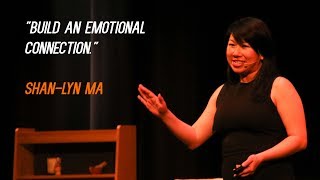
Shan-Lyn Ma, CEO of Zola, explains how she built a wedding registry company in a $19 billion market by copying Gilt's referral tricks and letting guests naturally spread the word. Zola raised over $40 million by offering one registry for gifts, experiences, and cash, with mobile-first design and the ability to delay shipments until couples are ready.
Chapters
Please give it up for Shane Lin Ma, the CEO of Zola. Well, you know you make me wanna talk, kick my heels up and talk, come on now, don't forget to sing, yeah, yeah, yeah, yeah, yeah. CEO and co-founder of Zola. So I think I can see most of you here. Raise your hand if you have gotten married and used Zola for your wedding registry. Yeah! Raise your hand if you've been to a wedding where Zola was the wedding registry. More hands. And raise your hand if you've just heard of Zola in general. Oh, cool. Well, if you are not yet acquainted with Zola, I hope that you very soon will be. And for those of you who don't know what we do, we are the fastest-growing wedding registry and wedding startup in the country, and we are also one of the fastest-growing e-commerce startups in the country. We started 4 years ago, and we set out with a mission to use design and technology to reimagine the wedding registry experience for couples getting married today. Those couples just happen to be the millennial generation. We're different to any other registry you might know of in that we work directly with 500 brands, brands that you might be familiar with as classic registry brands like KitchenAid or Cuisinart or Vitamix, that you see in every kitchen. We also partner with brands that you might be less familiar with, that are more up-and-coming, like Leesa Mattress, Parachute Home, Sonos, as well as experiences like Blue Apron, SoulCycle, wine tasting. And in the last 4 years since we started, it's been a 4-year hustle so far, we've raised over $40 million in VC funding. Last year, we did our Series C, of 25 million, and I was one of the depressingly tiny 4% of female founder CEOs who raised the Series C in 2016. Thank you. Thank you. Well, I hope that many of you here will help us drive up that number over the coming years. Is. So I want to tell you how we've seen explosive growth in the business, and to do that, I wanted to start at the beginning. So this is a picture of me and my mother and my brother. Isn't my brother cute? He looks a bit different now. And, and when I was growing up, I was not like other little girls. I think many of my friends wanted to be pilots or astronauts or firefighters or teachers, and I wanted to be this guy. Who knows who this guy is? Jerry Yang! He is the founder of Yahoo! And Yahoo!, you know, while today I know most of us here are probably Google users, Yahoo! started as really the company that helped us access the internet for the first time. Jerry Yang started the, the company Yahoo with the idea that he wanted to make the internet a friendly, accessible, fun place. And if it wasn't for Jerry Yang starting Yahoo, there wouldn't have been many of the great companies that exist today, like Google, Facebook. He really set the stage for all of us here. Growing up, I idolized and wanted to be like Jerry, and when I, you know, looked at him, I saw another immigrant who started with very little but worked really hard and has now had a lasting impact on the world. And when I looked at how do I get to Silicon Valley and start a company like Jerry, I didn't know anyone who had ever even heard of Silicon Valley, so was reading a lot of articles. And read that Jerry and other great Silicon Valley founders went to Stanford. So I thought, I guess you have to go to Stanford. So I was lucky enough to throw my application in, get accepted, and got to go there for 2 years to do my MBA. After my MBA, I, of course, went to work at Yahoo. And the best day of my 2 years at Yahoo was when I passed Jerry Yang in the corridor. And he didn't see me, but I definitely saw him, and I silently freaked out. I, to this day, still have never actually met him or spoken to him, so if anyone here knows him, please come and see me after. But most importantly, I learnt at Yahoo from the best product people who now run product at some of the best companies in this country. I then took that— those skills and moved to the East Coast to join Gilt Groupe as the first product person there. I learned a great deal, and most importantly, I got to meet great people like Kevin Ryan, the founder of Gilt, who also founded Business Insider and Mongo, and Nobu Nakaguchi, who was the head of the user experience design team, and both Kevin and Nobu are now my co-founders at Zola. At Gilt, I learned a lot about how to build a great e-commerce engine and what the requirements are for any explosive e-commerce company. Really, it came down to a simple but hard equation, and that equation is you need to build in demand intent and virality into your product to see product market fit, but that's not enough. You also need to build an emotional connection to your users. So I'll share a bit about how we saw this work both at Gilt and then how we iterated and improved upon that during our time at Zola so far. So this is Nobu and I. So, Nobu at Gilt, I mentioned, was the head of the user experience design team, and you can see some of his design genius in action here in this middle photo. This is Australia Day, the best day of the year at Zola, and Nobu somehow created a hat, which is the Opera House, out of a few random paper plates in the office. But really, what he and I learned together at Gilt was so crucial to the formation of Zola. We learned about, first and foremost, how do you create demand intent? How do you define an e-commerce product that customers then are led very clearly and quickly down that e-commerce conversion funnel to want to check out? The way that we saw this work at Gilt was that Kevin had created a company that offered great, beautiful design brands at 80% off retail price for a limited time only in limited quantities. It was the first time anyone had seen this before, and it drove a great number of people to check out really quickly. When we were thinking about a new idea to start, the year was 2013, and that was the year that all my friends were getting married at the same time. I'm sure many of you have had that same experience. Same year, if not you will, and that was the year that I had to buy a lot of wedding presents from a lot of registries that at that time were the traditional department store wedding registries. We saw there was a clear opportunity here, and we saw that there was already demand built into the wedding registry market. 2 million people get married every year. That means 2 million people have to create a wedding registry for the most part if you don't want gifts that people will just randomly buy for you. We realized it's a huge market. Who knew there was $19 billion of wedding registry gifts purchased in the US alone every year? And for the entire global industry, it was a $300 billion market. I think that surprised all of us and still continues to surprise many investors. So when we were thinking about the market is big enough, but how do we really differentiate and build something that we know our friends and couples today deserve? We started by thinking about what are users using today? And we did a lot of research. We spoke to hundreds of couples. And we heard that what couples were doing was they were going into department stores, they were faced with a sea of products, they had no idea what they were doing or what they should be doing, and it was painful to be led through things that all look the same, whether it was the same kind of coffee maker, same kind of plates, pots, and pans. That was the physical experience, and it led to a lot of fighting. On the right, you can see these were the department store registries as they looked in 2013, and some of them still look like this today. From an e-commerce perspective, it looks cold, it's impersonal, it looks like a checkout cart. We know couples today deserve better. We started to talk to couples about what would they do if they could do anything with their wedding registry. And the same themes kept coming up again and again. Couples said, "We want to register for products and experiences and cash, and we don't want to set up 3 different registries to do that," which is what they were doing before Zola. So we built a registry that let you register for anything you wanted all in the one place. A common complaint we heard was that when you register with department stores, they would, as people bought from your registry there, things would just start turning up at your house and you had no idea what was coming, who sent it, what's in the box. You weren't even ready to receive it yet. Often you might have been off on your honeymoon or getting married and yet things just kept coming. This was very easily solved using technology. All we did was we said, we will not send anything to the couple until they're ready to actually receive it, which is a huge innovation in the e-commerce space and still something that only we do today. Third, we heard couples want to make their registry as beautiful as the rest of their wedding day. So in this country, on average, couples spend $35,000 on one day. They want it to be beautiful. They spend a lot to make it reflect who they really are, and that extends to wedding registries. We let couples personalize what it means to have a registry. We made it mobile because that's where couples live today. We let them designate anything as a group bit gift because it turns out people were kind of hacking this by registering for a lot of things they didn't want, then taking it all back to the store after they received it to return it for the thing they really wanted. You should just be able to register for the thing you actually want in the first place and let people contribute to that. And then lastly, customer service. Every single customer we interviewed said to us, I have no idea what I'm doing because I'm getting married for the first time. Please help me understand what to do. And that's where our customer service really lends a hand and does what we say in our tagline, which is, "We do anything for love." So, number 2, virality. The way we saw this at Gilt, and we learned a great deal, was we saw at Gilt, we were one of the first to really productize the idea of refer a friend or invite a friend. We were one of the very first to launch the invite a friend, get $25. That was at a time when Gilt was a members-only site. People wanted a lot of credit to spend on Gilt, and there weren't that many referral programs out there, so it was unique, and a lot of people did share Gilt. We also were the first to come up with what is something I'm really proud of at Gilt, the personal invitation link, where we gave every member their own unique link that they could share with friends anywhere, and we could track back to that person how many people they refer and give them credits accordingly. And that drove huge growth of Gilt in the early days. It was virality that we had built into the product that really drove the growth. And we knew we had to figure out a way to do it at Zola. We also at Zola have the benefit of having natural virality because When someone gets married, on average, you invite 150 guests to your wedding. So the way we think about building virality into Zola's product is that if we can build a registry that is beautiful, that is easier to buy from than any other registry, then every guest coming to that registry will want to tell their friends who are married, getting married, or will want to use it themselves when they get married. And we just have to remind them that we exist. Number 3, last but not least, most important part of this e-commerce equation is how do you build an emotional connection? So when I joined Gilt, the first thing I did was interview all the users in multiple focus groups, surveys, one-on-one interviews about Gilt. And I heard, kept hearing the same things again and again. The same words were, "I love Gilt. I'm obsessed. I'm addicted. I cannot stop shopping." And those words really became the benchmark of what it meant to have a real emotional connection with users. The way that, you know, we thought about how to bring this to life within the Gilt product was in the Gilt mobile app. I don't know if any of you remember or still have it, but there's a notification that goes off when the sales start. And that was something that we would hear users say, "Oh, the sales start at 9 AM on the West Coast and I'm driving to work, but when I hear that notification, I pull over to the side of the road and— because I have to start shopping right there and then. Otherwise, I might miss out on something." And that kind of emotional connection and commitment was something that we thought about bringing to Zola in some way. The way that we have done that is we have looked at how can we bring this out through what we're hearing from couples they love and they want from Zola, and that is really the next phase of our business. It's going beyond just the wedding registry to help couples plan more of their wedding. We, for the first 4 years of our business, have been laser-focused on solving the painful parts about wedding registry, but we've been hearing users ask from us or pull from us things they also want us to help with. Things like, could you help me with my baby registry? Could you help me furnish more of my home? Or could you help me plan more of my wedding? And we've only in the last few months decided we would expand beyond registry to attack a bigger market. And between those three options, we landed with weddings. We wanted to help people really plan the wedding from the day they get engaged through their first year of newlywed life. We launched Zola Weddings two months ago with the idea being we could help couples plan through a checklist, a guest list, and a free wedding website. And we could do all of this for free because our business is registry. During the 2 years— sorry, the 2 months since we launched Zola Weddings, we've had overwhelming reception from couples who are using the tools to make their wedding planning easier. And as we look forward to our next step, we're looking at how can we build more to help couples with more of their wedding to make it from the currently the most stressful time of your life into how can it be an easier, simple, fun time of your life. And really, the reason we're doing it is because we know it's not just about building product market fit. We have that. We've shown that in the numbers. It's about how can we continue to build an emotional connection. And if we can do that, then, like Jerry Yang at Yahoo, like we did at Gilt, like we're starting to see at Zola, we can have a real impact on people's lives. Thank you.










