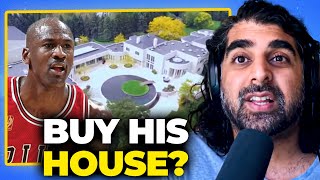
Sam Parr and Sean debate buying Michael Jordan's unsold Highland Park mansion and turning it into a museum or tourist attraction. They compare it to Graceland and Monticello, explore crowdfunding and fractional ownership via platforms like Rally Road, and consider alternative uses like a high-end Airbnb or memorabilia vault.
Chapters
Sean put something on here that I actually think— I was telling a friend as I was researching, I actually think that this is one of the better ideas that we and you, you've ever come up with. The Michael Jordan thing. All right.
Yeah. You want me to explain it? Okay. So I've been looking at this house for a long time. Michael Jordan's house has been for sale for like a decade and it hasn't sold. And this is his house. Kind of like in Illinois near Chicago where, you know, Michael Jordan was on the Bulls and he had this 56,000 square foot home in Highland Park. And so this thing originally, he put it up for sale and like, I don't know, 9 years ago for $30 million, $29 million. And now it's, you know, the price has been cut in half and the thing is still not selling. And if you look at the photos, you can just go— it's like on Zillow. So you can go look at the photos. He's got like an indoor basketball court. You know, the gate leading up to the driveway has this big 23 number like embossed in it. He's got, you know, everything you would want, like huge, you know, closets because he's got, you know, all his Air Jordans or whatever. And so his house is, it's pretty unbelievable, right? There's, there's all kinds of, um, epic shit here, but it's not selling and it's not selling for, I think, a couple reasons. It's like, you know, it's very custom to Michael Jordan. Um, like it just, it's like It was custom made in many senses. So, you know, the other rich people don't necessarily want to live in a house that's like made for another dude. It's also, you know, it's very expensive for the area. The property taxes are really expensive, all that stuff. But I was thinking, okay, the price is now cut in half. Now it's, now it's a $13 million house or $12, you know, $13 million home that you could buy, $13, $14. And now it's in range where maybe there's something fun you could do with it. Now you might be getting a value buy. So I was thinking, All right, there's a bunch of people obviously that are basketball fans that love Michael Jordan. Um, there's a bunch of, you know, new ways to crowdfund that we've been talking about— NFTs or Kickstarter or different, different crowdfunding platforms. So the question is, should we buy Michael Jordan's house? Should we start a crowdfunding campaign and buy Michael Jordan's house? So if you could get 5,000 people to each put in $2,500 then you could own a fractional share of Michael Jordan's house. Uh, you could, you, you could own a piece of, of this history and we could just buy it out, take it off the market, um, and we could own this thing. And then the question is like, what do you do with it? Um, and so I wanted to brainstorm with you. A, should we buy Michael Jordan's house? And B, what could we do with it if we did buy it? What do you think?
So the whole NFT thing, I wouldn't do that. I think that— I think you've had two ideas here. One is to buy his house, and two is to do the NFT thing. Uh, one of those ideas is great. I think the other one is overcomplicating it. I would 100% buy it. And the reason why I think it's such a great idea is immediately after you seeing you write this, my thought right away went to Graceland. You know what Graceland is?
No.
That's funny that you don't know what that is. It's because it's such a big deal in my family. Or Elvis's, at least. So Graceland is Elvis Presley's house. Uh, it's in Memphis. It's in downtown Memphis. It's actually in a pretty crappy neighborhood now, or the neighborhood is not nice, and it's like kind of gross, but it's just like a cutesy thing to do if you visit Memphis. And I went and did research on it, and so around 600,000 people a year go to Graceland, which brings in something like— where I have the numbers here. Okay, so Graceland, just in attendance just in ticket sales brings in $21 million. So it's, yeah, pretty wild just on tickets.
And then 600,000 visitors a year, $36 a ticket, right?
Yes. And I got interested in this, so I thought, what are the most visited homes in America? So I came up with a few and I want to fill you in on them. So the White House doesn't count because you can just— you— I think you can get a tour, but you could also just walk outside of it. But Graceland, 600,000. The second one, you guys are going to make fun of me. I don't know how to pronounce this. What is it? Monticello?
I think so.
Okay. Monticello, that's Thomas Jefferson's house. And so the interesting thing about this place, as well as a few other I'm going to mention, is that they're nonprofits, which means all of their numbers are public. And so the revenue for Monticello, which includes a ton of investment revenue, was around $200 million in 2010, but around $8 million, $7 million came just from ticket sales. So $8 million a year in ticket sales, which is crazy. And they have around 500,000 people. Another most visited home is Neverland Ranch. People don't go there. But another great one is Mount Vernon, which is, I think, what's our first president? George Washington's house. And they do in food sales alone. This is crazy. Just in food. $17 million a year.
Wow.
Is that crazy?
This is insane.
The whole operations, and then they do $15 million a year in admission sales, and in total they do about $51 million a year in total income, which includes $10 million from contributions. Is that crazy? That—
no, that's absolutely insane. So let me ask you, these— okay, so this all of a sudden, this starts to get really interesting, right? Because I think Michael Jordan is on par with Elvis and, you know, Thomas Jefferson. Michael Jordan's got TJ beat by a long shot. So, you know, MJ over TJ, I think, is, is part of the, the slogan that we have when we, when we buy this thing. But, um, if they're doing this much in traffic, I got to know, is there something else? Meaning, like, are these in really, like, popular areas, uh, where there's already just a lot of tourists or something like that, and this is just a pit stop? Because, you know, Michael Jordan's house in a neighborhood You'd have to only be going to go to this place.
I looked up Michael Jordan's address. Guess how far away it is from Chicago Airport, one of the most popular airports in the world?
I'm going to guess 45 minutes.
20 minutes. It's 20 minutes away. Okay, so it's like, have you been to Memphis? Memphis is like, there's not that much going on in Memphis and all these people are going to Memphis. People are all— Chicago is what, the 5th most populous city in America? Or maybe third, something like that. Something is interesting here. So what I would do is I wouldn't do the NFT thing. I would raise, uh, $2 or $3 million from a bunch of rich people, um, or I would try to use my own money if I had $2 or $3 million that I wanted to spend on this, and I would buy it. And then it would probably cost a fair bit of money to get it set up. It would probably cost a lot of money, another many more millions. But then you'd have to convince collectors to lend you the stuff and you create a Michael Jordan museum.
Yes.
And that's how you do this. And the companies that we've just mentioned, Graceland, Monticello, and, um, Mount Vernon— so those, obviously those folks lived in the 1700s or probably died in the 1800s. So they've been around, those properties have been around as tourist destinations for 100+ years. But they've done $50 million in revenue, which is a shit ton. But even if you've just done $2 or $3 million in revenue, and you could do that and adjust for inflation for 50+ years, kind of like Graceland has done it for 60 years, that's incredibly fascinating, right?
Yeah, I'm with you. So, so I think, you know, you're shitting on the NFT thing a little bit, but it's not about NFT. What I'm saying is crowdfunding. So I think that there's a benefit to crowdfunding, which is that Crowdfunding is a way to make the story more viral. It is a, it's a more PR-worthy story that, you know, people from the internet, people from Reddit, whoever got together and bought Michael Jordan's home off the market for $15 million. They raised $15 million and bought the house versus a rich guy went to his rich friends, raised some money. The second thing is those become, you know, your evangelists to spread the word and to come make the pilgrimage to go see Michael Jordan's house. And I think you could do 2 or 3 things with it. I think you could make it a museum that's like a modern museum that we've been talking about, like the Museum of Ice Cream or something like that, where the tour is very heavy photo-based. And so you're, you know, you're going through and it's all these different photo exhibits of, you know, you in Michael Jordan's bed and, you know, wearing, you know, a pair of his Air Jordans or standing in a pair of his giant Air Jordans or something like that. And you make it like a museum of ice cream where you're going to walk out with, you know, 10 photos that are Instagram-worthy at the end of it. I also think—
give people background on Ice Cream Museum.
Yeah, Brady, you can pull the latest numbers, but I think these guys raised it like $100 million plus valuation. And if you ever go to one, they're pretty cool. It's, you know, it's not the most amazing thing. I honestly, I was a little bit disappointed, but the photos do turn out cool. It's a museum that you walk through. So it's like a guided path. And you go through maybe like 13 different rooms and every room is something cool and you get a little, you know, you get an ice cream cone of some flavor and then you can take photos next to some like exhibit that they've set up. And the idea is not for you to look at the art like a traditional museum, but for you to like take a photo in the art and post it on Instagram. And that's their marketing. That's the free marketing that they get. And so Museum of Ice Cream. Oh yeah, here, Aubrey has it. They raised $40 million. They raised a $40 million Series A at a $200 million valuation last year. And I think this could be bigger. I think this could be much, much bigger as a brand. The other thing, the other thing that you could do is sports cards are having this incredible boom right now. And I think what you could do is you could have certain collectors put their collection in the house. The house could be basically the vault to store some of the most rare memorabilia in the sports world, signed basketball, shoes, and sports cards. And that could be part of the museum. And you basically store it and you, um, you store it for some of these collectors. So I think, I think there's a bunch of stuff you could do to make this work. But the idea is like, can you buy this thing for $13 million, put another $4 or $5 million into, um, you know, getting it all set up? And then could you make $5 million a year? Could you make $10 million a year like you're saying these other guys do? As a pilgrimage for tourists going to Chicago and basketball junkies?
I think the answer is definitely yes. I think it's so interesting. I found another example of one and it's called the National Trust for Historic Preservation. It's a nonprofit and all they do is buy historical Buildings. And they're historic. I looked at their numbers. They've been doing like $50 or $60 million in revenue for years. And I'm still trying to figure out how to entirely read nonprofit statements, but they have a line item that's revenue less expenses, which I guess that just means profit. I mean, I don't know how they define—
Yeah, it's EBITDA.
I don't know how they define either of those, but it was $26 million. And it's been doing that for years. Is that nuts?
So I like this idea. I like this idea a lot. And I kind of want to dig a little further into how these home museums work because I think this is pretty interesting. The other good thing about this, by the way, is that the Basketball Hall of Fame sucks. Nobody cares about it. Nobody goes to visit it. All the other sports, like, you know, Canton for football, these are like tourist destinations. You know, tons of people go there every year. It's really cool. And the basketball one is known to be super lame because They let way too many people in. And it's not like, it's not a thing that basketball fans really care to go do.
Can I give you two more examples that we, what we could consider doing instead of even doing a museum? Maybe this is even simpler. So I'm staying at my friend Jack's house. It's a badass house. Five doors down or 10 doors down, something like that nearby. Is what they call the Obama House. And when Obama was in office— from, uh, when was he in office? Oh, the '08 to '12 was the second, the second term, um, or whatever it was. He would stay at this house down here, and the owners let him stay, I think, for a massive discount. Now it's like— it has its own Wikipedia page, and it's called like the Obama House. And it sold 10 years ago for $7 million after he had already stayed there, which— or sorry, $7 million. I said— I say $7— for $7 million. Which is a lot of money, but they rent it out right now on Airbnb for $6,000 a night, or if it's booked all the way up, $180K a month, and it's branded as the Obama House. I think that you could absolutely crush it with a Jordan Airbnb house. Would, would you and a group of friends be willing to pull together $3,000 a day to stay there? Maybe.
I think the way you'd have to do it is you'd have to make it like a Vegas alternative for bachelor parties and stuff like that, birthdays. It's like, what is the man cave, man dream vacation? It's like, dude, we're gonna go stay in Michael Jordan's house. 14 of us are going, uh, and it comes with like all the amenities and, you know, all that stuff. This is where you go, this is where you want to go if you want to live like the sports fan's dream. I think you could do that. I do like the museum one better. What was the second idea you had? You said you had two.
Oh, what was in the second? I guess it was more so, uh, just another example. The Fresh Prince of Bel-Air house. Um, it's, it's kind of interesting, but do you remember living in San Francisco how there's like the— what's it called— the Painted Ladies, which is the Full House house, and then there's the Missed Out Firehouse? Um, I would just want to buy all these and turn them all into tours.
So I lived a block away from the, uh from the Full House house, and literally 24/7 there is somebody standing outside of that house during the daytime taking a photo of it. So there's just a constant— and it's not like a huge line of people, but there's always like 4 people standing outside taking a photo in front of the Full House house every single day for the whole year. It's kind of crazy. And then it just sold, actually, and it sold at basically like, I think, 1.5 or 2x the market rate in that area. Um, they got basically like a double premium because it is the Full House house, which I think is, you know, kind of interesting. Um, but okay, I think we should, uh, I think we should buy Michael Jordan's house. I think we should crowdfund, uh, I think we should crowdfund 5,000 people together. We should own this thing. Or we could go to Rally Road and we could say, hey Rally, let's put Michael Jordan's house on Rally and, uh, you know, let's sell this baby out. I think if 5,000— right now with— if you go on Rally Road, you'll get 2,000 or 3,000 people buying a fractional share of, you know, a pair of Jordans or a signed autograph or a signed rookie card or something like that. Fuck all that, let's own the guy's house. So I think you could easily get 5,000 people on Rally Road to buy a fractional share of Michael Jordan's house. I'm surprised they don't already do this. If they're listening to this, uh, you know, go, go for it. Just give us credit and give me a share of the house.
I actually think that they wouldn't do that because how do you liquidate that? It's been on the market for 20 or How long? 10 years. No one is— obviously no one's buying it. So like, how do you get liquidity from that after 7 years? I don't think you don't. I think that's the point of rally, right?
The point of rally is that they take things that are not assets and they make them not liquid assets, they make them liquid assets. So because you can own a fractional share, now there's liquidity. Any one person who owns a piece of Michael Jordan's house can swap it for anybody else who wants to own a piece of it. So you don't need a $15 million buyer. Because you can sell them in blocks of $1,000 or $1,500. And so when you bring that price point down, there's people who want to own a piece of the, a piece of the art, a piece of the asset, which is how they do like, you know, they'll sell, um, you know, a Harry Potter first edition signed, you know, set of books. And, uh, you know, instead of selling it for $25,000, they'll get, you know, 2,000 investors to each put in whatever, whatever the math comes out to, $150 to go buy you know, to own a piece of that thing. So they introduce liquidity by making it fractionally owned.
Yes, but there's still no cash flow. You have to create an operation around this. No cash flow.
There's no cash flow in a basketball card. There's no cash flow in Air Jordans. There's no cash flow in Harry Potter first edition.
Asian investor who's willing to buy it.
Now, dude, you're still thinking like the old world. You haven't seen what's going on in Rally. You're staying with Jack Smith. You should go ask Jack Smith about how this stuff works. He's the one who taught me, and he's one of the biggest investors in this stuff. He's not buying it for cash flow. You know, he's buying it because there are— there is another— there is another collector. And when you make it fractional, now way more people can get in on collecting it versus just the rich, deep-pocketed people who could buy the whole asset 100%.
Yeah, bro, but who— who liquidates it after a handful of years on Rally Road? someone actually buys the car after a few years?
Very rarely. Occasionally somebody comes and offers to buy out the whole, the whole lot, um, and, and then they put it to a vote. I don't know if you've seen this, but like, you know, let's say a box of Pokémon cards went on there, uh, like a super rare Pokémon card set. They— I don't know what the IP— what the IPO was, but on Rally they IPO'd it. Let's pretend it was $50,000. And then what happened is a, is a big, you know, Asian investor came in and said We'll buy this thing out for $85,000 now, so you'll all get a profit, but we want to own this thing. And they put it to the vote of all the shareholders and they said no. They said, we're going to hold it. We think it's going to go up. So they voted no. They voted to keep it. So they're not all trying to liquidate soon. You know, some people who are buy and hold investors will want to own these assets for a long time because they think, hey, you know, if I just hold this now, you know, what's Michael Jordan going to be? What's Michael Jordan's fame going to be 20 years from now? If Michael Jordan passes away, how much is it going to be worth? and, uh, there's people who are in it for the long term. So I think there's— I think the collectibles thing is a little bit different than— I think about it differently than you do. I would say you basically need Jordan to have like a tragic accident, or like, for example, The Last Dance came out. So, so The Last Dance, this 10-part documentary that came out on Netflix and ESPN, um, you know, millions and millions of people watch this thing, and Jordan's brand— you could see all the price of Jordans went up. Jordan's like brand visibility and brand sentiment went up, um, because this documentary came out. He's still alive. It wasn't a tragic event, but somebody told the Jordan story to the younger generation who, you know, grew up with, you know, they were 2 years old when Jordan was at his prime. And so Jordan Brand got stronger with The Last Dance coming out. And I think that's just going to continue, you know, over time because he's got all these different, you know, the legacy becomes bigger than the person itself.










