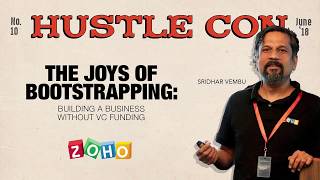
In this 2018 Hustle Con presentation, Zoho founder Sridhar Vembu shares the 22‑year story of building a private, fully bootstrapped software company. He begins with the humble Java SNMP API that funded the early years and taught his team engineering, sales, and marketing fundamentals. Vembu stresses that the core of bootstrapping is a mindset that conquers self‑doubt and focuses on survival—keeping cash flowing and avoiding the temptation to chase VC‑heavy markets. He advises founders to target underserved niches, treat early revenue as a runway, and view themselves as their own venture capitalists, reinvesting profits to expand into larger markets (ManageEngine, then Zoho One). Vembu introduces the “year ‑5” perspective to benchmark against funded competitors, discusses the amplified imposter syndrome bootstrappers face, and underscores disciplined cost management, especially regarding location and personal burn rate. The talk concludes with practical tips, a philosophical view of self‑discovery through bootstrapping, and an invitation for one‑on‑one meetings.
Chapters
I'm here to talk about a topic that's not very commonly talked about in Silicon Valley because this is the home of venture capital. But we bootstrapped our company entirely, never raised a single dollar. And it's a 22-year journey. And I'm going to talk about some of the lessons we learned. And I'm going to share. And the biggest one that's there in the title, it's the mindset. Bootstrapping is more than anything else, it's your— you have to conquer your own mind. First, and then only you are able to build the business. First question, how many of you recognize this SNMP, what it stands for? I would not be surprised if most of you didn't know because it's a very obscure thing. It's Simple Network Management Protocol. This actually is, if you look at, that was our very first product actually. This was 22 years ago. We called it a Java SNMP API. That's really very popular product, right? It's popular brand name. But you know, it's actually, there's a lesson here for bootstrapping. In fact, I, I remember even at that time, I mean, you're selling something like this, even your mom won't recognize what this is, right? And actually, we still sell that product, by the way. It's still— we have a website where we sell that product. But this is a very tiny part of our business. And we sell a lot more these days. I mean, you have probably seen the Zoho you know, commercials, watched all of this. Zoho is now, we call ourselves the operating system for business. And that's over 40 products in that suite, including this presentation. This is actually made from Zoho Show, our online presentation software that is part of Zoho One. So that's what we are known for these days. But as I mentioned, we still sell that original, that Java SNMP API. And here is the thing that I liked about that, starting there. Well, it paid our bills. It is not a huge sexy market, but it paid our bills. And it trained our engineers. We learned how to do, how to build software. And we learned how to build software outside the pressure cooker of large scale, right? We learned to build smaller kind of software, and that's valuable training. And then it taught us business, actually taught me sales and marketing. I'm an engineer. I still know how to write code. But the thing that I had to learn is how to sell, how to market. In fact, if I had to go back and redo it, I'd probably learn a little more of the sales and marketing, because that's one thing that probably in the early years I had to struggle with. And it taught us the business, you know, how to build a business, how to run a business. And it allowed us to invest in more software and more and more. In 22 years now, we have built a lot of software. And we are now, you know, we would be considered one of the largest private companies now. In probably definitely largest, one of the largest private software companies in the world, and having never raised money. And we are going to stay private. We are never, now that we have tasted this, the freedom, we are never going to go public. And SNMP also, this thing kept us alive to fight another day. This is something that I would tell our people early on, that this puts food on the table and it keeps us alive to fight. And fight and fight. And we built from that experience of staying in business and fighting, living to fight another day. And this is actually something that really I stress for a particularly for a bootstrapping company, you have to find, ask yourself, what is my SNMP? That's a good way to ask the question. And today this is our Zoho One, the operating system for business. And it is the full suite of sales and marketing and accounting from email collaboration, all of this in one suite. Let me give you some simple advice navigating the whole bootstrapping, how you do this. I won't be the person to approach if you are raising lots of money. And I don't say that this is the only way. In fact, there's something that's important. Everything I say in this, you should— the disclaimer, any advice in any philosophy, you have to realize that it's very contextual. There isn't some universal truth that applies to all people at all times. This is what, from our experience, what you can learn and apply it to your context. See what you— what makes sense for you. And the first 5 years for us, I was thinking only one thing, that is survive, survive, survive, survive, survive. And this is actually true for a lot of startups, but particularly bootstrapping, right? You literally have to bring in the money to keep the doors open. And if you— I know the most common thing in business failure is you just run out of money simply. Your idea may be good, your product may be good, Your vision may be good, you keep customers happy, you keep employees happy, but if you run out of money, it's game over. Particularly true in bootstrapping. So this is the first thing that I would tell myself, tell our team, that we have to survive. If we can survive, we can thrive. We can even win, but we first have to survive. And if a market segment is particularly in a bootstrapped mode. Actually, if you go back 22 years, and those of you who are old enough to remember, that was the time Yahoo and Google and eBay, they were all born. Amazon. They were all young companies at the time. In fact, I remember this when we were starting out, Yahoo had not yet reached a million dollars in revenue. That was the time. And why didn't we go and compete in that space? Well, all those guys, I mean, Yahoo had raised maybe $20, $30, $40 million at that time. There's no way we with no money could compete with them. Then why didn't we go and raise money? It's not actually easy. Even today, with all the capital floating around, most people still will get rejected. Most people who approach venture capital are going to get rejected. And most people who even apply for incubators are going to get rejected. So the default assumption you should make is you're going to get rejected for funding. And so my advice is how do you build in spite of maybe not being able to raise money? Or maybe you don't want to raise money. In our case, it was a mix of both. I mean, we knew it was going to be not easy to raise money. But we also maybe, you know, early on, we didn't really want to be raising money. So you find the market opportunity that's not heavily contested, heavily funded. And bootstrapping works best if you find that niche, but make sure something exists, right? There's a market. That's a balancing act. I mean, if the market is too large, too hot, too many players are already heavily funded or chasing it, your opportunity is going to be limited in the market. So you have to find that cross between a market that is there but not so sexy that too many players are chasing it. Typically venture capitalists will avoid anything that is not a billion-dollar potential, at least. And this is a true story, actually. In '97, we were exhibiting our software in a trade show in Las Vegas, where I actually drove from here to Vegas. I mean, I couldn't afford a plane ticket. I was cheap. And we stayed in this like $15 or $12 a night hotel where they subsidize you for gambling there, right? Except that I didn't gamble. So, and we were hawking. This was the show. We were showing this. And we actually found some really valuable customers at that event. That particular event probably got us half a million in revenue eventually. That was the particular event where we got started in the in effect. And a VC saw this and asked us, what do you guys do? And we said, we are doing this software. He asked, how big is this market? I mean, we are at zero, right? We are at zero revenue. I took a wild guess and said, maybe $10 million. That was a wild guess. I had no idea. And this was the thing. Why are you so unambitious? Verbatim. This was the question. I had no answer except that I thought to myself, well, if I'm too ambitious, then I wouldn't have a business because I wouldn't be able to raise any money for all the ambition. Ambition is good, but you know, then you have to tell the story and somebody has to trust you, put in the money, all of that. And if I start in this niche, maybe there is a way to find it. And yet it exactly worked out that way in that event where we actually we pulled in about 2 critical customers who each paid us about a quarter of a million dollars. So from that single event, we made half a million dollars. And yet, a VC told us, why are you so unambitious? And so you ideally want a small niche that could become bigger, right? And except that this niche we found, actually, I You know, I don't know why and what reason I uttered the 10 million number because we found ourselves actually saturating at about 10 million, about 7 years later. That's exactly what happened. So after 7 years, we reached the 10 million number that I had predicted and there was no growth left. I mean, we just completely flat. And this was also the time, if you remember the post September 11th, the economy was bad. Things were generally crappy and lot of dot-coms were dying or dead. And even our own customers who were label customers before now were going away. So it was that 7-year itch we faced, the doldrums. And well, we had a business. It was profitable. The bad news was there wasn't much growth left. I could see the trend clearly. I could see the writing on the wall. If we had stuck to that business, we would just stay tiny forever. Basically, it was clear. So here's what we did. We just simply became our own VC at that point. We had a $10 million business. It had reasonably profitable— it had good cash flow. We invested our own money in ourselves. This time we became our own VC and bigger market. And we found market segments again this time bigger, but again, not potentially too hot. That was part of our mission. Because if you find it too hot, if somebody else has raised $100 million, and if you're going up with your, like, say, $5 million capital, how are you going to win? So that's the calculus always in my head. I would always be looking for who's raising what in this because simply so that we can condition ourselves in what kind of money we have to compete with them. Because a lot of times people will outgun you in sales and marketing. So we actually found bigger market segments and we invested and that took off. And after we gained strength in that, we invested again in bigger market this time. This time we had a 100 million kind of revenue. Now we could reinvest a lot more. Right? Our scale had grown. We could invest a lot more. We reached a point at some point now, really just VC money cannot outgun us anymore. We can go head to head against any venture capital kind of money. So that is no longer a niche. And that is our Zoho.com, essentially our third act in the serial E. But we are still in the first two. We are doing quite well in our first two. The very first one I mentioned, the tiny niche, and then the second one we call it ManageEngine. The third one is Zoho. They're all divisions in our company now. And of course, Zoho is the biggest of them all. It's the— it's playing in the largest playground. Essentially, every business could be a customer for Zoho. That's how vast the market segment is. But to be able to do that, we need capital and we have succeeded in the was enough to bring in the capital to invest, and now Zoho has taken off in a big way. And this is the— Biz Stone was co-founder of Twitter. It's familiar that timing, perseverance, and 10 years of trying. But one modification, I'll say 20 years. That's the bootstrapping story, right? I'll just give you a couple of quick tips. It's useful to think of yourself starting at year -5, not year 0. That's why it's very useful when you're bootstrapping, because otherwise if you are comparing yourself to people who have raised money, it always will feel like they are ahead of you. But when you don't have any money, you use the mindset of -5. And if you reach year 0, you've gone 5 years, but you still have only gone to your zero, right? And the total number of people who really care about your business. I mean, how much truth can you handle, right? You got to assume that, okay? You have to assume that. Actually, well after maybe 5 years, 7 years, we still had to convince ourselves that we were in business. Actually, we were a business. And in fact, the zero is an optimistic count, right? Because if you include all the active naysayers, that's a negative count. But let's stay optimistic, keep it at zero, right? So your business, number of people who care about it, zero. That's a good number. And you know what? That includes the near and dear too. They may not tell you, but most of them actually don't believe in your business yet. Keep that in mind because, you know, it's useful to have that realistic mindset. And that way I never got upset. For example, you know, when my own cousin or somebody doesn't even know what we do. Never learned to not get upset, right? And after like the first million dollars in revenue is when we could feel that we are a legitimate business. That's what bootstrapping industry is. So you are, because you're constantly battling that existential doubt. Are we in business? Are we not? And they have a name for it, the imposter syndrome. For a bootstrapper, that's like imposter syndrome squared. You feel that even more strongly. So you have to overcome that self-doubt. And that's part of that mindset I talked about in the beginning. So that's the real essence of bootstrapping here, that the mindset of that you bring in. You start in year minus 5, and you assume that nobody will really care. You have to overcome your own self-doubt, and then the practical advice of your own, finding the market niche, all of that. So it's ultimately— now I'll go into a little bit of philosophy— you want to realize that it is a self-discovery process. You are discovering your own inner strengths over the course of time. And for myself, that is absolutely true, that it's some things I learned to do things I never thought I would be able to do, like actually presenting. Now, I'm an engineer. I only thought I could code. And then later I realized I could do these things. And when your self-discovery is funded by someone else, what happens is it kind of becomes self-indulgence often, which we see, right? When people raise too much money too quickly, they kind of become self-indulgent or, you know, we call this the, or familiar bootstrapping is about, cha, trustafarian. That's the name, right? The self-indulgent. You don't have any kind of self-discipline in the way you spend money. But bootstrapping, that's the nice thing about it. You have that balance between discipline and that indulgence. Your discovery is tempered by your discipline. And finally, I'll just leave you with this because you are in Oakland, you are in San Francisco Bay Area. It's something important. We are in the most expensive real estate in the world. As a bootstrapping person, you have to give yourself all the advantages you can give yourself because you don't have many advantages. So ask yourself, why am I paying the highest rent in the world and suffering from the highest cost of living in the world? Go figure out somewhere that's cheaper. That's something very important. There's something that I constantly tell people. You don't have to be in a particular location to achieve your goals. And cut your personal burn rate. When you do that, you give yourself a longer runway even with the limited funds you have. So, and finally, we have actually— we are outside. We have— you have seen our trailer outside the Zoho building. Big yellow one. And I have one-on-ones now after this, so you can sign up. And this is the zco.to/oneonone, that's the URL, so you can go register. I'll be here the rest of the evening, so feel free to meet me. Thank you. Thank you.










