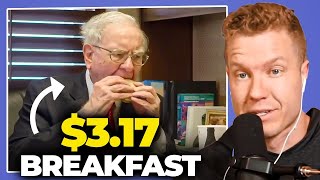
In this conversational YouTube episode, Sam Parr and his guest (Speaker B) explore why many wealthy individuals remain overly price‑sensitive despite their net worth. They introduce the "0.01% rule"—a heuristic that suggests people stop feeling the pain of a purchase once its cost falls below 0.01% of their net worth, creating distinct wealth tiers with decreasing price sensitivity. The dialogue weaves personal anecdotes (e.g., Sam’s hesitation over $1.50 premium coffee, an $800 kitchen backsplash, and cash‑flow scares when checking accounts dip to $38k) with observations about how early‑life money trauma can persist into adulthood, making even multimillionaires anxious about spending. They discuss the concept of "money therapy" or financial coaching as a way to address these deep‑seated anxieties, contrasting it with traditional financial advising. References to figures like Nathan Barry, Ramit Sethi, and Tony Robbins illustrate how the market already targets high‑net‑worth clients with behavioral interventions. Throughout, Sam expresses a mix of frustration and vulnerability, seeking empathy for his "rich‑people problems" while acknowledging the paradox of feeling insecure despite outward success.
Chapters
It's rooted in like trauma, like just fear. It bothers me so much. Like for example, Cometeer Coffee, they sent me some for free. It's so good, but it's $1.50 per cup. And compare that to like your bean coffee. I'm like, ah, $1.50? Sometimes I don't even drink the whole thing. And so like I've been really struggling with like, is that worth it? Is this worth it?
Can I tell you something interesting I saw? So the 0.01% rule. So Nathan Barry came on the pod and he was cool. So he's the founder of ConvertKit. He came on, he was telling us about some blog posts that either he's written or that others have written that he liked. So I went back and I read one of them and I saw this thing called the 0.01% rule. Have you seen this?
No.
Okay. So I'm going to pull up—
But he's pretty amazing.
I'm going to pull up this, where's the blog post? Blog, 0.01% rule wealth. Let me see if I can pull it up here. Okay, I'm not gonna be able to find it real quick here, but I'll put the link in, Ben, if you can find it, or search Nathan Barry wealth ladder 0.01%. So basically the way the guy's thinking, he's like, he's like, you know, he's like, he talks about price sensitivity and he's sort of like, you know, as you get more rich, you, You know, the way you think about money should change, right? This is like when I came to your house and you had like CVS receipts in the glove compartment because you were like saving them for like the $3 thing and you're like, hell yeah. And I was like, dude, you just sold your company for like many, many millions of dollars. What are you doing with these CVS receipts? You're like, ah, I just like to do it. It's a habit. And so this guy talks about like the richer you get, you should sort of, he's like, this works for when you sell something to somebody or yourself as you get to that level. Basically below 0.01% of your net worth. So that's, you take your net worth and you multiply by 0.000 whatever, you know, 1. So it's like, uh, 0.01% of your net worth. So let's say you're worth, um, let's do $100 million.
So $100 million, what is it times what?
Use $5 million, right? They'll use a little bit more of an approachable number here. So, um, so that would be $500 for if you have $5 million in net worth, $500 is the threshold below which you don't really feel it. You don't really care or feel it. You become a little bit price insensitive below that point. So that might be like, you know, opting for the, you know, the nicer hotel or like you just really don't give a shit. You can just ball out at a restaurant. You really don't care. And so he draws this little curve and he's like, at the first level of wealth, it's like he calls it like level 0, level 1 of wealth where it's like, you know, your 0.01 is like $100 or less than $100 at that point.
Well, $1 million. Yeah, $1 million would be $100.
Yeah. So he's like, you know, at that point, like, you know, if you're at the grocery store and something costs an extra dollar, like, you care. You don't want to buy the eggs that cost $1.99 more. You care. He's like, then the next level, the next jump up is you're like, well, I don't care at like, you know, the way he draws the chart. It's like, what are restaurant prices? Then the next one's like, what are vacation prices? It's like you don't even really care about how much your vacations cost. The next one is like, you could fly first class. And then the final one is like, or the next one's like, you can buy a crazy house. You're not really feeling house prices as much. And then the final one is like, what are prices anyways? This is when you're worth over $100 million. At that point, most things don't cost anything to you and you're pretty insensitive to the cost of it. So I'm sort of summarizing the idea, the exact, you know, you can quibble about what you should or shouldn't care about, but I thought it was kind of an interesting number. And the reason I bring it up is very few people that I know are like properly price sensitive. So there's a lot of people I know, like my dad, who no matter how wealthy they've got, like these sort of like the trauma of not having money is so deeply ingrained in his body that like You know, Starbucks, he's just like, he's like pissed off when they charge. Even if he buys the coffee, it like, he's angry at the price. He's like, oh my God, $4.99? Like, I could make this for so much less. And they're like, sir, you're welcome to do that. And he's like, oh, like what's going on? And you know, he's anchored to prices from like the '80s when like, you know, that's where like he thought movie tickets should cost X. And also, you know, it just like hurts him to spend more than some amount. Regardless of what's in his bank account. And so he's kind of on one side of the spectrum, too cheap. And then there's the other side of the spectrum, which is more where I am, where it's like, dude, you should really kind of like pay attention to this. You're, you're kind of spending like pretty crazy. And, uh, you know, completely price insensitive is on the other side. And then there's like whatever the sweet spot is. And then school, they don't really teach you how to, how to like gauge that or what, what those kind of like, what even should be a good number for this? What should I spend on things?
So you, you, you don't get nervous like I freak out a little because as an entrepreneur, like some years I just like knock it out the park and make so much money. Other years I make nothing. I mean, hopefully I don't think nothing will ever happen again, but like there's times you don't get nervous about running out.
No, actually, like 2 months ago I was like, oh my God, I have like no cash left, no cash on hand left. I was, I was investing in everything I saw. I was putting money into startups, into crypto, into stuff. I was then I was spending a bunch like my payroll expanded. And I was like, oh my God, I have like so little cash in my account.
I felt that way too.
It was under—
I had $60 grand in cash and I was like, I feel low.
Yeah, I think it was like $38,000 was in my like whatever Wells Fargo checking account. I was like, where'd all the money go? This was like— and I was like, oh yeah, I guess. And I looked at the like out— outgoing thing and it was like, it's not that my spending had gone up. I was really just investing a lot of money. But I was like, wow, I should, uh, I need to manage cash. For most of the time, for me, it's like, I need to send my invoices for things. I was like, all right, I'm going to teach a course and I'm going to invoice for the podcast and I'm going to do the things that bring in cash today versus most of the things I invest my money into are long-term illiquid things or my own businesses. Maybe I should take a withdrawal out of my business and put money in my bank account. And so it was just a reminder of that. But no, I don't really get too worried about that. Um, and maybe, you know, again, I think I'm too far on the dial of like willing to spend on whatever.
Ramit Sethi, this is pretty much what his entire, uh, not course, but his entire image and content is about, which is like he's got this podcast where two people, couples argue like, we have, we're worth $3 million and He got into a fight with me because I spent $80 on this silly thing. And Ramit's all about that. It's— I have— I'm more like your father than I am like you. Like, and I think it's just rooted— it's, it's rooted in like trauma, like just fear. Uh, I've got the same thing where it's just like, it's like, it bothers me so much. Like for example, um, Cometeer Coffee, um, I— they sent me some for free. It's so good, but it's $1.50 per cup. And compare that to like your bean coffee. I'm like, $1.50. Sometimes I don't even drink the whole thing. And so like I've been really struggling with like, is that worth it? Is this worth it? Or the backsplash on my sink in my kitchen, we need to replace it and it's $800 and I've been fretting over it for over a year now. I'm like, ugh. $800 to replace that. Like, you can't. So even though it will add value to the home and also make me happier, I understand why your dad thinks that way. It's really, it's real. I think it's challenging when you're, it's like, it's like, you know, it's proper trauma. I think of like, you felt one way for years and now you suddenly like, things are different. Yeah.
Maybe we actually need money therapy. Uh, money therapy specifically. I think that's actually a good idea here. So therapy is this broad thing that has a bunch of associations with it and mostly is stigmas and blah, blah, blah. I think somebody needs to spin off, and Ramit sounds like he's kind of doing this, which is straight up—
Money therapy is a great idea.
Financial therapy. And it's like, yeah, have a money coach. You probably need to— switching therapy to coach is the hack to like, oh, I'm focusing on performance and not fixing a broken part of me.
Uh, but in reality it's that I tried finding people like this and when I met them I was like, look, we just got to know each other.
Not a financial advisor, different thing.
No, I know. I would go to therapy for a lot and I would, and I would go when I, whenever I was trying out a new therapist, I'd be like, so I'm not going to like, I'm not trying to sound like a douche or big-headed, but like I'm a high, high achiever. Like I want to like conquer the world and like do cool shit. And so I don't want to talk like this is, this is the, the place that I'm coming from. Like, I'm high octane, baby. Can we, can we make this happen? Do you have the tools necessary or no? Or do you like specialize just in like, you know, like traditional?
What, what were you really trying to tell her? You were trying to tell her that my problems are not like I'm not broken, I'm trying to like just achieve a higher level of success? Or were you trying to tell her like, I'm an A-player, you an A-player therapist? Is that what you were trying to ask her? What were you trying to ask her?
No, the blunt way to explain it is I've got rich— I'm complaining about some rich people problems.
Okay, got it.
And like, I'm just like mostly just insecure about certain things, and I want to like use that to like conquer the world.
I'm not very fine on Twitter.
Yeah, and like I'm gonna complain about stuff that sounds super weak because like on outside like everything's going great, but I need you to like empathize that like I'm trying to like go places, and I don't need you to tell me that like Well, you made $1 million that last year. Isn't that good enough? Like, no, dog, it's not. Like, I need you to understand, like, what, what, like, what's at stake here? You know what I mean?
And Sam, what is at stake here?
That's a—
you're a better— I'm gonna be your money therapist.
But you know what I mean? Like, totally. And so, like, I would meet people and I'm like, oh, you've only worked with, like, a certain type of person. You have, like—
I don't think you unders—
I don't think you'll be able to help me.
Yeah, yeah, exactly. I, I know what you mean. It's the reason Tony Robbins gets paid $1 million plus per client, because it's like his clients are Serena Williams and Ray Dalio and, you know, or whoever.
He's like, trades you to rich. Yeah.
And he himself is successful and his other clients are, you know, objectively very successful. But everybody, everybody, um, you know, can improve the, you know, the little voice in their head.