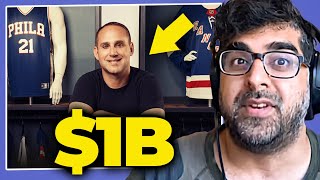
In this conversational podcast episode, Sam Parr and his guest (Speaker A) dissect the rise of Michael Rubin’s empire, focusing on Fanatics, a $10‑plus‑billion sports merchandise platform that prints and ships official jerseys and other gear. They trace Rubin’s entrepreneurial path from a ski‑shop startup to GSI Commerce, its $2.4 billion sale to eBay, and the creation of ShopRunner. The discussion then shifts to Fanatics’ aggressive expansion into the trading‑card space via the acquisition of Topps, highlighting Rubin’s strategy of leveraging existing sports‑fan licensing to sell collectibles. A central theme is Rubin’s ambition to grow the niche market of sports‑card collectors from roughly 5 million to tens or hundreds of millions by treating collectibles like a mainstream consumer category, using media, marketing, and celebrity endorsement—paralleling tactics used in sneaker culture and the Slack growth story. The hosts also reference Kevin Rose’s Hodinkee venture as an example of building a media brand around a hobby to create demand. Throughout, they explore how Rubin’s vertical integration, licensing mastery, and market‑expansion mindset have allowed him to dominate both jersey and collectible markets.
Chapters
Did you see, like, what Michael— that guy Michael Rubin did?
So we talked about him a little bit. To be honest, I don't entirely understand what his business Fanatics does, but I know that like he's got 3 different companies right now. One of them was worth like $50 billion, another one's worth like $1 billion, another one's worth like 5 or $10 billion. Like, it's just like crazy. It's like there's Fanatics and there's like 3 spinoffs of it.
Yeah, exactly. So I don't have like a ton of, you know, kind of like research on him or whatever, but basically Fanatics itself is worth over $10 billion. And what Fanatics does is they basically are a merch company, but for sports. And so what they do is you want to go buy a Steph Curry jersey, whether you buy it in the NBA shop the Warriors shop, or you just Google Steph Curry jersey and you land on fanatics.com. It's Fanatics that's printing and they are actually like printing the jerseys and then shipping them out to customers.
I get that. I just don't understand how can just like a rookie, like a noob— I mean, he's not a noob anymore. He's been doing this since he was 21 and he's probably 55 now. How can just like a guy come in and just like muscle like the people who have had those contracts for 20 decades? Yeah, 20 years.
I also had that same exact question. Now, I know he was kind of like successful before this?
I think he had done a, um, it was called, uh, GSI, I think, Commerce. And he sold it to eBay for, I forget exactly how much, but he made like $80 or $90, I think. And then it didn't work out at eBay, so he bought back some of the stuff and he grew that to be big. And then he also spun out a few things. So this company called ShopRunner, which was quite popular, it's basically like Amazon Prime for people who aren't on Amazon. Um, he built that business and, and a few other things. And so I started as like a ski shop when he was 18, I think.
Yeah, yeah, exactly. Ski, sort of a ski business, whatever. Then became like kind of apparel logistics. So that's GSI Commerce. That's sports, again, sports commerce. He sold that to eBay. I think, I don't know if you said the price, $2.4 billion.
Yeah, I think he only walked away with like $80, which is a lot. But, uh, I don't think he, I think he like gave up a ton of equity and he was like in his late 30s at the time.
And then, um, And then, yeah, I don't know how he got the contracts, but he basically just like continued licensing. I don't think he got exclusive. So I think he got the licenses to print the stuff and then over time demonstrated that like they had the best product with the best delivery, with the best quality assurance and all that stuff. And so they ended up being like, we'll just power your shop, right? We'll be the, we'll be the default one when you go to like the team's websites.
Well, he also bought a, recently started a cards company that is making cards and they just, and then he was like, you know what, let's just buy Topps while we're at it.
Yeah, exactly.
So I don't understand how he's totally just kind of brute forced his way into this, it seems.
Yeah. So he, uh, exactly. So they bought Topps, which is kind of like a pretty interesting move. We've talked about trading cards. We talked about, um, you know, like this whole thing. What they're, what it seems like what they're going to do is they're going to say, all right, we got the licenses from the, from the sports teams. We can get, we can, we know licensing as a business. We can get the licenses for cards as well. We know printing and manufacturing. We can do that with the cards as well. but then also with cards, there's like, basically it's the same customer, it's the same fan. So if I buy a Steph Curry jersey, odds are I'm gonna be like somewhat interested in like a Steph Curry rookie card. And when he, the, the reason I wanna bring him up is not because like I had some like deep insight on his like business plan, although I think it's pretty simple, which is like we have the sports fan as a customer. What do they buy? One of the things that they might buy is collectibles. Okay, let me go buy Topps and like, well, let's sell them collectibles. But I thought his approach was smart and one that people should take, which is he goes, Right now there's like 5 million people who collect sports cards. And, um, so like the whole business is like these 5 million people and nobody has like taken a like big approach to this. It's been this like hobbyist kind of underground. And that's like the charm of it. Like if you go to like the annual sports card conference, it's like this dump in Cincinnati that's like, you know, these hobbyists bring their cardboard boxes and like some, you know, special shout out to like, you know, Kentucky Fried Chicken for sponsoring this year's conference or whatever.
Right. And like Eric's mom's for bringing cookies.
Yeah, exactly. Third year running. Thank you, Mrs. K. So they're like, you know, that's the conference right now. So he's like, dude, why is that like that? But like SneakerCon is like this fucking state-of-the-art thing and CES is like this epic show that's like, you know, like cutting edge. So he's like, I'm going to do all that in the— no, he's like, nobody has spent a dollar on marketing collectibles. Like, nobody— like, it's like this hobbyist passion industry, but nobody goes out and markets this thing. He's like, but people have done that for sneakers and other things. So I think what he's gonna do, one, one smart thing, I like this part of the plan, was he's basically going to athletes that like to collect in general. He's gonna like make it known that these celebrities— oh, did you know, like, the whatever, you know, the, the guy from Billions, like the hedge fund manager, has like— oh, like he's gonna build stuff.
He's going to build like a media company on top of this a little bit, like a media company, or it's a, it's going to be a slick media play and they happen to sell the cards.
It's going to be, he's going to make it cool to collect. Right. Which is a smart thing. And the reason why, again, like, okay, that's just part of a plan. The one part I really liked is he goes, there's 5 million people who collect today. And what anybody else in the space has tried to do is try to get as much, take as much as they can from those 5 million. My question when we bought Topps was, How do we get 50 million or 500 million people to collect? And like, that's the only game I wanna play is expanding the total size of this market from 5 million people who do this thing to 50 million people who do this thing. And I just thought like, that's, that's a really powerful mental model for how you, how you build businesses. And I've talked about this before. That's the same, it's the same framework as the, the one that the guy from Slack did when he created Slack. He's like, yeah, there's work chat tools and some people use them, But he's like, the reality is 8 out of the 10 customers that we talk to, companies that we talk to, they don't use a live chat tool. They use email. So he goes, his memo was called, we don't sell saddles here, right? Because he's like, if we just go to the existing people who like horseback riding, they probably already have a saddle. We try to convince them to switch because we got a better saddle. They're kind of familiar with their ways. We're always going to be in this like tiny niche. But if we sell the dream of horseback riding and show people how fun it is to go horseback riding, We increase the size of the overall market. And then when they say, oh wow, I love this thing, but my butt hurts, we'll say, great, we have a saddle for you. And so that's like just like a general approach to business that I think more people should take is increasing the, um, the size of the number of people who even want your category before saying pick me. I think more people should take is increasing the, um, the size of the number of people who even want your category before saying, pick me.
Have you— I, I agree. That's a really good insight. And an example of that is, have you seen, uh, so Kevin Rose, this tech guy for years, Kevin Rose, for some reason after, I forget where he was, he was either, I think he was at Google leading like their venture arm. He left and he became the C— I think he became a, a part owner and the CEO of this blog called Hodinkee. Yeah, I think that's how you— Hodinkee. And I remember hearing about that and I was like, what? He goes, yeah, it's a blog for watches. And I was like, well, there was a middle step.
So he created a studio, a lab to incubate ideas. And that's why it was even more crazy. He's like, yeah, we're creating this like publication or this thing for watch collectors. And then that got acquired, I think, by either Hodinkee or that was called Hodinkee and it got acquired. I'm not sure which one.
Yeah, they, they sometimes— this guy already, already had this blog. Kevin was tinkering with it and they became one. And he started working on that and I was like, what the heck, man? You're like, who gives a shit about watches?
Yeah. Aren't you like, yeah.
Like a blog. Like, what are you thinking? And then I started watching some of their YouTube videos and it was either Kevin or the other guy who started the site and he was sitting with John Mayer and they were talking about their watches. And I sat for like 20 minutes watching this, like, what were John Mayer was like, yeah, this watch is actually special for this reason. And I was like, that's, that's amazing. And they had this show on YouTube where they were doing that. And I'm not a watch guy because I don't want to spend— I don't get joy out of— I get more stress out of spending $30,000 for something on my wrist. I kind of get annoyed with it. But I was watching his stuff and I was like, I want to— I want to own this. You've turned me into a connoisseur or a wannabe connoisseur. I want to be part of this.
Exactly. I want to want this. I don't know how yet. Yes, it's like sushi and wine. There's all been a whole bunch of these things where I'm like, oh, I kind of like the idea of getting into this hobby. Golf, right? Like, I want to want it.
Yes. And that's how I felt with him. And I could see myself wanting to do this with cards. I, when I was a kid, did you ever collect Magic cards?
Not Magic, Pokémon for me.
But yeah, I did. I did Magic and I don't even remember how to play it. And I remember like I was like, just let me look on eBay, see how much some of those are. And I was like, I'm just going to buy some. This is, this is fun. It'll remind me of my childhood. And I would totally do that with sports cards, even though I don't pay attention to sports now. Just remind me of my childhood. I would buy like a Mark McGuire card or something like that. Um, but yeah, this is cool. I think that's a really good framework actually.