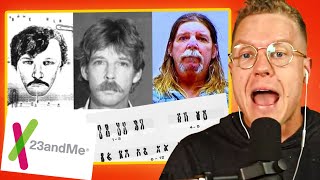
Sam Parr discusses how the Golden State Killer was caught when his relative's 23andMe DNA matched crime-scene evidence on GEDmatch. The technique has solved cold cases but raises privacy concerns: companies monetize genetic data, and uploading DNA to public databases can expose family secrets or enable misuse.
Chapters
Have you heard of this thing called GEDmatch?
No. Was that—
have you heard of the Golden State Killer?
No.
Okay. So in the 1970s, there was—
I thought that's what they call you.
Yeah, that was my nickname in high school, Golden State Killer. And then in the 1960s, '70s, and I think '80s, there was this guy who basically like raped like 50 women and then he murdered eventually like 20 of them. Like he was a serial killer and he got away with it for years. No one knew who it was. And Patton Oswalt's wife— Patton Oswalt, the comedian— his wife, who recently died, right before she died published her, like, masterwork, her life's work, and it was about the Golden State Killer and how he's never been caught, and it renewed interest. And then the FBI got all into it because all the press, and they eventually used this website called GEEJ. It's public, it's like, uh, anyone can use it. It's like an open-source website, and it analyzes all of the information from 23andMe, Ancestry, and like all that stuff, all the database stuff. And they found— they put his DNA, the Golden State Killer's DNA, which they had, into this GEDmatch thing. And they realized that the daughter of the killer— or like, they were like, well, this is so aligned, it must be like the daughter or the granddaughter of the killer recently signed up for 23andMe. And so they stake out this guy's house, they dig through his garbage, they find— they go, boom, got him! And that's how they arrest him. And they arrested him when he was like 80 and dying. And if you Google Golden State Killer, you'll see like these pictures of this old man. And they got him because he got away with it for so long. But eventually they brought him to justice. And now they've caught many dozens, maybe even hundreds of killers or rapists this way, which is good, but it's kind of scary. And so you could—
so I was going to say, so you're, you're worried about this?
Why?
Why is this worrying?
I'm— because it's being used for—
don't want to get grandpa in trouble.
It's being used for good now. But like, you could see, like, do I want to be in this? Do I want to be in this database? And so this is one thing I'm a bit worried about. So you can go to GEDmatch and you could upload your results and it could tell you all types of stuff about your results. You could see, uh, a lot of interesting stuff. And you could, like, if you can somehow get the DNA from an FBI case, which I believe in some cases you can, you can like upload it and there's like thousands of like these internet detectives using this database to solve crimes. It's kind of fascinating. It's kind of interesting, and it's definitely a little scary.
Wow. Is there like a subreddit for these?
Yeah.
You know, like sort of like public crime solvers?
Yes, there is. And it's very, very interesting. And most of the time they're wrong. So like, if you remember when the Boston— like the Boston Marathon bombing, they like named like these like 3 guys and they kind of fucked with these guys' lives. They didn't end up doing it, but everyone was certain on that subreddit and they're uploading pictures and they go, this guy works at this place. It wasn't them. They were wrong. No one guessed it, that it was the two actual guys. But this is a little bit different because it's DNA. But DNA isn't perfect. So it's like there's a— it'll say like there's a— this person is 5% related to this person. So it's like, all right, let's see what that is. That could be like a distant cousin. And so you like track your way down to that and you build these family trees to figure out, oh, you know, it's kind of weird that like this matches this person and they're— they also lived in the same area. And so it's not perfect, but it's like pretty good. Anyway, I thought that's why I may not get 23andMe.
Uh, yeah, I also know people who have gotten it and realized, like, their dad is not their real dad. Um, and I think that—
That happened to a family member of mine.
I think that's a, you know, uh, you know, side effect to be aware of. Sometimes ignorance is bliss.
A family member of mine— A family member of mine found out that their parent had a— Their parent— cheated on the spouse and had a, a, a kid. And so they logged on and they go, oh man, I've got a second brother or whatever, you know, like a stepbrother or whatever, half brother. And, uh, it changes shit.
Yeah, I was going to say, without getting too personal, that, that, uh, that has like— that went— they went public with it or they just kind of kept that information to themselves?
No, no, no, they did not go public with it, but it like was very— it was I don't know, they haven't talked about it with me too much, but it seems like it was somewhat earth-shattering.
Yeah, there's a thing that I've heard that goes on, which is people who use sperm banks, so like a sperm donor, will take the test— or sorry, people who didn't realize that their parent had used a sperm donor or whatever, they will get the sequencing done or whatever, and they'll find out like, oh my God, I have 42 half— Brothers or sisters out there. It's like, oh my God. Yeah, this was a person who, um, you know, this is a person who donated a bunch. And then so yeah, you actually do genetically share with all these different people. Um, like, wow, that's really crazy. So there's all kinds of like interesting stuff. And I think 23andMe, their business model is to sell your data, right? Like, I think that is the core business model is they sell it to pharmaceutical companies.
Yeah.
For, um, you know, like the research or whatever. Like, I don't know if it's fucked up or if it's like, this is for the good of science, but I don't think you really know or opt— it's not clear that, hey, like, it's not clear. Yeah, it's probably definitely the terms, you know, but nobody's reading the terms, and so that's the problem.
It's like, it's like a benevolent dictator. It's like, it's cool when they're making the trains run on time. It's not cool when they start killing people. You know what I mean? Yeah, it's like, it's good when it's good, and then, but it could go bad real easy.