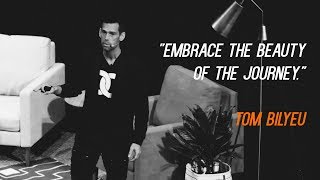
Tom Bilyeu, co-founder of Quest Nutrition, explains how he built the company from a kitchen startup to a billion-dollar brand using a "pyramid of influence" strategy with thought leaders and superfans. He argues skills are learnable, money isn't a true motivator, and discovering your "why" matters more than chasing cash.
Chapters
So let's give it up for Tom Bilyeu. Alright, what is up everybody? Man, come on, we gotta do better than that. I wanna know how many born entrepreneurs do we have in the crowd? Alright, nice. Well, I am very much not a born entrepreneur, and that's very important to know about me. I know a lot of you out there were selling flowers that you plucked out of somebody's yard, selling them right back to them, or you were trading baseball cards, or selling candy, lemonade stands, all of that. I was not. I was raised to be a good employee, which meant keep your head down, do as little work as possible, and avoid punishment at all costs. And that literally is what my parents taught me to do, and that's what I thought that a good employee did, and that was really how I started. And so, Really a bad track for somebody that wants to ultimately become an entrepreneur, but to be honest, I didn't start out wanting to be an entrepreneur. I wanted to be a filmmaker. I went to film school. That was my background. I was obsessed with human psychology. That was really the big driver for me. And I learned a lesson along the way, which was if you really want to control the art, you have to control the resources. And so that began my entrepreneurial journey of really wanting to be able to make the things that I wanted to make, but to do that, you have to really be in control. So I met these two guys, incredible human beings, because there were two 2 things about myself that I said, so I grew up in a morbidly obese family in Tacoma, Washington, in a family that teetered between blue collar and white collar, and I said to myself, there are 2 things about me that I know somehow in the future I'm gonna make come true. One, someday I'm gonna have 6-pack abs. And someday I'm gonna be rich. Give it up. I had absolutely no idea how I was gonna make either of those two things come true, but I really did believe to the core of my being that I would someday figure it out. So when these two buff bodybuilder guys who were very successful entrepreneurs came across my path and they said, "Tom, you're coming to the world with your hand out, and if you wanna control the resources, you've gotta learn business. You've gotta get rich. So come with us. We're building this technology company. We need somebody to be a copywriter." And this was back when I was a good employee, keeping my head down, doing as little work as possible, and avoiding punishment at all costs. They brought me into their world and they said, "Now don't think of yourself as a copywriter. You need to understand that this is a startup, so you can have any job that you want in the company, you just have to become the right person for the job." And that was the first time I really started to think about skill acquisition and the notion of, do you need to be born with a certain set of skills? Or are skills something that you can acquire? And that question has come to really dominate my life because so much of my journey has really been predicated on my ability to actually acquire skills. And so, I believe, as a very foundational belief, that the reason that any of us are here is for one simple reason: to find out how many skills you can acquire that have utility, and then put that utility to the test. Now, if you're getting good at something, building something that exists in service of other people, you're gonna have the energy and the passion and the conviction that you're gonna need to actually see it through. But it all comes down to whether or not you actually get really good at that thing. And if you guys take nothing else away from what I say today, that is the core thesis that sits at the absolute center of my universe. I believe humans can get good at whatever they set their mind to, and if you're willing to break yourself in half, you can become extraordinary. So my thing is, if you really want to be an entrepreneur, you need to be prepared to become capable of the extraordinary. So Quest Nutrition was a reaction. So I knew that I was gonna have six-pack abs and that I was going to get rich. I got into this technology company as a copywriter, and I worked my way up very rapidly. I began to believe and see the truth of the fact that a human can learn anything that they set their mind to, as long as you're willing to completely pour yourself into that. And that's something I cannot stress enough. So many people, in fact, somebody just today in this room came up to me and said, "I feel like I'm doing too much, Tom. I want to enjoy my 20s. What's your advice to me?" My advice is sell your 20s. I literally lost my 20s. They were completely gone. I didn't do anything with them other than work. All I did, because understand growing up I did not view myself as very smart, and in fact from a pure IQ standpoint, I'm not that smart. And I'll say that IQ is really the ability to process data rapidly. And I know that we all wanna push it off and say, "Well, EQ is equally important," and all that, and it is, it's great, But having the raw horsepower, if you have it, leverage it, and if you don't, address it. And so I had to accept that I wasn't one of those people that learns things really fast, so I had to go head down and do a lot of work. And that was how I moved through the company. So very rapidly, I took myself from being hired as a copywriter to becoming an owner in the company through pure sweat equity. I never put a dime into the company, but my performance was so dominant and my desire to succeed so freakish that the level of value that I was delivering to the company was extreme enough that they were willing to give me a piece of the company so that they wouldn't lose me. Okay, we'll call that being a linchpin employee. I don't think everybody needs to want to run their own company. Running your own company takes a certain thing inside. Derek talked about it in his talk. I think you've gotta be driven by something. There's gotta be something that's propelling you forward, some sickness, and if you know Batman, And if you know me, you know my obsession with Batman. Batman is driven by a sickness. There's this dark thing inside him that propels him forward. If you have that, if there's something that you need to build and bring to the world that you just can't shake, you can't get rid of, whether you're a born entrepreneur or not, 'cause to me they are very separate, whether you're a born entrepreneur or not is irrelevant. And I put that to the test, and I worked my way up through the company. I got ownership in the company. I became the chief marketing officer. I was making more more money than I'd ever made in my life, and I had six-pack abs. And it was horrific, and I fucking hated my life. And I thought, there's no way, it's not possible that I'm living the cliché of money can't buy happiness. Like, this is a joke. It's something that you see coming 10,000 miles off. So how is it humanly possible when I understand the power of money You guys know people are gonna chase money forever, right? You get that? So when people tell you bullshit stuff about money not mattering, let me tell you right now, it matters and it matters a lot. Money is, I promise, more powerful than you think, not less. But it isn't at all what you've been told. And once you understand the difference between what you're expecting it to be and what it actually is, then it can become a useful driver in your life. But when you're just chasing money, unaware of the fact that money is inert, it does nothing. Money is a facilitator. Money allows you to make your dream into a reality, but that's it. If you don't know what you're trying to build, if you don't know what you're willing to die for, money has nothing to offer you. So, it really became figuring out why I felt the way that I did, and the reason was I did not know what my why was. So, yes, we end up building Quest, 57,000% growth in the first 3 years, but to understand that, you need to understand why we did it. So, I was miserable making the money that I was making. I thought this, there's just gotta be a better way. I actually went to my partners and I quit. I gave them their equity back. I said, thank you very much, but I'm not willing to live this life. I'm not willing to feel miserable inside. That holds absolutely no interest for me. So I was going to go do what made me feel most alive. And as I was driving home, I called my wife, "I did it, I quit, that's it. We're never going to be in that situation again. I'm never going to be depressed. We're going to do something beautiful." I'm literally pulling into the driveway at my house, and my phone rings, and it's my two business partners. And they say the now-famous words, "We could do this without you, but we don't want to." That allowed me to reconnect to something other than the money. And for the first time, I felt so at rock bottom that I wasn't afraid to tell them the truth. I said, "Here's the truth: money isn't my highest value. Camaraderie is my highest value." 'in business.' What I actually care about is that feeling of brotherhood. What I actually care about is feeling connected to the customer. What I actually care about is tapping into my passion and building something that makes me feel alive, that's a real reflection of my actual personality. Those things I care about. I don't actually care about money that much. And that was sacrilege. At that point in our relationship, 'cause we had all taken a pact that we would always do whatever was most profitable. So if that meant giving up a family vacation, if that meant going out to meet as a business trio at 2 AM on a Saturday, these are all real things that we did, then we did it. Because we had taken that pact. So saying that was such a shift, and in that moment they said, "We actually feel exactly the same way, and we felt that way for a while." And in that moment, we all realized that you can get so myopically focused on the money that you lose sight of what you're actually trying to do. So you have to answer that question. Who knows Simon Sinek? Woo! Alright? Incredible human being. He has this whole concept of start with why. Absolutely critical. Understanding why you're doing what you're doing. And I'm gonna tell you, and in the rest of this talk, you're gonna see it throughout everything that I talk about. The world is changing, and I cannot say that emphatically enough. I'm sure there are gaggle of millennials here. Millennials are just the first wave of a shift that is coming. The world is moving to a commerce style that is driven entirely by impact. What are you trying to do? Where the consumer is going to make a demand that you tell them what you stand for, that you tell them how you're spending your profits. They wanna know, and they're not gonna support your brand unless you do that. And we're gonna get into that more and how it should affect your business and how for those of you that are in this for the right reasons that really wanna build something that matters and you're willing to break yourself the fuck in half to pull it off, this is the best news ever. But make sure you know your why, what's driving you. Now we live in a highly social technological age, but one thing I want you guys to get very, very comfortable with is the idea from Elon Musk that once you break a problem down to its physics, you will actually know what is and isn't possible. And I'm here to tell you as a marketer, your physics is the human mind. And if you don't take the time to study neuroanatomy, to learn the brain, to understand emotion, to read about how people make just crazy weird decisions that are totally irrational, you'll never be able to speak the language of your customer. So figuring out social media which I'm sure is way overplayed in terms of how we talk about it, but way underutilized in terms of its potential effect if you can find the humanity in it. The idea behind technology isn't to form fake relationships, it's to communicate and add value. It's to show people who you really are. It's to get to a world where you're able to build authentic connection with your consumer. Really think about those words for a second, 'cause neither of them are an accident. Authentic connection. So, you, as somebody building a brand, you don't get to hide anymore in your lonely office with the, whatever, 8x8-inch window that we saw earlier. You've now got to step forward, and as somebody who, I literally lied about my birthday on my Facebook page, 'cause I was so convinced someone was gonna use it to steal my identity, okay? I had no desire to step out front, I had no desire to be the face of the company or anything like that, they hounded me, literally, my chief marketing officer, a wonderful millennial, hounded me to finally go out front because what he made clear was that there are two new kingmakers, which are authenticity and transparency. Now why does that matter? Because millennials and Gen Z wanna have impact, and they wanna know how by engaging with your company they can have that impact. And so that's one of the things that you're gonna need to make clear in your marketing. You'll notice I'm not yet even talking about your, I'm talking about the relationship that you need to build with your community. So how did we get to 57,000%? I got so angry at myself for chasing money and pretending like I didn't just want to connect with people, that I didn't want to add value, that I didn't want somebody to write in and say, "Your product has changed my life." I was so furious that I'd wasted so many years of my life doing that. It was 8 and a half years by the time we finally sold that company. That's almost a decade of my life. Chasing money. And at the end of that decade, I said, "Never again." And so when we went into Quest, we said, "This is gonna be predicated around delivering value, and that's what we're gonna focus on." So showing people how not only your product is gonna deliver value, but how your marketing efforts are gonna deliver value. Now here's the thing, if you're gonna build a business, at the end of the day, there is one thing for all the like airy, wonderful, beautiful stuff I'm talking about, building relationships, really connecting, putting yourself out there, being authentic, you have to know how to build a business. The rubber has to meet the road at some point. Understanding this pyramid of influence in today's social world is exactly what you guys need to understand, and this pyramid is exactly how we built Quest into a billion-dollar brand. From nothing, by the way. We bootstrapped it. We started with like $10,000. We were making the bars by hand in a kitchen that we rented by the hour. It took like 8 or 9 people, 7 or 8 hours to make 1,200 protein bars. We now make 1.5 million a day. Okay? Scale. But how did we get there and how did we get there so fast? The pyramid of influence. At the top are the thought leaders. It's the people most people don't understand. Okay, they're very bright and they literally, they're the ones winning the Nobel Prizes, but they're not easy to understand for the average person. Influencers are the band of people that pay attention to the thought leaders but make it accessible to the masses. Now the influencers in a highly social age is the boon to your business, and if you can find them, it's how becoming an entrepreneur has been so radically democratized. Your job is to find your 1,000 screaming fans. Find the most influential 1,000 screaming fans that you can, people that really resonate with your product, they love it, they use it. So for us at Quest, we literally gave the product away. And we would write, you wanna talk about unscalable, we would write well-researched letters to each of these people showing them that we knew who they were, that we knew what they were trying to bring to the world, and we thought that our product would give them the unique ability to offer something wonderful to their community. And that we didn't want to control their message. If you hate it, tell people you hate it. If you love it, tell them you love it. All we ask is that you talk. And because we didn't try to control the message, people felt way better about it. Now, when people think about getting influential people, they normally think of these guys. But in the way that things have changed, you should be thinking of people like this. Now, I'm guessing most of you don't know any of the faces there, but I'll give you an example. Of a social influencer? Anybody know Jenna Marbles? Alright, crazy, we'll say that was about 10% of you. She reaches over 20 million people a day. 20 million people a day. How did we get her to post with our product, a huge stack of product, by the way, so somebody with a reach of 20 million, that's like primetime TV, how did we get her to post a photo for free with all of our product. We knitted sweaters for her dogs because she's huge into her dogs, okay? So you want to identify your influencers, you want to add value to them and their community, engage with their content, figure out what it is that's meaningful to them and make sure that you do it, go above and beyond. Sending huge stacks of products for her along with the sweaters for her dogs, for her it was just over, above and beyond, nobody had done it. And then your goal is to build those relationships into real partnerships where it starts with getting to know each other, having something in common, and it becomes building a business. Alright, don't market, build a community. There are a lot of ways that you can engage with your fans, but the goal for you guys is to really get in there, give content that delivers value to them, Engage with them, reply to them, look at their page, give contextual responses. It is a lot of work, but when you do that, people feel really known and understood, and you can get them talking to each other, which is incredible. I could do a whole hour-long talk just about how to do that. And then make amazing impactful content. That is really, I think, the thing that's most overlooked. Your content has to crush. And there's just no shortcuts to that. And when people ask me what the shortcut is to making amazing content, I know they're gonna fail. Let that sink in. If what you're looking for is the shortcut, I know you're gonna fail. Stop asking yourself how little you can get away with and start asking yourself how much you can bear. At the end of every talk that I give, I will stand out in the lobby, today included, and I will answer your questions for as long as there are questions to answer. I've done it for 8 hours in the past. Until the last question is answered, I will stand there. That's how you add value to your community. Alright, what if I told you guys your customers hate your content? Don't sell. You need to find a way, in today's world, the marketing in and of itself needs to be awesome. It needs to be something that I wanna watch, I wanna consume that adds value to my life. So, if you look at the show that we do, it's called Impact Theory. Impact Theory, we don't charge for it, it's not a revenue generator, but the number of people every day that write me and say, "You've changed my life with the people that you've interviewed on that show. You've changed my life. I'm gonna start a business that I wouldn't have started without that. I'm getting out of a depression that I was worried was gonna consume me." Now, imagine I can build 100,000 people that believe I've changed their life, 1 million people that believe I've changed their life, 10 million people that believe I've changed their life, what can I do with that? When you switch your mind from I wanna sell something to they're gonna wanna buy something just to be deeper in this community, that's when it gets interesting. And when your product is real, When your product delivers real value, whether it's a suitcase, whether it's a protein bar, whether it's a t-shirt, it doesn't matter. If you're delivering real value and they feel like you have materially improved their lives, they're gonna be with you. And then I'll leave you with this. Do cool shit. There's literally no substitute for it. And I hope that you will leave today understanding that you're not yet the person you need to be to succeed. And once you can embrace the beauty of the journey of becoming that person, the person that is capable of executing at the highest level, the person who is no longer worried about getting a championship ring, and instead they are focused solely on becoming capable of a championship performance, then you'll win. And that brings us back The reason you are here is to find out how many skills you can acquire and put them to service for something greater than yourself. You do that, you'll build a big business. Thank you.










