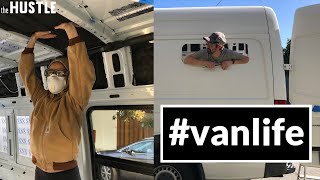
In this episode of The Hustle’s Behind the Hustle, host Nick DeSantis interviews San‑Francisco contributor Mia Sullivan about her upcoming van‑life adventure planned for the summer of 2020, amid the COVID‑19 pandemic. Mia explains that she and her fiancé (and their dog) want to take a year off to travel and simplify their lives, and they have chosen a 2015 Mercedes Sprinter as a “bunker‑style” mobile home with a 35‑gallon water tank, running water, heat, a toilet and an outdoor shower. The renovation is underway: they have cut three windows, installed insulation, and are working through electrical wiring challenges. Their travel route will start on the West Coast but, because many Oregon campsites are closed, they will first head to Idaho and Montana, relying on dispersed camping in national forests that remain open. They discuss how state‑by‑state decisions affect campsite availability and their plan to stay isolated for weeks at a time. Health‑safety measures include high‑filtration masks, gloves, social distancing, and a willingness to use antibody testing when available. Mia also outlines a media plan: a podcast called “Places” launching in June that will feature stories from small‑town America, weaving in their road experiences and exploring the rural‑urban divide in pandemic responses. She notes that friends and family have been largely supportive, though some express concern about timing. The interview ends with anticipation for a visual tour of the finished van and best wishes for the remaining renovations.
Chapters
The way it's working is that some states are choosing to close like the developed campsites in their national forests, um, and then others are actually keeping them open. So you really have to go forest by forest and look to see what's going on.
Hey everybody, this is Nick DeSantis from The Hustle. Uh, welcome to another episode of Behind the Hustle, the show where we take you behind the scenes to tell you a little bit more about some of the stories that we're working on. And I'm really excited about today's episode because we're here to talk about van life. And this is a trend that you may have heard of on Instagram or on social media, uh, people who essentially live life from the road. And we actually, about a week ago, we wrote a story about this in our daily email. And it was not something that I, I obviously had heard the Instagram hashtag and had read a little bit about this trend but didn't know a ton about it. But luckily we have a contributor who writes for us out in San Francisco. Her name is Mia Sullivan, and it turns out that she is actually planning, as soon as the shelter-in-place orders lift, to hit the road and live a little bit of the van life herself. So I wanted to invite her in to talk a little bit about where the idea came from and what she was planning. So thanks a lot, Mia, for joining us. I really appreciate it.
Yeah, of course. Hey everyone, so I know now is kind of feels like a strange time to choose to move into a van, but me and my fiancé planning on doing that in the summer, so we're, we're hoping to still go. And just a little bit of background on how the idea came about for us. We were really interested in taking a year off and traveling, living a more simple life. And we're big backpackers, so we thought we'd be pretty good candidates to move into a small space. And we have a big dog who's going to be traveling with us, so we're designing our van with him and kind of our, uh, our lifestyle in mind.
Yeah, one of the things that you had called out in the story that you wrote for us a couple days ago was the fact that, um, there's sort of a wide variety of vans, and there are certain people who sort of do a more, uh, low-tech version of it, and then there, there are other people who have vans that you sort of called kind of mini bunkers. So you sent me a couple pictures of the van that you're actually like building out, it looks like. Tell us a little bit about what that looks like.
Yeah, so it is a 2015 Mercedes Sprinter van. It is, it has a 170-inch wheelbase. So it's, it's one of the longer ones. There's like a shorter one, then a bit of a longer one. I would say our build-out is going to be more, definitely more like the bunker than bare bones. So we'll have running water. Will have heat. We won't have a full bathroom, but we will have a toilet and we'll have like an outdoor shower situation. So it will be pretty, pretty contained. We won't have to rely on gyms or, you know, bathrooms in random towns. So I'm feeling pretty good about that, especially now. And we were gonna get a small smaller water tank, but we're opting for the bigger 35-gallon tank given the pandemic. So how are the—
how is the— how's the renovation going? Like, you sent me some photos. Has it been challenging? Have you run into headaches? I'm curious about sort of how— what that process has been like.
Yeah, so it's going well. It is very challenging. Um, for me, my fiancé is the builder out of the two of us. So he's been the one who is figuring out, you know, like what to do and what to buy. And then I am the assistant. So the other week we cut out a window in our van. We've— it's the third, um, window that we've installed and he was the one who was doing all the cutting, um, and the planning and the measuring. But I was basically, you know, helping him, handing him things, cleaning. So it's going well, but there are certain things coming up like the electrical wiring that I know he's pretty nervous about. So far, you know, cutting a window into a van is nerve-wracking and I think we handled it well. So, so far so good.
Good. I mean, it certainly looks— it was— I was surprised at how big the van was. It's— but it certainly looks like things are going well.
Yeah, it's, it's pretty big. I think that, um, you know, with our— with the two of us and our dog, it'll probably be a good size and probably won't feel very big once we have everything in it. But right now it's really just an empty box with insulation and a few windows.
So tell us a little bit about, like, your, your plans. One of the other things that you had written about, uh, last week was sort of where people are allowed to go and how there's national parkland and national forests where maybe some of the sort of more common camping facilities in those places are shut down to visitors, but, you know, there's sort of more wide open spaces that are where people can go. So I'm curious, like, what does your route look like? Are there particular landmarks or places where you want to go?
Yeah, so we were planning on doing more of a— we're gonna start going up the West Coast. So I live in San Francisco. We're gonna go up the West Coast and hit Oregon and Washington State. However, much of the land right now is closed in Oregon, and because we're starting a month later than we wanted to, we're gonna actually skip that for now and do that on the back end of our trip. So we're gonna head to Montana— Idaho and Montana first and hit national forests. It's pretty confusing. It's not like, oh, all national forests are closed right now. The way it's working is that some states are choosing to close like the developed campsites in their national forests, and then others are actually keeping them open. So you really have to go forest by forest and look to see what's going on. What I have found is that most national forests are open to dispersed camping. So that means you can just drive your van somewhere on this huge piece of land and, and camp and be alone. So that is what our trip is going to look like. Especially in the beginning, you know, there might be— I think that, you know, there are some states that are reopening. Maybe there'll be like small towns in Montana that we can check out and just, you know, be really, really careful. But especially in the beginning with the pandemic still, you know, kind of raging, we're gonna be mostly like isolated. We might even stay in one national forest for like 2 weeks and then kind of continue on and just you know, hike and explore.
Have you thought about if you do run into other people on the road, how you'll handle that given all the concerns about social distancing that aren't gonna be going away anytime soon?
Yeah, so we bought, we bought cool masks with mask filters. So we're definitely gonna be wearing those. Yeah, we'll have gloves and, you know, we'll just kind of keep our distance from people. I think that it actually— we're going to be interacting with a lot fewer people than we kind of happen to interact with now, just going to the grocery store and like being in a city. So, you know, I'm— I think that I'll If antibody tests, if and when antibody tests are available, that's obviously something that we'll be interested in doing so we can feel more safe meeting people. But I think for the beginning, it's gonna be like masks, keep our distance. But another thing I'm thinking about is it'll be interesting. We might go to certain places where no one's wearing a mask. We might be in a small town in Montana and like people will look at us like we're crazy.
Sure.
So I'm really interested in how all of those dynamics will play out.
And are you planning to, uh, document your travels in any way? I think one thing that, that we had talked a little bit about is you were maybe hoping to write some stories from the road, or I'm curious about like, are you going to be, uh, trying to, uh, tell any stories of people who are in who are dealing with the pandemic, and I'm curious about like, are you going to try to document this trip in any way?
Oh yeah, so yeah, as a journalist, it will— my aspiration is for it to be incredibly documented. So the main thing I'm doing is a podcast. It's called Places. It will launch in mid-June. And it's going to be about, um, it's going to be stories about, um, like small towns across the US. Uh, that was my original plan for it, and I'm already a few episodes deep just on, on the background, um, from, from kind of how we're planning to go about the trip. However, I do think that with the coronavirus situation, um the focus may change a little bit. So that's, that's still to be determined from my end. But yeah, the podcast will also weave through our experiences traveling on the road. Um, so that's one. Yeah, that's one thing I'm doing. And then, yeah, I would— I am planning to collect stories, um, on the trip and Yeah, I want to write about like what it's like, what kind of like how people are living in smaller towns, because I think that the view that I'm getting is this is how people are living in cities. And I think that that's a lot what's being reported on. But like, how are people approaching it in small towns? Are they afraid of it? Are they like, this is ridiculous. So I'm really interested in that and kind of the rural-urban divide of fear in the crisis.
In maybe some places that haven't been quite so hard as hit as places like San Francisco or DC where I am.
Yeah.
I'm also curious, like, as you talk to friends and family about your plans, are there misconceptions that come up or things that you— where you have to sort of— people try to talk you out of it or they have concerns that they raise? I'm curious, you know, what is the reaction when you tell other people about your plans? Have they been supportive? Are there things that you have to sort of explain? What have some of those conversations looked like?
Yeah, so in the, like, before the pandemic, I think everyone was extremely supportive, even to a point that it really surprised me that people were so supportive. But at the same time, I think that, you know, a lot of the people I was telling know me very well. And it's the type of thing that's like, oh, that makes sense that you would want to do that. Maybe like they wouldn't want to do that, but it makes sense for you. So yeah, I felt really lucky for people to be supportive. I think now, honestly, it's surprising, but no one has said, oh, I think that you should postpone this trip. I don't think it's a good idea to do it. This year or anytime soon, but I wonder if people kind of think that, but they don't want to burst our bubble. But some people, some people have said, oh, well, you know, we just want to make sure you have a great experience and we don't want you to like not be able to, to go to the places that you wanted to go and do the things that you wanted to do. And so that I get that. But the other people say, oh, well, that seems like the most socially distanced thing you could do right now, like live in a van just with your, you know, partner and boyfriend and like hike around in places that there, you know, aren't people.
So it's not as if you're getting on a bunch of airplanes.
Yeah, so I don't know. I mean, no one's come out and no one's come out and said, I think this is a horrible idea yet to me.
Good.
They're people.
What is the thing that you're like most looking forward to? Obviously circumstances are different now, but you know, what's the thing that you're most excited about?
So I think a combination between like a slower pace of life and, um, being able to connect with people and tell stories about places that are foreign to me. I think the connecting with people part is one thing I am anxious about. That's a huge part of the trip, and if we can't, like, interact with that many people, I think it will be very unfortunate, but I'm optimistic that we can figure out creative ways to still connect.
Cool. That's really good. Well, thanks for taking some time to tell us about it. Obviously, with, you know, this, the— you're still sort of waiting on the green light, I think, but we're going to be excited to follow some of your trip, and I'm sure we'll talk more. And I think you had said the other day that we might, when the van is finished, get a little bit of a visual tour. So I'm looking forward to that as well.
Yeah, absolutely. Yeah, I'd love to show everyone around. It should be done at the end of June, so—
Well, good luck with the rest of the renovations. I hope everything goes well, and I'm sure we'll talk more soon.