Granola AI Co-founder Sam Stephenson on designing for AI and Human Agency
Sam Stephenson, Granola's co-founder, built an AI notepad that transcribes meetings and pairs user notes with AI summaries while keeping humans in control. The product launched publicly in May 2024 and grew through word-of-mouth. Stephenson emphasizes narrowly useful features like follow-up emails over trying to automate everything.
Questions this video answers
May 2024.
About 150 users.
Chapters
Sam, thanks for coming on Humans in the Loop step.
Thank you. Thanks for having me.
So you're the co founder of Granola. For those not familiar, tell us what Granola is.
Today. It's a AI notepad for people in back to back meetings. So looks and feels a lot like Apple Notes, but it's different in a bunch of ways. You have it kind of side by side on your screen during a zoom call. Granola will transcribe everything that's happening in the zoom call, letting you kind of like relax, not stress about taking every single note. And then at the end of the meeting, we will basically take whatever notes you've written and flesh those out into a kind of like human AI mashup summary. That's hopefully the best bits of what you cared about and all the things that the AI thought you missed. Yeah, bigger picture, longer term, I think this will evolve into a tool that you're using for much more than meetings and it's more of kind of like your work, the workspace that you're kind of collaborating with AI in to do your everyday work. But that's where we are today.
Awesome. And yeah, as a user of Granola, I can certainly attest to the quality of the product as it stands today and I would love to spend some time delving into that future vision. But before we do, take me back. What do people need to know about you? Your background to understand how you think about company building, tech and how you come to be the co founder of Granola to begin with.
I see. So I guess my background, like most of my career I've been a designer that started out as a, I guess building websites as a teenager and poking around with Photoshop a lot, watching lots of Photoshop tutorials. And then I kind of studied graphic design, but then during those studies really realized that tech and building apps was where I wanted to spend my time. I find it by far the most fun way to be as a designer. And so following that I kind of went straight for product design, for digital product design and have been in that world since I started my career at a design agency in San Francisco. I was with them for about a year, then had a, had a hiatus doing a nonprofit thing, not at all design related, and then came back and have worked for startups since basically up until joining Granola or starting Granola. So yeah, a real mixed bag of startups always like the, always the first designer on the team. So like kind of designing often from scratch or from like a very, very early version of the product. Trying to like do a lot of talking to users, trying to figure out what do they actually want this tool for and what shape does the tool need to be to be useful to them. Yeah.
And alongside. So I guess there's the career track and the roles that you've done, which primarily come from that design background. What are the other influences that shape Sam, that shape how you think about, about the world and the company you're building?
Oh, good question, good question. I think I'm trying to think of like the moments that have, like the, the areas in life that I've been through that have had like forward carrying impacts. I think living in San Francisco, aside from the work I did, I lived in a sequence of. They call themselves intentional communities, like commune, a fancy modern day word for a commune where everyone. Big houses, 20ish people living in them, but not just a collection of roommates. It was people who wanted to build something greater than the sum of its parts. Kind of like, you know, using the people and the space we had together as a house of 20 people, you kind of like need to. It behaves a bit like a company in a bunch of ways. Like you're too big for there to be like consensus and everything. You have to kind of like have like. We had all kind of like cultural values, I guess, of individual empowerment. And like every person should have their ability to just go and do something if they think it's correct or if they think it's the right thing for the whole. And that was messy, but I think it was a very inspiring and optimistic way of living that you could take the resources. We had a shared pool of money for the house we were in and you could spend that money however you thought was best for the house as a whole. There were lots of different versions of that or rules that came out of that that were interesting to live in. It was like a cool experiment and sounds like I love that stayed with me.
Sounds like it.
Yeah.
I'm curious there like living in this house of 20 people, as you say, it almost sounds like you're running a startup before you're running a startup and that kind of thing. To what extent does that. Do those communities have to, I guess make some of the, you know, the values and the principles and the kind of the operating rhythms of like the household. Do they have to make those things explicit in the same way when you're running a startup, you're kind of consciously having to build culture or is it just a messy emergent process?
It's funny, there's A whole subculture of these houses, at least there was when I was there in San Francisco. And every house is its own little experiment, so everybody kind of does it differently. And there were houses that were super organized and had a weekly meeting that you shouldn't miss. And everything was decided in that meeting. And there were assigned roles. There'd be someone in charge of the money and someone in charge of this and someone in charge of that. Ours was pretty chaotic by comparison. There were people who did. There were assigned roles for some of the major jobs. So someone's job was food buying for the house and someone's job was managing trash and things like that. But then all the organizing was entirely ad hoc. And like whoever was excited about a thing would either just do it themselves or would rope in a few other housemates and do it too. There was a. I guess you ended up like passing down sayings or like principles. I don't think that many of them were written down, but if you want to, if you want to go paint the living room pink, then cool, you should do that. But you should post in. We had like a house slack. You should post in slack and be like, I'm going to paint the living room pink because I think it's good for X, Y and z reason. But I'm giving you 24 hours notice to like say, you know, chip in and add your opinions and change my mind if you don't think it's a good idea. And so I guess, yeah, there were some kind of loose guards in place to stop complete chaos. But it was pretty anarchic.
Yeah, it sounds it. I have to ask, are there any particularly wild stories from 20 person communal living you can share?
Good question. We have a lot of events all of the time, which was great. Like every evening I would come home to something happening in the living room that someone had organized. There was a friend of someone in that house, ran a bondage workshop once a week for a couple of months. And so I would come home, you know, tired after a day's work to like a bunch of people tied up in the living room or practicing knots on each other, which was quite the sight, I bet.
I bet that is something to come home to. Well, there we go.
Yeah.
Only in a San Francisco commune, I guess.
Only in a San Francisco commune. Yeah.
So tell me, how did you and your co founder, Chris, how do you guys end up meeting and you know, what's the origin or the seed of granola?
Yeah, so I guess pre granola, I was working as a designer on A different note taking app, A very early stage company like we were trying to figure out the product, trying to get product market fit. When I left that I left, but I hadn't really scratched the itch totally to build something like that. And so I quit and I immediately started hacking on prototypes and ideas still around note taking. And there's like a, there's a bit of a scene in software around called like Tools for Thought, the Tools for Thought community. It's I guess on a higher level it's like folks interested in building tools and building tools that like help empower humans to be better through computers and through software. Kind of like a lot of the kind of original inspirations are folks like Doug Engelbart who invented the mouse, or Alan Kay or early, early computer pioneers. And I was fascinated by that scene and really enjoyed kind of being around those people. I quit. I was tinkering with note taking apps. I was kind of spending a lot of time online talking to Tools for Thought people. There was a Tools for Thought meetup group who met online over Zoom every month or so. And I think Chris actually found me through that. We were the only two members of that group in London and he was. And yeah, and so he kind of found me through there. I think Chris was more explicitly looking for a co founder for his next startup. Chris had a company called Socratic which he co founded of a few years back. Was like an AI tutor for high school students that had been acquired by Google. And then he'd done his four years at Google and quit to do another startup. And so he was kind of like, yeah, he was on the path to finding a co founder. I was kind of like in exploring, messing around mode. And we found each other. Yeah, found each other, hung out socially a bunch of times that kind of graduated to working on or like chatting about ideas and projects together and then eventually to working on something together. And it was a good six months from first meeting to actually deciding to build the thing that is granola.
And in that six months there's obviously the social bit you said about getting to know each other, but how do you land on this is the particular project Granola of today is the thing that we're building.
It was incredibly messy. I don't know that there definitely wasn't a linear path. It's so messy that every time I tell this story I feel like I tell a slightly different version because I honestly can't remember the sequence exactly. But I had all of this experience and obsession with note taking apps and I guess note taking apps as a way of organizing your work life and all of the kind of mess of things you need to do and stuff you need to remember in your head and helping you kind of make sense of that. I was always fascinated by that problem. I think Chris simultaneously was doing a lot of toying with GPT3 at the time. The LLMs were, this felt like a fairly new thing at the time. ChatGPT hadn't come out yet and he was kind of like on their path trying to figure out how do we make this new technology useful. Um, and this feels like it's going to be transformative, but like where is the application that could really work here? I think the combination of those two interests meant we ended up spending a lot of time talking about how LLMs could help improve work tools and productivity tools. We talked about a bunch of ideas there. We like tried a bunch of things like transcription was interesting because real time transcription especially was like fairly new at the time or it had only recently become kind of good enough that you could use it in a product. I think what was interesting was a transcript in itself is just not a very useful artifact. A lot of the time it's like this huge 5,000 word essay with no paragraph breaks and spelling mistakes everywhere. And it's like no human should ever have to read a transcript in my opinion. But what was interesting was it sounds obvious now, but you put an LLM on top of a transcript and it's like magic. You can send like putting on glasses and being able to see again. You know, suddenly you can pick out the shape of a conversation and the details and you can ask the LLM to change the shape of that and pull out like put on whatever lens you want over the top of the transcript. That felt really interesting. And we very quickly kind of got excited by all the potential LLMs understanding what was happening in a conversation could create. And then I guess like we started prototyping, I guess simultaneously prototyping and talking to people about their work and about like how like where are the pain points? What sucks most about your day? Where do you waste the most time? Hey, there's a lot of people who spend whose job is like being on phone calls most of the day. And often those people are, it's, it's, it's even more intense than that because they're like back to back, they're doing 30 minute call after 30 minute call at 30 minute call. And you talk to those folks and they have a bunch of struggles just keeping track of Everything that was talked about when you're back to back is incredibly difficult because as soon as you get into the next call in your head, the content of the two calls starts blurring and you start forgetting who said what and which thing was this, which call was this mentioned in versus this one. Yeah. So the lines blur between the calls and every call creates follow up work. And when you do like four or five back to back calls, the pile of follow up work that needs to happen after each of those calls gets really, really high. And we just heard again and again, my job is to be on calls all day. And so I schedule calls from nine to five, but then that means I have like two or three hours of follow up work that needs doing after every day, which I do in the evenings or I do on Saturday morning. And it's a pain in the neck and it's not a good use of my time. That just felt like a really interesting problem to spend time on. It felt like the kind of thing that, especially with this new technology, there's just a lot of low hanging fruit there. I think that we could make much easier using an LLM to help you with that work.
And as a user of Granola, one of the things I admire in the product is its simplicity. So where does that simplicity come from? Because as a former product guy, I know that simplicity is hard, deceptively hard. So yeah, where did that simplicity kind of originate?
Yeah, it definitely wasn't always the case. The early versions of Granola were much, much more complicated and we were kind of like throwing the kitchen sink at the problem, trying to try out feature after feature after feature to see what would stick. The granola you see today, or I mean, it's evolved since we launched, but the granola that we had when we launched publicly was radically simplified from what it looked like six months before. We basically, I think we went through this arc of trying to find what the kind of key interactions should be while you're in a meeting using granola. And we approached that by building lots and lots and lots of prototypes and putting them all in the app and getting people to try them. And so the first six or nine months probably of our time on Granola was spent doing that. And so at the end of those nine months, it was a real airplane cockpit of an app with buttons everywhere and features here. Everywhere. Yeah, I think we basically got to a point with that work where if you carefully onboarded a user and explained how to use it, and explained the philosophy and what you should do, then people Loved it. And they would use it for every meeting, and it really, really helped them. And that kind of gave us the confidence that we. Well, we got something here. Like, it feels like this could work, but we definitely hadn't solved the. Like, how do you make this understandable and easy to pick up as a new user? You gave Granola, then to anybody that was new, and they just would be confused and turned off and not excited by it at all. So at that point, the game kind of switched from finding what the core interactions were to, like, paring back everything that wasn't that and making the row core flows as smooth and seamless as possible. And that's kind of what got us to what we have today.
Okay, maybe I, as a user, skip the airplane cockpit phase, because certainly my entry point was much smoother than that.
Yeah, I mean, that was all in private beta. We had like, 150 users by the end of the private beta. So we really, like. It wasn't that many people and we were just working very closely, closely with them. Yeah. So you're not alone. Yeah.
And you guys have had a lot of success so far, Raised a lot of money, grown a lot. The impression I get as a sort of outsider is. And as a former product guy who still mixes in certain circles there, I get the impression with Granola that it's traveled very virally. Word of mouth, that's certainly been the case in some of the circles I mix in. Of people just say, hey, there's this great tool I'm using. You should use it too. And of course, transcription and some of these things. Granola is not the only one playing in that space. But through some combination of user experience and various other aspects of the product, it seems to be in the circles I move in something that's really taken off and solidified. So I'm curious just to put that to you and get your take on what the growth has actually felt like from the inside, as the founder. And how do you think about the growth trajectory that you guys have been on?
Yeah, this has been a new experience for me. I've never worked on a thing where we've had this level of, I don't know, resonance and growth with users. Um, it's. It's been fun, it's been a lot, and it's been a big learning curve, but, like, it's immensely gratifying to see it, like, keep spreading and having more people talking about it at a high level. What it's looked like is like, we. We launched in May last year. So May 2024 and we had a pretty good launch. I think a lot of our, I guess a lot of our beta testers and then kind of investors who tweeted about us on launch day had quite large followings. And so we were able to get a good amount of attention and buzz around us on launch day. And yeah, that got us a good number of people in through the door on the first day. Nothing like spectacular. Definitely wasn't like an explosive start. But I think it seeded us well with people right at their kind of part of the Silicon Valley ecosystem. A lot of founders, a lot of investors, and I guess luckily for us, those folks, a lot of their job is talking to people and networking. And so it's a very talkative group to be seated in. And so we've basically seen it's like a beautifully smooth growth curve since then. People recommending it to people who recommend it to their friends. To their friends.
Yeah, it says you're doing something right with the product right when that occurs. And people, people do tell their friends, even when they're not necessarily directly incentivized to do so. I want to delve in a little bit to take you back to something you said earlier on when you introduced what granola is. And on the one hand you talked about the AI notepad for people in back to back meetings. Strikes me as a very crisp articulation of a very real problem that almost everybody probably listening to this will be able to relate to. And you also pointed towards changing the way we work and the future vision of how that might evolve. How do you wrestle with the short term versus the long term, particularly in an environment where just the technology is evolving so quickly, the world is evolving very quickly with it. So. Yeah. How do you sort of think about those things in relation to each other?
Yeah, it's a challenge. Yeah. I don't know. We grapple with this a lot, I think. I guess there are a few ways this kind of challenge manifests for us. There are a few ways we have to think about it. I think. One, we're in a space which is like as you said, moving really, really fast. And all our time spent is spent building a great product experience. We don't touch building models or even fine tuning models yet. So we're kind of like dependent, I guess on the foundation model providers. And it's a. What that means for us is we need to build granola in a way where as the models improve, granola also improves and granola improves rather than granola is overtaken or made obsolete by GPT5 or GPT6 or whatever. And so we're often asking ourselves, is this feature that we're building going to be made better by the next round of models that come out, or is it going to be made unnecessary? And that's come up and influenced a lot of decisions we make as a company. I think there are a lot of things we decided to just leave alone, even though users might be asking for them a lot because we could sink three months in it now, or we could wait six months and let OpenAI figure it out and introduce it as a feature in their, in their API or languages was a great example of this. When we launched Multi Language, Real Time transcription wasn't a thing and would have taken a bunch of effort for us to build or figure out how to do. We briefly started working on that for a few days and then kind of woke up and we're like, ah, this is going to be a big project if we want to do it. But it also feels like the kind of thing that is inevitable and that there are a dozen transcription companies out in the world incentivized to figure out multi language transcription and they're going to do it faster and better than we could do. So that was one example of something which we kind of killed and decided to sit tight and wait for someone else to figure it out. And they did. And like a month or two ago we released Multi Language Transcription. So there are a lot of, kind of, a lot of decisions like that where the kind of wider space comes into play. I guess then there's also the more of the strategic question for us of like, how do we build granola towards the bigger vision that we have there? I think like building an AI tool in general, like you, there's this tension always where LLMs give you. It's so easy for you to kind of dream up an amazing thing that an AI tool could do and for you to make a kind of demo that proves that it could work, that it could be possible. But then the difference between what looks good in demo and what's actually useful to you in real life is vast and takes a lot of work to really make something good. You can ask ChatGPT for a meeting summary and it produces something that looks like a meeting summary. But every time we've done this with users, if it's not quite what you cared, the things that you cared about from the meeting, or it's in the wrong shape, or one of a hundred things isn't right about it, Then it's just not useful. It kind of falls down in practice. And so I think that same rule applies to every new thing that we build. It's really easy to over promise and under deliver in the AI space and I think we kind of want to do the opposite. We want to be over delivering on the things that we ship. I was going to say like I think the way that manifests is I think we end up focusing pretty tightly on overly specific workflows and kind of like now we have notes, can we help you write a really great follow up email? And let's just solve that problem. Let's not solve, can we help you do every kind of follow up action afterwards? It would be great if we could do everything but the chances of us pulling that off in a way that you're actually going to use it are very low and they're like delta and usefulness. If we can just pull off really good follow up emails is already really high. So that's kind of the trade off that comes through our minds every time.
Yeah, it's an interesting one. The application layer, I guess which is almost how I would describe or my understanding of where Granola is building. So much is built into the user experience of that Obviously the user experience is dependent on the large language models and the ways in which they evolve. So you kind of got that side of the equation at the same time you've got the lovables and the vibe coders and that side where people are kind of saying, well won't it just be easy for all of us to build our ideal user experience? We're all just going to near term, we're going to ship our own apps, design our own experiences and plug the two together. So yeah, for you guys, as you think about the strategy, the defensibility, the long term value of what Granola is, it almost sounds like there's a bet in there that basically you will just be able to create user experiences that are just meaningfully better than what can be created by the, you know, by combining these other tools and things that exist out there on the market. Is that, is that a kind of fair summary?
It's a big part of it, yeah, yeah, yeah. I think that means we can't sit still as a company as well. Like I think I do believe, like I believe that a good product experience is a real moat for want of a better term. Like it does it, you know, it's hard to pull off and replicate. You know, you could copy a lot of what you see on the surface of granola, but that wouldn't get you a great product experience. Like there's, there's layers beneath that. Yeah, I do think it means that we have to keep evolving. Like the, the, the whatever kind of head start we might have in this, in this space we're in right now is going to be eaten into by other, by other folks. And we just have to keep kind of moving ahead and, and you know, becoming more and more useful.
And I mean, how is that for you as a founder? Because I think there's, you know, this global promise that AI makes us more productive in a sense, takes some work off our hands and that there is some very clear truth in that. You know, when I use granola to summarize notes from my meeting, that saves me a bunch of time. That used to take me, whatever, half an hour to write, write these things up thoughtfully. Now I can do it within with granola, plus a few of my own tweaks here and there, I can do it in five minutes. So definitely meaningful time saved. At the same time, it feels like there is this global kind of fomo, shall we say, once in a lifetime opportunity to build at this point in time. And because we can be so productive, every moment that we're not working is sort of a moment wasted. And so I guess my experience with some founders, plenty of founders who are building the AI space and sharing this message about greater productivity and is that they're also the ones who are kind of most up against it or more up against it than ever because of that sense of we've got to move faster than ever before. Everyone's snapping our heels. This is such a unique moment. So how's that for you as a founder in amongst all of that?
It's intense. I mean, a lot of what you're saying is resonating. Yeah, yeah, yeah, there is, I think there's, I think there's always been, I mean, you know, this is my first like venture backed startup, so where, you know, where, where I've been a founder, so I, I can't speak to what it would have been like for founders in previous eras, but I feel like the VC backed startup way has always been like, grow, grow, grow, but, and you know, gotta go, gotta go faster, gotta go faster, gotta go faster. Um, but it does feel accelerated right now, like, and more intense right now, like. Yeah, yeah.
How do. I mean, do you switch off? If so how.
Sometimes, sometimes. Sometimes, yeah, for me, like getting out of London or getting, you know, doing things where there's no like no computer around helps. My partner helps a lot. I can't imagine if I was single I would be just like, just kind of like wrapped up in it 24 hours a day. Yeah. So having people around that care, but also don't care in a healthy way, they care about you in other ways definitely helps.
I bet. Talk a little bit about the changing the way we work. Neither of us is equipped with a crystal ball that's going to tell us exactly what the future is going to hold. But what are some of the bets or assumptions that you guys at Granola are making or at least thinking about around how work is going to continue to evolve. And looking beyond Granola is the note taker and the notepad. What's the next step of that journey or the next few steps of that journey as you sit?
Yeah, good question. I think one thing we see is, I think it's going to become more and more normal for us to be doing all of our work assisted by AI models in some way or another. And there are a lot of people working on making those AI assistants for helping you do your work. I think one thing we're realizing is the context that those models have and the degree to which they're aware of an accurate, up to date picture of what's happening in your life. And your company makes such a difference to whether they can do a good job or not. Like, we internally use Granola a lot for everything for every meeting. And we have shared folders in Granola so that every meeting is going into a place where the team can see it. And that means you can kind of ask our internal instance of Granola for like what's the latest on Project X or what's the feedback we've had around why? And it knows, it has a picture of what's going on. It can find the right information and surface it to you just in a just in time way. And it feels like the future. It feels like the computer is aware of what's going on in just such a more up to date, high fidelity way than it ever has been before. Work is like a lot of moving things forward and kind of updating each other and updating the state of things again and again and again. And you know, historically we do that through documents that someone writes and shares or Slack messages or emails that go backwards and forwards. And those are all like valid. And they have. There's a lot of merit in like using a document as like an organizing moment to all agree on something and move on. But it's also Much, much slower than looking at like the conversations we have day to day. The stuff that's happening in the conversations of the company at any given moment are kind of like what the latest state of whatever'. Whatever's happening in the company. Right. And so it feels like that is a lot of the industry is like waking up to the fact that that context could now be available to us or to an LLM and could be made useful. I think collectively as an industry, we're kind of like realizing this, but we haven't yet figured out what are the interfaces and what are the tools that we can give people to make that context useful. And that's like, that's what we're spending a lot of our time thinking about.
The way I think about it is there's the kind of individual level impact of these tools, whether that's through enhanced productivity, whether that's through the kind of copilot thought partnership type of models. And it strikes me that there will be big impact there. But if we look at organizations today, and as someone who spends a lot of time working with teams and organizations, the coordination complexity like we've all experienced, what happens, particularly if you're an early startup, what happens when you go from a couple of people to 5 people to 10 people, to 20 people? The coordination complexity doesn't just sort of double with headcount, it starts to increase by orders of magnitude and there's just so much time that people are investing day to day with just trying to keep the nodes of the organization sort of appropriately joined.
Yeah.
So yeah, it almost strikes me as you're talking about that, that actually like the big opportunity kind of lies in solving probably the big inefficiency there, which is just like, how do we drastically reduce this coordination complexity that people are currently solving with very slow mediums of documents and slack channels and whatever else might be going on.
Yeah, yeah, yeah, yeah, yeah, yeah. And it's an interesting, I don't know, it's a really complicated, like nuanced problem as well, I think because like, you know, we could, we could all turn on just transcribers for like every, every conversation that's happening in every company now, say you're the head of a company, you could at least turn that on for your company and you could be amassing this huge body of transcripts that you could give to ChatGPT or something like that. I think the challenge there though is there is still value in the old way of doing things, in that when somebody writes a document and gets a Bunch of reviews on it and approvals and whatever. That document becomes a source of truth that everybody agrees on, and that is like a solid ground to move forward on a project or whatever it is. And just pure looking at what's happening in every conversation is like way less solid than that. The transcripts will be full of people throwing out ideas or making jokes or doing all kinds of things which aren't solidly agreeing on a thing. And so I think any, any tool that's going to try and solve that problem needs to grapple with this. How do you let the tool be aware of the really up to date stuff that's happening conversations, but also let humans be in control over what are the things we're agreeing on and what are the concrete milestones that we want to base the next set of decisions on and things like that.
There's obviously the things that are being said, but there's also lots that goes unsaid and there's a lot of emotional nuance to what gets said. And so, I mean, a point of curiosity, probably one we can't answer here and now, but is like, how good the AI tools get delving into that level of nuance. It's one thing to say here is what was said between two people, but you and I might witness that conversation and on some level be able to pick up on the fact that what was said, you know, we, we can kind of just sense, yeah, they were saying that, but there was something off about it. There was something in their body language. There was something in like the pause that happened there. There was, yeah. And, yeah. And that like what feels very human right now, I guess it's like how, how far AI gets into that, into that world feels like a determinant, at least for some of us, of like, how much of my job can this do?
Yeah, yeah, yeah, it's true. So much of your job is, I presume, is reading between the lines of what's being said and not just taking it at face value. Right. And that's like a skill that you've honed over years and years and years of doing what you do. And so many people in the knowledge work category, for a better word, have an analogy to that. If you're interviewing someone for a job, then, yeah, you're listening to what they're saying, but you're also assessing are they talking about the right things and like, how's their body language. And you know, a lot of, a lot of what matters from the interview is, is not the things that were talked about, but your overall assessment of that, that person and how they feel as a fit for what you're looking for. Um, and I think there's a real risk that like lazy, lazy AI based tools could like take away that level of agency and judgment from us. And I think what we need to do as people building those tools is like always be trying to increase that level of agency that you have and like, you know, the best tool like frees you up from the, from the busy work and from the menial stuff so that your mind is freer to be exercising his judgment and be doing the high level thinking which makes you uniquely good. And yeah, that's kind of, that's at least what I want to work on. Enabling more people.
Yeah, that topic of increasing agency seems important. It's definitely something that comes up, has come up time and time again in conversations I've had with people on this and related topics as founders building the space. How much are you thinking about that? About that? Kind of almost on a philosophical level, the interface between us as people and AI as a new form of tool. Yeah. How in the weeds are you. To what extent do you think it's a responsibility for founders building in this space to be in the weeds on those topics? Or is it just build and ignore that side of the equation?
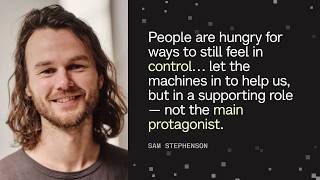
For me that's like, it's like partly a philosophical stance that that's like the world I want to live in where humans still have a lot of agency over what our work and what we do. It manifests in a lot of small decisions, like design decisions in the product, things we let users do versus things we don't let them do. The fact Granola's a notepad is explicitly. And the notepad during a meeting is 95% of the interface and the AI is like 2% of the interface down at the bottom of the screen. Doing the transcription is because we want you to feel like you're in control and that what you have, the stuff that you want to write down or that you think about is the stuff that really matters. And everything else is kind of like gravy on top of that. I think pushing those ideals on the product makes our product better, but it also resonates. It's like human agency is still really important and is kind of at risk at the moment with the pace that AI is moving is a story that really resonates with people. And I think a lot of people feel this fear that they're going to be replaced or that they're going to less dramatically than that. Just that they're going to be behind their coworker who's really good at AI stuff, is going to be just better than them, and they're going to be the one that's made redundant next time the company shrinks or whatever. And I don't know, I think people are hungry for ways to still feel in control, but kind of let the machines in to help us, but in a supporting role, not letting the machine come in as the main. The protagonist.
Yeah, yeah. Sam, I'll wrap up with a last question here. What's the vision for the future that you're excited for, and what role do you hope that granola plays in it?
The vision is pretty aligned with some of the things we've talked about. If your job is like, knowledge work, talking to people, making decisions, moving information around, coming up with ideas that you, as a person working in that space, you're just able to be more and more high leverage in everything that you do and the kind of bits that are uniquely. You're uniquely good at as a human, you're just spending more and more of your time doing that and less and less of your time on the drudgery and on the details that don't matter. And, um. And, yeah, I don't know. I think. I think it's just a fun. Like, it's a fun thing to keep in your head as we keep building towards that. And I think if you. If you. If you build with that intentionally in mind, like, the tools that you end up building end up being very different to what they would have done if you. If you didn't. So.
Yeah.
Yeah.
Awesome, Sam. Well, that feels like a good place to wrap. Thanks so much for coming on Humans in the Loop.
Thank you, Zeb. It's a lot of fun.
More from Sam
From Designer to $250M Founder in Two Years | Sam Stephenson, Founder of Granola | Speed