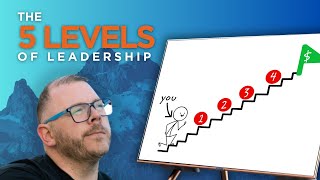
Adam Sand (speaker) presents a walkthrough of the "five levels of leadership" applied to roofing company leaders. He defines each level: Position (title-based authority), Permission (people give you permission to lead), Production (leadership increases team output), People Development (developing others into leaders), and Pinnacle/Level 5 (developing leaders of leaders). He also states two purposes of a company (founder/corporate origin and serving teammates' personal/professional/financial goals) and emphasizes that leadership growth is bounded by belief in oneself and the business (origin, mission, vision, values).
Chapters
Foreign There are five levels of leadership and the first one is position. That just means because you have manager or because you have CEO or because you have owner written next to your name. And this is something you can teach to your people too. Because I remember Joe, you said that you want to develop the leaders around you so you can look to your leaders and say, hey, if people aren't listening to you and you think that they should because you're the manager, right? That's just the first level of leadership. You haven't even reached level one yet because some people will only listen to you and do what you say. You can only compel them to do what they're supposed to do in the business because of your position. Just because you the manager, like that's the very baseline level of leadership, which is just, I have the position, I tell people what to do and therefore they listen to rise up and to become a better leader, you have to get to, to the point of being a permission leader. This is where people give you permission to lead them. Not because of your position, but because they have given you permission. A company exists for two reasons. The first reason is to, yes, take care of the courageous founder who stopped selling for that other roofing company because he didn't believe in his boss, decided to go and start his own roofing company, to go out there and knock doors to get the five first five customers, and then hired that first office manager. The second and equally important purpose of a company and is to be a vehicle for the teammates who contribute to achieve their personal, professional and financial goals at a rate that excites them. Because it's not just there to serve you, it's there to serve the people who serve the corporation. When they care more about the logo, when they take care more about the flag, then they're taking care of the company. And in exchange for that, they should achieve their personal, professional and financial goals at a rate that excites them. And how you in turn lead around, that is by understanding to the point where they know that, that you know their personal, their professional and their financial goals. You then have the right to lead them because they say he or she understands my personal, professional and financial goals and they're trying to help me achieve them. They communicate the needs and wants of the business around my personal, professional, financial goals, what and achieving those things, therefore I give them permission to lead me. The next level, the third level is production. And that's where by the means and methods and ways of your leadership, people produce more than they would on their own. And they feel good about it. Because again, you've already crossed the Rubicon of your leadership helps them achieve their personal, professional financial goals at a rate that excites them. If your leadership in their eyes, helps them produce more, and thus they grow to their personal, professional financial goals at a rate that excites them at a faster pace than they would otherwise on their own. You've now become a level three leader, people development. I at best think that I'm a level three leader in some cases, right? I'm trying to achieve the goal of being a level four leader. And you might be a level four leader in the eyes of some people and not in others. Like you might have accomplished permission level leadership with some of your people, but other people might only follow you because you're the leader. It's not that you become a level four leader. The people you lead determine that you're a level four leader in many ways, right? You have to have the skill, but then the other people have to kind of label you that like you will know based on the results of your people if you're developing them. So people development is where you then now develop other people into leaders of themselves. And it starts with me leadership and then turns into we leadership. So they start with I can lead me to eventually become they can lead we. The Level 5 is the pinnacle, right? And a pinnacle leaders. When they develop leaders, who can develop leaders? If you can be a level five leader, you can be president, you can be CEO of a billion dollar company, it's publicly traded. You have to be a level five leader to even get into that realm. Because now you're the leader that develops other leaders of leaders. You're developing level fours, right? You're creating level four leaders. And when you get down to this point, well, now you've got your operational effectiveness lid covered. You've got your leadership lid covered. Once you have those skills and you continually stay humble and cultivate those skills, all it comes down to is what do you believe you can achieve? Can you run a $3 million company, a $10 million company, $100 million company, a billion dollar company? And I say this to myself almost as much as I'm saying it to you, because your leadership lid will grow, your operational effectiveness will grow, but it will only grow to the constraint of your belief in yourself and the belief in your business. And your belief in your business is going to be based on your origin and your mission, your vision and your values.