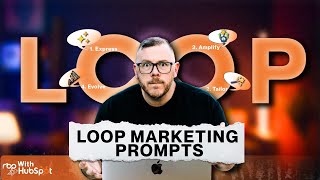
Adam Sand walks through HubSpot's loop marketing strategy, showing how to use AI prompts to build brand positioning and launch campaigns. He covers creating effective prompts, running peer reviews, and the full workflow from analysis to deployment.
Chapters
All right, so you've probably heard about loop marketing and if you haven't, it is from HubSpot and it is about the next era of marketing and it's all about the response to the massive traffic loss that has been incurred by AI. So HubSpot released these hundred prompts that related to how to get aligned to the loom marketing playbook. They give you these prompts, copy it to the clipboard, and then shoot it into your GPT. All right, let's take a look at this first one. You're a senior brand strategist with expertise in competitive positioning and value proposition development. I need you to analyze our customer success stories to customer success stories. Okay, well, where do we get those? To identify our unique differentiators and create a compelling brand positioning statements that distinguish us from competitors. Analyze the provided customer data and identify our current value propositions and create differentiating positioning statements. So paste your top 10 to 15 customer success stories and case studies. Paste your customer testimonials and reviews, paste any win loss feedback data, and then a little bit about your company. Okay, so you have to tell it about your company. So that's some work. And you have to get all this and then you hope to get this output right. So it gives it an analysis framework. It says the output is doing a unique value analysis, problems uniquely solved, distinctive outcomes, unique approaches, customer language patterns, proof points and metrics. And I'm like, all right, well how do I make sure this thing gets the best possible chance? So I had to say, all right, how I did this? This is the writer downer of the day. If you want anything to come from this. How I did this was, was they said, first I need to make a pre prompt to get this and this in a way that AI would have its ability to chew on it. And so began my prompting journey. So the first thing I did was because HubSpot has access to HubSpot as a tool, I said, okay, well first your job is to kind of get this from our HubSpot data. So I said, I want you to basically get me ready for it. And it did a good job, but never one to waste an AI dollar. I also came here and did the exact same thing at the start of this one. And I burned through some credits this month. This is a massive munch of credits. So it's kind of pulling out some stuff about my clients, businesses and my businesses. And so I had to kind of keep going back through. And I said, okay, identify my competitors. And then I had to go through and Say, okay, it filled this out. And I did the same thing in Gemini. So if I go here and I go back to chats and I go here and it started this research and it did the same thing. So then what I did was I got it to do a peer review. So basically I said, hey, I did this same activity with all four of these AI tools. So I said, I want you to conduct a peer review. Essentially this is five PhD level research teams having done this task. I want you to create one massive document that retains all the facts and no hallucinations. And then I said, focus on authentic patterns. And basically they said, I want you to do a peer review of this. And so then it basically made me my mega report of that particular task. And I went and did this for all the way to this prompt. This is how far I got in five hours. But I basically did the pre prompt, got it as much information as I could. So at some point I went into our Avoma meeting recorders and I said, all right, find me customer stories, Find me points where customers mention revenue going up. Find me all. Like I went and collected all this stuff. I got it to peer review it twice to see who did a better job doing the peer review. So after I did this peer review process, I wanted to make sure I got multiple chances of doing it to see which one would give me the best peer review. And what I can tell you is the output was fantastic. Like, that's what I'm trying to convey here is that these prompts are really good. They are fantastic. But the cool thing was, is once I was done, I ended up building a ton of documents that I pulled out of this thing. But then I put all that into Notebook LLM and then the output in here is great. Like this lead to review operating system. That's what it gave it. Gave it this name. And that was really cool. And then saying like, okay, well what is it that we do? P grade visibility, you know, like a lot of this stuff for training a new employee. I mean, this is crazy to like teach them the brand. And then in my studio here, I also got it to say, okay, I want you to do a debate brand versus results. I got to do a debate between is this overkill, all this brand messaging stuff and like how important is it? I did a video on how we're going to change, like change things that it caught that was wrong. Like it found things on our website that didn't align with our yield brand voice because our website was done two years ago. And this is all just the start. I'm on prompt four, getting to prompt five because each prompt required me to first do some prompting to get the inputs. Like there's mutually exclusive and collectively exhaustive list of inputs, right, like your company name, that's like the same multiple times because it's treating this prompt differently. Your ideal customer profile, that's the same on multiple of them. Key strengths and capabilities, current brand positioning. So that's like the whole output from a previous prompt. So I kind of had to pre prompt my way here. I could then fill in this section with these three page mega documents that were the result of a peer review of using four AI tools to crunch through it. Like I said, it took me five hours to do four prompts, but that's putting the effort in. What I'm really excited about is seeing what already came from just the first four. What does that mean by the time you actually get through the work? And what I'll tell you is how many people are actually going to do the work? I don't think a lot of people are. Because if you just look at the express stage, that's all the prompts for the express stage of the loop. Then there's the Taylor stage. Here's the Taylor stage of the loop, the amplify. So this is after you start actually doing some work. Then you have this for the amplify stage of the loop. And then there's the evolve state of the loop. This is something that nobody else is going to do the work. And this is where the major kind of white space of opportunity exists. The whole reason HubSpot did this, in my opinion, is because what they've built in the HubSpot, if you put this in there, if you put this stuff in there and use this inside of HubSpot for your marketing hub, it's going to be insanely powerful and I'm really excited for it.