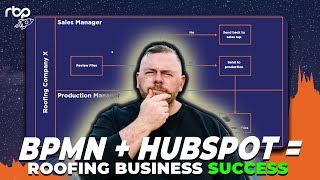
Learn how roofing companies use process maps and BPMN to document workflows, train crews faster, and scale operations. The video breaks down swimlanes for different roles, decision points, and how to show manual tasks versus automated HubSpot workflows with simple icons.
Chapters
So what a process maps do? Well, they're a how to on how to break down our processes, do meaningful guides so we can understand our job role. They also help us systemize our businesses, freeing up our time as owners and we can train quickly to scale. Train quickly to scale is huge. I remember thinking when Adam and I first started talking about these, I was 16 plus years into the business. I thought, where was this when I first started? Useful for us near the end, but man, to have these in the beginning of our journey as a business and entrepreneurs to be able to train quickly and scale would have been huge. So I'm glad that you folks have the opportunity to learn that now. So before we get into what they are, let's talk about what a process map is. Not a process map is not this a bunch of words, little arrows, like sort of jumbled on a page? You know, I'm sure it could be followed, but it's not an easy visual. This is also not a process map very much recognize the standard in the industry for sales process. This is what they had laid out. You know, you see it's kind of, you know, they got 1, 2, 3, 4, 5, and then sort of run in room and they go back here. The process is good, but this map is not a good representation of it. So if a roofer wants to document their processes, how can they be the most effective and efficient at doing it? Well, the system that we recommend is something called bpmn, which stands for Business Process Model Notation. So what is this? Well, BPMN is a system. Shapes, arrows, different icons, that sort of thing. That all means something when they're laid out a certain way. So what it does is it gives us a system and a process in and of itself for a way to easily lay out everything that we need to do in our business. So everybody, they know what they're looking at, they can read the same thing. What happens in BPMN is we first start with what's called a pool, just a rectangle where we're going to organize the process that we want to map out. And that pool is divided into swim lanes. So say if we have a process that we want to map, we can put our roofing company here. And then we want to separate our swim lanes into what we call the actors or the people that are going to be engaging in this. So in this example, we have a sales manager and a production manager. So then when we want to start putting our shapes, the two most main things that we work with in BPMN are What are called tasks and, and gateways. We'll talk about that. So a task is the most basic level of an activity that cannot be broken out any further. In that particular representation that we're working with, a gateway is represented by this sideways square at diamond. And what a gateway is, it evaluates the state of the business process and based on the condition, breaks the flow into one or more mutually exclusive tasks. We can also call these decision points. So sometimes our tasks come into gateways. And a gateway is like, well, if this happens, then we're going to go up here. If this happens, we're going to go down here. It could be a yes or no or some sort a condition. We'll show you what that is. So using tasks and gateways, we can start to represent very simple process. So let's say we're doing the job file review. So the task could be review the job file. And the gateway could be does the file have all the correct information? Well, if yes, then certain things will happen. We can pass that off to production. If no, then it might have to go back to the salesperson for the review. So the other thing we like to do is we not only want to define human actions in our BPMN process maps, we also want to define workflows, automations that happen in our system. So say we have a pool with our three swim lanes. Two of them could be people. We could have our sales manager and our sales rep. We could also have any software that we're running. So say HubSpot. When we create a new deal, we've got a little hand icon here to note the fact that it's a manual task. But then it comes down here to HubSpot. And this little gear icon can indicate that it's a workflow. It's something that's just running automatically, not something a human is responsible for. And we can map our human interactions relative to the software that we're doing and express those interactions. So everybody knows where certain people are touching it manually and what automations are happening in the background to move that along after that. So say we have a task review files. Do we have all the correct information, yes or no? If no, we send back to our sales rep. If yes, send it to production. Production gets it and they review the file. We can map this different process not just within our sales department, but between say a sales manager and a production manager. Production manager gets that manual task review files after the sales manager has reviewed it and we know that it has all of our correct information. Something else that we can work with in process maps. You're probably thinking well you say a task is the, the sort of the minimum like the irreducible thing that we can express. But I mean you can always break something down you know lower like a name can be broken out into a first and last name. A first and last name can be broken down to letters. How granular do we want to get this? Well this is why we deploy when we're doing process mapping we deploy sub processes. So say we have that job file review. Well obviously there's several little things that could happen inside a job file review. So then we can have a sub process sometimes even an entirely different map to map this out. We can have this represented by dotted line box and we can show the various stages that happen within that one action. So we can express it as one action in one map but then we can break that out into the.