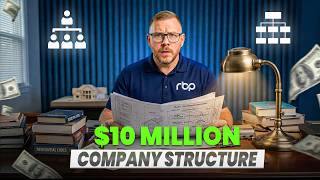
Adam Sand maps the team structure for a $10 million roofing company, from owner down through production and sales roles. Hire a production manager at $1 million revenue, a production coordinator after 16 roofs per week. Sales and production must coordinate through the owner to keep jobs flowing and deals closing.
Chapters
By the time you hit $10 million, your business can't run on grit and hustle alone. It needs a repeatable team structure. In this video, we'll walk you through the ideal team structure for a $10 million roofing company. When to hire production managers, field managers, and site supervisors. And how sales connects to production so jobs flow and deals close. Stick around. I'll give you the exact roles, hire triggers, and the chart you can copy for your own company.
What the ideal team looks like at $10 million. And here we have our meet the team graph, right, with our owner spreading into our classic production managers, production coordinators, site supervisors, and how the framework works all together with each other. You can see that there are different layers in the hierarchy that work with each other, and the production manager and sales manager work with each other through the owner and talk to each other to make these two sides of the business work with each other. If we move on to the next slide, we can go ahead and understand some of these roles better. So in a roofing company, you're going to have your production manager, and he's going to be the guy that's inside of your CRM going ahead and coordinating, you know, your your orders, your supplier orders, your labor orders, and also coordinating your production resources. You usually need him after $1 million. You as the roofing owner, you need to be there to do what is important for the company, and that is growing the company. And that can mean a lot of things, and that often means letting go of the production side of things. That's a very scalable process if we can get it nailed down right and get it trained to someone else. And so around $1 million in sales, we get that production manager in early. We also have the production coordinator after we're doing 16 roofs per week. So he's the person below the production manager. That production manager is going to get stressed with all the client communication, different things that he has to do to then split himself between talking and planning, right? Planning all the things that need to get done for the job versus going ahead and talking to the people about the things he just planned and getting things done for the job. It's something you can wear two hats for, for a little bit of time, but after you hit that 16 roofs per week, you're going to go ahead and experience an issue with the load. And so this production coordinator serves to be able to help facilitate that that communication. We also have the field manager. So this is the guy that's below the production coordinator, or if you're not at that 16 roofs per week yet, that is below the production manager. He's the person that is responsible for the day-to-day operations, making sure they run smoothly. They're the bridge between the site supervisors, that which we'll get into one second, and the project manager, the guy that's doing the plan, managing the real-time events and day tasks and things that are happening in the day. A lot of you who are the business owners here have been in that position of wearing multiple hats.. And so if you've been spread between those positions, you know that talking, planning, and then also dealing with the fires at every given moment can be a lot to handle. And so if we want to be that standout roofer that provides value for our customer, that's where the field manager comes in. And last but not least, the site supervisor. We hear a lot about this role. I already have that field manager in place. He can go around writing these different things, but the site supervisor is actually the most crucial part of this Puzzle makes $15 to $21 an hour. He gets $150 site referral bonus for every deal that he closes, right? Super impactful to have the site supervisor. And not only that, they're doing everything on the day of the job to make sure that your customer is happy and that you have this cycle of basically success with your company where you have happy customers leading to more inbound from marketing, leading to more happy customers, and the flywheel keeps moving. But the site supervisor is the last piece of that puzzle to make that work. And so with that, we get into the other side of the tree. We've got the sales manager. He plays a crucial role in building and managing and optimizing the sales function in the company. The sales manager is one of the people that are crucial to efficacy in the company. You have to remember that sales is what's bringing in the revenue, the value that goes ahead and lets you grow the company. And so he's hiring and training the sales team, maintaining the CSM out of view. He's auditing marketing and reporting back. He's the guy that's reviewing the job file playbooks at the end of the day and making sure that everything there can be ready to hand off production so that they can review it there. And he has a salary or 0.5% of sales, whichever is higher. We've got inside sales. They are the one that is sort of lead intake and qualification. They're scheduling the appointments in Arrivi. They are well-educated part of the team that is educated, knowledgeable in roofing and can deliver for their outside sales and close deals. And then there's outside sales. Your field tech is responsible for generating sales and he's the one that's getting scheduled by the inside sales. He's on site doing the documentation. He's talking to the customer. He is going ahead and building your relationship in that capacity, and he's usually a commissioned worker.