How the Pros Train Their Creativity
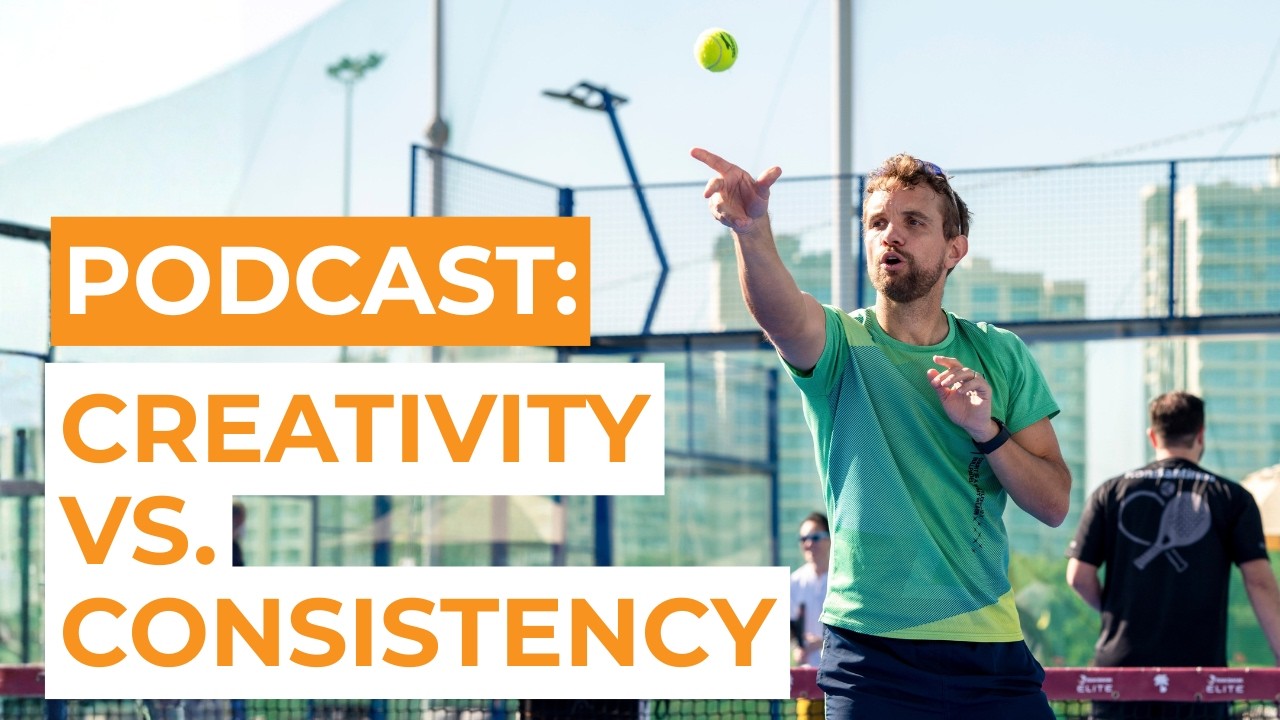
In this podcast episode, host Sandy Farquharson and co‑host Tom explore whether creativity on the padel court can be trained. They contrast padel with tennis, noting that trick shots are often dismissed in tennis but are a strategic asset in padel due to the court’s geometry and the need for unpredictability. The conversation moves through several themes: the importance of solid fundamentals (ball control, consistent strokes, chiquitas and lobs) before introducing creative, low‑percentage shots; a staged training approach that builds from basic grip and trajectory control to advanced trick shots; the need to be unpredictable to opponents while remaining predictable to one’s partner; the psychological side‑effects of a relaxed, flow‑state mindset that reduces fear of failure; practical advice on drill volume, repetition, and timing of creative shots in matches; and insights from pro Paquito Navarro, who attributes his creativity to both personality and extensive on‑court practice. The episode concludes with three take‑aways: balance drills and technique with trick‑shot integration, prioritize ball‑control fundamentals, and deploy creative shots at the right moments rather than high‑pressure points.
Chapters
Tom, I'm excited to have another podcast episode with you today. The big question is, can creativity be trained? Now, before you answer, we're going to do something slightly different in this episode. We're going to hear from one of the pros. We've got one of the top 10 players giving their thoughts on creativity and the training of it. But, but for you, is that something that you think it can be trained? And how have you found developing creativity on the padel court?
I just think creativity is one of those things, isn't it? It's a bit of a nice-to-have, or it's perceived as a nice-to-have, isn't it? I feel like it's— people think of it as trick shots and maybe it features on the highlight reel. I think that particularly coming from tennis, I think padel is very different to tennis. On the tennis court, trick shots were seen as not really something you would do, definitely something you wouldn't train, and the players that did the trick shots, a lot of other players and stuff, and especially coaches, would look at that and see that as, oh, this, this player isn't very serious. And I remember when I was training, if I would ever train trick shots during practice, it was almost seen as, okay, he's lost his, he's lost his concentration here, he's not, he's not really serious. Whereas I think in padel, a lot of players are creative, but also I think that they're creative on the court and it's effective and they can win points from it. So I think it's a really interesting discussion and I think that, I think it is something that can be trained and should be trained.
I think the difference is in tennis, it's very one-dimensional, isn't it? Like you don't, okay, sometimes there might be a net cord and it goes behind you and you have to react and you do something, but it's really rare. Like not even barely once in a match. Whereas because of the way padel is laid out, you've got the fence, you've got the corner, you've got the, the tap, like tap out from the other side from your opponent's smash, or you're running out the door. Like I think there are so many I'd say opportunities, but, but in a way actually necessities to be a bit more creative, to try and get that ball in. And I think that part of it is a journey. Like when we have beginner players or, or players from tennis that come to padel and they're going for these wild smashes and wild shots, we're saying, look, play percentage, be sensible, be consistent. So do you think it's at the beginning of their, their time on court that players Should learn this creativity?
I feel like that's one of those questions.
I've loaded you up there.
Everyone who's just started, like, please say yes. Please, please get me playing creativity. I think that, I think that for beginners and people new to the game, of course you have to learn the foundations. And I think that, I don't think it's something that you go out and you learn all the trick shots from, from day one. But I also think that, like you said, that Padel favors the, the, the creativity and being unpredictable, and I think that you, you can start training that, I think, early on. I think even some of the skills and the racket control that you can develop from doing trick shots and skill shots even when you first start padel, I think, I think can be useful. I definitely think that the majority of the training for players new to the game should be the foundations, but I also think that Yeah, like players can, can learn some trick shots. I think, I think that'd be good, but with the focus on the foundations.
I think it's in stages, isn't it? Like we focus a lot with our members on ball control. Like when they come onto the platform, there's a whole course around how can we control this ball in the continental grip with, you know, using both sides of the racket, being able to hit softer, you know, like basically organize the trajectory of the shot. And that's almost the start of the ball control journey. And then you go into like being effective with chiquitas and lobs, and then eventually you do go into— they're called more talented shots, but they are more trick shot-based shots, more creativity. But I think it is important for people to have the stability first, to have the consistency, to have that organization. And particularly if you are someone that plays Mainly social matches or club matches, there is nothing more annoying than playing with a partner who is doing trick shots and they go for some ridiculous shot and they miss it, and you're going, we could have just easily won that point. We could have won that point.
4-all.
And it was one of the things I remember you coming across to padel and I was like, and it was so nice that like playing with you where it was like you were just always gonna play the solid shot. Like, I didn't ever think you were going to go for some fancy dormy loaner off like a ridiculously difficult ball when, you know, you would always play the solid shot and I always play the solid shot, but I'm not, yeah, I'm not saying that the players should never go for that shot, but it, it needs, it needs to be trained. And I think like, let's get the solid shots first. Right.
Yeah. But I also think that in a way that mindset, that taking the solid shot option again, probably carried over from, my tennis. And I, and I feel that the level that we play at now, I think that is limiting because I think that so much of padel is like not being predictable. And I think that I've had so many matches where I've had a tactic and I'm playing the solid shot and I'm trying to almost execute on that tactic so, um, rigidly, so thoroughly. Yeah. All the time, like, okay, I'm gonna play the solid shot, I'm gonna play the solid shot, I'm gonna play the solid shot, and then After a while, actually, the opponents start, start to read you and, and they start to know that, okay, he's going to go for the solid option. And I know having played players that when you play those players that have, have a few skills, they have, they have a few tricks up their sleeve and they're, they're unpredictable. And I think that it's definitely a balance, isn't it? It's like you said, it's, it's not going for the ridiculous trick shot on a break point, but I also think that to have that disguise and that being unpredictable on the court, I think as you go up the levels, is, is not like a nice-to-have. I think it's key. And I think that coming over from tennis is very different. I think that tennis benefits you when you're, you're playing the solid shot and it's break point and you're just gonna play 2 more balls solid and that's what wins you the point and maybe the match. But I don't know, I, I'm interested to hear your thoughts. I think it's, I think it's slightly different.
Yeah, I think it's finding a balance. I always say to players Be unpredictable to your opponents, but be predictable to your partner, or at least a partner that you're used to playing with. Right? Because if you do a Chiquita and charge, and I'm not expecting it, and I'm not predicting it, then I can't go with you, or I you know then it then it affects me. And so it's it's being unpredictable to your opponents, but being predictable like to to your partner and being able to play. And I think that it's interesting when we spoke to Paquito. So Paquito is. is our pro who's giving his tips this week.
Fitting, fitting for the Creativity Podcast. Fitting man. One of the most creative out there.
And, and one of the things he says, and we'll listen to it in a second, is, you know, really it's the hours spent on court practicing that. And it reminded me of your backhand tap out because that was something that would happen in a game at the beginning and you're like, oh, it's so annoying because it's a, it's, it is a creative shot. It's a flicky shot that you need to be able to hit and it would Happened time and time again. And if you can't do that, then their opponents suddenly think, well, I can keep smashing here because he's not causing me any damage. And, and you put in the time and the repeatability of that to make it effective, I think, right?
Well, I remember you saying to me, one of the, the piece of advice you gave me so early on was, particularly with that shot, was practice that. Go to the court 5 minutes early, get on the court, and just practice your backhand tap out, and it will come It might not be, you might not get it straight away, but I remember I did that every time I got on court and it was, it was free. I'd do like 5 minutes of that and now it starts to feel more comfortable. It took months and months and months of maxing that to get it to a level where it's comfortable. But I remember when I first were in matches and, and it come and you get it maybe like once every set or depending on the level you're playing, right? Not often. And you would miss it and it was always on a big point. And, but how, how do you then practice it? You can't practice it in a match, like that many reps. So.
Well, I think that leads kind of nicely into that conversation with Paquito where we asked him a similar question. For me, one of your, your skills is your, your creativity. And when, when I knew the, the Premier was coming to London, I hope a lot of people will see your creativity and the guitar and everything from you this week. Do you think that creativity when you play is something trained, or do you think it's more your personality, the way you are?
Maybe it could be the personality. Yes, I always be like, we can say, yes, creativity, because I spent a lot of hours in the court. And when I was young, I always tried to do some tricks, some to making wheelies, or how do you say, por la espalda, behind your back. And then there is not my first option in the court, but at least I have some resource, resources if I need it. So Yes, but you, you have to, to train. And it's, it's not— I always say that you cannot— you don't have to play seriously all the time when you are with your friend or when you are young, no? Mm-hmm. You have to try something different. You have to, to see what is your limit and, yes, to make some tricks. Yeah, it's good. Yeah, Tapia, Tapia, I, I know that he trained a lot of tricks.
Yeah.
And then he, he make it easy. He seems easy.
Yeah, I think it's also important to say that there is also the, the drills and the training, because I see a lot of people practicing the Willy and the, the other shots, but maybe not doing the, the drills, like the, the consistency exercises.
And first of all, the consistency, you have to be a solid layer, make a lot of gloves, a lot of bandeja, and then el por tres, the wheelie, the tricks. But of course, there are some people that practice more the skills than the game, no, the solid game.
Yeah. And it's funny when you think about Tapia, because so often when I go to the premieres and I— what I love to do is go to the practice courts, and I love to watch like Tapia Coelho and what they do in the practice and And Tapia without fail will go and he will do a few of these where he smashes in his side. He does a few flicks. He does a few dormilonas. He'll do a few little like like trick shot mess around shots,
partly to to be relaxed, but it's partly like what he's used to doing. And I think that people watch him, and another example might be Tolito Aguirre. Like you watch him, you think oh he's a he's a trickster, or he he does loads of these trick shots. But if you actually put that in the percentage of shots. that he hits, he still only does in his whole practice of, of let's say 2 hours or an hour and a half, he still probably only does 10 or 12, right? Like, it's not like it's a high percentage. 10 or 12 out of 900 or 1,000 shots, right? So it's still very low percentage, but he just puts that little bit of practice time in.
Yeah, and you use the word to keep himself relaxed, and I think I, I really think that this topic is interesting from the mindset perspective because I think that in a way, if, if you're— if you have the, the intention of playing trick shots, I think that you have to be in a, in a mindset that doesn't have fear of failure. You have to be in a fun mindset. You're out there having fun. And I think that for a lot of players that are very serious, you know, there's some players out there that are like very serious and they're really focused and They almost don't have that capacity to even think about doing a trick shot. Whereas what I really admire with with Tapia and Paquito when they're playing is that they're obviously they're in a like a flow state, isn't it? Yeah, like if if you're if you're very serious and you're just focused on the winning, you don't have capacity for it. I think that in a way just that being part of their game, I think helps like them just play better because they're in that. that fun or that flow state, and they're, they're relaxed, and they might try a trick shot. And I think the mindset of it is, is also important, right?
And I think it's one of the really difficult things to get from another sport, is that you need to have that like calmness and that flow state even though there might be tension in the game. Like, and I remember this well from tennis, that it'd be a tension point in the game, a set-all, 4-all, 30-all, and It's okay that you feel that tension because you're gonna be aggressive on this next shot and you're gonna take the game to your opponents. Whereas in padel, you almost got to always like bring yourself down to a bit of a calm state because you've, every rally you've got to almost see what happens, right? You gotta play a lob, you play soft, you gotta almost manipulate the game, and you can only really do that if you are, are calm and, and more relaxed.
Yeah, exactly. And, and those players, when, when you are calm and, and you're having fun and you're relaxed, Usually you have a better performance. Yeah. Usually it leads to you playing better. You, you don't have that fear of failure. You're not frustrated with errors because you're having fun. And I, I think you mentioned tennis there, but you see some tennis players have a little bit of that. I noticed that with Alcaraz when he, when he's playing, he, he looks like he's having fun and, and he's creative on the court. And I'm, I'm sure that that's also intentional from those players because they know that when they're having fun, that their performance is better.
And so I, I wanna just take you back to the channel when we had a bit of fun. Not that we don't have fun now, but at the beginning of the channel, you, you weren't around in the Paddle School in those days, and it was right at the start. And believe it or not, we actually started with trick shots. Um, so I've got a few of our most original.
Oh, you pulled them outta the archive, have you?
Yeah. Yeah. Little golf, golf shot into a 3-meter.
This has gotta be AI with that accuracy of the golf shot. I've seen your golf.
There was no, there was no AI in the making. That
was a great golf swing.
Yeah. Well, yeah, it was not just—
that wasn't the point of this video.
The swing, it was more than 3 meters into the basket was the, was the shot. And then the next one is, is almost even more impressive of how to use a tennis racket to hit the contrapared. You don't want to ask how long it took to, to be able to execute these, but But that's how we started back in the day.
You can see by the celebrations how long it's taken and how pumped both you and Javi are getting.
Yeah, how many repetitions in order to do that. But it's that, that's almost how we started, was making some of these trick shots, doing this creativity. And each week it'd be like, right, what should we do as a trick shot? And back then they were incredibly original trick shots because no one was doing them. Now there's obviously a lot of, a lot of that going on, but
And you know, it's not AI because that was back then before anyone could say, oh, it's AI. Yeah.
Yeah. That was back when I was editing in iMovie on my phone to try and, to try and get the social media started. Um, but I mean, kind of joking aside, like it's, it's, it's an important bit to, to find a balance and, and playing with Javi was a good example in that he was really talented. He had loads of the trick shots and sometimes we would play and I would get frustrated with him because he would go for a trick shot. But then also he would play, do the trick shot and win a point and be unpredictable to his opponents. I'd be like, oh, I'm, I'm glad that he is, he is doing that, right? Like, you know, to, to, to make it difficult for the opponents to know what, what's coming next.
Yeah, it's what we talked about earlier, isn't it? It's, it's that there's, in padel, there's definitely a, a strength to being unpredictable. And I've played, also played against Javi and, and players like Javi who are very creative and It's hard. You don't know what's coming next, and so it is really difficult to play against. Now, as a partner, like you say, it can be. It can also be challenging because as a partner, you're not sure what what can come next as well. But I definitely think that as as you go up the levels, and I mean we talk about Tapper and Paquito, they they've almost got it. They've mastered that, haven't they? In terms of how do they integrate it in their game to make it effective, but also keep enough of the foundation and the the solid play to, to win.
So Tom, now on our podcast, we're going to go Out by 3, which is basically we're going to summarize the top 3 takeaways from this podcast. So what is your number 1? What's your, your first takeaway?
I think for me is the, the balance between doing the drills, getting the technique, getting the foundations in place, And then integrating trick shots in.
Yeah, yeah, I like that. Number 2, I think, is build on ball control. Like, do the ball control first. Like, get good at ball control. Like any other part of your game, you've almost got to, to build it in sections, right, in building blocks. So get really good with just general ball control. And if you haven't already joined our platform and you haven't seen our ball control courses, we have a whole course on this, on how to control the ball from different positions, different angles of the racket face, and then build that up to working on, you know, the, the creative shots within your game, I think.
Yeah. And then number 3 for me, I would say, is when you come to implementing it in a match, is I think doing it at the right time. And you mentioned earlier about on those big points when it really matters, Yes, you can be a bit unpredictable, but it's probably not the time to try the most outrageous trick shot that has a very small percentage of, of succeeding. So it's going— I think, I think it's doing it at the right time. I think the big thing for me is, is try it in matches, don't be afraid to try it, but I think it's, it's doing it at a time that is, is right, and, and maybe not doing it at, uh, you know, breakpoint when, when everything's riding on it.
And not overdoing it, right? Not trying to do it every single game, because then you will only just frustrate your, your partner. But the motto, practice your creativity. It can be trained.
More from Sandy





Want to finish more points? 🎾 #padel #padeltips #padeltennis #sports #coaching


Want more side spin on your Vibora? #padel #padeltips #padeltennis #sports #coaching

