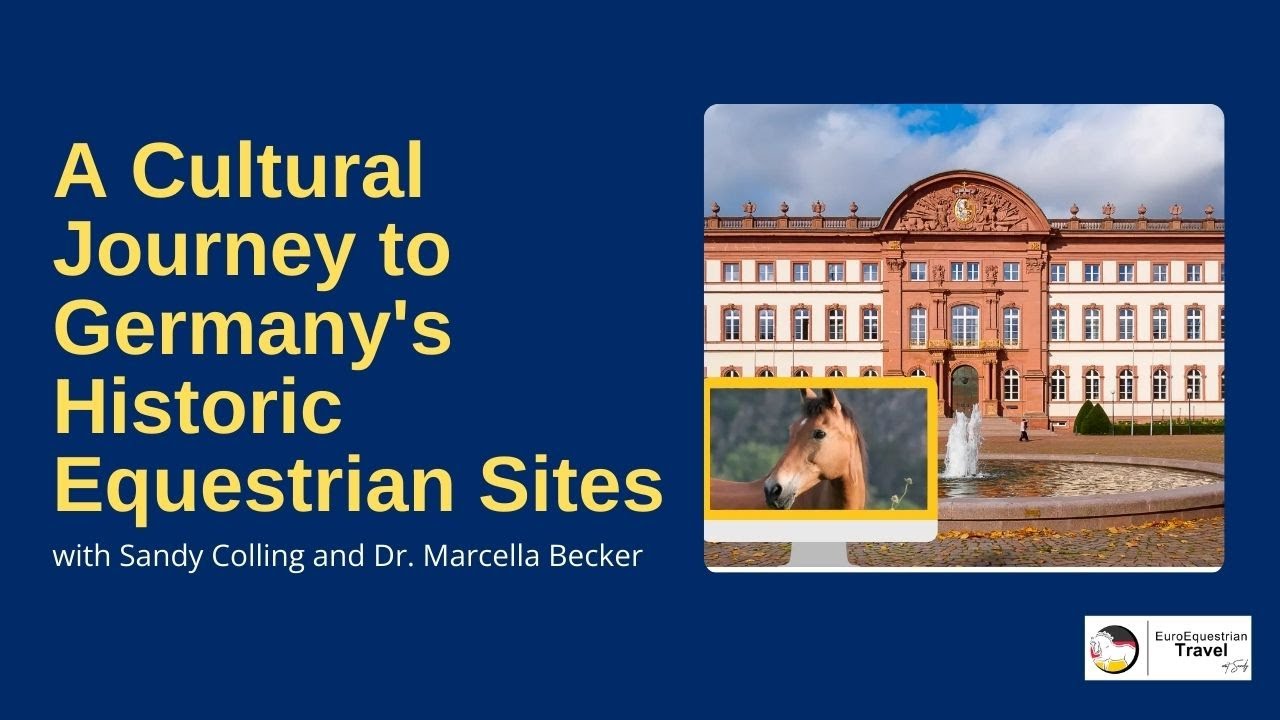
A Cultural Journey to Germany's Historic Equestrian Sites
In this hour‑long webinar, host Sandy Colling (a bilingual interpreter from Zweibrücken) and dressage trainer Dr. Marcela Becker explore Germany’s deep equestrian heritage. They begin with personal introductions, then trace the historical development of German horsemanship from medieval cavalry and the seminal works of Gustav Steinbrecht, Felix Büchner, and other riding masters, through the evolution of the cavalry manual (Heeresdienstverschrift) to modern sport. The discussion highlights major state stud farms—Marbach, Celle, Gestüt Schweiganger, Neustadt‑Dosse, and the historic Marbach/Weiler Arab program—detailing their founding dates, breed contributions (Trakehner, Zweibrücker, Hanoverian, Holsteiner, Bavarian Warmblood, Oldenburg, Black Forest horses). They describe everyday German equestrian life: indoor arenas, riding clubs, the “Reiterklause” café culture, festivals, and the pervasive bond between people and horses across ages. Dr. Becker introduces a practical training concept, Losgelassenheit (serenity/suppleness), and explains her kinesthetic writing‑simulator studio for improving rider seat and body awareness. The hosts conclude by promoting a 10‑day immersive trip to German equestrian sites (Marbach, Hohenzollern, Esslingen, Schwäbisch Hall, etc.) and a 7‑week virtual journey, providing logistical details, discounts, and contact information. The tone is conversational and enthusiastic, emphasizing pride in Germany’s horse‑heavy culture and inviting participants to experience it firsthand.
Chapters
Welcome everybody to a cultural journey to Germany's historic equestrian sites. That's a mouthful. And, um, I'm super excited to welcome everybody. Um, this whole thing kind of happened because there's so much out there on riding and training and all the different, you know, scenarios along those lines, but There's really not so much that I saw about the horse heaviness of Germany, and of course Germany's equestrian sites. Germany is a not a huge country, obviously not compared to America, but it is it's very horse dense. So we're just gonna focus on you know one of the main regions in called Baden-Württemberg, which is if you you know Bavaria, Baden-Württemberg, and then is my. Home, Bundesstaat Rheinland-Pfalz. And the reason I say that is because the picture you see there is the castle in Rheinland, in Zweibrücken. Zweibrücken is my hometown, means 2 bridges, and it's actually called die Stadt der Rosen und der Rosse. So the town of the roses, we have a beautiful rose garden, and the Rosse. Rosse is an old-fashioned name For horses, and in Zweibrücken, just a little tidbit before we get started, is the the Landesgestüt Zweibrücken breeds Trakehner, but it also breeds Zweibrücker. And Napoleon Bonaparte, our claim to fame, rode a Zweibrücker. So just a little little snippet there. So before we get into the meat of the presentation, I'm gonna go ahead and just quickly introduce myself, and then I'm gonna hand it over to Marcella. So my name is Sandy Colling. I am from Zweibrücken, Rheinland-Pfalz, was raised— I don't want to say on horseback, but I started riding at the age of 5. Horses have always been a part of my life. And they come, you know, it comes and goes, comes and goes. But I think for those of you who, you know, have horses in your heart, it's just something that's there, right? It doesn't go anywhere. And so I also work with Dr. Gerhard Hoeschmann in that I've been doing his US clinic organizations for, I don't know, 13 or 14 years now, forever. He's become a very good friend and mentor of mine. And so I'm very, very connected in the horse world and absolutely love it. I'm an interpreter and translator by profession. I was raised bilingually. And French, just because Rhineland-Pfalz is very close to the French border, French just, you know, was another language. But Horses have always been part of my life. So I'm gonna pass over the virtual mic to— I'm gonna be formal— Dr. Marcela Becker, but we'll just call her Marcela, whom you see here with her 2 beautiful horses. So Marcela, if you just wanna introduce yourself.
Yeah, that's always difficult talking about myself, but I had the horses always in my heart, but I was in a— I was raised in a completely non-horsey family. And this is just something my parents didn't understand. And from our standing or whatnot, it was just not considered something that they felt like they really wanted to support. So I snuck secretly off to— with my little bike, little red bike, to wherever I could find horses. Of course, smelly me coming back home kind of told the whole story. So writing— so that didn't give me any consistency in writing. You know, I was cleaning Stalls are helping out, and maybe got to write around in walk one round. So, and then later I started once a week in a writing club with my own earned money. But in Germany we have a saying: Zu wenig zum Leben, zum Sterben zu viel, zum Leben zu wenig. You know, not enough or too much to die, but not enough to live. So. Those were my riding beginnings. And interestingly enough, when I went to study in Oregon, I went on an exchange program and then I stayed. I actually ended up starting to ride more and ride young horses, have some— have a teacher that showed me, yeah, just to get closer with the horses. And then my classical training, I got— I started in Oregon with Dr. Thomas rider, which later when both of us were back in Germany, I continued. And Germany in a way is, is really rich in the possibilities to work with classical trainers. So I had exposure to some French school, to Portuguese school, to what is called Baroque riding here in Germany. And so in a way, I I kind of had exposure to the different classical schools, which now that I ended up being a dressage trainer myself, I find really useful because we have a lot of different types of horses that I get to teach. And I always think that the difference in the classical schools have to do with the different type of horses that they have predominantly. So in my teaching of classical dressage, I somehow just evolved into somewhat of a seat specialist. And this is something that I've pursued further the last few years by building up a writing simulator studio, which gives students the chance, isolated in peace and quiet, to really kind of do a redoing of the seat. Very interesting process. I'm learning every day as I go. And yeah. Other than that, I love teaching. I love all horses, and yeah, that's become my life.
That's become your life. Wonderful. So let's get right into it. Historical journey. So up here I have four pictures. A lot of you have probably heard of Gustav Steinbrecht's Das Gymnasium des Pferdes, the Gymnasium of the Horse. It's kind of like the Bible, even though it's not like a book that you read in bed at night because take reading a page is like takes me two years. I mean, it's very in depth. It's not an easy. Read, but it's definitely such a foundation. And then I have two pictures here of Vettien and Felix Vettien. No, Felix Birkner and Vettien. And Vettien and Birkner are maybe not as well known in America. But Vettien actually, and I'll talk about this in just a second, he came into the horse world at the age of 14, and his dad gave him his first horse. He was a cavalry captain in the reserve, so there's a lot of that cavalry, and I'll get to that in a minute. So with Felix Büchner, whom you see next to him, he trained the German riders for the 1936 Olympic Games. He also wrote a book called— it's more like a textbook called Dressage Riding, and the 9th edition was actually published kind of recently in 1986, not that recent, but relatively recent. And he is regarded as a riding master who really had a huge influence on riding. He— one thing that I actually didn't know in research, that he actually trained Egon von Neindorff, which I was actually not familiar with that. So he— and again, a lot of you may know Neindorff, but so he was his trainer. He also trained the U.S. military team in '48 and '52 and the English eventing team, and so that's how he gained international recognition. Um, Büchner, of course, and Marcella, did you want to say a couple words to Büchner?
Um, well, what I find interesting with all those guys that were like writing between the wars and on, um, there was a lot of cross-pollination also with the Vienna Riding School. So there was the Hanover School, there was Vienna, and these guys all knew each other. And I'm not sure if it was Bürgner even, they also studied in Vienna for a while. And so they all knew each other. And yeah, they, they learned from each other and studied with each other.
Can you can you imagine just hanging out with those guys and just like having coffee with them and picking their brains? Like so cool. So it's you know it's just and and these are just two of the many, but true masters. And there's so many masters that of course other countries as well France and Spain and you know whatever. But on Austria, but Germany is just so horse heavy. And then the kommentierte Hadi for twelve. So the Hadi for twelve is the Heeresdienstverschrift. It's the cavalry manual. It's basically Steinbrecht explained, but not explained because it kind of gives the factual layout. And there's a new version in Germany. It's not in America yet. Hopefully one day it will be. The kommentierte Hadifat-Zwerf. So it really explains the cavalry manual, which the Hadifat-Zwerf itself is translated and available on the US market. And Dr. Hirschmann, as well as Kurt Albrecht von Ziegner, did the comment— the comments on it, the explanations, I guess. And it's a really, really powerful, powerful read if you have not read it. And of course, a lot of this is horse, you know, dressage horse heavy. But, you know, I always say that dressage is so important for pretty much every you know, every discipline that we ride, the basics. So these are good books to read even if you're not a dressage rider. I know these are dressage heavy, but it's not just about that. So talking about historical German journey, Germany is a beautiful country. Well, I'm biased, but I think Germany is a beautiful country and it's got a lot of tradition, but it's also got a lot of equestrian tradition and it's made a huge impact in the world. So equestrianism isn't new. It dates back centuries and centuries and centuries. And you go back to the ancient times or the medieval period. So kind of like prehistory up until the 15th century-ish. That's when horse domestication and early use in agriculture and warfare started. The Germanic tribes utilized back in the day horses for of course, warfare, but also for transportation. And of course, we all know about the knights, right? The knights in shining armor. They played a huge role in Germany in their— and they weren't just, you know, the knights and their horses were and their steeds, as you know, we often say it was really— they had a lot closer connection than just this is my, you know, mode of transportation. They, they really relied on each other. So it's really, really beautiful. To think it goes all the way back there, and then Renaissance moving forward to Renaissance in the Baroque period. So Baroque, Baroque, Baroque, Baroque, fifteenth to eighteenth century advancements were incredible in horsemanship, but also in the art, the equestrian art, you know, equestrian arts, and classical styles at that time were heavily influenced. As you know, Marcella just briefly touched on Italian and French schools and the nobility, especially in aristocracy. They showcased their wealth through and status through their horses and their ties to equestrianism. So moving forward to the 19th century and modernization and industrialization, The 19th century marked a significant change in Germany as far as the horse world is concerned. So the role of the horse went more from— to prime— from— sorry, from primarily agricultural use, it went to sport and leisure. And so it was heavy use prior to that in agriculture. and it really moved to the sport. And it became popular, especially with nobility, again aristocracy, because horses were expensive. You know, horses were— there was a lot of money, and the status was often connected to how many horses, what kind of horses. And so that was a very, you know, a big— not just the jewels, like, you know, London, you know, the London Jewels, but it was really The horse was such a status symbol, and many ridevereine, so like the riding clubs that are so scattered all through Germany, became very popular and just popped up everywhere. And the competitive aspect started playing a bigger role: dressage, show jumping, eventing primarily. And although the military influence, you know, they were still used for military influence. The advancements of technology kind of in a it's a good thing. I think it's a good thing. Kind of like pushed it a little bit to the side. So we go to the 20th century, and they did still use in the First World War. They actually still did use horses. Hence, the Commentierte Hadifatzwerf, the cavalry manual, dates earlier, but it was still used and played a you know. a decent role. But moving forward to World War II, that all kind of came to a screeching halt. And again, I'm like super happy because we know how many animals and horses were, you know, lost during that. But during that time, what I've read, like several, you know, excerpts and books and like tidbits on it, it's really incredible how— and not just in Germany, but in general, especially in Germany, the horse and the human, the connection was so profound. It's just really, really, really powerful. So you look at the 20th century and, you know, as the horses were being pushed out of the whole, you know, cavalry and then also the agriculture, disciplines such as dressage, again, mainly show jumping and eventing, and we look at riders that are world known. Hans Günther Winkler. So Hans Günther Winkler, on a side note, Hans Günther Winkler had a very famous horse called Halla. And Halla, there was one little story where Hans Günther Winkler rode in a competition and he was exhausted and he had massive pain, and I forgot where it was. But he, he didn't think he could make it.
1956 Stockholm.
Was it Stockholm? Okay, I was gonna say that, but I wasn't sure, so I didn't. Yeah, so Stockholm.
He had a Leistenbruch. I'm not sure what that is in English. So he actually had an injury, and he was in a lot of pain.
He was in a ton of pain, and he wasn't sure if he could make it, if he could do it. And the story goes that Hala turned around, looked at him, and said, I got you. Just hang on. I— and I'm getting chills just saying it. I've got you. And I actually had the— I actually met Hans-Günter Winkler at a show, and I saw how he— his connection, it was just unbelievable. So Hans-Günter Winkler, for me, has a real dear little spot in my heart. And then of course there's Dr. Rainer Werner Klimke. We all know, of course, that whole generation has, you know, the son and the daughter, very famous, but Dr. Rainer Werner Klimke. So a lot of, again, a lot of German equestrians just became, made a huge influence on the world, in the world. And what I also love about Germany is The it became very, and I mean this may sound a little negative, but it's not. It became professionalized. Professionalized meaning there's strict standards. You know, with the FN, the German National Equestrian Federation, FN, which comes from the French Fédération Équestre Nationale, which I've never really understood why the but it does. FN, they played a pivotal role in standardizing training method, training methods. And promoting horse welfare. So this is something that is kind of unique to Germany. Also, a lot of you may know the books, The Principles of Riding. Well, there's actually six or seven Richtlinien zum Reiten und Fahren. There's like a bunch of different books in America. I think there's only one translated because in Germany they also have one for breeding, one for lunging, one for carriage drives. So There's many different ones. It's just a very horse, you know, horse-intensive, horse-heavy country. And Germany remains a global leader in equestrian sports. We know that they usually oftentimes rank at the top in Olympic Games, World Equestrian Games, European Championships, and the trainers are Of course, there's always those that are not, but I'm just looking at an overview. I mean, nothing is 100% everywhere, but they do for the most part. And I talked to Gad about this oftentimes. They are known for their technical skill, their precision, and competitiveness, like Germans are competitive. So the diversification of equestrian activities really goes beyond the sport. So of course, sport, you know, the different disciplines are, you know, pretty popular and heavy. But we also see a lot of recreational riding, not just, you know, competitive riding. Natural horsemanship has become more popular. Of course, there's a lot of therapeutic riding. And it really shows that these activities, they really create that deep bond that Germans honestly have with their horses more so than I've seen in a lot of different countries. And so let me move on to the next slide here, and we'll talk about some of the stud farms. So here I have pictured the Landesgestüt Marbach, which is the state stud farm in Marbach. And there are many, many, many state stud farms, though. So one of them up north, founded in 1735 by King George II of Great Britain, the Celle State Stud is one, one of the oldest and one of the most famous in Germany. It's in Niedersachsen. Go ahead, Marcela, you wanted to say something?
If I just may interject, because that is really just part of the history that on the one hand, the warmblood breeding Happened in all the different states since Germany was relatively late unified. So all the states had their own breed of warmblood. And through the changes in the military where they had cavalry, they had the big breeding farms, and they were looking for a horse that's tough, that can go long distances. That is in a way also an easy keeper and is able to do different disciplines. So as much as I'm happy that the horses are not anymore being used for war, it actually made the horses or the baseline for the horses that we still have today. And then the whole competitive riding started really out from officers that were kind of meeting up on Sunday or whatever and comparing, hey, what can you do? What can I do? And, um, back to the picture where you have Bürgner and Wettjen. I mean, these guys, um, I don't think there are really people, um, you know, we all love horses, we ride, we do. But these guys, I mean, they were, they were jumping cross-country, they were riding several horses, they were riding youngsters. Um, they had a much more, um, Much more riding, um, yeah, we can do today.
Back in the day, when even when I trying to remember back in the day though, every dressage competition they had a little cavalletti, a little jump at the end. Yeah. The Horsensprung is what it was called.
Yeah.
So it was you know it was definitely a lot more diversified. But back to Zelle. So Zelle initially focused focused on Hanoverana on the Hanoverian Hanoverana for military purposes, like you just said. That's what they focused on. But over the centuries, the stud, it extended, it expanded its breeding programs to other warmblood breeds. For example, Holsteiner, Trakehner, and also still Hanoverana, of course, because it's up up there in, you know, closer in that area. And, um, Celle today is really celebrated as a very famous stud farm and its contributions to the sport horses and the breeding and the preservation of traditional German horse bloodlines. So it's, it's very, you know, focused on that.
Well, and just the number of stallions that they still have. I mean, when I lived up north, um, I was going to the Celle Hengst Parade, stallion parade. I was going through the, through the barns. I mean, I want to say something like 80 stallions.
Yeah, so I think it's more actually. I was talking to Gabby about it. It's amazing.
Huge, huge.
And then there's a state stud farm called Gestüt Schweiganger. So that's actually a smaller one. It's not as well known. It's in, um, Bavaria, and it dates back again Going back, and this is the historical part, to the 16th century. It was actually originally a monastery stud farm, and later it was acquired by the state of Bavaria, Bayern, as we say in Germany. And again, it had a really instrumental, played an instrumental role in breeding the different warmbloods, including the Bavarian warmblood and the Oldenburger. So it also today it still does a lot of research and does and offers a lot of educational initiatives in equine studies and husbandry. Then there's Neustadt-Dosse State Stud, again one that's not very well known. It's in Brandenburg, which is the former East Germany, what used to be East Germany, and it has a long history of breeding for agriculture. Military and later than sporting purposes, and the it's it's the Brandenburg breed, which is known for its versatility and athleticism, is you know one of the horses that or one of the breeds that is is mainly bred there. And then there's Mabach. So this is where the picture is. Mabach. Mabach is in Baden-Württemberg again. It's the state that borders Bavaria to the left, so to the west. It's the oldest state stud farm in Germany. It goes back to the 15th century, and it also— and I wanted to have Marcella talk about this for a second— it makes it one of the oldest Arabian horse breeding centers in Europe.
Yeah, which is, which is really kind of cool. And I remember as a young girl, I was reading about them importing bloodlines from Egypt. And so I was like, you know, getting all the books that I could get my hands on and dreaming of Arabs. The interesting thing is, it started out actually 1817 with a private Arab breeding, which was done by King Wilhelm I of Württemberg. And that was not in Marbach at the time, but in Schönhausenweil. But later on, it— they moved basically to Marbach in 1932. What's really interesting is that, and still today, they're really— they were breeding and are breeding a type of Arabian that is really used for riding. So even though they have Egyptian bloodlines now, they have horses to ride. The stallions go in the sports. The mares are at least started under saddle, and they have to pass a test. So it's really about riding Arabs. And what's also interesting is it wasn't just to breed pretty beautiful Arabs, but those Arabs actually were used to put some nobility into the other breeds. So there are still Trakehner lines that go back to— I don't remember his name now. You know, Arab is OX in this thing.
Right.
So the Trakena used the Arabs to to get blood in there. The Zeller hengste there are some stallion lines in the Hanoverian breed that also have bloodlines from the Marbacher or Weiler Arab horses in there. So there too, it it's a cooperation. And now of course it's it's it's there and they maintain it and. It's beautiful.
It is beautiful. And you see here, there, you know, there's the air. So you see the different breeds. This is a Schwarzwälder, um, and, um, which is the Black Forest. It's like a light draft. I mean, look at it, how cute. And, um, they're awesome.
I was, I was there in, in Marbach a few years ago, and we did also, um, get to see the Black Forest horses and the stallions. I mean, you just fall in love with them. You know, they've got all this hair and Like a big halfy, like a little— so, well, and they're, they're really smart horses too. So, and I'm, I'm glad that they maintain the breed.
Yes, yes, absolutely. So back to Marbach, the foundation of the stud farm is said to go back actually to all the way to 1491 to Eberhard Imbach, who was the first Duke of Württemberg, and he established this stud farm with horses near Marbach. In in Reutlingen and in 1491, and so he then, and this is you know I mean who knows, but you know that they have to know it from somewhere. But he actually is said to have brought back horses from pilgrimage to the pilgrimages to the Holy Land, and also imported them from Hungary, Bohemia, and Transylvania, Turkey, and Holstein. So it's interesting, right? All the way back. I mean, how how predominant and the different breeds. And and then in the 16th century, in 1514, the stud headquarters were moved to Mabach. Around 500 horses are housed at the stud farm, and the stud farms that you know are adjoin adjacent to it: St. Johann Offenhausen, and there's one more. Güterstein, I think. So they also, which I love, and I didn't know this in my research, according to the stud manager, the focus on the stud is really still a lot on agricultural operations. And so, and they have to feed a lot of horses, right? So they produce their feed in-house and have around 600 hectares. So I don't know how much a hectare is. A hectare isn't an acre. I'm not 100% sure what What the correlation is, but 600 hectares of pastures available to the animals. So can you imagine like seeing? I mean, that's just amazing. It is the largest center for the profession of Pferdewirt in Germany. The state riding and driving schools are also attached to Mabach. Now, Pferdewirt—I don't know how to actually translate that. So it's. It's the profession of Pferdewirt. It's, it's the profession. Do you know how to translate that?
I was thinking, yeah, I mean, in, in you speak, you would say something like a Bachelor of Horse Management. So the, the people can do different, different focus on breeding, on teaching riding, on training horses. Yeah.
So again, this goes back to the professionalism that I was talking about earlier in Germany. You know, there are different places that you can do the Pferdewirt, but it is, it's, yeah, it's, I guess it's like, you know, it's a hands-on degree, and you're really not supposed to teach without, you know, right, you know, Pferdewirt, right, you know, auf Reiten, so riding, and, you know, or breeding, you know, whatever it is that you're Your specialty is, and then so so so those are the stud farms. So Mabach again is there's many other historic stud farms all throughout Germany. But you know those are just I've just highlighted a couple of them again. We'd be here all year if we went way too deeper. So equestrianism in everyday life, in today's life, like. Just how it is every day. So, I have some friends who went to Germany, and they're like, "Wow! You drive through these little villages, and there's a barn with an indoor arena, sometimes two and three, depending on you know some areas have four and five, and there's horses everywhere, and there's like stables everywhere, and there's like riding lessons everywhere. And like you can see on this picture on the top left, okay, you know, ausbinder. How do you say side reins? A side. But this is how I was raised. I started at the age of five with bolting, which you see on the bottom right. These little kids bolting—it's so fun. It's such a great way. Actually, this horse has markings like my Sunny did, and it's funny. I just—I just saw that. So the bolting to really learn balance, learn feel. Then a lot of times you go to lunch line lessons, the sitzübungen, you know, the seats. And then you go to these, and I remember, you know, riding like you see on the top left in a 20 by 40 indoor arena in the winter. There's, you know, when you can't go outside because it's cold and it's freezing and it's raining and it's drizzly and it's dark oftentimes. There's 2 in the middle that are lunging their horses. There's a couple of private riders on their horse, and then there's a Schulebetrieb, a lesson. with like 8 or 9 kids all in a 20 by 40. And it works. There's no chaos. Well, there can be chaos, but—
There can be.
But for the most part, there's not. It's like this understood. And again, because it's so ingrained. And then you see, you know, here on the top right, you know, little, you know, little kids face, you know, face painting, painting the pony. So it's very— it really, truly, the bond between Germans and their horses is It's, it's, it's pretty special. It's pretty powerful. And it really comes from that historical journey that obviously we just only scratched the surface because we only have, you know, max an hour. So I didn't want to go too deep into it. And then one of my favorite things on the bottom left, you see a picture of what we call Ne Reiterklause. So anytime I talk to somebody in America, they're like, what? What is that? So what this is, it's a little restaurant cafe. And you'll see the windows, and then you look into the indoor arena. So after your lesson, or after your ride, or after whatever, or parents watching their kids ride, you go into the cafe and you have a beer and a Brezel, or a Hagebuttentee, or whatever, and you sit and you chat and you enjoy, and you watch the vaulting lesson, or you watch the riders, or you watch whatever. So this is really, again, this just shows the connectedness of, you know, the horses and the humans in Germany. It's just a very cultural thing. And when I say, you know, I kid you not, and it's regional, in the north it's a lot, in Rheinland-Pfalz it is too, which is where I'm from, but also in other areas in Baden-Württemberg, you literally can drive through villages and you'll see an indoor, or you'll see 2 and 3. Or you— I know a lot of my friends in Germany, they have their horses at a Bauernhof, at like a farmer, and then they ride their horses to the indoor, to like a little— to the Verein, to the club. It's just a very, very common thing. A lot more than I would say that you see here in America. And of course, you know, there's a big tourism. You know, a lot of people go to Germany to ride. A lot of people, you know, for guided trail rides, for tours, for horseback riding, but also for education. So Germany is really renowned for its comprehensive education and training programs. There's riding schools and, you know, even like, in fact, I was at a seminar a couple of years ago at the Suder Mühlenhof with Gerd Hoeschmann, and I'm trying to remember the name of the program, but there was a program that was being offered online. And then of course you had to do your hands-on stuff all around different equestrian, different, you know, different subjects around equestrianism. So it's very, very equine science and riding instruction and breeding and all these qualifications. And again, I know you have this in America too, but in Germany it is just for such a small country, it is so Condensed. So equestrianism in Germany is really not just a sport or a hobby, but for a lot of people it's truly so deeply ingrained, and it's a way of life, um, and it's a tradition. And you know, you go to, you know, going to the Reiterklasse, Marcela and I, when we were talking about the webinar, you know, on Christmas we have the Nikolaus, you know, the, the Santa Claus little rides. Or we do like I remember we used to ride in a Weihnachtsquadrille, so a little quadrille at Christmas time, right? And then fashing the kids dress up in their little Mardi Gras like you know little outfits, and then they ride in the arenas and just have fun. It's just so deeply, deeply ingrained, and I just I just love love love it, and it really transcends age. age. Like, it really truly transcends age. There's kids, like, you see the little ones, and then, you know, I mean, I know 80-year-olds that still, you know, go to their horses. I mean, you look at Klaus, Klaus Beikenhoorn, you know, he's getting up every day, just so involved with their, with their horses and the infrastructure, but really supports it too. So, you know, like I said, every area, you have so much of it. So it's, it's become really a philosophy. And the other thing is there's many, many horse festivities all throughout Germany, all throughout the year. My hometown Zweibrücken, not a big town. I mean, Zweibrücken is 40,000 inhabitants, not maybe 50 now. It's not a big town. But we had our Pferdetage, our horse days. So die Zweibrücker Pferdetage. And there were— it was just fun. You'd go, there was competitions, there was good food, and it was all revolved. We also have a racetrack. Not a big fan of the race industry, but whatever. We have a racetrack. And it's just, again, there's all these horse markets and horse fairs and horse, just horse fun. So at this point, talking about horse training, I'm actually going to hand it over to Marcella, who is going to share with us a little bit Well, she has some fun. She has a fun exercise for you and something fun she wants to share. So can I move the slide forward, Marcella?
Sure, you can.
I can move the slide forward.
So I got the task to share something that I do in the studio with my students, and it's how to start. Basically, in, in when we talk about the horses, we want what in German is called Losgelassenheit. Yeah, the interesting thing is, if you look up this German word in the dictionary, you find things like composure, calmness, equanimity, placidity, or one of my favorite English words, serenity. Yeah, in equi-speak, it's simply suppleness. Yeah, but what I find interesting is when we, when we look at the wider meaning of Losgelassenheit, we're getting to the place when we, when we use the serenity, for example, that it is a state where you do not need muscular tension. So, and we want that in the horse, and of course we need that in our seat. So when we do courses in the studio, we also address some issues on how do we move in our everyday life. Since I mean we can't do another hour of sports just so that we can sit well in the saddle, right? So it's much, much better to think about how you do things, how you do them better in your everyday life, so that when you get to your horse in the evening or whatever, you can get into the saddle and you get a losgelassen, a supple. Easygoing seat. So one thing we look at is how we stand. Yeah, all of us are standing a lot. We're sitting a lot. We're walking a lot. So if you look through these pictures on the left, this is kind of you know standing with a lot of tension. Sometimes, of course, people are even told on this in the saddle, you know, chest up and hurrah, and then you you see the stiffness. Yeah, especially you also see how the lumbar area is very tight and how the sternum is tight. It doesn't even look like one can breathe. So then if you go to the next picture, you know, that's how a lot of us spend a lot of time, like looking down into the cell phone, standing without good body organization. So that's not really useful either. And what happens very often And after we, we stood slumped like that, if we then only open our head up, but our shoulders and our sternum is still kind of going backwards, shoulders are forward. This is something, and you can try it out on your seats. If you slump your shoulders but open up and tense your, your neck, you can even feel it all the way to your lower back. So a useful thing to help you is, I call it active standing. Yeah, where you figure out, how can I stand? How much bend do I have in the knees? And how do I stabilize my body without muscular tension? And this is something I teach then, of course, on my writing simulator too. We need a pelvis that has relaxation, and we need a lumbar area where we give up the tension, which is a place anyway where everyday stress tends to go there. So this is something that you can actually check out in your everyday life. How do I stand when I have to stand, and how can I organize my spine to just have the natural curvature but not extra tension? Um, also, I find that when I'm in stressful times, I always check when I'm driving my car that I'm not tensing up in the lumbar area. So these are little things, um, you can do in your everyday life. Yeah, um, easy to do, just a little bit of mindfulness, um, which then helps you when you, when you get to your horse and you get into the saddle. And you have a good organization and no unnecessary tension. So, well, we know playing with it.
Yeah. Have fun playing with it. And we know, like, tension. And it's so, it's so true. I mean, I actually have a standing desk, so I'm standing because when I was sitting all the time, I just, and I'm at the computer a lot. I just noticed. So I just really got a standing desk and it's it's made a huge difference. So that, that's something we can be mindful of for sure. So going back to a little bit of history, in this picture on the left, you see Hohenzollern, Schloss Hohenzollern. Hohenzollern is on top of a mountain hill. And it is really a prominent symbol of Germany's medieval architecture and history, and it had a lot of military and royal importance, but it also holds a connection to horses. So as you know, with the knights and, you know, the knights in shining armor, and years and years ago the grounds— and maybe now still, I don't even know— but the surrounding forests were used for royal hunts and equestrian training. And they really emphasized again the bond between rider and horse amidst, you know, this, this beautiful— I mean, you look at it, this beautiful, you know, scenery. And I was just there. Well, not just a couple of years ago, I went to visit Hohenzollern. We walked up the hill and with my friend, and it's just, it's absolutely spectacular. And then located—
And it's actually a rebuild. So it's not itself super, super old. Because of course castles in old times got destroyed, right? But, but the, the king's family of course rebuilt this thing, and that's why it looks like a dream castle.
It really does. It's absolutely spectacular. And then a little, you know, lower from the Hohenzollern, from the castle, is Esslingen. Esslingen is a very cute little town. It cobblestone streets. It has the Fachwerkhäuser. They're like the, the timbered houses. I don't even know, like, they're the Fachwerkhäuser. They have that wood in them, the well-preserved timber.
The logs.
Um, and it really reflects the military heritage. And, um, there were a lot of fairs, a lot of horse fairs there through ancient times, horse trades, and, um, just, you know, again, very connected to, um, the horse world. And on the right you'll see Burg Liechtenstein, not like Marcella reminded me to mention, not to be confused with the country of Liechtenstein.
Yeah.
So Liechtenstein is one, is I, and Liechtenstein, and so this is really a beautiful, beautiful castle. And one thing I didn't know, because I've actually been to Liechtenstein, That there's an old Burg, right? There's an old castle within walking distance, right? Isn't that what you said, Marcella? Like there's the old—
Yeah, there's, there's some old ruins. Ruins, yeah. What I love about this Liechtenstein here is, I mean, you can see it that it's on sitting on a bluff and then it goes all the way down and it's, it belongs to the Swabian Alb, which is not to be confused with the big Alps, but this whole area is quite interesting geologically. There are caves too and all that kind of stuff because it used to be actually under an ocean, and that's why you also have these, um, yeah, like canyons. Yeah, like canyons that were underwater at some point. And this particular castle, it's not really big, but because of this location It's, it's pretty cool.
And it looks, it literally looks like out of a fairy tale because it like, when you look at it, it's like lifted. It's like on this little rock and it just, it's absolutely spectacular. So, so again, there's castles all throughout Germany, but we just, you know, highlighted and, and this in, you know, this little tower in Esslingen, obviously in the middle, is not a castle per se or a Burg, a fortress. But again, it highlights that architecture, the medieval, the style, the horse connection, and all that good stuff. So if— and Marcella, did you have anything you wanted to add to any one of these?
Because I know you know that area quite well. It's really cool because, I mean, where I live, I haven't really visited them all because I have horses, so I don't have time. But they're probably 20 castles that I can drive to and visit from where I live. So they're all over the place.
They're all over the place. And you live in Baden-Württemberg, so you're not far from, from, from these, these areas. Yeah. So if any of this resonated with you and piqued your interest, we have a surprise for you. In July, We will be going to Marbach, to Hohenzollern, to Lösdau, to various horsey and non-horsey places in Germany. And, um, we will also have a 2-day intensive boot camp with Marcella in her studio. And, um, So what's included in your, you know, 10-day experience? So there's the 2-day exclusive rider boot camp with Marcella, 9 nights at a charming hotel in Esslingen that we showed you, and we'll visit Hohenzollern. We will go— and I didn't talk about this, but we will go to Schwäbisch Hall, which is literally a fairy tale town. Very beautiful. Absolutely. That alone is worth the trip, even though it's not horsey. Absolutely spectacular. We will go to Mabach with an exclusive Prosecco welcome in the historic carriage room and a tour of Mabach, all in English, so don't worry. We will go to Hohenzollern. We will go to the Burg Liechtenstein, and we will visit the Stuttgarter Reit- und Fahrverein, which is the Stuttgarter Riding And we'll get a tour of the of the club, and we will watch some vaulting lessons from the Reiterklause. So you'll be able to experience the Reiterklause and look in and watch vaulting or riding or whatever is happening at the time. And we'll also have a private shopping experience at Lösdau. Lösdau is Dover Saddlery on steroids. Lösdau is a Fantastic tax store, but it's like several levels. It's phenomenal, and honestly, prices are a lot better. I mean, that alone.
Yeah, the Lösdau is is quite reasonable. But anyway, by the way, this particular Lösdau is situated in such a way that the windows that you know have a few of the Burg Hohenzollern.
There you go. So you get a view. Shopping with a view. How about that? Shopping with a view. And you'll get, you know, private attention there. We are— we'll have 2 guides that will take you, private transfer. And for those of you that are going to Aachen, it is literally— Aachen's last day is the 7th. So it literally connects with that. And we only have room for 8. People, um, just because we want to, you know, keep it exclusive. And we, you know, we just want to have fun together and we want it to be intimate. And so you can go to youreequestriantravel.com for all the details. And if you, um, register by the 1st of March, you will get $300 off, $300 discount. There's single occupancy, double occupancy, what, you know, whatever it is you prefer. Grab a friend, and hop on a trip because this is really going to be a trip of a lifetime. And, um, what I have for you— so there's another bonus. I have a 6-week virtual journey throughout Germany. It's actually 7 weeks. Um, it's on a course platform, but it's not a course. And, um, it showcases German breeds, cultural events, language, digital downloads. It's all about horse-heavy Germany and, and also teaches you a little bit about the non-horsey things. So you will get that as a bonus. And, you know, if you're interested in it and can't do the trip this time, it's $99 and you can, you know, register here or you can send Marcella or myself an email if you have any questions around the trip. Or when you go on the website, you can also book— like, there's the phone number, like a little quick consult if you have any questions around travel. And this is Marcella's email. This is my email. So if anybody has any questions, you can put them in the chat, and we'll be happy to answer them. Or of course, you can send us an email or just respond to the email you got, the reminder. And I will be sending out A recording as well. So you can also respond to that email. So I'm just gonna—
in the chat here, I'm wondering if I should say a few things about the writing simulator.
Absolutely, absolutely.
Because it's a pretty unique thing. It's actually the first one in Germany of its kind, and it sticks out in its functioning because it's purely kinesthetic. And I have it now for 2 years, and the longer I work with this thing, the more I'm impressed on how relatively quickly a person is able to make some changes in how we organize our own body on this thing. People here in Germany are kind of like, well, why should I sit on a riding simulator? But it really is. It's, it's basically a luxury because you get super direct feedback. what your body is doing. And because it works kinesthetically, it's also in a way easy to find a much better organization in your body, which then you can sort of take to your horse once you felt it. We're basically doing some neurological repatterning, and we do some assistant, you know, or additional exercises. We focus walking, how we walk, how we use our body. And I always say there are no shortcuts in learning to write. There really aren't. But if there's just a little bit of a shortcut, it's working with this writing simulator. Gives you a leg up, quite literally.
And, and I have— and I'm just putting Marcella's email in here if you have any questions specific— Specifically to that, yes, I'm happy to answer. So those are the 2 websites if you want to copy them down. One, the first one is for the virtual journey, and the second one is for the actual trip. Um, and then my email and Marcela's email. And, um, if you have any questions at all, or, you know, want to hop on, see Germany, it's going to be a fun way to really explore You don't have to worry about any of the you know how to get from A to B, and you know how do I get from here to there, and what do I order, and where do I go? And because there's like I said, there's going to be two full-time guides with you, myself included, and who will be able to you know navigate the journey and answer any questions and help you out. And pretty much everything is included. Most meal well some meals are. All breakfasts, and the only thing that's not included is your flight. So, um, if you want to do this and you want to say, this is for me and I'm going to take a friend and we're going to go and we're going to have the 10 best days of our life, then, um, you know, we're here for you.
Go for it.
Exactly. And improve your riding or, you know, your posture along the way. So super exciting. And, um, thank you so much for popping on. We're happy to have had you, and if anybody has any questions, just pop them in the chat. If not, we will be in touch with a follow-up email, and you can always ask questions there as well. Marcella, anything to add before we wrap it up?
Can't think of anything right now. Come to Germany.
Yes, it's beautiful, and July is a nice time of year too.
Yeah, normally, normally it's quite nice from the weather.
Yep, it is. So thank you so much. Thank you, Marcella. It was great, and I look forward to hearing from you guys. Have a great day. Bye.
Bye.
Thank you. Thank you. Bye.
Bye.
More from Sandy


Quick passport tip I highly recommend doing. #JustTravelWithSandy #PassportTip #Travel


Don’t let language barriers stop you! #JustTravelWithSandy #Travel #Wanderlust

My absolute favorite Travel apps. What are yours? #JustTravelWithSandy #TravelApps #Travel

Trailblazer podcast! What fun? #JustTravelWithSandy #Travel #TravelTheWorld #TravelMindset

Let’s talk travel mistakes!#JustTravelWithSandy #Travel #SandysTravelLounge #TravelTips

Explore Equestrian Adventures with Meghan Brady 🌍🐎 | Equestrian Journeys Podcast