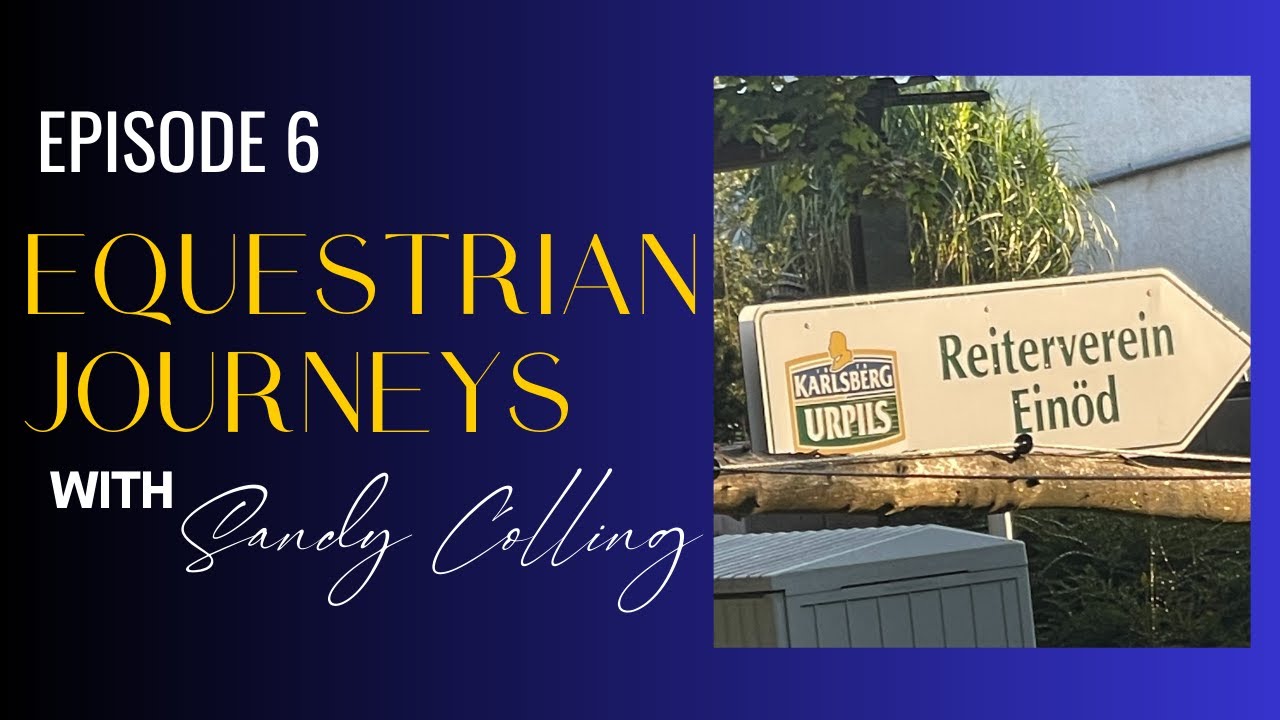
Sandy Colling grew up riding in the German town of Zweibrücken, where instructors Conny and Konrad Wallner ran group lessons using a punch-card system and strict routines. She learned vaulting, lunge-line work, and traditional German methods like hand-cleaning horse tails, with a penalty of buying drinks if straw was found in one.
Chapters
Welcome to Equestrian Journeys. I'm Sandy Colling, your guide to the captivating world of European horse culture. And each episode, we talk about century-old traditions, rich history, and the so vibrant modern horse scene. You'll hear great stories, get insider travel tips, and meet wonderful guests who share our passion of horses and travel. Whether you're planning your next adventure or exploring from home, Equestrian Journeys offers a unique perspective on travel and equestrian, As well as non-equestrian culture all over Europe. So join me each week as we uncover hidden gems and stories from Europe's amazing horse scene. And today I wanted to share with you a little bit about my background and my growing up around horses. As we say in Germany, plaudern aus dem Nähkästchen, which literally translates means just share from the Nähkästchen, from the little sewing basket. You know, they had those baskets back in the day where they put all the sewing stuff and the thread and the needle. All that good stuff was in the Nähkästchen. Maybe some people still have them. I know I don't. But when I was a little girl, through my friends, I was introduced to horses. I used to go with my friend Heike to the farm and just fell in love. Fell in love with the horses. I started with vaulting lessons, then went to lunge line lessons, and then later on to the Gruppenstunden, to the group lessons. And remember, we had this Zehnerkarte, so a ten a ten hole punch card, and each lesson it was punched. I don't know why I remember this. I want to say it was eight Deutschmark, eight German Deutschmark. So Deutschmark doesn't even exist anymore because it's euro. But anyway, back in the day, maybe it was a lot of money, but looking back. Now it was 8 Deutsche Mark, and I think at 10er Karte you got— so for 10, I think it was 70 Deutsche Mark. You had a little bit of a saving. So I had to play the piano. So my mom, if I did not practice piano, I was not allowed to go to horseback riding lessons. So that was her little bribe. And the horseback riding lessons were everything. I lived for Saturday mornings when I went to my riding lesson. And when I got a little older, around 8 or 9, I would Ride my bike. I would ride my bike to Ein, which is a small town. I was raised in Zweibrücken, and we also had a state stud farm, and there were riding lessons there. But I went out to Einöd because that's where a lot of my friends were. So I would ride on my bike. I can't remember. I think it was thirteen kilometers, something like that. I don't know. I would ride my bike to Einöd, to the farm. The barn, the stables, it was all lesson horses. There were no private horses. It was a lesson facility. And we had an indoor arena. There was a big outdoor arena and jumping arena. There were actually 2. And then there were also— you would ride up this hill, and there were fields in the back. And so sometimes in summer, we would ride ins Gelände. We'd go ins Gelände. So we would go out on the trail. And I remember there were these stoppelfelder and we would canter over the stoppelfelder. Sadly, as I got older, all that land was built up and it became houses and we couldn't go out anymore. So we would, on a Saturday morning, if we were the first lesson, we would go and have Wallner, who was my riding teacher at the time, and I absolutely adored him. Conny Wallner. He also had a brother who was a riding teacher and I forgot his name, but Konrad Wallner was my riding teacher. Conny And he was incredible. He was just such a great guy. And he would stand in the middle of the arena. And sometimes if it was cold, and it was the first lesson, and the horses were just, just came out of their Boxen, or they had the Ständer too. I don't even know if they have these here in America, but the Ständer, it's like just you walk in and the horses were on a halter and they were tied to the side. They did do away with that. It became illegal in Germany because they have strong animal protection welfare. So they did do away with the Ständer, but way back in the day when I was a little girl, they still had them. So if the horses were cold, it was the first lesson. Sometimes they would buck and run and kick, and Havanna would stand in the middle. I will never forget this. And he would start whistling and he'd stay very calm. Mm-hmm. And if somebody fell off, he'd say, get back on. You're not a real rider if you haven't fallen off. He always just really, really kept us calm. It was so, it was so great. It was such a great influence. So we'd get to the barn and Havanna would just divvy out the horses. He'd say, you ride Tamara, you ride Phipps, you ride so-and-so on. And he would distribute the horses. He would tell us what horse to ride. And I will never forget. I mean, this is— I'm looking back, this is 50 years ago, and I still remember it was Tamara, Phipps, Fidelio, Carmen, Edgar, Alfred, Pietro, Zigeuner, and Julia. Those were the school horses, and they were in, in a row around like an L-shaped. And he would say, okay. And we'd say, I want to ride Fidelio. And Fidelio was actually my favorite horse. Oh, really? And he would say, nope, you're riding Tamara today, or you're riding Carmen today. And I was like— and he would not let us swap. So it was really great because every time we went, we would ride a different horse. Now, when it was our birthday, we got to pick. So that was always fun. And if it was the first lesson of the day, he would distribute the horses and we would then go and groom them. And tack them up. All the tack was in the barn with the names, and we had to take the striegel, so the curry comb, and we would have to curry, and then we'd have to bang it on the floor, and there would have to be at least 20 imprints of dirt on the floor. Otherwise, we were not allowed on. The other little thing that there was, we had to clean their tail. We were not allowed to use brushes. It was done with the hand. Fell. Okay. Den Schweif verlesen. I don't know if there's actually a term in English, but we'd have to pull the mane and take pieces of straw or hay out. And the bedding was actually straw; they didn't use shavings. And if a horse had a piece of straw or a piece of dirt in their tail, then the person who was riding the horse with the straw or the dirt in the tail would have to Eine Runde ausgeben, spendieren, eine Runde spendieren. Would have to buy a round of Cokes back in the day. It wasn't beer, not yet. That happened later. All these little nuances, and it's not specific to Einöd. This is like all across Germany. If das Pferd was im Schweif hat, if the horse has a piece of straw or anything in the tail, you have to Buy a round of drinks. So then we would tack up and we would walk into the arena. There was a door and we'd walk into the arena, into the indoor, and we'd have to say, Tür frei! And then somebody in the barn or the riding teacher would say, Ist frei! So basically, door free. Was the door free? And then the person would say, yes, it is. Tür frei. Ist frei. It is free. Or it is clear, I guess. And so we'd walk in and we'd go to the middle and we'd line up in the middle. We'd mount and then he would say, okay, under tête. So tête is actually the French word tête, which means head. So at the top, at the front is whatever, Heike with Tamara. And then next is Sandy on Fidelio. And then he would tell us. where to go and we would ride in the group lesson. And then sometimes from outside little farms, people would ride on their private horses to the indoor and they would come in from the outside. And again, they would call Tür frei! And then one of us would say, Ist frei! And they'd come in. And sometimes we'd be 8 in a group lesson and then 2 private riders in the middle and maybe even another person lunging. So. There was a lot going on sometimes. And we would get instruction from Havanna. Initially, we would walk, and then we would trot and canter. And a lot of times, the first person would canter and meet up with the last person, and then the next person, and so on. Sometimes we do a little bit of a quadrille. So we do a drill, like I think you say drill in English. And all these fun different things. We do cavalettis. Havana would make us jump over a cavaletti without arms. Then sometimes he would put a jump up without arms. There was a lot of discipline, a lot of variety, and it was just so fun. At the end of the lesson, we would all come in, and then we would aufmarschieren, and we'd all stand next to each other. And when we were all standing, then we were allowed to dismount. If it was the first lesson, the next students would be there, and then he would have already distributed the horses to the next group, and they would come and hop on. And sometimes the poor guys had to go 3 and 4 group lessons. It was just different back in the day. And then the last lesson, when they dismounted, they would then bring the horse into the stall. And untack them and then clean them. So back in the day, there was a lot of discipline that went into it. A lot of structure, I guess, is the word I'm looking for. And we would sometimes then stand at the Bande, at the kick wall, and we'd watch the next lesson. And of course, we would go into the Reiterklause. So we'd go around and we go up into the little restaurant slash cafe area. And we'd have in winter, a lot of times we'd have Hagebuttentee. So we'd have a tea, an herbal tea with a Brezel with Kräuterbutter, with herb butter. And later on, we'd maybe have a beer as we got older. Of course, in Germany, you can drink wine and beer at the age of 16. I went there from the age of 5 when I started with vaulting to 16, 17 even. So I was there for many, many years. Then in the summers, we'd have little Vereinsinterne Turniere, which are little shows. There were dressage shows and there were also jumping shows. And we'd have to do the Gehorsamssprung. So if we rode a little test, we'd have to then jump a little at the end. Then you had to do a little jump at the end just because it was an all-rounded thing. It was so fun, but it's still done like that today. So the way the group lessons are run in Germany, it is a little different. And when the group of us went to Germany this summer, and some of the American participants, when we went to the riding club in Germany and they watched a group lesson, they were blown away at how different it is done in Germany as in America. They actually took some of the ideas back. And implemented them in their lesson program. So I think that's really, really cool. Andere Länder, andere Sitten. So different countries, different traditions. So I just wanted to share a little bit of an insight with you how I was raised and how the riding is so different in Germany growing up. What I love, most small towns have an indoor arena and people will keep their horses at farms on the outside and they will come ride and go into the indoor. And there's just so much variety and it's such a big part of the culture. So this wraps up another episode of Equestrian Journeys. And I wanna thank you for joining me and listening to me sharing a little bit of nostalgia about my childhood growing up and how it is so different in Germany as it is in America. And if you enjoyed the journey today, why not share it with a friend? who loves horses and loves other cultures and traditions. So don't forget to subscribe to Equestrian Journeys on your favorite podcast platform so you never miss an episode. And for more content, travel tips, and beautiful images from our equestrian adventures, visit the website linked in the show notes. If you have questions or suggestions or wanna give me some feedback, you can reach out to me or find me on social media @EquestrianJourneys. Until next time, keep your passion for horses and travel alive. alive.
More from Sandy


Quick passport tip I highly recommend doing. #JustTravelWithSandy #PassportTip #Travel


Don’t let language barriers stop you! #JustTravelWithSandy #Travel #Wanderlust

My absolute favorite Travel apps. What are yours? #JustTravelWithSandy #TravelApps #Travel

Trailblazer podcast! What fun? #JustTravelWithSandy #Travel #TravelTheWorld #TravelMindset

Let’s talk travel mistakes!#JustTravelWithSandy #Travel #SandysTravelLounge #TravelTips

Explore Equestrian Adventures with Meghan Brady 🌍🐎 | Equestrian Journeys Podcast