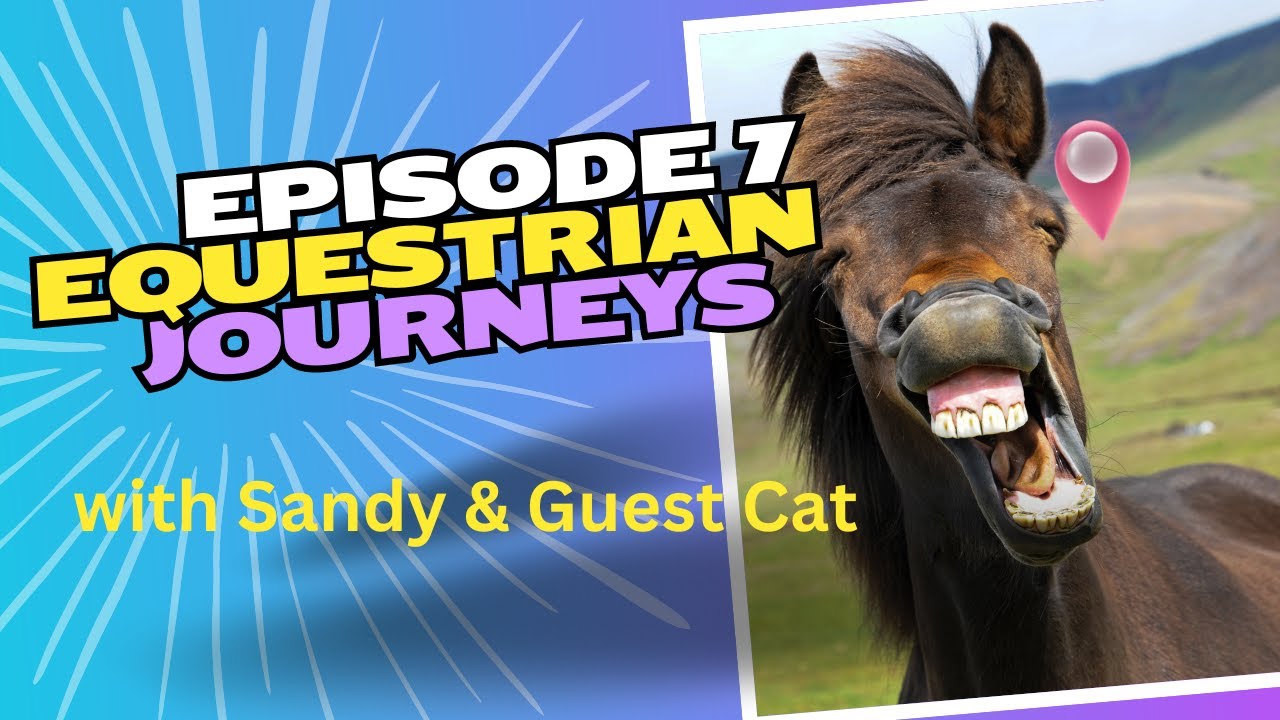
Sandy Colling talks with Kat from Germany about her Icelandic horses. They cover the tölt and pace gaits, how she found and trained her horses, and what it's like to ride them in Iceland's landscape.
Chapters
Welcome to Equestrian Journeys. I'm Sandy Colling, your guide to the captivating world of European horse culture. In each episode, we talk about century-old traditions, rich history, and the vibrant modern horse scene. You'll hear great stories, get insider tips, and meet amazing guests who share our passion. So whether you're planning your next adventure or exploring from home, Equestrian Journeys offers a unique perspective on travel, and equestrian as well as non-equestrian culture all over Europe. So join me each week as we uncover hidden gems and stories from Europe's magnificent equestrian heritage. And today I have the pleasure to have with me Kat all the way from Germany. So it's actually 8:00 at night. So I'm so glad and grateful that you came on today, Kat. Welcome. Welcome to Equestrian Journeys Podcast. Great to have you.
Hi, Sandy. I'm very happy to be here with you.
Kat and I were chatting the other day, and she is a lover of the Icelandic horses. And to be honest with you, I don't know much about the Icelandic horses. And she told me some facts and features that I had no clue about. So I just thought this would be such a fun topic to, to share. So Kat, Have you always ridden Icelandic horses? Have you, or did that come later? Why don't you share with us how you actually got to the Icelandic horses?
I've started, like a lot of people, at least in Germany, in a riding school riding warmbloods in a rather big group. And I did that till about my early 20s. And then a friend took me to a farm where they bred Icelandics. And I fell in love instantly.
Why?
I admit I love the big mane and the shopf.
The shopf, yeah, the forelock.
Yeah, it's the warmbloods have 3 or 4 hairs here and the Icelandics have really like the Beatles.
Yeah, that's funny.
And of course a very bushy tail. And yeah, even though I'm rather tall, I also like the size. It's easy to jump on without when you're not— when you'd like riding without a saddle. So it seemed a pretty good thing. And I fell in love with a young Icelandic mare.
Aww.
And really, I bought her. I saw her, I fell in love, and she was pretty far away on the— not— I didn't even— couldn't even see her close or even touch her or anything, but I was in love.
So did you see her on the internet or did you see her—
No, no, she was on this farm.
Oh, in this farm. Okay.
But a bit far away.
Oh, okay. Gotcha. Gotcha.
Downhill somewhere on the grass.
I see.
It was like I was running like here, like a dog, you know, like, oh.
You were salivating.
Yes, I was salivating. And then the breeder, she said, this horse is— she's really so clever and I don't know who can— I won't keep her. She's too clever to be easy to ride, to teach. But I wouldn't listen. That if you want to marry, you You don't listen to anybody. I wanted this horse. I didn't listen either. And so I bought this horse, and before I bought her, at least I patted her. She was—
So you didn't ride her?
She was too young to be ridden.
Okay, okay, she was a youngster. Gotcha.
She was a youngster, and, and I was like sweet 17 and fallen in love. So that's how it started. And then of course I knew from books, I knew a little bit about Icelandics, I knew they have this fantastic gaits. And they have not only 3 gaits, they have 4 or even 5 gaits. And I thought, I'll wait a bit and get friends with my new horse, and then I'll have all these riding surprises and a wonderful tölt outside through the forest. And then, yeah, I quickly realized that this— the thing with tölt and pace was only in books. And because what I didn't know is that tölt is a gait you have to create. It's not— you, with a free-gaited horse, you give a driving aid. If it— you mount the horse, you give a driving aid, and the horse will move on in a walk.
So you have to teach the gait, the tölt, to the horse?
Yes.
Oh, interesting. It's not natural?
It depends. There are a few horses, a few Icelandics, who prefer to go tölt. That is pretty good. They have— it sounds like paradise. It's only half paradise, as always, because then they don't trot.
Oh, okay.
So some— somewhere it's always a little bit but.
This—
the Icelandics are some— if you think about a clock, you would have tölt at 12 o'clock Trot at 9 o'clock and pace at 3 o'clock. And the Icelandic you have is somewhere in this—
Interesting. I did not know that. Okay.
So if you have an Icelandic who prefers to trot, you have to be able to ride him towards the pace. Let's say your Icelandic is about at 10 o'clock, right? If you want to go up to 12 o'clock, so you have to ride towards the pace.
Right.
But not too much, because then you're over it.
And you tip over. That's interesting.
And if it's the other way around, your horse prefers the pace, then you have to ride as if you wanted to trot.
Huh.
And if you're not used to that, because you drive, you have walk, you drive more, you have trot, and drive a little more, you have a canter. This is quite new and really not easy.
So she taught you a lot, this mare. What was her name?
Her real name was Brynja, which is an Icelandic girl's name. But because of the tremendous mane she had, her name was Strubbel.
Strubbel, like the Strubbel Peter.
Yes, Strubbel. That's cute, her barn name. And she knew her name very well when she knew she was Strubbel. Then I went through a very, really very deep valley of tears and despair because I just couldn't do it.
Interesting.
I just couldn't do it. I had a trainer and he kept telling me, you were too slow, you're too slow, you're too slow, because you have the tölt and then it moves into a direction you don't want to. And of course, in that moment you have to say, nope, don't want that.
Interesting.
Okay. And I was already, oh, what's that? It doesn't feel like trot. Is it still tölt? And of course you have no time to think about that.
Wow.
So it was really a hard time I had.
Did you get it with her then eventually?
Yes, I got, I got it, but it really was honestly tears.
Yeah, I believe it. It's frustrating.
I wanted it so badly and just couldn't do it. And also the trainer said, this Icelandic is not an Icelandic you start off with. She's far too difficult.
Oh, wow. Okay. So.
Yeah. And then I thought, and he always said, sell her, she's too difficult for you. You can take one who's a bit easier and you will be quite successful. And I read a book and the end of this book was a story of a man who bought a horse and this horse was ugly, had a short neck.
Yeah.
It had a, not a very friendly way. The horse bucked him off quite a number of times. The tummy was big, the legs were short. Everything was terrible, and he took lessons and visited clinics and tried everything. His friends and family, they said, why don't you sell this horse? This is terrible. You're falling off all the time, and there's no success. And he said, no, I'm not going to sell her because this horse has decided to teach me how to ride.
Aww.
And that's why I also kept my—
Yeah, your mare.
I thought Okay. And I really, I learned very much. All riders know that you don't learn from the easy horses who make gifts all the time. You learn a lot from the troubles.
So besides the tölt, what distinguishes Icelandic horses from your warmbloods or your thoroughbreds or your other horses? Like, besides the forelock and the mane and the tail?
They're pretty small, actually. They're pretty small. I think that's a wonderful thing if you're getting older because it's so easy to climb on.
Yeah. They're—
I think they're friendly, they're easy. I also think all these troubles we have with the lot bigger horses, with lameness for example, I think that's all easier because the legs are shorter, the horse is closer to the ground. So I think there are less injuries, lamenesses. Of course.
So they're not as prone to injury.
Yeah, that, that, that's it. And of course, here in Germany, it's quite different. In Iceland, people have loads of horses, and if you go for a ride there, you can also have very lovely tourist, um, guided tours. And there they have a big group of Icelandics, and you get one, and after 50 minutes you switch the horse.
Oh, fun.
So nobody goes walk.
Uh-huh.
You take the full speed all the time, and after 50 minutes you get off, you put your saddle onto another horse, and you have a fresh horse.
That's interesting.
The others just follow like they're not on a rope.
They just follow like in the herd or whatever.
They just follow like that, and, and all— you have a fresh horse all the time. It's not like here when I go with my horse Um, for a 3-day ride, I have to be careful with him. I walk parts of it.
Right.
I go do it in a walk, but in Iceland, nobody would think of that.
Those tours are so popular in Iceland, those horse tours, those riding tours, very popular.
I think they got a lot safer now with so many tourists going to Iceland, but it used to be quite an adventure because if you went there and you said, yeah, you have Icelandics and you're advanced rider, you got a horse, you couldn't stop at all. You disappeared at the horizon. You fell off. You've— because in Iceland, it's just quite different. There's so much space in Iceland. Nobody thinks of stopping.
And the terrain is so different. You actually told me something interesting, that there are no trees in Iceland. I didn't know that either.
No, that's a— it's a very special landscape. They have the geysers.
The geysers.
They have volcano. Very interesting. They have— if you do these tours, you come to a little hut at the evening and there's a, like, a hot pool where you sit all together.
Like the natural spas, like the hot springs is what they're called.
I would say, yeah, you have hot springs, you have a lot of nature, you have Birds, you have whale watching, you have seals.
Nice.
It's really very special. You have waterfalls. It's a very particular landscape. It's an adventure.
We'll have to plan a trip, Equestrian Journeys trip to Iceland one day.
You should.
We totally should. I find that fascinating because I know several people who've been, but I just didn't know a lot about it. I just find that really fascinating, especially the no trees situation.
It's really quite different from what, what one is used to. It's, if you do that, you should really be in a little slot because in Iceland it's cold and dark a lot.
Yeah.
So I think it's only in the summer months, and also then you need warm clothes.
It never gets hot.
June, July, August, and otherwise it's dark, cold. And as I said, in these tours, you move in telt at a really fast pace. Over Geröll.
Yeah, over the rocky landscape.
Yeah, rocky landscape. Nobody thinks of walk. It's all in in all in.
That's interesting.
It's through the water and better not fall off because then you will be wet for the last rest of the day and cold.
And cold.
Yes.
So tell me a little bit. How did your journey with her progress? And then did you always have Icelandic horses after her? I know you have Mousy now.
Yes, Mousy is Strubel's nephew.
Oh, interesting. Okay, I did not know that.
I saw him when he was 1 year old, and I, again, I fell in love.
Aww.
Um, so yeah, since then I'm addicted. I must say, I think I took so much effort and thinking and passion into getting able to ride this toad Yeah. I think that's why now I think a horse has to do that.
So was it easier with Mousy? No.
The funny thing is that when I got Strubbel without knowing anything about these gaits, she was very close to pace. What she wanted to do was pace running, which is— was heißt durchgehen?
It's like taking off, like they take off. Yeah.
So pace and taking off of a horse is pretty similar.
Okay. Interesting.
You only ride it very short at a high speed. Otherwise it's called piglet pace and it's something awful. It has to be really, really very fast. And you could never do a curve in a speed pace. The horse would fall.
Okay. Yeah, I could see that.
It's only in a straight line and it's not so easy to learn because you cannot practice. If you have a horse that can do that, You could try probably 3 times a week for—
It's the pace where the 2 legs go at the same time? At the same time. Okay, so it's— yeah, okay.
But it's not supposed like this.
It's at a fast pace.
Very fast. And that's why the horse cannot move around the curve. You just have to be straight. And as I said, you— it's pretty exciting for the horse, so you cannot do that every day, and you cannot do it for 2 hours. You can do it I don't know, 30 seconds, 3 times a week. And how can you learn something if you have one horse?
Yeah, exactly.
To ride this pace is this really the— do you say Königsdisziplin?
Königsdisziplin is like the ultimate discipline.
Or the Icelandic. And I had that, and then I thought, oh, I would like another horse, but I would like a horse who is secure in trot, because I must say Strubbel was always— no, trot was not her gait.
Okay.
Then I fell in love with Mousy, and he's very safe with trot, but also had a problem in doing the tölt because he wants to trot. One horse wanted to do the pace, and I heard you always buy the same problem, and I did that. I bought a problem. Other people always buy an easy Icelandic. I always do that. So you do what you're used to.
Exactly. You stick with your, what you're comfortable with.
Yes, that's what you do. What I think is also very special about Iceland is that they're very careful about the pureness of the breed. So a horse that has left Iceland can never come back.
It's so fascinating. So if somebody exports a horse to wherever, From Iceland, they can never go back.
No.
What if somebody, like, hypothetically, just hypothetically, you live in Iceland, you're Icelandic, and you're moving for a job 3 years to Germany, you have to leave your horse if you want to go back. That's so interesting.
And that's always also a problem if you want to take part in a world championship.
Yeah.
European championship. You never take the best horses because you cannot bring them back.
That's so crazy. I never thought of that. That's right. Championships, horse shows.
The horse has to say if they come from Iceland, they'll get sold after the championships.
That's crazy.
And they're really, the Icelandics, they're very cautious, vorsichtig, about diseases.
Yeah.
So it used to be like that, that you couldn't also, if you went to Iceland to do such a Guided tour. You couldn't take your breeches or anything. It has to be new because they're scared you would bring anything into the country.
Is that still like that now?
Yeah, it has to be new, or you have to prove that it has to be gereinigt.
Yeah, clean, dry cleaned, sterilized, or whatever. Wow.
Take breeches, gloves, boots, jackets. Helmet, everything has to be—
So do these tours in Iceland, do they let you borrow the helmets, and, or are you allowed to bring your own?
No, you buy it, or you can be removed. And for example, the professional riders go to Europe for a tournament, a show, something like that. So I was— I have to have several places where I can have breeches. And so to— in Europe, don't take my best Her favorite things out.
Oh my gosh, that's crazy. That's crazy. That's really interesting. I had no idea. The other thing that I was wondering, like so many different breeds, they were originally used either in military or in agriculture. Were Icelandics ever used for farming?
The Icelandics have done all that. Pulling the plow, pulling the sled. It's always cold and windy and snowy in Iceland, or much of the year is like that. So they have been the farm workers, I think, just like in other countries. So we had the machines to do. Now, of course, it's a lot of pleasure and tourists and of course professionals and breeding and all that, like all over the world.
So interesting. So interesting. I definitely, now I'm so curious, I will definitely have to plan a trip, an Equestrian Journeys trip to Iceland.
It's really a very special country, and it's also a country where it's a very nice mixture between new and old.
So mythology is a big part in their day-to-day life.
So they always, for example, the horse Sleipnir from the old Icelandic saga, that was the horse from the head god Odin. Okay. He had 8 legs and he was the, the fastest horse, of course, with all his legs. And he was the one who could move Between the worlds, between of the god worlds and the human world.
Oh, interesting.
So he, Sleipnir, is the horse. And for example, there are also other horses. For example, Nikur. Nikur is the water horse. Okay. And he was so pretty. And when people came to, to ride him because they were attracted by him, he went into the water and that was it.
That's hilarious.
Iceland also is the country of the elves.
Okay.
And a lot of stories and beliefs around that.
So a lot of mythology, a lot of fairy tales, fables.
But on the other hand, it's also a very modern country. And of course they have all that, but we have in other modern countries too.
I see that a lot in Ireland too, with the storytelling and the mythology. So it's just reminded me of Nieve of Tirnanog, that fable, that mythology, and the storytelling. That's so interesting. I love it.
So there's a lot of that. I think there are even in the government, there are people who are Trollbeauftragte. Something like that.
Was macht ein Trollbeauftragter?
I have no idea really, but You see the importance. It's not like a little group does that and everybody thinks, oh my God, they're crazy. It's really a part of the life.
But what do they look for? Elves?
I don't know.
That's hilarious. I will have to Google that. Trollbeauftragte.
Something like that.
Yeah.
But it's—
That's so funny.
It's really a big mixture between former times and modern times. The old and the new.
I love that.
And the Icelandics are part of it because it's always said if you're Icelandic and you are good friends It will always be also a bit into this world of elves and trolls and Sleipnir and all these stories.
All the mythology. That's really interesting. So, Kat, to wrap it up, Mousie, I know he's still around.
Yeah. The very best one.
The very best one. And do you get to ride him a lot?
Yes, I do. So I could also just let you know for the, the tölt. It's 4-beat. It's like riding a walk, only that in the walk you always have 3 legs on the ground and 1 leg in the air. And in turn, you have 2 legs on the ground and 2 in the air.
Oh, interesting.
That's why it doesn't—
you, if you ride, it's so smooth. It's like gliding.
You can hold a glass with beer in your hand. It won't drop anything.
Very smooth. Very smooth.
Um, and it sounds, if it's done correctly, it sounds like the German Bohrmaschine.
A drill? Like a big drill?
Yes, because they have advertising.
Yes, absolutely. That sounds like the drill.
Yes, so fun.
Are there a lot of Isländer in your area?
Yes.
Okay.
Yeah, I think they're very popular because it's easy to keep them. They're easy grazers.
Keepers, yeah.
They don't need a stable. They can be outside with a shelter. Yeah. They're friendly with other horses. I think it's a lot easier to have them. No rugs needed. A friend of mine, she had a warmblood, and then she also, she got attracted by the Icelandics, and she said, I can't believe it, I had boxes full with stuff for my warmblood, and for my Icelandic, I have a halter, a saddle, a bridle, a brush, That's it.
That's it. So they're easy keepers. That's really good to know. And especially like you said, when you get older, it's, they're easy to mount because they're smaller. They're easy keepers. It sounds like the perfect— It's comfortable to sit.
If you have a sore back, it's much better than trot. Very smooth.
That's awesome. I love it. I can't thank you enough to share with us about the Icelandic and about the Culture and know trees and the landscape. Like I said, I'm definitely going to look into taking a trip to Iceland and you need to join us and you can be our tour guide.
I would love to. If you go, I'll come.
There you go. I love it.
For sure. That would be great, Sandy.
Thank you.
And I know you would have a, you would prepare a fantastic route for all of us then.
Yep. I love, love exploring and checking things out and we'll definitely have to do it.
Thank you. I'm sure that would be a great trip we would have with you.
We'd have a lot of fun.
Don't disappoint.
I will. We'll plan it.
Thank you.
Thank you. So this wraps up another episode of Equestrian Journeys, and I want to thank you for joining us today. Kat, our guest all the way from Germany, talking to us about the Icelandic horses, which I just find fascinating because honestly, I didn't really know much about them except the tölt and the pace. That's literally all I knew. So if you enjoyed our journey today, share it with a friend who loves horses or travel or both. Don't forget to subscribe to Equestrian Journeys on your favorite podcast platform so you never miss an episode. And for more content, travel tips, and beautiful images from our equestrian adventures, visit our website linked in the show notes. And if you have questions or suggestions for future episodes, feel free to reach out to us on social media @EquestrianJourneys. And until next time.
Bye.
Keep your passion for horses and travel alive.
More from Sandy

Quick passport tip I highly recommend doing. #JustTravelWithSandy #PassportTip #Travel


Don’t let language barriers stop you! #JustTravelWithSandy #Travel #Wanderlust

My absolute favorite Travel apps. What are yours? #JustTravelWithSandy #TravelApps #Travel

Trailblazer podcast! What fun? #JustTravelWithSandy #Travel #TravelTheWorld #TravelMindset

Let’s talk travel mistakes!#JustTravelWithSandy #Travel #SandysTravelLounge #TravelTips

Explore Equestrian Adventures with Meghan Brady 🌍🐎 | Equestrian Journeys Podcast